Dresden in 2–3 days: the palace treasuries, the galleries, and the hill above the Elbe

Last updated 8 August 2026
Overview
One day in Dresden is a walking day: the old town is small, almost everything famous in it stands within six hundred meters of one bend of river, and a single day is spent outdoors going past doors. Two days is when you start going through them — and that matters here more than in most cities, because two buildings facing each other across one street hold two of the great collections in Europe, and a one-day visitor has to take one and lose the other. Two days is not more sights. It is the end of that choice.
So these two days divide by building rather than by district, and each has a weekday it cannot take. Day one is the Residenzschloss and the churches around it — the treasury day, and the palace closes on Tuesdays. Day two is the Zwinger and the Albertinum, the picture day, and every gallery in both shuts on Mondays. The two trade places freely, which is what makes the arrangement survivable: the rules are set out at the end of this page, and the arrival they exist for is a Sunday.
Day two also leaves the old town in its second half, and that is the other thing the extra day buys. Five kilometers upstream the Elbe turns under an iron bridge of 1893 and the right bank climbs; two little hill railways go up it, one of 1895 and one of 1901, and the roof of the upper station of the second is where this city finally has a shape rather than a frontage.
That stop depends on the light, so here is the arithmetic before you plan around it. The sun sets here from just before four in the second week of December to about half past nine at midsummer, and everything on day two above that platform comes to about seven and a half hours of recommendations and moving together. That sum is a latest start and not an exact one, and the galleries cap it: take your month’s sunset hour, subtract seven and a half, and start then or at half past ten, whichever is earlier. The cap is what you will actually follow, because from the end of March to the middle of October the subtraction alone returns a start too late for museums that shut at five. Starting earlier than the sum asks costs you nothing — the light is still up there when you arrive — so for most of the year the answer is to start at nine as written, reach the platform in whatever the afternoon gives you, and take the long evening on the riverbank as the compensation. And for the ten weeks or so around the shortest day it does not solve at all, because the sun is gone before you could possibly get up there; in those weeks day two runs backwards, and that version is written out in full below.
One thing is booked before you travel and one only: the timed ticket for the Historic Green Vault. It is sold in slots of a capped size for conservation, so it is not a line that rewards turning up early — the slot exists or it does not. It was in the fifteen-to-twenty-euro range in 2026, the ticket covering the whole of the rest of the palace was about the same again, and there is a combined one for both at under thirty. The only other thing worth reserving is optional: a performance at the Semperoper, which is how you get inside that building without a daytime tour, and it wants weeks rather than days. The third day adds no booking at all — a rock takes no reservation and neither does the train.
Beyond that, this route asks the transport network for two or three tram journeys on day two — out, and back to whichever station your train home leaves from — and, on the third day, a fare that reaches past the city boundary. The hill on day two is not on the tram ticket: the two little railways up it sell their own, in the five-to-ten-euro range for a return in 2025, and an ordinary day ticket does not carry you up, though a weekly or monthly Dresden pass does. The parent city guide covers how tickets are bought here; this page assumes nothing else in your hand.
Two things these days deliberately leave out. They never spend an evening in the Äußere Neustadt, the nineteenth-century bar quarter on the north bank — it is an evening rather than a stop, and it belongs to whichever night you are not out east. Five stops on tram 11 from Postplatz to Albertplatz, then walk north. And they leave out the two excursions the city is known for, because each one is a day: the third day below takes one of them.
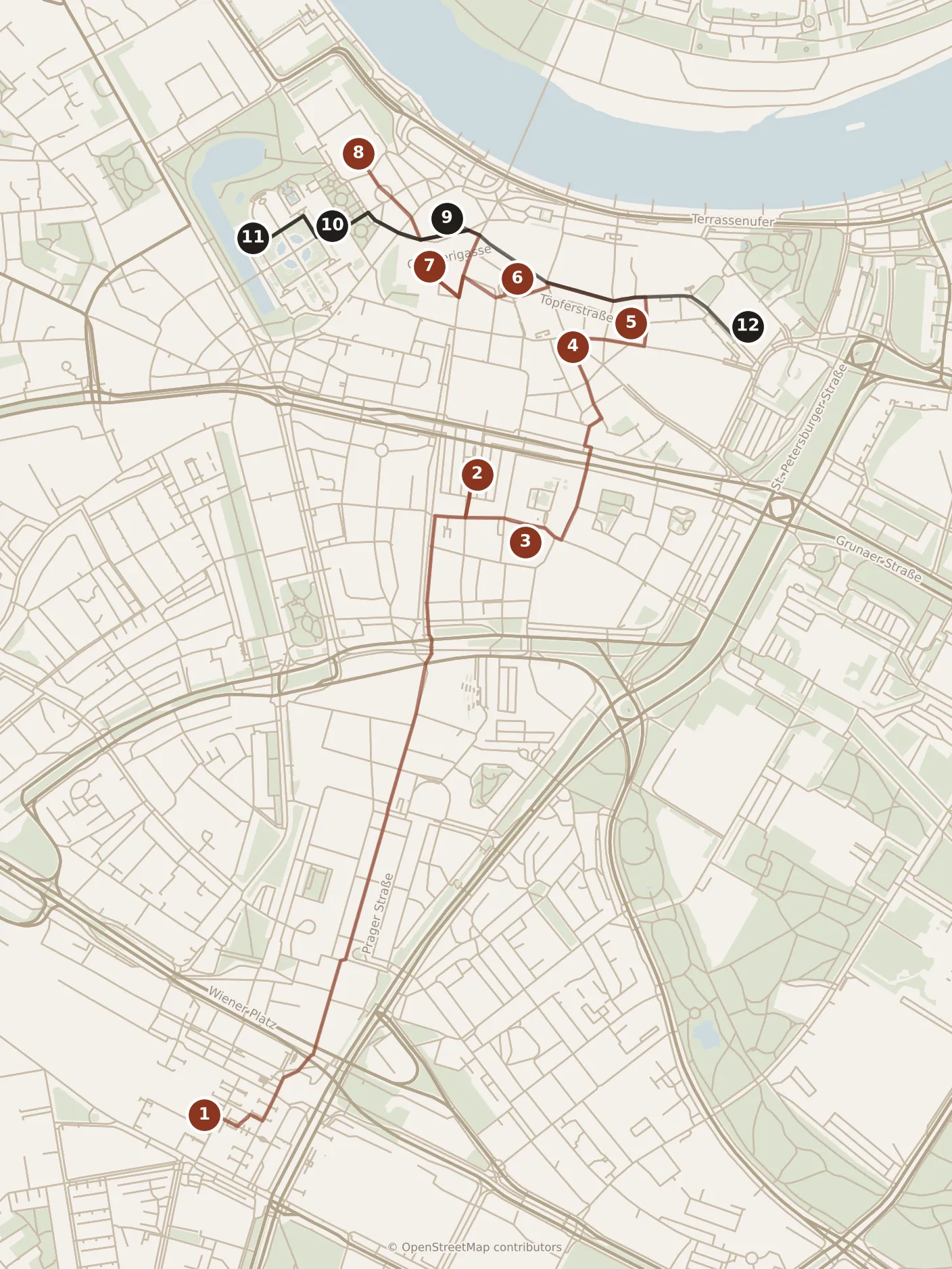
- Day one
- 1Dresden Hauptbahnhof
- 2Altmarkt
- 3Kreuzkirche
- 4Neumarkt
- 5Frauenkirche
- 6Stallhof
- 7Residenzschloss
- 8Semperoper
- Day two
- 9Katholische Hofkirche
- 10Gemäldegalerie Alte Meister
- 11Mathematisch-Physikalischer Salon
- 12Albertinum
Day one

Everything today sits in a rectangle six hundred meters long, and the day crosses it once, south-east to north-west, ending on the square in front of the opera house. The recommendations come to about seven hours with the climb to the dome gallery and six and a half without, and the walking to just under one — about three and a half kilometers end to end. That total is the time you spend inside the places and on the sidewalk between them and nothing else: it does not include the palace cloakroom, which on this route is not a trivial omission, because the treasury takes your coat and your bag at the door and does it minutes before an entry you cannot be late for. If this day runs late it will have run late in a lobby.
The hour this day rests on is a closing, not the light: in 2026 the Residenzschloss shut at five every day it opened at all, and only on Fridays did the Green Vault stay on until seven. That is why the churches are the morning and the palace is the afternoon and not the other way round, and why the Historic Green Vault slot you book wants to be an early-afternoon one. Two o’clock is the one to aim for: the morning as written runs about five hours with the dome climb and lunch inside it, so it wants you walking up Prager Straße by about nine, and a two o’clock entry still leaves the palace’s second half inside the five o’clock close. If you find a different hour, the method survives it: fix the slot first, count the palace’s remaining rooms forward from it, and put everything free and open into the hours before.
Morning
You will almost certainly arrive at Dresden Hauptbahnhof, where the fast trains from Berlin, Leipzig and Prague end and where the S1 and S2 both call. Leave by the north side and go straight up Prager Straße: a little over twenty minutes on foot to the first stop, and the street is the first exhibit rather than a corridor to one — a pedestrianized axis of long socialist-modernist slabs and fountains laid out across flattened ground in the 1960s, which is what this city’s rebuilding looks like when it is done in the other language. If you would rather ride, tram 11 leaves from Hauptbahnhof Nord and runs up the same street to Postplatz, and from Postplatz it is four minutes east on foot. If you arrive instead at Dresden-Neustadt, on the other bank, tram 11 comes south through the center to Postplatz too.
The Altmarkt is the oldest market square in Dresden and reads as the least old thing in it: a vast paved rectangle framed by 1950s blocks in a stripped, colonnaded classicism, because this was rebuilt as the socialist city’s main square and not as a restoration of anything. Give it a quarter of an hour and, if it is clear, stand in the middle rather than at the edge — the emptiness is the point, which is also why the markets and stages that occupy this square for a good part of the year change the place completely. The largest of them is the Striezelmarkt, one of the oldest Christmas markets in Germany, which fills the whole square through Advent.
On its south-east corner stands the Kreuzkirche, and this is the building to see before the Frauenkirche rather than after it. It burned out on 13 February 1945 like everything around it, and between 1946 and 1955 the inside was put back in a rough gray render meant as a temporary surface and then simply kept — a vast bare hall with the plaster left scratched and open, which the careful restoration of 2000 to 2004 deliberately preserved rather than smoothed away. Half an hour, and go in knowing that this is the argument against everything else you will see today: one Dresden church chose to look repaired and the other chose to look recovered. It is the home of the Dresdner Kreuzchor, one of the oldest boys’ choirs in Europe, and if your day one is a Saturday there is a collision worth settling before you fix the afternoon, and the end of this page settles it. The tower can be climbed, two hundred and fifty-nine steps to a platform at fifty-four meters, and you should not: two better views sit on this route already and one of them you will have paid for anyway.
Six minutes north-east to the Neumarkt, the newest thing in the old town — rebuilt from the 1990s onwards on the medieval plot lines, some fronts copied from photographs, some frankly new behind historic faces. Twenty minutes is enough to walk it and to read the north side, closed by the Johanneum, the old electoral stables turned gallery, whose far wall round the corner carries the Fürstenzug.
Two minutes and you are at the Frauenkirche. Look at the outside first: more than three thousand salvaged blocks were lifted out of the rubble heap and set back where the survey said they had stood, which is why the pale sandstone is spattered with black — and why the dome above them is not, since the fire-loaded stone was not trusted with that load. Inside, forty minutes. The altar was dug out damaged and rebuilt with its damage showing, against the pale gold and green of a Baroque interior repainted from nothing, and the dome sits on eight slender piers with almost no wall between them. The original cross from the lantern, buckled by the fall, was found in the rubble in 1993 and stands inside; the one up there now was made in London by a British goldsmith whose father flew in one of the aircrews, and it went up in 2004. The church was reconsecrated on 30 October 2005, after forty-five years as a deliberate ruin and a decade as a building site.
One date is not a matter of opening hours and you cannot guess it. 13 February is the anniversary of the raids, and in the center it is not an ordinary day: the city commemorates it publicly around this church and the Altmarkt you have just crossed, and since the 1990s the far right has used the date as well, which brings marches, counter-demonstrations and police lines through the old town. Nothing on this route closes for it. But those two squares belong to the city that evening, and the only decent way to be standing on them is as somebody else’s guest.
The one-day version of this city tells you to skip the climb to the dome gallery, and for one day that is right. Two days changes the arithmetic, so go up: another forty minutes, a separate ticket, part of the way by elevator and the rest a long ramp, and a platform at sixty-seven meters. What it gives you is not the river panorama — day two has that from the hill — but the thing no ground-level view of this city can: the Neumarkt’s new roofs directly beneath you, the whole footprint of the old town, and the flatness of everything beyond it. Know before you buy that this is not the only tower on today’s route — the castle’s own is included in the palace ticket you are about to buy anyway, and the paragraph below says where it is. If you want one tower rather than two, take that one and keep most of the forty minutes — the castle tower is a shorter climb and it is on a ticket you are buying anyway.
Local tip. Of the three tickets sold at the palace you are about to walk into, only one is timed and only one can sell out. Buy that one — the Historic Green Vault slot — before you travel, and buy the other at the door on the day, because until you have stood in the treasury you cannot know whether you want ninety more minutes of gold or ninety minutes of Ottoman tents. The combined ticket saves a little and commits you to both.
Afternoon
Lunch first, two minutes back down onto the Neumarkt, or better one street off it — the tables in sight of the dome are priced for the dome and the kitchens a street away are the same kitchens. Give it an hour. This is the meal to have Quarkkeulchen at if you are going to have them at all: small fried quark-and-potato cakes, sweet, eaten as a meal rather than after one, and heavier than they sound.
Four minutes north, down Augustusstraße, and the wall on your left is the Fürstenzug — a hundred and two meters of Meissen porcelain tiles carrying the rulers of the Wettin house in procession. Do not stop in front of it. Go round to the arch and into the Stallhof behind it, which is what the extra day buys and which almost nobody walks into: the 1586 tournament courtyard of the electoral stables, a long arcaded yard with a row of columns down one side that horsemen rode at. It is free, open and usually empty — except through Advent, when a ticketed medieval Christmas market fills it, and on the set-up days around the concerts it hosts. Twenty minutes, and it is the only place on these two days where a sixteenth-century Dresden survives as a space rather than as a reconstruction of one.
Three minutes more and you are inside the Residenzschloss. Take the Historic Green Vault first, on the slot you booked: ninety minutes, and it is not a museum of objects in cases. Nine rooms and an ante-chamber have been put back the way Augustus the Strong had arranged them by 1733, with mirrored walls, gilded consoles and about three thousand pieces standing free in the open, sorted by what they are made of rather than by who made them — a room of ivory, a room of silver, a room where the light is thrown about by glass. You go in through a sealed lock that holds the humidity steady, which is also why the groups are counted. Bags and coats do not come in with you and there is a cloakroom before the door; leave time for it, because a timed entry does not wait.
Then one of the two halves upstairs, and one is the honest number. Give it an hour.
The New Green Vault is the modern presentation of the same treasury — about eleven hundred pieces in dark rooms with each thing lit alone. The two to find are Dinglinger’s court of the Grand Mogul at Delhi, a table-top city of gold and enamel figures that took seven years to build and holds nearly five thousand diamonds, and the Green Diamond, forty-one carats and green all the way through from natural radiation, which is not a thing that happens twice. The alternative is the Türckische Cammer and the Riesensaal beside it: four hundred years of Ottoman material gathered by gift, purchase and war, its centrepiece a three-masted tent twenty meters long in satin and gilt leather that took fourteen years to restore, and past it the armoury’s great hall of parade armor and tournament gear. The castle’s own tower, the Hausmannsturm, rises above both of them and is included in the palace ticket rather than sold separately — this is the tower the morning paragraph pointed at, and the climb up it costs you nothing you have not already paid and about fifteen minutes. If you let the Frauenkirche dome go this morning, this is the tower that replaces it, at a quarter of the time.
Trying both halves after the vault is the mistake this afternoon offers you, and it is how the day dies indoors at ten to five with nothing seen properly.
Evening
Three minutes west takes you out of the castle onto Theaterplatz, where the Semperoper closes one side: the second opera house Gottfried Semper built on this spot, the first having burned in 1869 and this one having gone the same way in 1945. It was rebuilt between 1977 and 1985 and reopened on 13 February 1985, forty years to the day after the raid. Twenty minutes on the square, at the hour when the day’s ticket-holders have gone and the floodlights come up. Getting inside means a daytime guided tour or a performance, and the performance is the reason this is the evening it is: it is the one thing in Dresden worth arranging from home. If you have a ticket, the evening rearranges around it — eat early and off the Neumarkt, let the riverbank half hour go, and be back on this square for the curtain.
Dinner is nine minutes back east, one street off Münzgasse — the lane of terraces running from the Frauenkirche up towards the Brühlsche Terrasse, and priced for the sight of the dome exactly as lunch was; the kitchens a street behind it are the same kitchens. The free half hour that closes this day is the riverbank below the terrace with the whole rebuilt front of the city floodlit above you, and floodlight wants the dark. In December the dark comes at four and that half hour is yours before dinner rather than after it; from May to July it does not arrive until ten, so you are either waiting for it or letting it go. That is the one respect in which the short day here is the better one, and it is why day one is the day a winter date costs least — nothing on it turns on daylight, and the whole second half of day two does.
If the day is short, this is the order things go. The dome climb first: forty minutes and a separate ticket for a view day two improves on. The Altmarkt second, down to the five minutes it takes to cross it. The Stallhof third, reluctantly. Never cut the Green Vault slot — it is the one thing on these two days that is timed, paid for, and gone if you miss it.
Day two

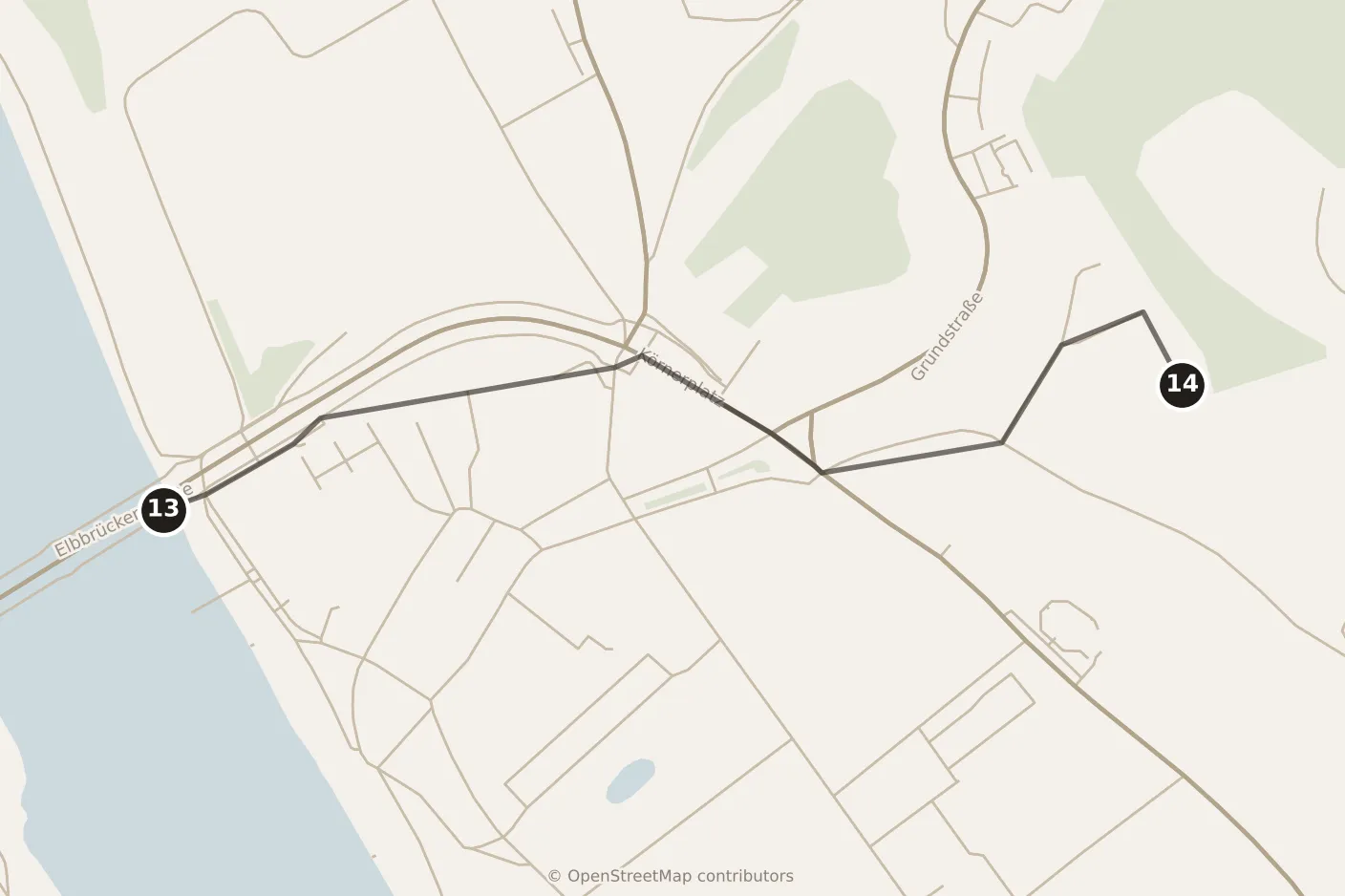
- Evening
- 13Blaues Wunder
- 14Schwebebahn
Today is two museums in one courtyard, a third at the far end of the terrace, and then a tram out of the old town to the only part of these two days that is not flat. The recommendations come to a little over seven hours and the moving to about an hour, about a third of it the tram and the rest on foot — and the seven and a half hours counted backwards from the light above is everything above the platform, which is those two figures minus the forty minutes on the hill itself. Like day one’s, the count models the time you spend inside the places and on the pavement, and models nothing else: not the two cloakrooms, not the ticket desks, and not whatever you wait at Pirnaischer Platz for the tram. Build in a margin at that stop rather than at the museums, because it is the one point in the day where the delay is somebody else’s schedule and not your own pace.
The hours that decide the order here are openings. In 2026 the picture gallery in the Zwinger admitted nobody before ten and the two smaller collections beside it not before eleven; the Albertinum opened at eleven, and everything named today shut at five. So the morning goes gallery first and small collections after, the free hour before ten belongs to a church, and the afternoon cannot be stretched at the far end. If the hours have moved, the shape holds: start with whatever opens earliest, and keep the eleven o’clock rooms for after it.
Morning
Start at nine at the Katholische Hofkirche, which is free, which opens before any museum door in this city, and which stands four minutes from the Zwinger’s entrance — though it is a working cathedral whose visiting hours move around its services, so read the day’s before you fix the hour. Augustus the Strong turned Catholic in 1697 to make himself eligible for the Polish crown, and a Catholic court in Lutheran Saxony needed a church of its own; this is it, joined to the castle by a covered bridge so that nobody had to cross the street to reach Mass. Forty minutes, and three things in it. The pulpit Balthasar Permoser carved in 1712 for the older court chapel and which was carried in here in 1748. The crypt, where forty-nine members of the ruling house lie and the heart of Augustus the Strong sits apart from the rest of him. And, in the chapel at the far end, a Pietà that Friedrich Press made in 1976 out of Meissen porcelain as the memorial to the dead of 13 February 1945 — white, blunt, entirely modern, in a Baroque building. This is a working cathedral and services run through the morning: if you walk into one, sit at the back or come back in twenty minutes, and put the camera away.
The Gemäldegalerie Alte Meister occupies Gottfried Semper’s wing of 1847 to 1855 on the far side of the Zwinger courtyard — the Semperbau, which closed the open flank of a Baroque orangery with a gallery and is the reason that courtyard now feels like a room. Two hours. Almost the whole collection was evacuated before the raids, taken to Moscow and Kiev by the Red Army afterwards, and returned in 1955; a little over two hundred pictures did not survive and five hundred more have never reappeared, which is a fact the gallery does not hide from you.
Four things justify the two hours. Raphael’s Sistine Madonna, and the two bored cherubs along its bottom edge, which are the most reproduced thirty centimeters of paint in Europe and belong to a picture almost nobody has actually looked at. Vermeer’s young woman reading a letter at an open window, from which a painted-over cupid was uncovered in a restoration finished in 2021, so the picture now means something other than the one in every book printed before then. Giorgione’s sleeping Venus. And the room of Bernardo Bellotto, the Dresden Canaletto and the elder one’s nephew, who painted this city from the far bank in the 1740s and 1750s in such topographical detail that his canvases were used as evidence during the reconstruction. Stand there last: you are inside the rebuilt city looking at the original, painted from the far bank — which is the one view of Dresden these three days never send you to, and which is a bridge and a quarter of an hour off the terrace if you want it.
Then three minutes across to the Mathematisch-Physikalischer Salon, the small astonishment of this trip: forty-five minutes of globes, burning mirrors, telescopes, calculating machines and automata — the instruments an electoral court bought when knowing how the world worked was a form of display. It reopened in 2013 after a rebuild, arranged in four rooms by theme rather than by date. Lunch after it, an hour, in the streets south of the Zwinger.
Local tip. The picture gallery and the two small collections are one ticket, so choosing between them is a choice about time and not about money. If you are only good for one museum this morning, take the gallery and let the Salon go — and if you take the Salon, take it after the gallery rather than before, because it opens an hour later and nothing at all is gained by standing about at ten to eleven.
Afternoon
Sixteen minutes east along the Brühlsche Terrasse, the old fortification rampart that Brühl was given in the eighteenth century and turned into a private garden, and which the occupying Russian governor opened to the public in 1814 after Leipzig. It runs about five hundred meters above the water between two bridges, with the Freitreppe and its four bronzes of the times of day at the western end. Walk it eastward, deliberately and against the crowd, which goes the other way: the western end drops onto the bridge and the postcard, and the eastern end is a museum most people on this terrace never turn round to look at.
What stands at this end is the Albertinum — an arsenal of the 1560s rebuilt in the 1880s to hold the royal sculpture, wrecked by the flood of 2002, and reopened on 20 June 2010 with its courtyard roofed over and the storage racks hung in the air above it inside a glass box, so that you see the depot from the floor. Ninety minutes in the top-lit halls. This is the other half of Dresden’s painting, the half that begins where the Zwinger stops: Caspar David Friedrich, who lived and died in this city — two men looking at the moon, a cairn in the snow, and the great enclosure of Elbe meadows just downstream that you could go and stand in; Ludwig Richter; the German Impressionists; and then rooms given over to Gerhard Richter, born here in 1932, and to Georg Baselitz. If ninety minutes is more than you have, the Friedrich rooms are the ones to keep.
Out of the Albertinum it is five minutes south to Pirnaischer Platz, where you take tram 12 towards Striesen. Blasewitz, Schillerplatz is the eleventh stop and something over twenty minutes.
Evening
From Schillerplatz the road runs straight down to the water and out onto the Blaues Wunder, and crossing it to Körnerplatz on the far bank is a quarter of an hour on foot; give the bridge and the bank half an hour altogether. It was built between 1891 and 1893 to Claus Koepcke’s design, a single span of a hundred and forty-six meters with nothing standing in the river, which in the 1890s was the wonder in the name — the blue was only the paint. It survived the war twice over: bomb-damaged, and then saved on 7 May 1945 when a handful of local people cut the demolition charges the retreating army had laid, which is what the plaque at the end is about. It has carried a fifteen-tonne weight limit for years and has been through a long restoration, so you may be walking past work — and since the crossing is how this evening reaches the hill, check that the footway is open on your date before you build the evening on it.
Körnerplatz is also where Eierschecke belongs on this day: the layered Saxon quark-and-custard cake is an afternoon thing here rather than a dessert, so take it on this bank rather than after dinner, in whichever half of the day this bank falls. Then the hill, and this is the stop the day is built around. Just off Körnerplatz the Schwebebahn goes up: opened on 6 May 1901, two hundred and seventy-four meters of track climbing eighty-four vertical meters, a car hanging from a single rail and pulled by cable, and one of only two of its kind anywhere. Four and a half minutes up. The roof of the upper station at Oberloschwitz was made into a viewing platform in the rebuild of 2001 and 2002, and that is where you go — the Elbe swinging away below you, the bridge you have just walked, the villa slopes and vineyard terraces on both banks, and the old town’s towers small and flat in the distance. Forty minutes for the ride up, the platform and the ride down. The Standseilbahn, a funicular of 1895, leaves from the same square and climbs to Weißer Hirsch through a tunnel and over a viaduct in five minutes; it is the better ride and the worse view, and it is the answer if the suspension railway has a line. Both are run by the city’s own transport company and both sell a fare of their own: the day ticket in your pocket does not carry you up, though a weekly or monthly Dresden pass would.
Come back down and cross the bridge again to Blasewitz for dinner: the bank on that side is beer gardens and terraces under old trees, and on a warm evening it is a better place to sit than anywhere the old town has. From Schillerplatz, tram 6 runs to Albertplatz and Bahnhof Neustadt; tram 12 goes back to Pirnaischer Platz and Postplatz, and for the Hauptbahnhof you change at Postplatz onto the 11, which calls at Prager Straße and Hauptbahnhof Nord.
Two ways this day comes apart, and what to do about each.
The ten weeks around the shortest day. Starting at nine puts you on the platform at about half past four, which is inside the light from roughly February to October and after dark from about the middle of November to the end of January. In those weeks run the day backwards with the same furniture: the Hofkirche at nine exactly as written, then seven minutes to Postplatz and tram 12 out to Blasewitz, Schillerplatz; the bridge and the Schwebebahn in the late morning; back on the 12 by about midday; lunch; the Albertinum from one and the Zwinger gallery from about three until it shuts at five. The only thing that goes is the Mathematisch-Physikalischer Salon, and that is a fair price for seeing the river in daylight.
Rain and low cloud. The platform is worth nothing in fog and neither is the bridge. What replaces the whole evening is the part of the Zwinger the morning left: the porcelain collection, on the ticket you already bought at ten, a hundred meters from where you had lunch, and open until five — and the Salon beside it too, but only if you took the morning’s tip and let it go. You come out of the Albertinum at about half past three, so the hours come out about the same as the evening they replace, and it means these two days never leave the old town — a real loss rather than an equal swap, because the hill is the only thing on this page that tells you what shape the city is. And the fallback has a hole in it: the porcelain collection was shut for building work from 7 September to 30 October 2026, which is exactly the part of the autumn a wet-weather fallback exists for, so check it before you count on it.
If the day is short, the Salon goes first and the Albertinum comes down to the Friedrich rooms. Do not cut the hill.
With a third day

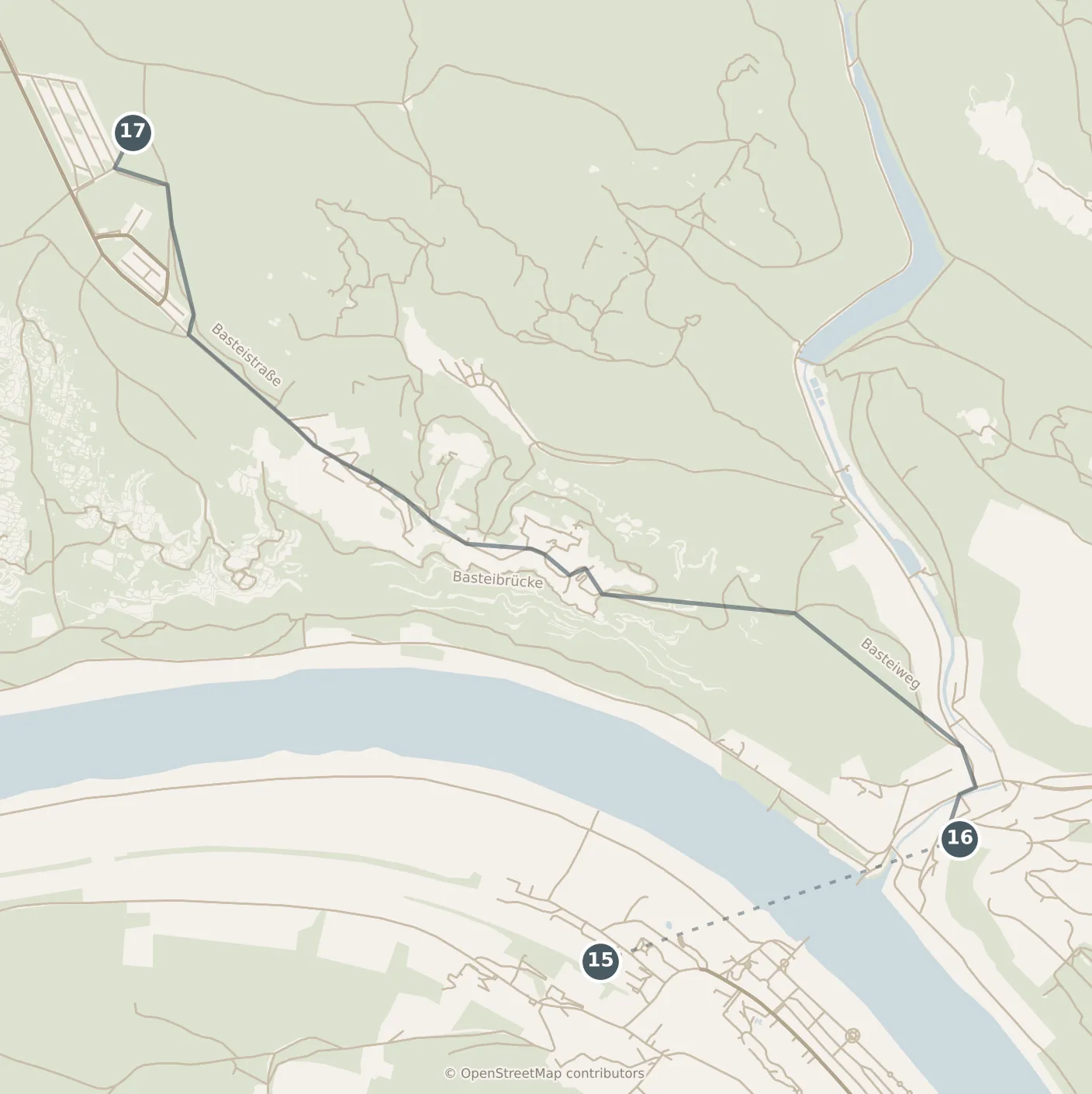
- With a third day
- 15Kurort Rathen railway station
- 16Rathen
- 17Bastei
The third day is appended, not inserted, and it leaves the city — and because as written it carries no weekly closure at all, it is also the day you slide into the middle when a weekday would otherwise wreck one of the others. With three consecutive dates there is always an arrangement, and the one that needs thinking about is a Sunday start: Sunday takes day two, Monday takes day one, and the trip out goes on the Tuesday — that way round and not the other, because day one cannot have a Tuesday at all and day two cannot have a Monday. If you would rather keep the written order, day one on the Sunday, the trip out on the Monday and day two on the Tuesday does it just as well, and that is the arrival the insertion above exists for. Every other one is covered by the weekday rules at the end of this page.
Give it to the Bastei, the sandstone outcrop twenty-five kilometers upstream where the Elbe cuts through the rock, and which is what people mean by Saxon Switzerland.
Getting there is a train, a boat and a staircase, in that order and with no ambiguity. The S1 runs from Dresden Hauptbahnhof — and from Dresden-Neustadt, if that is your bank — towards Schöna, every half hour, and Kurort Rathen is a few stops beyond Pirna, well under an hour in total. Then the part that catches people out: the station is on the wrong side. It stands in Oberrathen on the left bank, while the village, the path and the rock are all in Niederrathen on the right, and the only way over is the ferry — a reaction ferry, the Bergland of 1954, with no engine at all, hung on a cable and pushed across by the current itself. It takes a few minutes and it is the nicest thing that happens all morning.
From the village the way up is signposted, and it is 675 steps to the Bastei, with the published walking time three quarters of an hour to an hour — and another hundred and thirty-two above that to the viewing platforms this day sends you to. The walking time is right and the distance on the map is a lie: it is barely a kilometer of ground and nearly two hundred meters of climb. There is no other way up from this side, so treat the steps as the price of the day rather than as a surprise in the middle of it.
At the top, the Basteibrücke: seven sandstone arches, seventy-six and a half meters long, thrown across the Mardertelle ravine in 1850 and 1851 to replace a wooden footbridge of the 1820s that the earliest tourists had already worn out. It is not the view; it is the thing you look at. Walk over it into Felsenburg Neurathen, the excavated remains of a medieval rock castle wedged into the crevices beyond — chambers cut into the stone, a cistern, the stone shot of siege engines — which is a better half hour than the bridge and which most of the crowd skips. Then the viewing platform, three hundred and five meters above sea level and getting on for two hundred above the river: a twenty-one-meter structure holding a hundred and forty people, opened on 3 February 2023, seven years after the old one was closed for the sandstone crumbling under it. Two hours for bridge, rock castle and platform together, and eat up here rather than hurrying down for it.
This is a national park, and about one and a half million people come to this one rock every year, which means two things a photograph will not tell you. Stay on the marked paths: the ground either side is protected, and at the edges it is unfenced sandstone that has been coming away for decades. And go up first thing, because by the middle of a summer Saturday the bridge is a line rather than a walk.
Down is faster, half an hour to forty minutes, and the ferry and the S1 take you back the way you came. Door to door from the Hauptbahnhof this is about six hours with lunch at the top, and a little over five without.
Local tip. The steps are the whole question of this day, and there is no buying your way out of them from Rathen: Kurort Rathen sits at the bottom, the Bastei sits at the top, and nothing in between is on wheels. What you can choose is when you meet them — go up first thing and come down slowly, because it is the descent your knees will remember and there is nothing waiting at the bottom that you have to hurry for.
If that is not your third day. It genuinely is not for everybody: over eight hundred steps, no shelter, and worth very little under low cloud. If it is the steps rather than the weather, the rock is still yours: a road and a large parking lot reach the plateau from the Lohmen side, and a bus goes up from Pirna, which is on the same S1 you would have taken — so the bridge, the rock castle and the platform all arrive without the staircase. For the weather, the replacement is Meissen, and it deserves the same detail. The same S1 goes the other way, downriver, to Meißen Altstadt, also every half hour and also well under an hour. The Albrechtsburg on the hill above the town was begun in 1471 by Arnold von Westfalen and is usually called the first castle in Germany built as a residence rather than a fortress: big windows, rooms meant to be lived in, the Großer Wendelstein spiral stair cut around an open well, and ceilings of cell vaults that look like folded paper. Augustus the Strong put Europe’s first porcelain works inside it in 1710 and it stayed there until 1863, which is why the name means what it means; the manufactory is down in the valley now and shows what it does. The cathedral shares the same courtyard. This replaces the whole day rather than part of it, it is indoors when the weather is wrong, and it asks for no climb — but unlike a rock it has opening hours at all, so if you are using the third day as your insertion day, read the castle’s published dates the week before rather than assuming a rock’s freedom.
And if the third day is only a morning — a train home at two — then neither of these fits, and pretending otherwise costs you the train. What fits is the one thing days one and two leave out entirely: the Äußere Neustadt in daylight. Five stops on tram 11 from Postplatz to Albertplatz, then walk north into the grid of nineteenth-century tenement streets the raids barely touched. It is one of the largest parts of Dresden the rebuilding never had to touch, which after two days of reconstruction is a stranger experience than it sounds.
Practicalities
One booking before you travel, and one optional. The timed ticket for the Historic Green Vault is the required one: capped for conservation, so arriving early buys you nothing. Take an early-afternoon slot, because the day counts forward from it and a late one loses you the rest of the palace at five. The optional booking is a Semperoper performance, weeks ahead. Everything else on all three days is sold at the door or is free, and the third day adds nothing to book.
The closures, and the rule the answer comes from. Two days, two constraints, and they do not overlap. Day one must miss Tuesday: the Residenzschloss, and both Green Vaults inside it, close that day. Day two must miss Monday: the Zwinger’s picture gallery, the Mathematisch-Physikalischer Salon, the porcelain collection and the Albertinum all close then, and losing them loses the day. The two days trade places freely, and no single weekday takes both away — which is the whole reason this trip is arranged by building rather than by district.
Four weekdays then need a sentence of their own. A Sunday arrival is the trap, because running the days in the written order puts day two on the Monday that shuts every gallery in it: arrive on a Sunday and run them two, one — day two on the Sunday, when every museum in it is open, and day one on the Monday, when the palace is. That Sunday morning the cathedral is holding Mass rather than showing itself to visitors, and there is no fixing it: give the hour before ten to the Zwinger courtyard and the western end of the terrace, which are free and open, and pick the Hofkirche up on the walk east after lunch — which moves its forty minutes into the afternoon, so on that day count the start back from a little over eight hours rather than seven and a half. A Tuesday arrival wants the same swap for the opposite reason. Sunday has a second, smaller effect, and it bites only if your day one lands on one — which it does on a Saturday arrival taken in the other order: the Kreuzkirche did not open to visitors until midday on Sundays in 2026, so on that day begin at the Frauenkirche and pick the Kreuzkirche up after lunch, six minutes each way off the line and no other cost. A Saturday day one carries a collision, and the answer is a real trade rather than a painless one: the Kreuzchor sang vespers in the Kreuzkirche on Saturdays at five in 2026, outside the Saxon summer holidays, and five is also the hour the palace turns you out. If the choir is what you want — it is free, it is the best hour that church has, and it is the reason the building is famous — take the Green Vault slot at midday: ninety minutes there and an hour upstairs has you out of the palace by half past two, and the church is about eight minutes away, so the afternoon loses nothing at all. What it costs is the morning. Counting the written morning back from a midday slot puts you on Prager Straße before eight; cut the dome climb and the Stallhof and it is a quarter past eight, which is the real price of the choir. If the morning is what you came for, let the vespers go and know that you did. Friday is quietly the best day one of the seven, because in 2026 the Green Vault alone stayed open until seven, which hands that afternoon two extra hours. Wednesday and Thursday constrain nothing at all, and a Monday arrival works exactly as written.
Moving between these stops. Days one and two are walked inside the old town — day one about three and a half kilometers end to end, day two about two before the tram. The whole route contains two or three tram journeys and one ride on the hill railway, and the hill railway is not on the tram ticket. Out: tram 12 from Pirnaischer Platz to Blasewitz, Schillerplatz, eleven stops, then the Schwebebahn from Körnerplatz up to Oberloschwitz, which sells its own fare at the lower station. Back: one journey on tram 6 from Schillerplatz direct to Bahnhof Neustadt, or two for the Hauptbahnhof — the 12 as far as Postplatz, then the 11, which calls at Prager Straße and Hauptbahnhof Nord. The third day needs a fare that reaches past the city boundary to Kurort Rathen; whether the ferry across at Rathen rides on it is not something this page can tell you, so have a little cash at the ramp. The parent guide covers how tickets are bought here.
The bag. This is not a between-trains route and its reader has a room, so the bag matters on exactly two mornings and the answer differs for each. The Hauptbahnhof is where left luggage is, which resolves the first morning at the cost of a decision rather than a journey: if you have come straight off a train, the case goes down there before you walk up Prager Straße, because that walk is the wrong start with one and because the Green Vault will not take a bag or a coat through its door at all — they go to a cloakroom, minutes before a timed entry you cannot be late for. The Hauptbahnhof is also where the S1 leaves from, which settles the second morning neatly: if the third day is your last, the bag waits at the station your train home goes from and you come back to it anyway. What the road up from Lohmen does not fix is the top itself — there is nowhere up there to leave anything, and over eight hundred steps with a case is the one genuinely bad idea on this page. If your dates force a case onto that day, take Meissen instead, where the station and the hill are ten minutes apart and the whole of it is indoors.


.jpg)
