Dresden in one day: the Altstadt on foot, one treasury, then over the Elbe

Last updated 3 August 2026
Overview
One day in Dresden is not a problem of distance. Almost everything the Altstadt is known for stands within six hundred meters of the same bend of river, and the whole route below — first square to last courtyard, on the far bank — comes to about four kilometers on foot, an hour of walking spread across a whole day, and nothing retraced but the width of the first square, which the morning crosses three times.
The problem is that two of the great collections in Germany stand two hundred meters apart, and each of them is an all-day building. The Zwinger holds the old-master picture gallery. The Residenzschloss, across the road, holds the Green Vault. With one day you take one of them, and this route takes the Green Vault, because a great picture gallery is a thing you can meet in any capital and a baroque treasure chamber put back in its own rooms is not. The argument runs the other way if Raphael is what you came for; swapping one for the other costs you four minutes of walking and, except on the two weekdays one or the other is shut, nothing else in the day.
What a single day really costs you is the second half of the afternoon, if you spend it indoors. That is the expensive mistake here. Dresden is a city of two banks that do not resemble each other, and the rebuilt baroque half only means anything once you have stood on the other one and looked back at it. So this day gives the museums the morning and the river the evening, and it gives up the Albertinum, the climb up inside the Frauenkirche dome, and both of the excursions the city is known for — the sandstone gorges and the porcelain town are each under an hour away and each want a day of their own.
One thing is worth settling before you arrive rather than on the morning: the Historic Green Vault is entered in timed groups of a capped size, so it is booked rather than joined. If you are here between trains, the walk in from the Hauptbahnhof is about half an hour up Prager Straße, or a few minutes on a tram. A good share of trains stop at the Neustadt station on the far bank instead, and that one is where this route ends rather than where it starts. The day begins on Theaterplatz either way.
The day

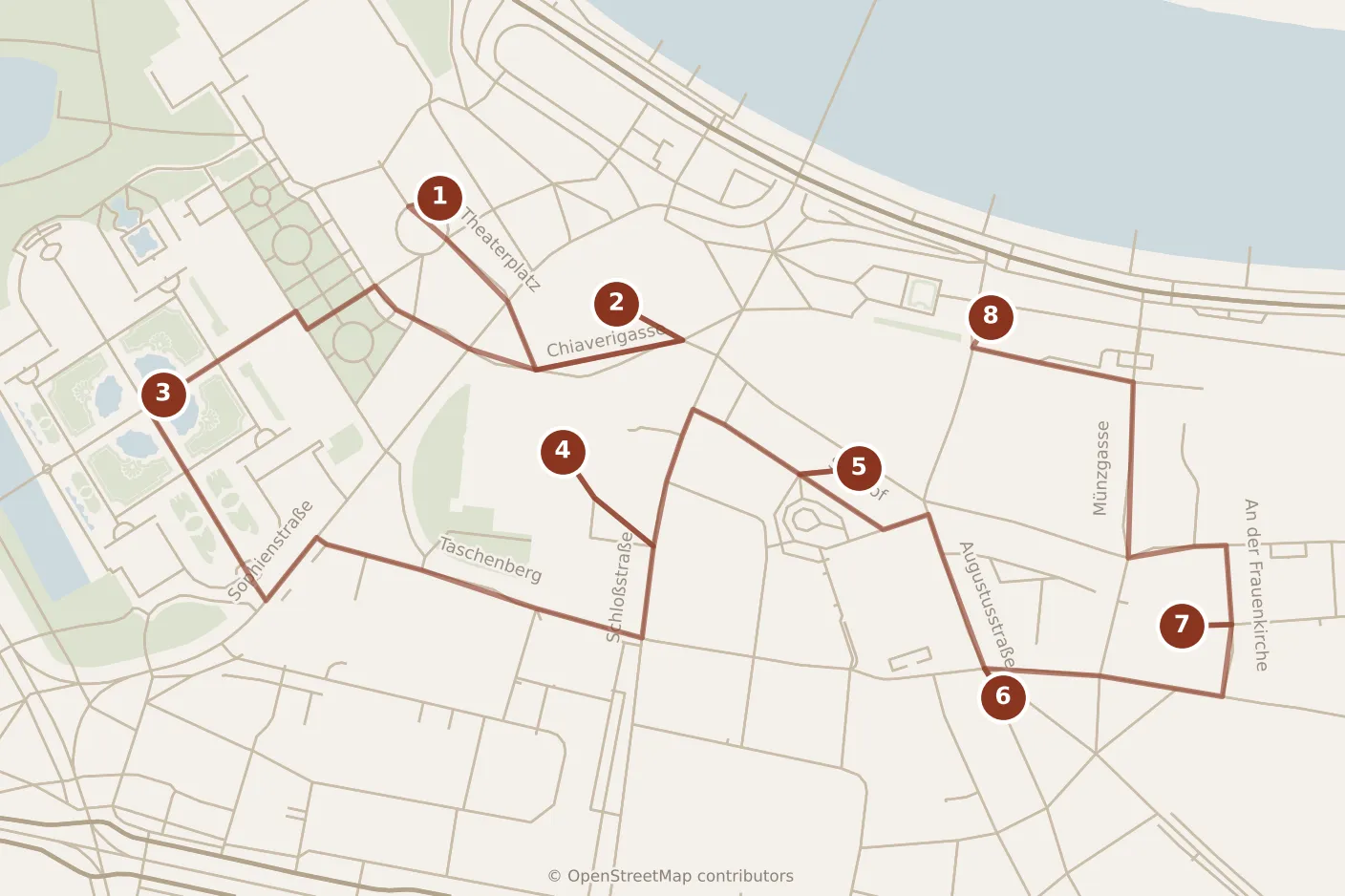
- Morning and afternoon
- 1Theaterplatz
- 2Katholische Hofkirche
- 3Zwinger
- 4Residenzschloss
- 5Fürstenzug
- 6Neumarkt
- 7Frauenkirche
- 8Brühlsche Terrasse
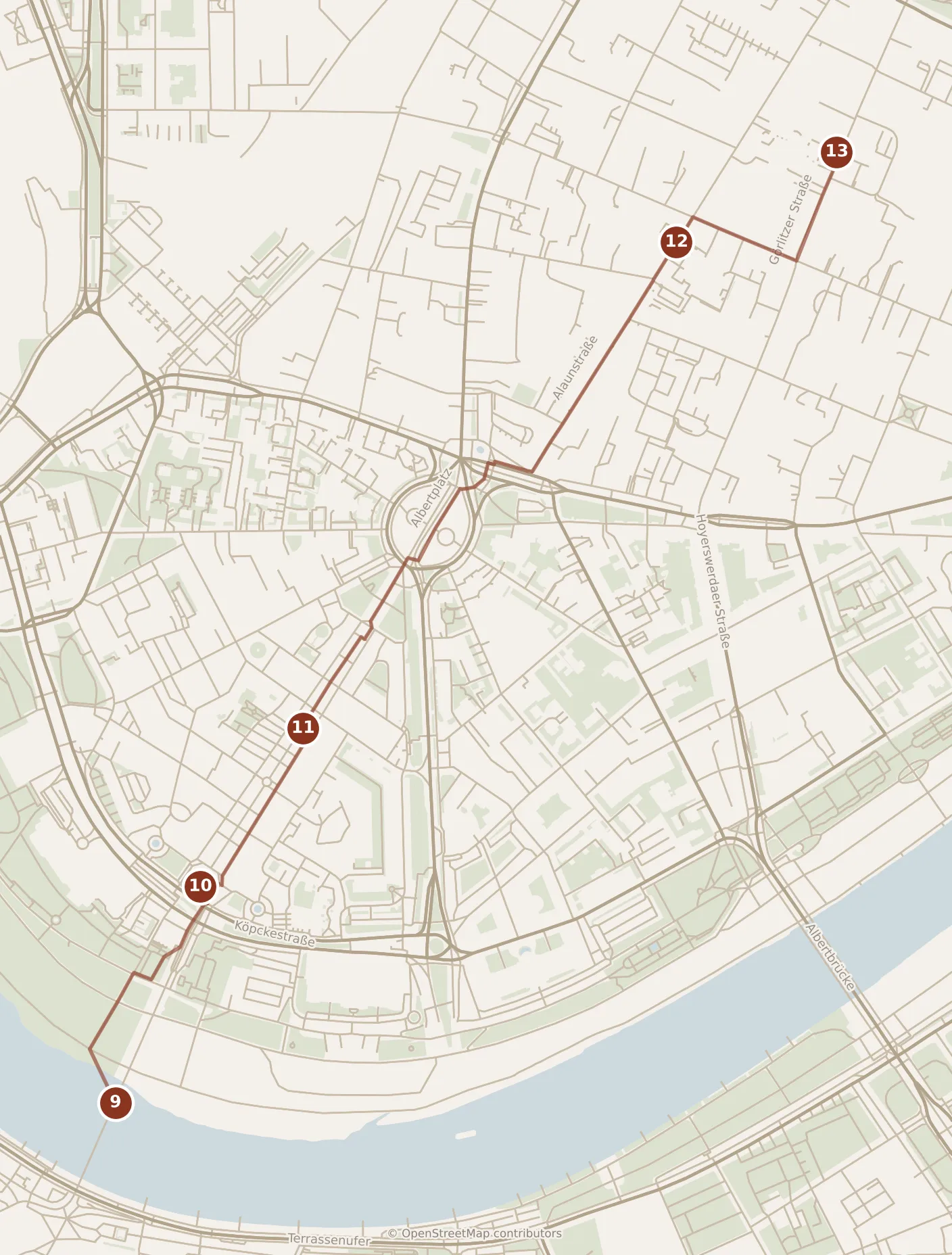
- Evening
- 9Augustusbrücke
- 10Goldener Reiter
- 11Hauptstraße
- 12Alaunstraße
- 13Kunsthofpassage
Morning
Start on Theaterplatz, because it is the calibration for everything that follows. The Semperoper closes one side of it, the Hofkirche and the corner of the castle another, and the long flank of the picture gallery a third. Every one of those buildings burned in February 1945 and every one of them is a rebuild, but not the same rebuild: the Zwinger was finished by 1963, the opera house between 1977 and 1985, and work on the castle is still going. Twenty minutes standing here does more for the rest of the day than any single room will. The inside of the opera house is seen on a guided tour or with a ticket for a performance, and one day has room for neither — look at it from the square and move.
Two minutes east, the Katholische Hofkirche, which is free and which explains the city’s whole eighteenth century. Augustus the Strong turned Catholic in 1697 to make himself eligible for the crown of Poland, and a Catholic ruling house in Lutheran Saxony needed a church of its own — so Chiaveri built one between 1739 and 1755, the biggest church in Saxony by floor area, joined to the castle by a covered passage so the court never had to cross the street to reach it. Inside are two things worth the fifteen minutes: the organ, the latest and the only survivor of the four that Gottfried Silbermann built in this city, contracted in 1750 and finished by his pupils after he died; and the crypt below, where forty-nine members of the House of Wettin lie, and where the heart of Augustus the Strong sits apart from the rest of him in its own capsule.
Then five minutes west into the Zwinger, which is free to walk into and is not a palace. It was built between 1711 and 1728 as an orangery and a festival ground — that is why it is a courtyard with pavilions and no rooms anyone could live in. Half an hour is right for it: the Kronentor with its gilded crown, the Nymphenbad in its corner, and the sheer size of the open middle, which is the point of the building. The picture gallery opens off the courtyard, and if you have decided to spend your one indoor stretch here instead, this is where the Sistine Madonna and the Vermeer whose painted-over cupid was uncovered in a restoration finished in 2021 are hanging.
Four minutes east to the Residenzschloss and the Historic Green Vault, which is the ninety minutes this morning is built around. It is not a museum of objects in cases. The rooms have been put back the way Augustus the Strong arranged them in the 1720s, with mirrored walls and about three thousand pieces standing free on their shelves, and you enter through a sealed lock that holds the climate steady — which is also why the groups are timed and counted. Upstairs, the New Green Vault is the modern half, ordinary walk-up on the palace ticket, cases and low light, and the thing to find in it is Dinglinger’s table-top Mughal court in gold and enamel. The jewel room of the historic half is where the burglary of 25 November 2019 happened. The castle also holds the Turkish Chamber, and half a dozen other museums besides; take the vault, take the Ottoman tent, and walk past the rest, because trying all of them is how this day dies indoors.
Local tip. The two halves of the Green Vault are bought differently, and only one of them can sell out on you: the historic rooms downstairs are timed and capped, the modern rooms upstairs are walk-up on the ordinary palace ticket. If the slot you wanted has gone, the day loses nothing but that ninety minutes — the upstairs half and the Turkish Chamber are still open to you, and the picture gallery is four minutes back across the road.
Three minutes further, out on Augustusstraße, the Fürstenzug: a hundred and two meters of about twenty-three thousand Meissen porcelain tiles along the outer wall of the castle’s Stallhof, carrying thirty-five rulers of the House of Wettin riding in procession. It was scratched into plaster in the 1870s and transferred onto porcelain between 1904 and 1907, which is the reason it is still here — in February 1945 the tiles took the heat of the firestorm and came through with almost nothing broken while the street behind you burned. Ten minutes, free, and it is the one wall on this route that came through the firestorm in place rather than being put back afterwards.
Afternoon
Lunch on the Neumarkt, or better one street back from it. The square is the most recent thing in the Altstadt: rebuilt from the 1990s onwards on the old plot lines, some facades copied from photographs, some frankly new behind historic fronts, and whether that counts as honesty is an argument the city is still having with itself. Give it an hour and eat sitting down. The tables with the view of the dome are priced for the view, and the kitchens a street away are the same kitchens.
Two minutes to the Frauenkirche, which is free to walk into during its posted visiting hours — those are the hours to check, since the church keeps a separate calendar for services and the middle of the day has gaps in it. Look at the outside first. The dark stones scattered through the pale facade are the salvaged ones, more than three thousand pieces lifted out of the rubble heap and set back where the survey said they had stood, which is why the exterior reads as a mosaic. The dome above them is entirely new stone: the fire-loaded blocks were not trusted with that load. Inside, half an hour is enough. The altar was dug out damaged and deliberately rebuilt with its damage showing, against the pale gold of everything around it. The buckled original dome cross was found in the rubble in 1993 and kept; the one on the lantern now was made in London by a British goldsmith whose father flew in one of the aircrews, and it went up in 2004. Give the climb to the dome gallery a miss — it is a separate ticket and a long spiral, and the view this day is built around comes later and is free.
Four minutes and a flight of steps up onto the Brühlsche Terrasse, the old fortification rampart that a minister turned into a private garden and that was opened to the public in 1814, which is where the “balcony of Europe” tag comes from. It runs about five hundred meters above the water between two bridges. Walk it westward, away from the Albertinum at the far end — that is the museum this day gives up — and take twenty minutes over it, because it is the last of the Altstadt and the first sight of what comes next. At the west end it drops by a broad staircase onto Schlossplatz, and the bridge is right there.
Evening
This is the stop the day is built around, and it is the one that will not wait. Walk out onto the Augustusbrücke and turn round. The Altstadt from the middle of the river — the Hofkirche tower, the dome, the terrace, the castle, all in one line — is the reason this skyline is on every postcard of the city. Then keep going, because the painter Dresden calls Canaletto set his easel not here but on the far bank just downstream of this bridge: cross, and walk a little downstream on the Neustadt side, which is where the composition actually resolves. It wants the end of the daylight and the beginning of the floodlighting, and everything recommended above it — the ninety minutes in the vault and the hour over lunch being half of it, the walking above the bridge a further twenty minutes — adds up to a little under five hours. Count that back from the light and you have the hour to start at — but only where the light comes early enough for a morning slot to reach it. Where it comes later the two cannot be made to meet, and there is no order that gets both: take the morning slot the vault needs, cross when you get to the bridge, and come back down to the water for the floodlighting after dinner. What those five hours do not include is the wait for your Green Vault slot, which is a fixed time you build the morning around rather than the other way round, nor the ticket desk before it; those are the two places this day loses time it did not plan to.
The bridge is a good place to stand because since January 2022, after a long restoration, it has been closed to private cars and carries trams, bicycles and people only.
Seven minutes at the far end brings you to the Goldener Reiter, Augustus the Strong in gilded copper and Roman armor, put up in 1736 three years after he died. From the statue, Hauptstraße runs north as a tree-lined pedestrian avenue with the Neustadt’s own reconstruction along both sides — slab housing of the 1970s laid over the baroque street plan, which is what this city’s rebuilding looks like when it is done a generation earlier and in a different language altogether. Five minutes gets you into it, and this is the place to stop for coffee and a slice of Eierschecke if you have not had one; the Saxon habit is mid-afternoon and you are going to be later than that.
Then the last stretch, eighteen minutes north up into the Äußere Neustadt along Alaunstraße. This quarter was barely touched in 1945 — it is one of the largest surviving blocks of nineteenth-century tenement streets in Germany — and it feels nothing like the rest of the day: no symmetry, no reconstruction, and a kitchen or a beer tap every few doors. Five minutes up it, the Kunsthofpassage opens off the street: five linked courtyards finished in 2001 and decorated by local artists, and the one to find is the Hof der Elemente, whose blue wall is plumbed with funnels, gutters and drainpipes wired into each other so that it plays when it rains. It is free and you walk straight through it to the next street. Half an hour, and it is a better last thing than another church. It is a passage rather than a public road, though, and it does shut at night, so it belongs before dinner and not after it.
Eat here. If you have a train, the Neustadt station is about twenty minutes’ walk away and the trams from the top of Hauptstraße run down to the Hauptbahnhof.
Practicalities
One thing on this route is worth buying before you travel and one only: the timed ticket for the Historic Green Vault. Its numbers are capped for conservation rather than for crowd control, so it is not a line that moves faster if you arrive early — the slot exists or it does not. Take a morning slot. The rest of the day counts forward from it, and an afternoon slot pushes the river past the light. Note what that ticket is: it admits you to the historic rooms and to nothing else. The rest of the palace — the New Green Vault and the Turkish Chamber among it — is a separate admission, and there is a combined ticket if you want both.
The museums here do not all close on the same weekday, and that is the fact a single day turns on. The Residenzschloss, with both Green Vaults inside it, closes on Tuesdays; the Zwinger’s galleries and the Albertinum close on Mondays. So no one weekday takes both away from you, and the route as written is a Tuesday problem, not a Monday one. Check the palace’s day before you fix your order, since it is the one this morning depends on. If your day falls on it, run the morning in the Zwinger’s picture gallery instead and everything else stands unchanged; if both are shut for some reason of their own, the day still works, because the rest of it is a square, a church, a wall, a market place, a terrace, a bridge and two streets, and all of those are free.
The other thing to check is the Frauenkirche’s visiting hours, which are posted separately from its services, run differently on the weekend, and close for about ninety minutes around the middle of the day — a gap this route is timed to come out the other side of, so the risk is arriving early rather than late. Look them up before lunch rather than after it, and if they do not fit, the church and the terrace swap places — not for nothing, since it means coming back east off the terrace for the church and then west again to the bridge, but a few minutes of retracing is cheaper than a closed door.
The whole of this day is walked, about four kilometers, and the only stretch worth riding instead is the last one: eighteen minutes from the top of Hauptstraße up into the Äußere Neustadt, which the trams do in a few — though none of them runs up Alaunstraße itself, so the stop is on one of the streets either side. They take the same one-way ticket as everything else in the city, and the city guide explains how that is bought. Nothing else here needs any transport at all.
If you are doing this between trains, do it without a bag. Leave it at whichever station you arrive at — bearing in mind that the day ends nearer the Neustadt one than the Hauptbahnhof — because none of the buildings on this route is a place to solve that problem. The vault in particular refuses coats and bags of any kind at the door: they go to a cloakroom or a locker, minutes before a timed entry you cannot be late for.


