Dakar in one day: Gorée by ferry, the Plateau, and sunset at the Mamelles

Last updated 28 October 2026
Overview
Dakar is the wrong city for a walking day, and the honest way to spend one here is to accept that and split it in two. The places a visitor comes for sit at the two ends of a long peninsula, with ten or more kilometers of jammed road between them, so this day is built as two walkable pieces joined by a taxi ride, not as one route on foot. The morning and early afternoon stay in the south, where the island of Gorée and the old downtown of the Plateau are a twenty-minute boat ride and a short walk apart; the evening goes north up the Corniche to the hill of the Mamelles for the light going down over the Atlantic.
What one day costs you is the north coast as a place to linger: Almadies, Ngor and its island, the surf. They are where you would spend a second day, and this one only reaches their edge. It also leaves out the long day trips the city guide mentions, Lac Rose among them. Gorée is the one thing not to give up. If the day has to lose something, it loses it in the afternoon.
The day has one stop that does not wait, and it is the last: the monument on the Mamelles, which is worth reaching in the hour before the sun goes. The sun sets here from about twenty to seven in mid-November to about a quarter to eight at the start of July, so take your month’s hour and count back from it through the durations below, which the afternoon section adds up.
The day

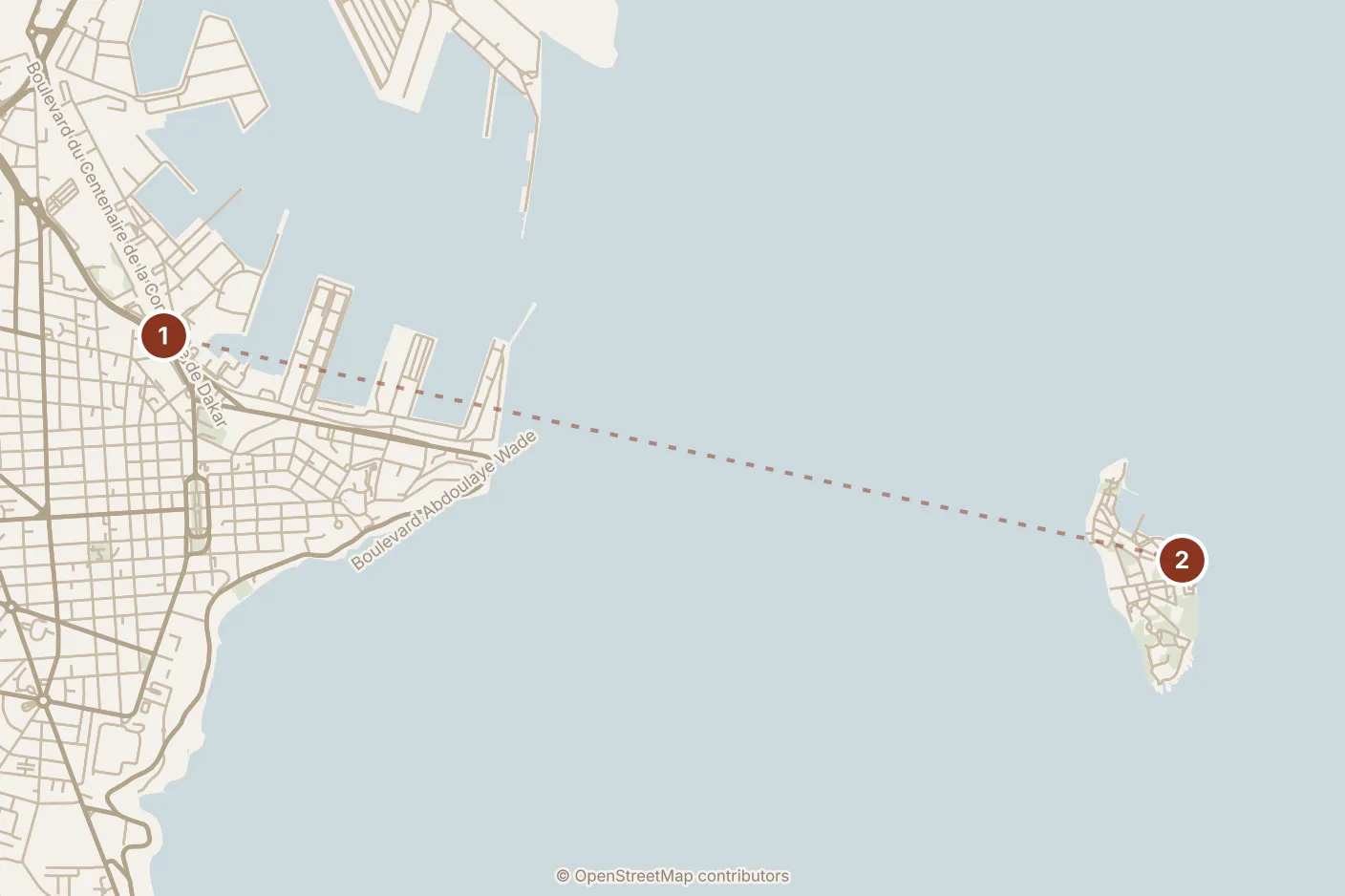
- Morning
- 1Gare de Dakar
- Gorée ferry terminal — in the prose, not on the map
- 2Maison des Esclaves
- Castel — in the prose, not on the map
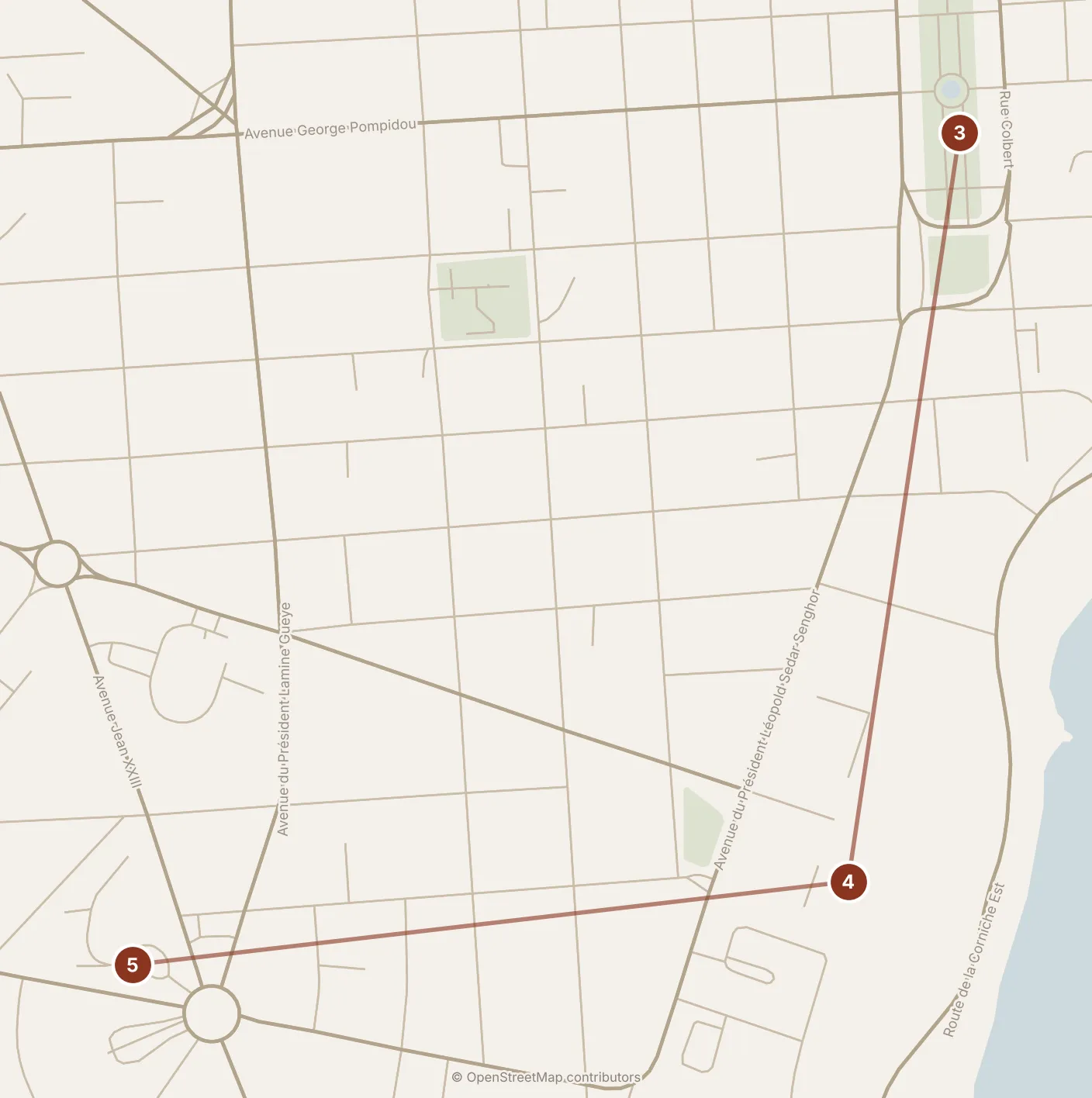
- Afternoon
- Kermel market — in the prose, not on the map
- 3Place de l'Indépendance
- 4Presidential Palace
- 5Musée Théodore Monod
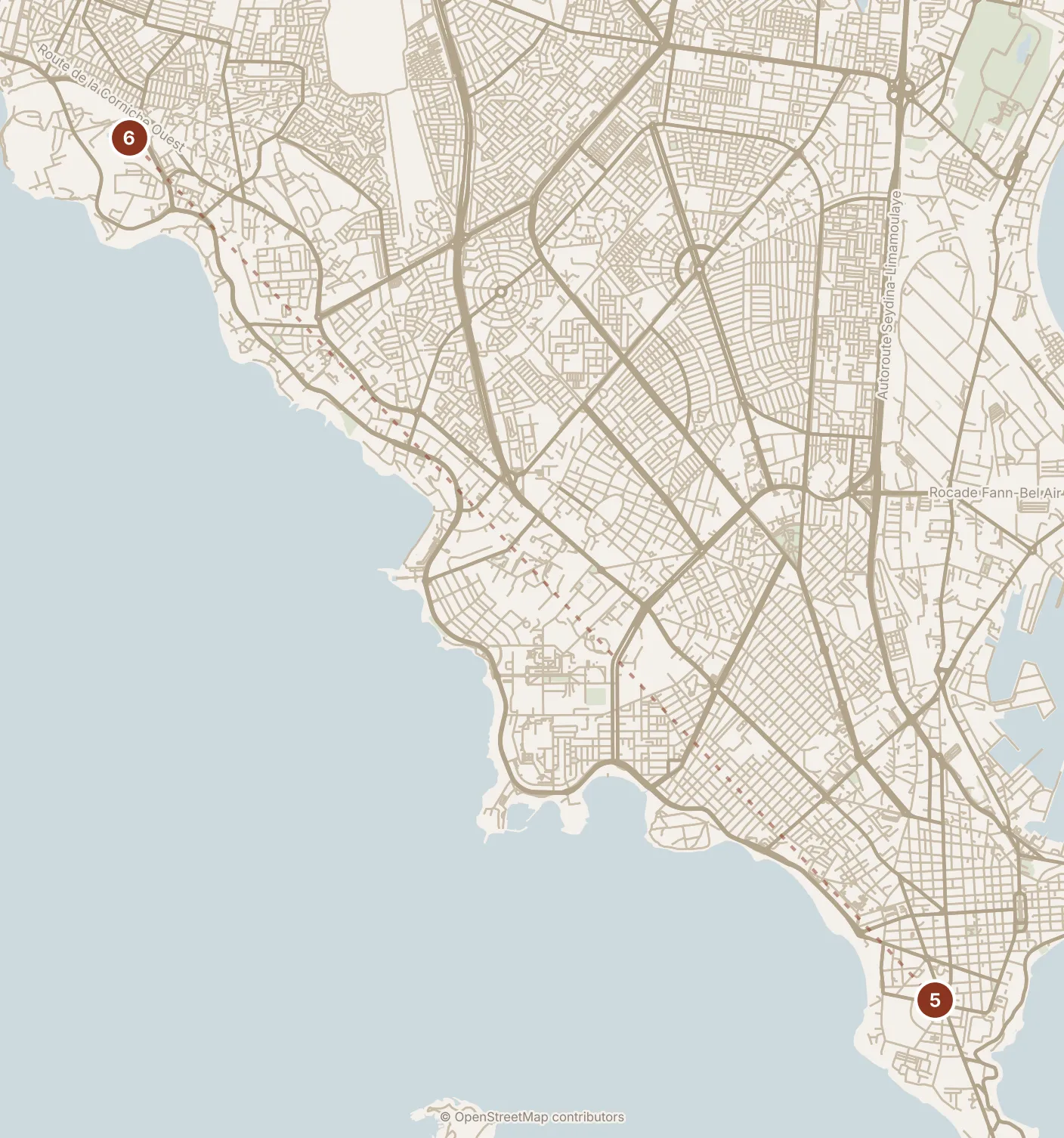
The leg out of the center: from stop 5 by taxi, not on foot.
- Evening
- Soumbédioune — in the prose, not on the map
- 6African Renaissance Monument
Morning
The day is counted from a boat. The ferry to Gorée, which everyone in Dakar calls the chaloupe, runs to a timetable posted at the terminal, with departures through the day roughly every half hour to hour and a half, and the boat you catch is the start of the day; aim for one in the middle of the morning, before the island fills with day groups.
If you arrive by the TER, the regional train, you come in at Gare de Dakar, its terminus on the eastern edge of the Plateau, and the Gorée ferry terminal is a short walk south along the port, about ten minutes. Since late September 2026 the same train also runs from Blaise Diagne International Airport, so an airport arrival comes in the same way; by taxi instead, tell the driver the Gorée ferry, not the Plateau, because the Plateau is a district and the terminal is a place. Buy the ticket at the terminal window, in cash: non-residents pay the highest fare, the fare covers the return, and a small communal tax for visitors to Gorée is paid on top. Expect to be approached here by people offering to guide you on the island; a polite no is enough, and you need nobody to find your way round a place this small.
The crossing takes about twenty minutes, and the boat lands you at a small beach beside the jetty. Gorée has no cars, its lanes are sand and stone, and its houses are the ochre and pink the photographs promise. It is a UNESCO World Heritage site, and it is small enough that nothing on it is more than a ten-minute walk from anything else.
Walk a few minutes into the lanes to the Maison des Esclaves, the House of Slaves, a two-story house with a curved double staircase over cramped ground-floor cells, and at the end of the passage beneath it the doorway onto the sea known as the Door of No Return. Be clear about what this place is: historians dispute how many enslaved people passed through this particular house, and the island’s role in the trade is better documented than the house’s. What it has become is the memorial where the Atlantic slave trade is remembered in Senegal, and it is visited in that spirit. Give it forty minutes, and go in without a guide if you prefer to stand in the cells in silence.
From the house, climb south through the lanes to the Castel, the high rocky end of the island, about ten minutes uphill. It carries old gun emplacements and the island’s best view, back across the water to the Plateau and the port. You may meet painters selling work up here; look as long as you like, and say no as often as you need to. Give the walk down through the rest of the lanes an hour, then take a boat back. All told, the island is worth about three hours.
Local tip. If the morning runs short, the House of Slaves is the one stop on Gorée to keep and the Castel is the one to cut: the lanes between the jetty and the house already give you the island, and the house is why it matters.
Afternoon
Back at the ferry terminal, you are on the edge of the Plateau, and the afternoon is on foot. Lunch comes first, and it should be thiéboudienne, the national dish of fish and broken rice, which is a midday meal here rather than an evening one; eat it sitting down somewhere in the streets around the Kermel market, a few minutes’ walk inland from the port, and give it an hour.
Kermel market itself is a covered hall in the colonial style, with fish, fruit and vegetables inside and stalls of crafts, fabric and flowers around it. It is smaller and calmer than the markets further into the city, which is why it is the one for a single day. Give it half an hour, keep your bag in front of you, and expect to bargain for anything you want to buy.
From Kermel it is five minutes west to the Place de l’Indépendance, the large square at the heart of the old downtown, ringed by ministries, banks and the old colonial buildings of the Plateau. There is nothing to go into; walk across it and take it as the center of the city as the colony built it. Then go south down the avenue to the Presidential Palace, ten minutes on foot, a white colonial palace behind railings and gardens, guarded by soldiers in red. It is seen from the street, not visited, and it is worth the walk because the museum is past it.
The Musée Théodore Monod, the museum of African arts run by IFAN, the research institute, sits on Place Soweto about ten minutes west of the palace on foot. It holds masks, sculpture, textiles and instruments from across West Africa, in a modest building, and it is the right size for one afternoon: give it an hour and do not try to read every label.
The afternoon adds up like this: an hour for lunch, half an hour in Kermel, the better part of an hour across the square and past the palace, an hour in the museum, then the evening’s two taxi rides and half an hour at the fishing beach, which come to well over another hour. Call it five hours from sitting down to lunch to standing at the monument. What that count does not include is the traffic on the Corniche, which is the largest thing the day cannot control: in the late afternoon the drive north can take twice what it takes at noon, so if you have to err, err early.
Evening
From the museum, take a taxi north along the Corniche to Soumbédioune, the fishing beach below the road, about ten to fifteen minutes in light traffic. Agree the fare before you get in. This is where the painted pirogues land their catch, and toward evening fish is grilled at tables set out on the sand. Give it half an hour. This is a working place: ask before you photograph anyone, and take no for an answer. If the afternoon has run late, this is the stop to drop: the monument is the one the evening is built around, and the beach is what you can lose without losing the light.
Then another taxi further up the Corniche Ouest to the African Renaissance Monument on one of the two Mamelles hills at Ouakam, about twenty minutes when the road is moving. It is a bronze figure group of a man, a woman and a child, unveiled in 2010, built by a North Korean studio and argued over in Senegal ever since for its cost and its style. You do not need to like it. You climb the long stairway to its foot for the view, which runs west over the Atlantic and back over the whole city, and the hour before sunset is when to be at the top. A paid visit inside the statue keeps its own hours; the view from the top of the stairway is the one this day needs.
From here the day ends by taxi, wherever you are going. Almadies and Ngor are the closest places to eat by the sea, a short ride north. Back to Gare de Dakar for a train is the whole length of the Corniche again, and in the evening traffic you should allow an hour. For Blaise Diagne International Airport, the train from Gare de Dakar avoids the road, but reaching the station is that same hour; if you have a flight that night, leave the monument with a wide margin rather than wait for the last of the light.
Practicalities
Nothing on this day needs booking ahead. The one ticket the route turns on is the Gorée ferry, bought at the terminal window on the day in cash, and the timetable posted there is the fact the morning is counted from: read it the evening before if you can, or on arrival, and if the boat you wanted is not running, build the morning back from the one that is. The museum ticket is bought at the door.
Two stops are the ones most likely to be shut on the day you are there. The House of Slaves and the Musée Théodore Monod each close one day a week; check which before you set out. If the house is closed, the island still holds the morning: walk the lanes, see the house from outside, and give the time to the Castel. If the museum is closed, leave the Plateau earlier and give the hour to the craft village beside the beach at Soumbédioune, which still gets you to the monument with time to spare.
You need cash in small notes all day: for the ferry, the taxis, which have no meters, the market and lunch. The rest of what the city guide covers, from arrival to the fare rules for taxis, is there rather than here.
The bag is the real problem, because this article knows of no left-luggage office on the route to send you to. That changes the day: the ferry, the sand lanes of Gorée, the climb to the Castel, the beach at Soumbédioune and the stairway at the monument are all bad with a case. The one way to do the day as written without holding it is to hire a taxi for the whole day, agreed at the start, and leave the case locked in the trunk while you walk, keeping your passport, money and phone on you. If you cannot do that, the case decides what goes: carry it on the ferry and keep to the flat lanes between the jetty and the House of Slaves, skipping the Castel; in the afternoon keep the Plateau, which is pavement, and drop Soumbédioune; and at the monument, look from the foot of the stairway rather than climbing it with a case in your hand.


