Curitiba in two or three days: the old center, the parks to the north, and the railway down off the plateau

Last updated 14 August 2026
Overview
Curitiba is a two-day city for a reason you can measure rather than feel. The old center is four hundred meters across and you walk all of it; what the city is famous for lies two to seven kilometers beyond that, in two directions that share nothing: south-east to the botanical garden, north and north-west to the museums, the woods and the flooded quarries. One day makes you choose a direction and lose the other. Two days buys both, and buys them in an order that means something — the small walkable half first, because that is where the immigration this city is built out of gets explained, and the wide green half second, because that is where you then walk through it.
A third day is not more of the same and it does not stay here. It is the mountain railway to Morretes, which leaves the plateau by way of the Serra do Mar and takes the whole day with it.
Day one is walked from the first square to the market, apart from the ride out to the garden and whatever carries you to dinner. Day two is not walkable and does not pretend to be: it has six legs, four of them ridden, and the two the route walks are the four minutes across the grass from the museum to the wood and the eighteen minutes from the opera house to the park above the quarries. One thing on the whole trip has to be booked before you arrive, and it is the third day’s train. There is one exception and it is in the last section: if the calendar strands you and the third day becomes the lookout tower on the western rim, that tower is visited by appointment, and the appointment is made online in advance through the city’s own tourism service. The two tickets day two needs are bought at their own doors, and day one costs nothing to get into at all.
The one piece of infrastructure this route asks you to know by name is the cartão turismo, the boarding card for the Linha Turismo loop. It is sold on the bus itself at any stop, for cash or by card, cost about fifty reais a head in 2026, and it is good for unlimited boardings for twenty-four hours counted from your first one rather than from the purchase. Whether it is worth having here is a real question and day two answers it. The other thing to have before day one is a ride-hailing app — Uber and 99 both work here — because every leg this route calls a car is one of those or a taxi off a rank. How the ordinary city buses are paid for, and how you get in from the airport, belong to the Curitiba guide and are not repeated here.
The stop the trip is built around is the terrace above the quarry lakes at Parque Tanguá, at the end of day two, and what it wants is the last of the light. Sunset on this latitude runs from about twenty-five to six on the first of June to a quarter past seven in the first week of January: a band of just over an hour and a half, and it is the June evening that is the short one, because the seasons here are the other way up. Read your own month off that band and work backwards. From the museum door at ten to arriving at that last park, day two adds up to about six hours; the park then wants an hour and a quarter, terrace at the end. What that sum measures is the hours you are inside places and in transit between them, and not one minute more. The one thing capable of standing outside it is the ticket desk at the museum, which is the only line day two can produce.
Rodoferroviária, Morretes — not on the walking map.
- With a third day
- 17Rodoferroviária
- Morretes — in the prose, not on the map
Day one

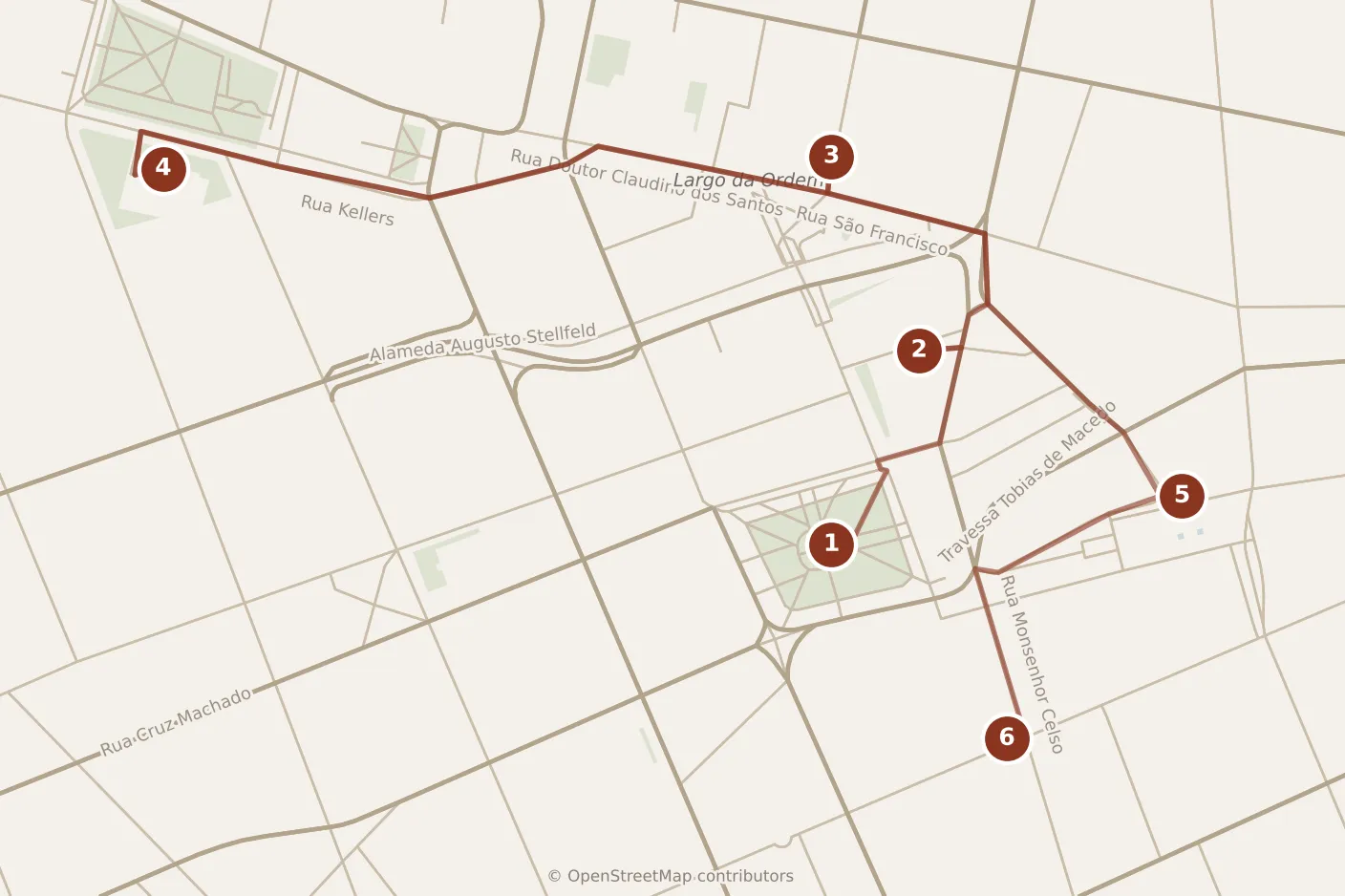
- Morning
- 1Praça Tiradentes
- 2Curitiba Cathedral
- Largo da Ordem — in the prose, not on the map
- 3Igreja da Ordem Terceira de São Francisco das Chagas
- 4Museu Paranaense
- 5Paço da Liberdade
- 6Rua XV de Novembro
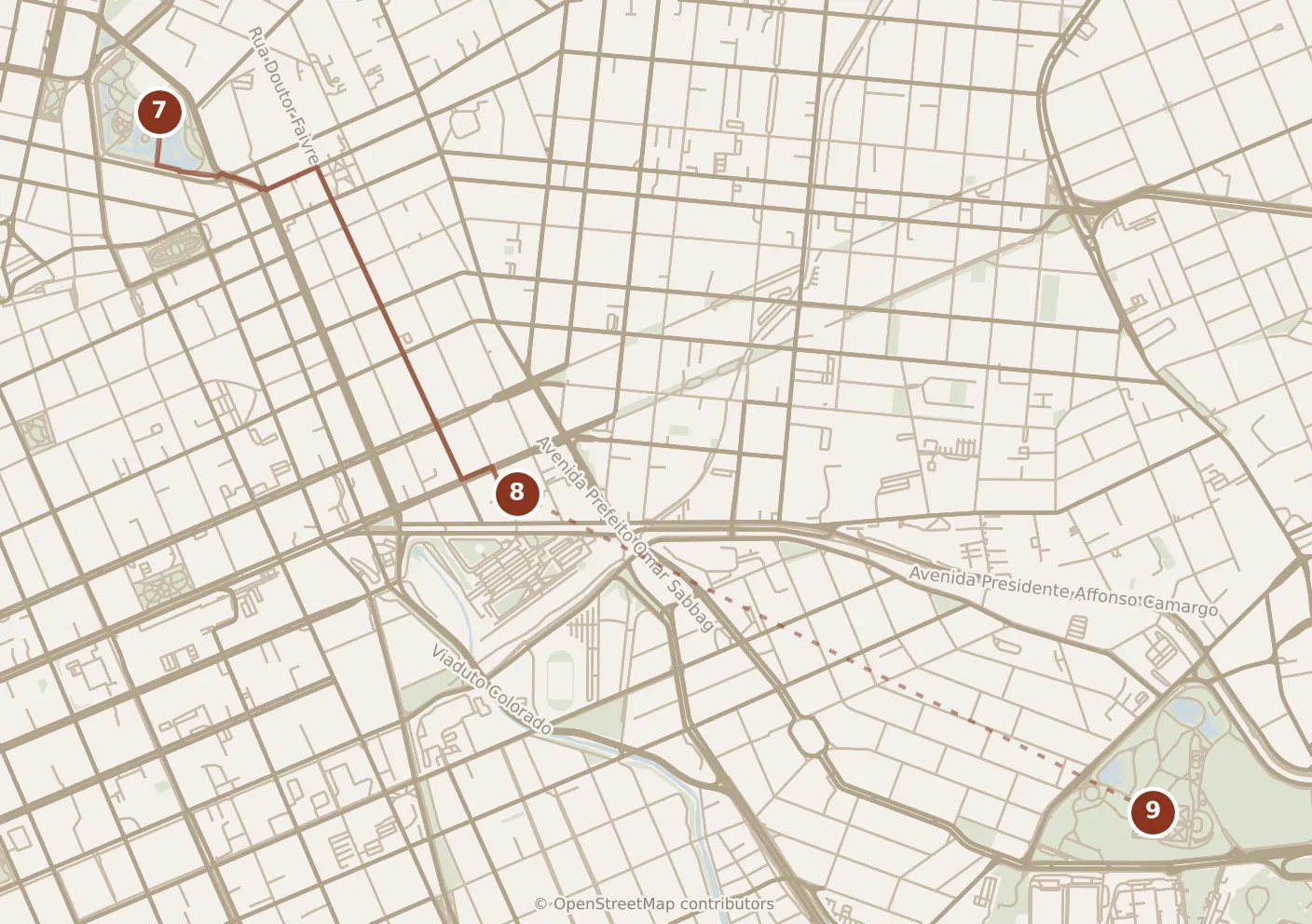
- Afternoon
- 7Passeio Público
- 8Mercado Municipal
- 9Jardim Botânico
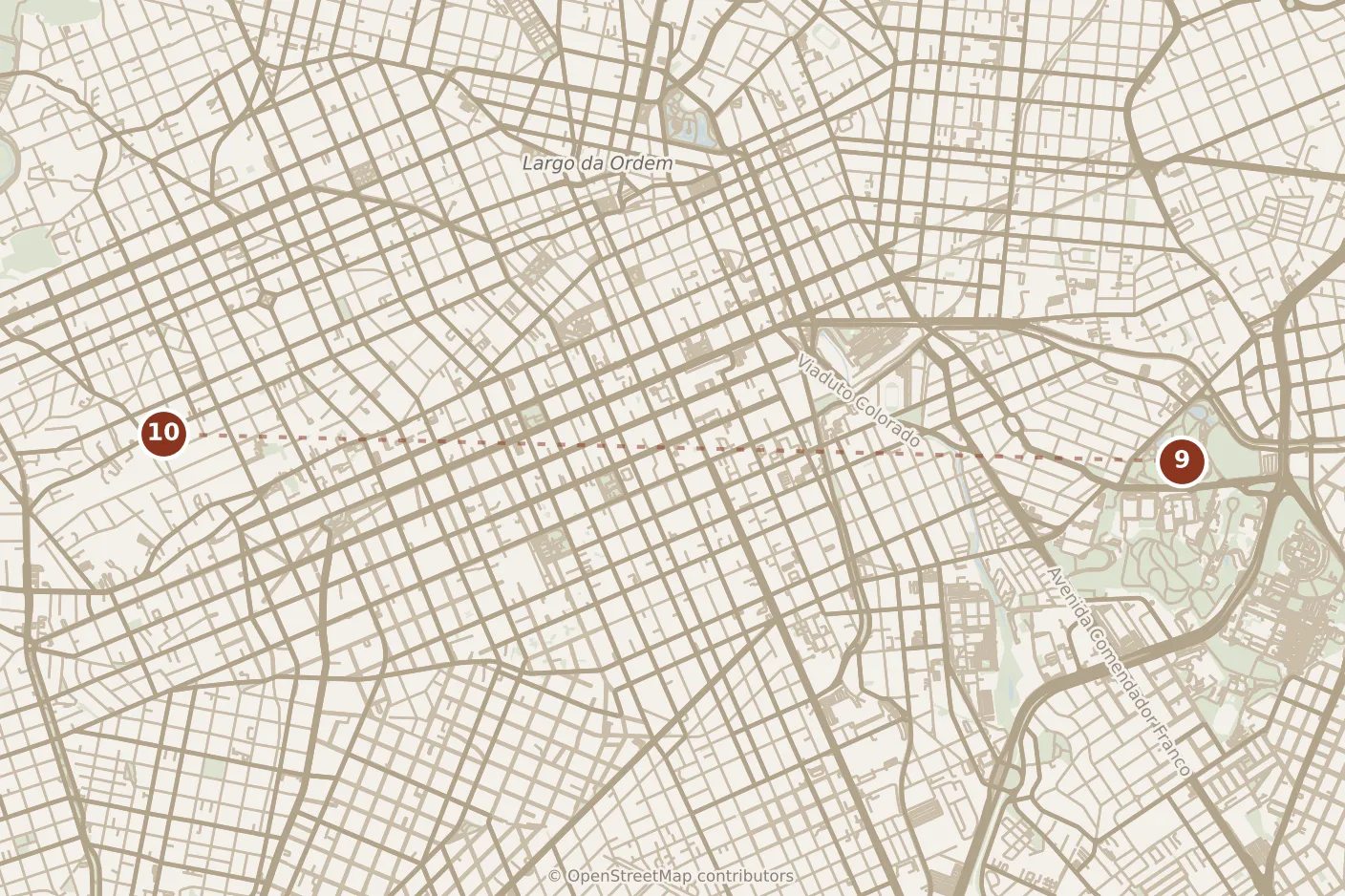
The leg out of the center: from stop 9 by taxi, not on foot.
- Evening
- 10Batel
Everything before lunch today sits inside four hundred meters, and the one door that keeps hours is the state museum: in 2026 the Museu Paranaense admitted nobody before ten, and nobody at all on a Monday. Everything ahead of it is a square, a cathedral, a slope and a church, none of which cares what time it is. So build the morning backwards from ten. The stops below take about an hour and a half to carry you to its door, which makes half past eight a fair start and nine o’clock the last sensible one; if the hour has moved, build it back from the new one, because the order does not change.
The first leg is the one nobody describes. If you land at the combined coach and rail terminal on the eastern side of town, Praça Tiradentes is ten minutes away by car, or a little over half an hour on foot through blocks that give you nothing. From the airport the executive bus runs into the center, and the Curitiba guide has the detail.
Morning
The city started on Praça Tiradentes and the square has been in service ever since, which is why it reads as an interchange rather than a monument: shelters, a shopping subway, benches under trees. Ten minutes is enough, and the useful thing to do with them is to fix the compass. The cathedral occupies one flank of it, a Gothic revival finished in the 1890s whose inside is taller, darker and much barer than its towers promise; fifteen minutes there, and if a service has begun, stay at the back of the nave or look in again when you come back down.
Downhill from the square the ground drops away into Largo da Ordem, and the drop is the point: the century changes underfoot, from office blocks to low colonial houses on cobbles. Give the slope twenty-five minutes with nothing particular to look at, then twenty inside the Igreja da Ordem Terceira de São Francisco das Chagas — the oldest church standing here, thick-walled and almost undecorated, and the one interior in the center that could not be anywhere else. Sunday mornings the entire hillside turns into an antiques and handicrafts market, which will either double this stretch of the morning or take it over completely.
Eight minutes further up the hill, inside the Palácio São Francisco, is the Museu Paranaense: founded in 1876 and the third-oldest museum in the country. Its permanent floor runs from the archaeology of the plateau through the objects of its indigenous peoples to the arrival of the Polish, Ukrainian, German and Italian settlers whose neighborhoods day two drives through. Give it an hour and take that floor only. Entry was free in 2026, so the hour costs you nothing but the hour, and it is the piece of the trip that stops the memorials and woods to the north being scenery.
Thirteen minutes back down the hill stands the Paço da Liberdade, built in 1916 to house the council and working now as a cultural center. Half an hour, and give it to the staircase and the rooms rather than to whatever is on the walls. Four minutes on lies Rua XV de Novembro, the flower street, closed to traffic half a century ago and one of the earliest such streets anywhere in the country. This is where the city’s planning reputation actually begins — before the buses, before the parks, on four blocks of sidewalk. Walk it end to end, twenty minutes, and know that it is the last of the center today.
Afternoon
Fourteen minutes north-east through ordinary downtown streets, the Passeio Público is the oldest park in the city, opened in 1886, and its gate is a faithful copy of the one on the dog cemetery in Paris. Inside is a small urban menagerie of the old kind — birds, animals, an aquarium — and the Memorial Árabe on the square at the far end. Thirty-five minutes. If a nineteenth-century zoo is not something you want to look at, this is also the stop to cut first, and the last section says what cutting it hands back.
From there it is about half an hour on foot south-east down Avenida Sete de Setembro to the Mercado Municipal, and lunch is there: a covered hall of counters and kiosks with the country’s first organic market attached to it. Give it an hour. In winter this is where to eat pinhão, the roasted araucaria seed that is most of a Paraná June, and pierogi are on the counters all year round. Two things about that hour. In 2026 the market’s counters shut at one o’clock on a Sunday rather than at six, but its restaurants ran on to three — so a Sunday lunch here still works, and what a Sunday costs you is the hall around the meal rather than the meal. On a Monday it closed at two and opening at all was left to each stallholder, so a Monday lunch here is one you cannot count on: eat on the flower street instead and ride straight out.
The terminal stands directly behind the market, and that piece of geography is worth holding on to: it is where left luggage is in this city, where the coaches go, and where the third day begins.
A ten-minute ride south-east from the market is the Jardim Botânico, and this is the afternoon. The garden opened in 1991, and the picture everybody has of Curitiba is the one you get from the top of the entrance steps, looking straight down the length of the French parterre to the glasshouse — modeled on the English Crystal Palace, with tropical-forest planting under it. Behind and around are the woodland paths and the Museu Botânico. Give the whole thing an hour and three quarters. The Jardim das Sensações inside the grounds is a walk done blind through planting chosen for smell and texture; it is a fixed half-hour route, it is free, and it does not run to the gate’s hours. Neither does the glasshouse, and that is the thing to plan against. In 2026 the gates were open from six in the morning to half past seven at night, but the glasshouse took its last visitors at five and the blind walk at half past four, and neither of them opened on a Monday. So this end of day one does have a deadline after all and it is five o’clock — comfortably met by the count below, and missed by a lie-in. Take the glasshouse first, then the blind walk, then the woodland paths, which are the only part of the garden that keeps the gates’ hours.
Counted up: the stops come to about five and a half hours, lunch to another, and the moving between them to an hour and a half. Just under eight hours in all, so a half-past-eight start puts you back out of the garden at about half past four. What that count does not hold is the market’s counters at Saturday lunchtime, when the line is the first twenty minutes of the meal.
Evening
Dinner is in Batel, fifteen minutes west by car — the district where the eating and drinking are dense enough to walk between and to choose on the spot, which is the one thing the center cannot offer. Ask for Avenida do Batel rather than for the district and walk from there: the bars and dining rooms thicken along that avenue and along the street it runs into, and the district around them is mostly towers. Take the ride rather than the idea of walking back downtown. The office blocks empty hard after dark and the streets around the older squares and around the terminal are the ones people here leave alone at night; that is the ordinary local rule rather than nervousness, and it is why day one deliberately ends somewhere else.
Day two

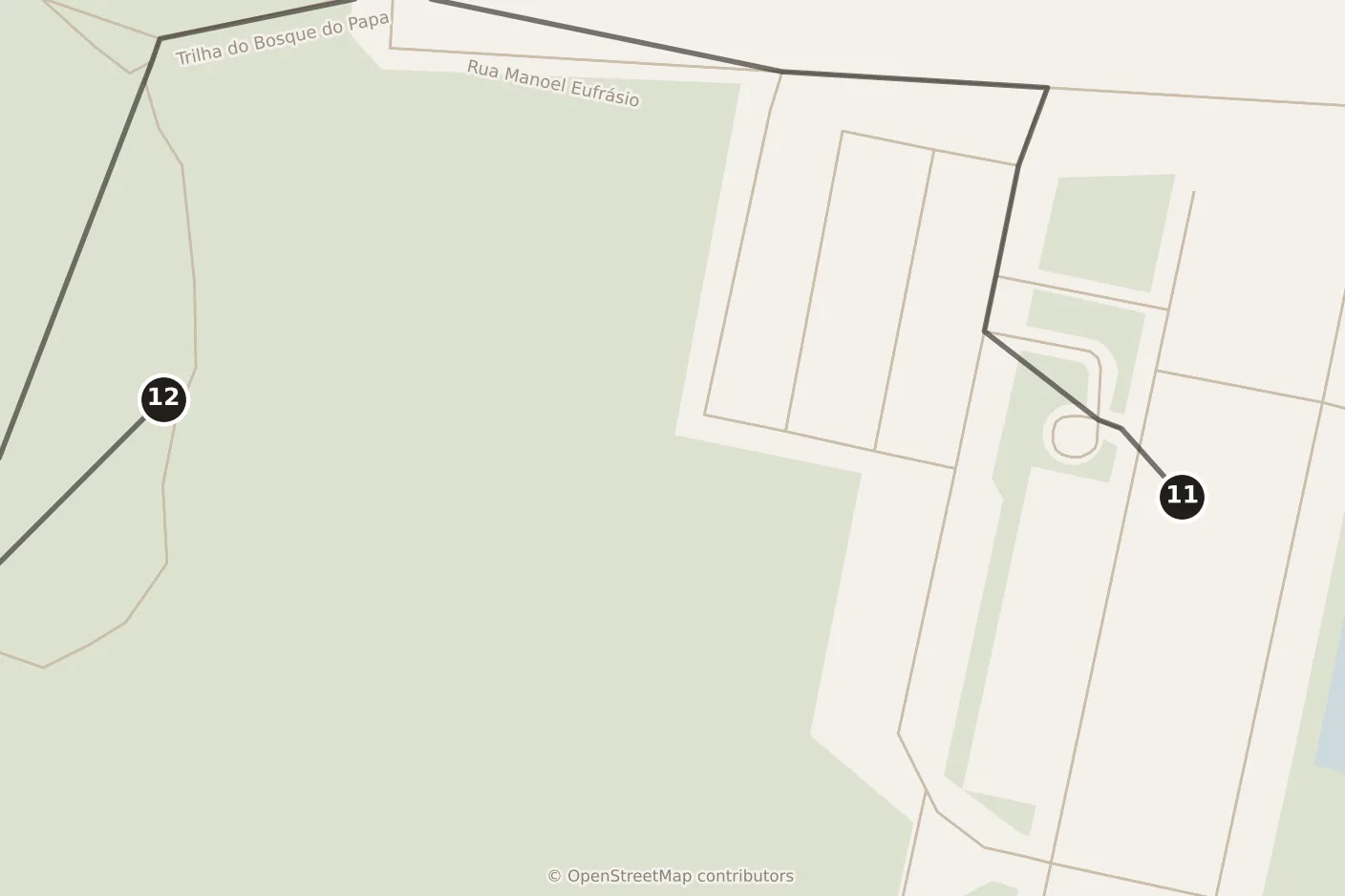
- Morning
- 11Oscar Niemeyer Museum
- 12Bosque do Papa
- Afternoon
- 13Bosque Alemão
- 14Ópera de Arame
- Evening
- 15Parque Tanguá
- 16Santa Felicidade
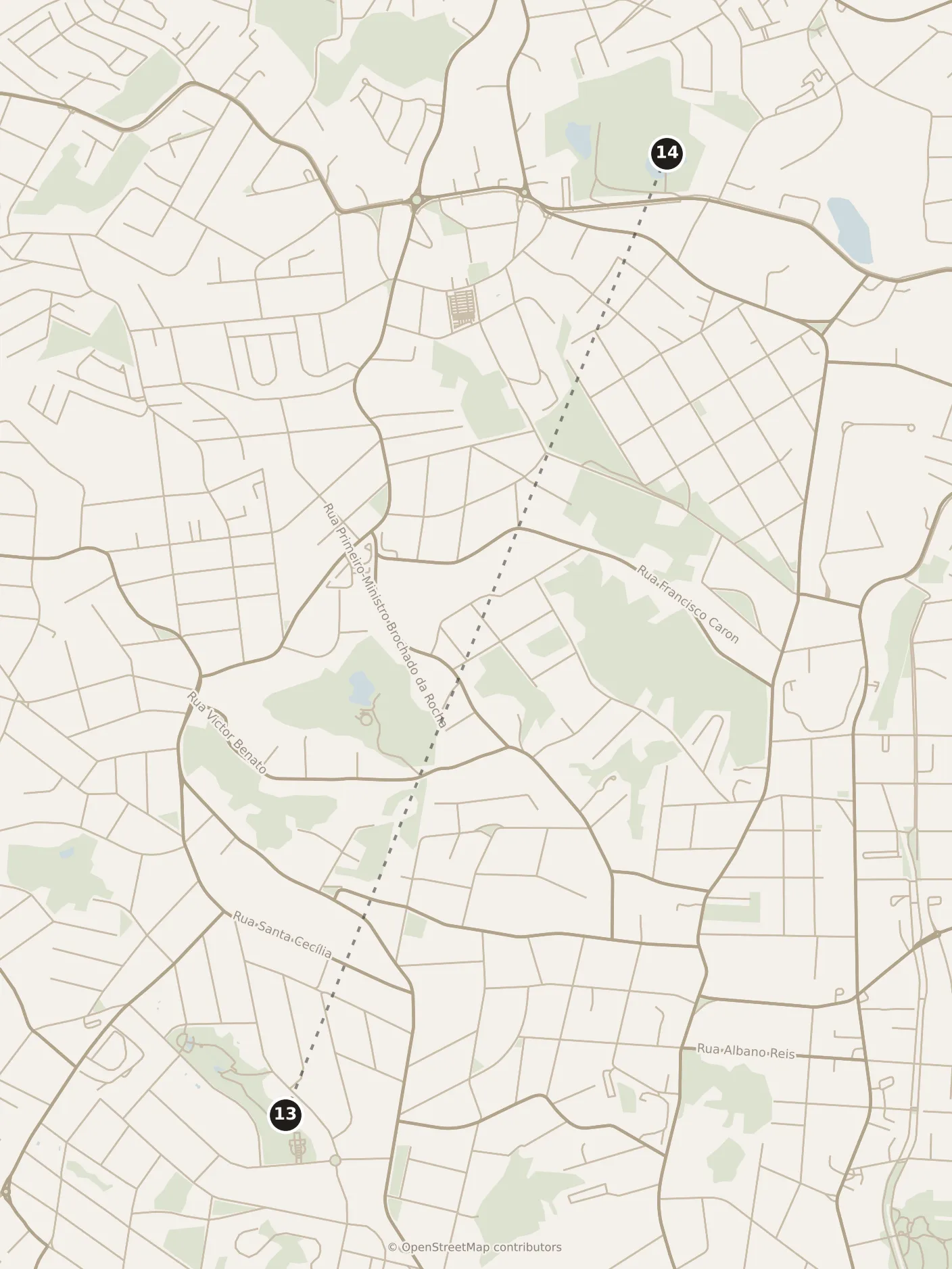
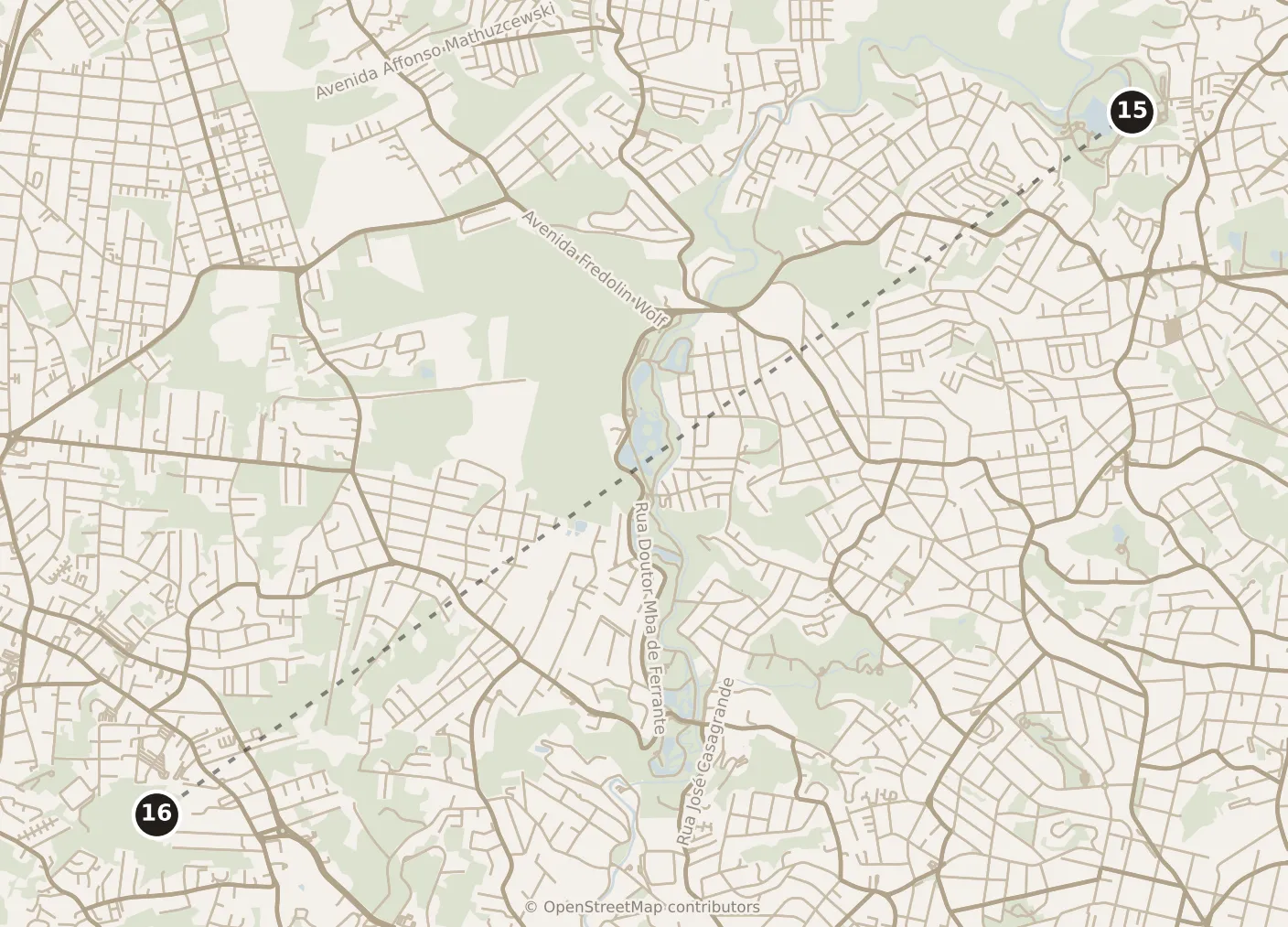
Today runs one way — north out of the Centro Cívico, then west along the top of the city — and it never doubles back. In 2026 the museum stopped admitting at half past five and turned everyone out at six, and the opera house shut at six as well, while the park the day finishes at was still open at eight. That gap of two hours and more is the entire reason for the order below: roofs first, sky afterwards. Reverse the day and you finish at a locked door.
Morning
Start at the Oscar Niemeyer Museum, ten minutes by car up from the center, and start when it opens — ten in 2026, Tuesday to Sunday, with the last admission at half past five and the whole place free to everyone on a Wednesday. The tourist loop stops at its door, but reaching it from a central stop means riding almost the whole way round a one-way circuit that takes three hours, so this first leg is a car whatever else you do today. What everybody comes for is the annexe — the Eye, a lens of concrete and glass held up on one pillar — but do not stop there. The slab behind it was designed by the same architect decades earlier for another purpose entirely, and was adapted rather than knocked down; seen together the pair make a single case about how a state builds in public. Two hours. Spend one on the annexe and the ramp that climbs into it, one on whichever of the temporary shows looks worth it, and feel nothing about walking straight past the others: this is among the biggest museums on the continent and nobody covers it. Eat before you go — the museum has a café and the next stop has nothing whatever. Give that meal three quarters of an hour, and count it inside the day’s sum rather than as a break from it.
Cross the grass behind the museum, four minutes, and you are in the Bosque do Papa — a stand of araucarias left in the middle of the city, with seven timber houses among them that were taken apart in the Polish colonies out beyond the edge of town and rebuilt here. Forty-five minutes. Treat them as a shrine as much as a display; the city itself calls the place a sanctuary, and people behave in it as they would in a chapel. One distinction matters to anyone planning a Monday: in 2026 the wood was open daily and the memorial was not, shutting that day for cleaning. Those colonies are why pierogi are eaten in this city at all, and standing among the houses is what stops that being a caption.
Afternoon
Eight minutes west by car, in a residential street, the Bosque Alemão does the same work for the German arrivals and does it more strangely: a wooden lookout called the philosophers’ tower that clears the treetops rather than the city, a replica of a Lutheran chapel used as a concert room, and a trail through the wood illustrated with a fairy tale. Forty-five minutes, and this is the day’s cuttable stop.
Ten minutes north the ground gives way into an abandoned quarry, and the Ópera de Arame stands in the water at the base of the rock: a concert hall framed in steel tube and skinned in wire mesh, raised in two and a half months and finished in 1992, with the much bigger open arena of the Pedreira Paulo Leminski blasted into the stone alongside. An hour takes in the walkway over the water, the hall itself and the arena — and the arena, which nobody photographs, is the better half. It is one of only three attractions on the tourist loop with a ticket, sold at the gate, requiring nothing in advance.
Evening
Eighteen minutes on foot, four by car, brings Parque Tanguá: a second pair of worked-out pits, both under water, joined by a waterfall and by a passage driven straight through the rock between them, with a viewing terrace set on the upper edge above the whole fall of ground. An hour and a quarter, and take it in the right sequence — the lakes, the falling water and the passage first, the terrace at the end, because the terrace is the part that needs a low sun on it. Once the light has gone there is nothing here to see.
In June and July the day above fits and nothing more. What pushes you on is not any gate hour — you are past the last of them by mid-afternoon — it is the sum: overrun by twenty minutes at three stops and you reach the terrace after the sun has left it. From November to February the light holds until a quarter past seven and you have the better part of two hours in hand. Do not take them as a later start, because the museum stops admitting at half past five and the opera house closes at six, and those two doors fix the front of the day whatever the sky is doing at the back of it. Take them at Tanguá instead, on the lower circuit, where an hour disappears without being noticed.
Dinner is out in Santa Felicidade, a quarter of an hour west of the park by car — and a car it has to be, because the loop’s last departure from the center is in the late afternoon and by the time you come down off the terrace there is no counting on one still coming round. This is the Italian quarter, and the barn-sized dining rooms along Avenida Manoel Ribas — the road the city itself designates as the quarter’s restaurant strip — bring you course after course of polenta, pasta and chicken and keep bringing them until you say stop. Give the driver that avenue and not the district: the district is large and the eating is one road of it. Give it two hours and turn up empty. Heavy, unashamedly aimed at visitors, and still built on what one immigration actually cooked — and the only reason a one-day trip here cannot include it is that one day never reaches this corner of the map.
Local tip. If the loop appeals at all, today is when to buy the card and not yesterday — but count the legs first. Day one holds a single ride and it is a ten-minute car. Today holds four, and only two of them are ones the loop can take: the wood behind the museum to the German wood, and on from there to the opera house. The ride up from the center goes against the circuit, and the ride out to dinner is late enough that no bus can be counted on. Two legs is a thin case for fifty reais, so buy it for the top deck and the commentary or do not buy it at all — and if you do, buy it on the bus, since the twenty-four hours begin at your first boarding rather than at the counter.
With a third day

Give the third day to the train, and understand first that you do not choose when it goes.
The railway from Curitiba down through the Serra do Mar to Morretes is the reason a third day here is worth having: 41 bridges and 13 tunnels off the edge of the plateau, through forest, with the line hanging over the drop for most of it. In 2026 it left the terminal behind the Mercado Municipal at half past eight in the morning, and the operator, Serra Verde Express, gave the run as four to four and a half hours. The return left Morretes at three in the afternoon, moved to four between the end of December and the first of March. That is the shape of it: a whole day, gone before nine, back at dusk.
It is placed, not appended. The operator publishes a calendar of departure dates rather than a weekly schedule, so the third day is whichever of your dates has a train on it, and days one and two close up around it. Two things make that easy. The train wants an early night in front of it, which is day one — day two ends at the far north-west of the city over a two-hour dinner, and following that with a half-past-eight departure from a terminal on the opposite side of the center is the one arrangement to avoid. And if one of your three days is a Monday, the Monday is the train day, when the calendar has one, because Monday shuts most of the doors on days one and two — the last section counts them — and the railway cares about none of them.
Where the calendar leaves no choice and the train falls the morning after day two, swap days one and two. That swap is not free: day one is the small half of the city, and the immigration floor in the Museu Paranaense is what makes the woods and memorials of day two read as a sequence rather than as a list of parks. Taken second they are still good and they are less legible. It is the trade worth making anyway — a missed train costs a day, and a day out of order costs an hour.
Book it before you travel, from Serra Verde Express directly; the plain seat was from a little under two hundred reais in 2026, and the package that takes you down by rail and brings you back by road from just under five hundred. Two things decide between them. Rail both ways gives you barely two hours in Morretes, because the return goes at three; the road back leaves the afternoon intact. And seats are allotted by carriage rather than chosen, and some of them face backwards — so ask which when you book, not on the platform. Lunch at the bottom is barreado, the sealed-pot beef stew of this coast, and it is the reason to want the longer afternoon.
If the calendar has no train on any of your days, the third day becomes the western rim of the city, and that is a different day rather than a smaller one. Start at the Torre Panorâmica in Mercês, a car of ten minutes from the center: a lookout on a telecommunications mast a hundred and nine meters high, with a full turn of the horizon, from which the busway spines and the ring of parks read as the plan they are. It is the only place on this trip where the city explains itself in one look, and it is the third of the three loop attractions that charge, so this alternative costs a ticket that the railway day does not — a few reais only, and the one ticket on any of these days that is a booking rather than a line, reserved online beforehand and paid for by card at the door. Book the slot when you fix the day, and do not fix it on a Monday: the city’s own page for the mirante gives it as Tuesday to Sunday. Forty minutes. Then seven minutes south-west to Parque Barigui for an hour of flat walking round the lake. Then eat, and eat at noon rather than when you feel like it, in the ordinary neighborhoods between the two parks: in 2026 the last stop shut between twelve and one every day it opened, and closed altogether on a Monday, so the midday hour is the one thing here that has to be planned around and lunch is what you plan it with. After that, ten minutes north to Parque Tingui and the Memorial Ucraniano inside it — a replica of the oldest Ukrainian church in the country, timber-built and Byzantine in form, with a small museum of painted eggs, icons and embroidery inside it and a craft shop beside it. An hour, which puts you back in the center in the middle of the afternoon. Forty minutes, an hour, an hour and a lunch: it is a real day — on any day but a Monday, which takes the tower and the Ukrainian memorial both and leaves you the lake at Barigui and the lunch. So if your dates hold a Monday and no train on any of them, spend the Monday the way the last section spends one, outdoors on the parts of days one and two that keep no door, and give this western rim one of the other two days. It is not the railway, and it is not offered as though it were.
Practicalities
One booking, and it is the train — or, on the version of the third day that has no train, the lookout tower that stands in for it. Buy the train from Serra Verde Express before you travel, pick your date off their published calendar first, and arrange the other two days around it. Nothing else on days one and two is bookable and nothing else needs to be. The Oscar Niemeyer Museum and the Ópera de Arame sell at their own doors and are the only two places on those days that charge at all — in 2026 the museum was in the thirties of reais and free to everyone on a Wednesday, the opera house somewhere between fifteen and twenty-five, and the state museum, the botanical garden, the market, the parks and the memorials were free outright. The alternative third day adds a third ticket at the Torre Panorâmica, a few reais and reserved rather than bought at the door — which is why the sentence above says days one and two and not three.
Mondays are the thing to plan against, and they bite harder here than in most cities. In 2026 a Monday closed the Museu Paranaense, the Paço da Liberdade, the Passeio Público, the glasshouse and the blind walk inside the botanical garden, the Oscar Niemeyer Museum, the Ópera de Arame, the Polish memorial inside the Bosque do Papa, and — on the alternative third day — the Memorial Ucraniano, and the Torre Panorâmica, whose booking page gives it as Tuesday to Sunday. The Mercado Municipal is the one commonly listed as shut that is not: it closed at two on a Monday, with each stallholder free to stay shut, which is a lunch you cannot rely on rather than a locked door. That is three whole stops on day one and two on day two, and on each day one further stop that stays open with a closed interior inside it — the glasshouse and the blind walk in the botanical garden, the Polish memorial in the Bosque do Papa. So on a two-day trip a Monday cannot simply be swapped away from — it has to be spent. Spend it outdoors, on what stayed open every day: the squares, the cobbled slope at Largo da Ordem, the flower street, the botanical garden’s own grounds, the wood at the Bosque do Papa, the Bosque Alemão, Parque Tanguá, and dinner in Santa Felicidade. Then run days one and two as written on the days either side, minus whatever you have already used. No other weekday takes anything off this route. The city sets out each attraction’s closing day one by one on its own Linha Turismo pages; read them the week before, and if a day has moved the rule has not — put the doors on the days that are not Monday and the open air on the day that is.
Sunday has one trap of its own. In 2026 the Mercado Municipal’s counters shut at one rather than at six, which is before day one’s lunch would reach them, while its restaurants stayed open to three, which is after. So a Sunday costs you the hall and not the meal, and there is exactly one way to buy the hall back: cut the Passeio Público — the stop this route is already willing to drop first — and walk from the flower street straight to the market, which puts you among the counters by about half past twelve. That works only if the morning has run to time, and Sunday is the one morning that cannot be relied on to, because it is also when the slope at Largo da Ordem is a fair rather than a street and the fair will either double that stretch or take it over completely. So the Sunday choice is the fair or the stalls, and it is worth making before you set out rather than discovering at one o’clock. Keep the fair, and lunch is the market’s restaurants, which ran to three, or the flower street and a ride straight out to the garden.
What to cut when the day is short. On day one it is the Passeio Público, and it goes first: the stop is thirty-five minutes and the dogleg to reach it is another fifteen, so it hands back about fifty minutes, on day one, to be spent either on the garden or on a nine-thirty start — one or the other, not both. On day two it is the Bosque Alemão, which hands back the better part of an hour, on day two. Do not convert that hour into a later start, because the two doors fix the front of day two; convert it into the museum’s changing galleries or into the lower circuit at Tanguá. Everything else on both days is load-bearing. Cut the Oscar Niemeyer Museum and day two has no morning; cut the Museu Paranaense and day two has no subject.
Getting between the stops. Only two of day two’s four ridden legs are ones the cartão turismo can actually take: the two in the middle of the day, which run in the loop’s direction and inside its hours. The first goes against a one-way circuit that takes three hours to complete, and the last falls after the hour when a bus can still be relied on; both of those are cars. The card itself is bought on the bus, unlimited for twenty-four hours from the first boarding, with a service every thirty minutes on a weekday and every fifteen on weekends and on public holidays. The first bus of the day leaves Rua 24 Horas at half past eight and the last one at five, so treat it as a daytime service and plan both evenings by car. Day one needs no loop at all: the whole morning is on foot, the walk out to the market is half an hour along one avenue, and the single ride inside the day is the ten minutes to the garden.
The bag. The reliable place to leave luggage in this city is the combined coach and rail terminal, whose published list of services carries both a staffed counter and lockers. The building is a seven-day operation, so the question to settle in advance is what hours the counter keeps, not which days. That matters more here than it looks, because the terminal stands behind the Mercado Municipal, where day one eats, and it is where the third day’s train leaves from and returns to. So an arrival too early to check in is the easy case: leave the case, ride into Praça Tiradentes, and day one starts where it starts. A departure by coach on the last evening is easy for the same reason, and if the railway is your final day the train sets you down in the very terminal your coach leaves from. Three stops on this route are genuinely bad with a case in your hand — the cobbled slope at Largo da Ordem, the botanical garden, and the climb to the rim at Tanguá — and none of them is anywhere near the terminal.
Flying out on your last day is the case where two of the rules above collide, and it is worth saying so rather than going quiet. The airport is south-east of the city; day two ends six kilometers west of it and of everything else, which makes it a poor last day, so the last day wants to be day one — but the train wants day one immediately in front of it, and both cannot hold. The trade is this. If the calendar allows, put the train first, then day two, then day one — accepting both that the trip’s earliest start lands on the morning after you arrive and that this is the swap described above, with the center read second and read less well for it. If it does not, keep day one before the train and fly out at the end of day two, giving the transfer across the city an extra half hour that a map will not show you.


.jpg)


.jpg)