Copenhagen in two or three days: the palace island, the harbor and a third day up the coast

Last updated 17 October 2026
Overview
Copenhagen’s old center is small and flat, and almost everything a first visit wants sits within a half-hour walk of the harbor. Two days covers it properly if you split it the way the city itself is split: day one is the palace island and the waterfront running north from it, with the royal square and the old fortress at the far end; day two is the royal garden quarter around Nørreport and then, across the water, Christianshavn. A third day is best spent leaving: the coast line north runs past a world-class modern art museum to the castle Shakespeare called Elsinore, and both are an easy train ride away.
Everything below is on foot except three short rides, each named where it happens. The one thing you need in your hand is a way to pay for them: a Rejsekort, or tickets bought in the DOT Tickets app. The city guide explains the fare zones and which to choose; the airport, the metro and the coast line all accept the same tickets.
The first leg: from the airport, a regional train reaches København H, the central station, in about a quarter of an hour, and the M2 metro runs from Lufthavnen station to Kongens Nytorv in about the same time. Day one starts from København H and ends opposite it, so arrive by train if you are carrying a bag: the station’s left-luggage lockers are the place to leave it, and the evening brings you back past them.
Both days are counted against the light, because their best stops are outdoors and by the water. The sun sets here from about twenty to four in December to just before ten at the end of June, so in winter the days below are tight and in summer they are generous; each day says what to cut when the light runs short.
Helsingør station, Kronborg Castle, Humlebæk station, Louisiana Museum of Modern Art — not on the walking map.
Day one

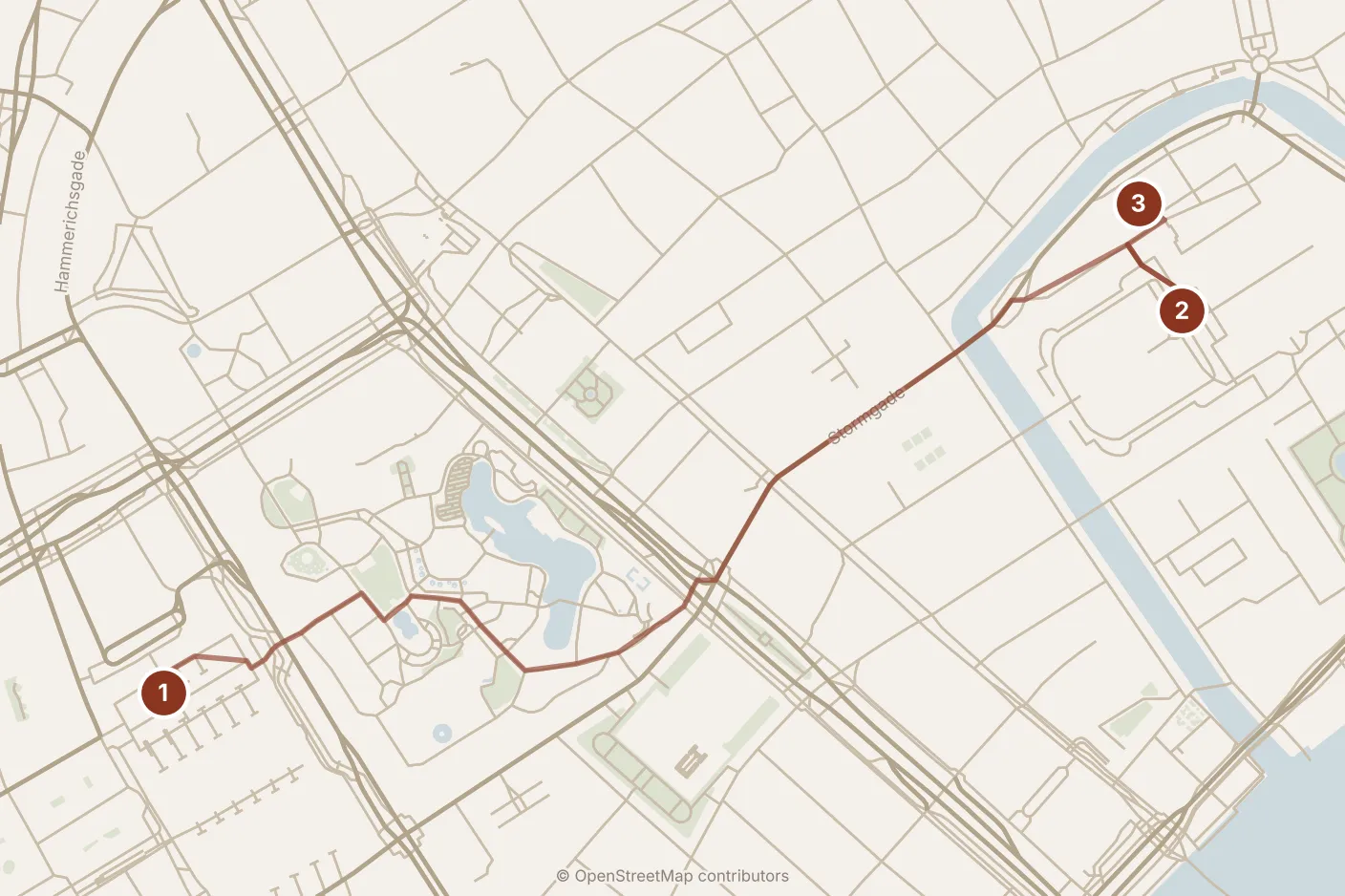
- Morning
- 1København H
- 2Christiansborg Palace
- 3Thorvaldsens Museum
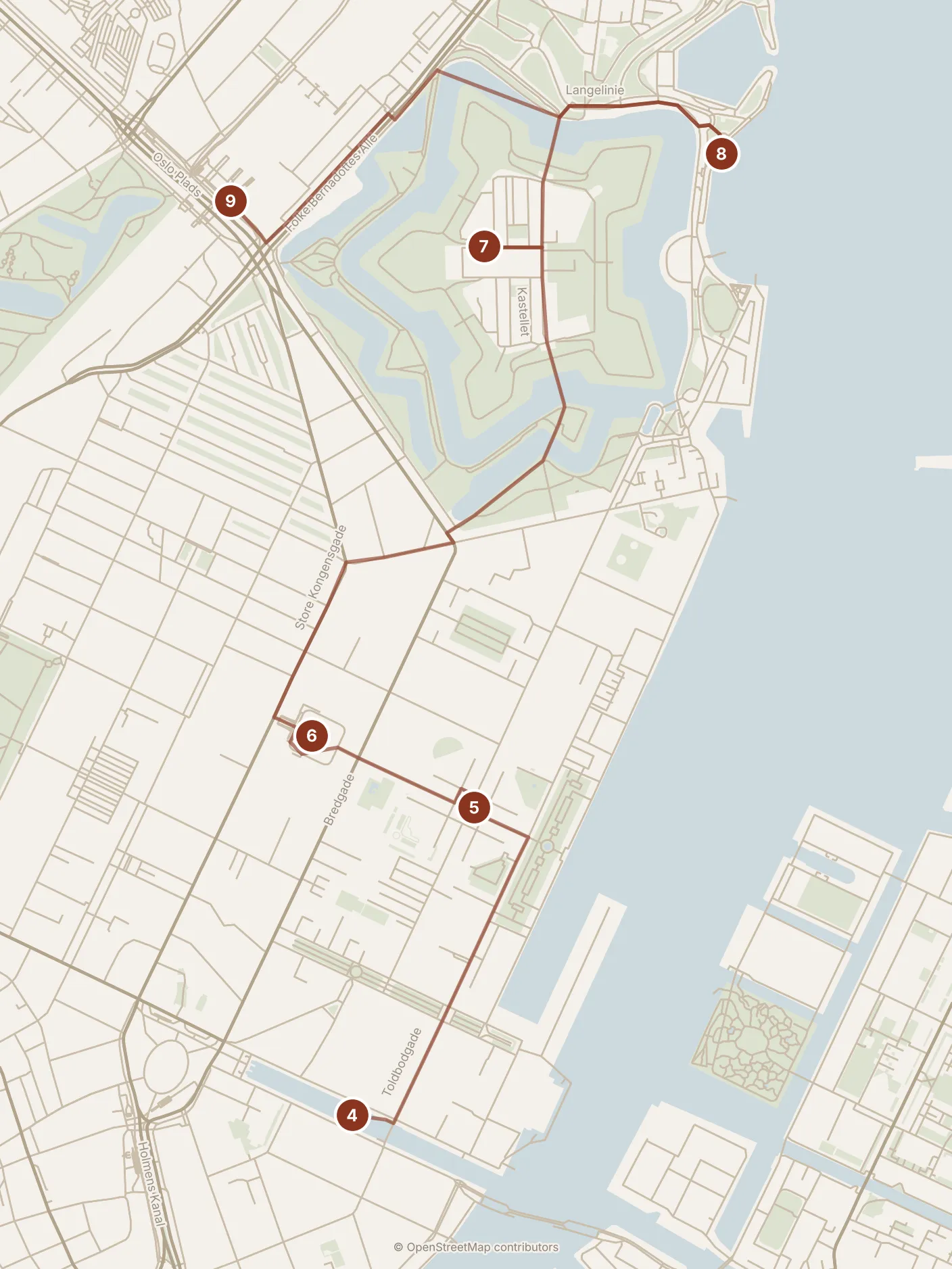
- Afternoon
- 4Nyhavn
- 5Amalienborg
- 6Frederik's Church
- 7Kastellet
- 8The Little Mermaid
- 9Østerport station
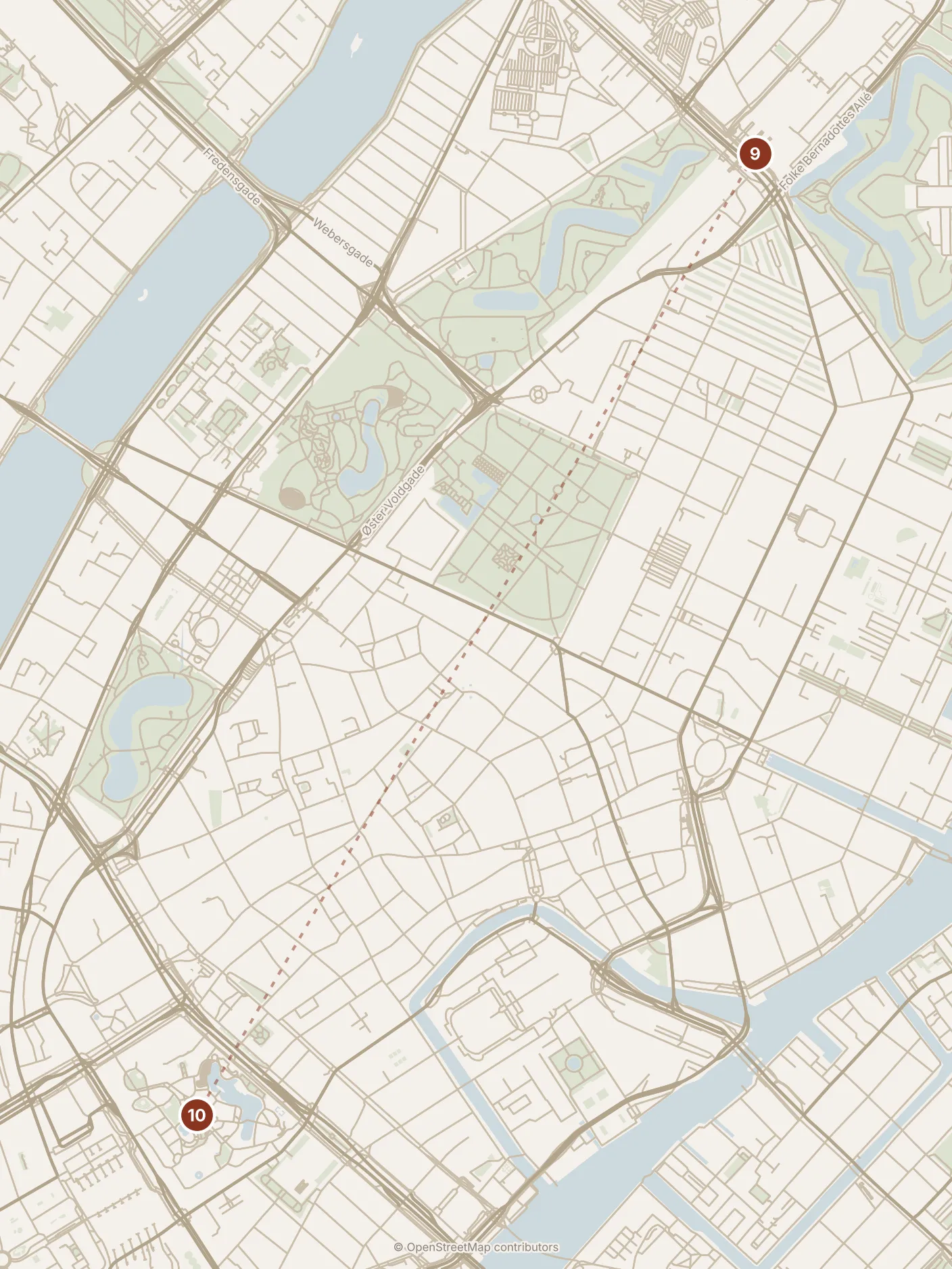
The leg out of the center: from stop 9 by metro, not on foot.
- Evening
- 10Tivoli Gardens
Today runs in one direction: from the palace island at the south of the old center, along the harbor, to the fortress at the north end. You never walk back over ground you have covered.
Morning
From København H it is about twenty minutes on foot to the palace island, across Rådhuspladsen, the City Hall square, and down through the old streets beyond it. If the weather is against you, the M3 metro runs two stops from København H to Gammel Strand, which is on the canal facing the island.
Christiansborg Palace is the building that runs the country: the Folketing, the Supreme Court and the prime minister’s office all sit inside it, which makes it the one place in Denmark housing all three branches of the state. What a visitor sees is the Royal Reception Rooms, still used for state banquets, and the reason to go is the Great Hall, hung with a modern series of tapestries telling the history of Denmark in loud, crowded color; it is the least stuffy room in any palace you will see this year. Below the palace, the ruins are the foundations of the earlier castles on this spot, back to the fortress of Bishop Absalon, the city’s founder, in the twelfth century. Give the reception rooms an hour and the ruins half an hour, and skip the stables and the kitchens unless you have a particular reason.
Thorvaldsens Museum is beside the palace, a low building painted ochre outside and in deep reds, blues and greens inside, built to hold the work of Bertel Thorvaldsen, the sculptor who spent most of his life in Rome and came home a national hero. Thorvaldsen himself is buried in the courtyard. It is a building more than a collection: the white marble against those walls is the point, and three-quarters of an hour is enough unless neoclassical sculpture is your subject.
Leaving the island toward the harbor, you pass Børsen, the seventeenth-century stock exchange with a spire of twisted dragon tails. A fire on 16 April 2024 destroyed its roof and brought the spire down; it has been under reconstruction since, so expect scaffolding and look at what is left of the brick front rather than for the spire.
Afternoon
From the island it is about fifteen minutes on foot to Nyhavn, along Holmens Kanal and across Kongens Nytorv. Nyhavn is the seventeenth-century canal lined with painted gabled houses that is on every poster of the city; Hans Christian Andersen lived in three of those houses at different times. It is crowded and the cafés along the sunny side are what you pay for the view, so treat it as lunch somewhere just off it, a walk down one side and back up the other, and the place the canal boats leave from. The standard harbor loop runs about an hour and is the most efficient way to see the waterfront you are not going to walk; take it here if you want it; the other departure point on this route, Gammel Strand, comes before the palace visit.
Ten minutes north is Amalienborg, four identical eighteenth-century palaces set around an octagonal square, the royal family’s town residence. In 2026 the guard changed in the square at noon, after marching through the streets from its barracks by the King’s Garden; this route reaches the square after lunch and misses it, so if the guard is what you came for, cut the morning to the reception rooms alone, walk straight to Amalienborg for midday, and come back to Nyhavn for lunch. Stand in the middle of the square and look both ways: the axis runs from the dome of Frederik’s Church on one side to the Opera House across the harbor on the other, and it was designed to.
Frederik’s Church, which the city calls the Marble Church, is four minutes away at the end of that axis. Go in for the dome, which is the whole building; ten minutes is enough.
From there it is about fifteen minutes north to Kastellet, a star-shaped seventeenth-century fortress that is still a working military site and still entirely walkable: the ramparts are a raised grass path around a moat, with barracks painted red in the middle. Walk the half-circuit of ramparts on the harbor side, which takes twenty minutes and brings you down at the water. The Little Mermaid is five minutes further along Langelinie, a bronze by Edvard Eriksen from 1913, on a rock just off the shore. She is small, and crowded by coach groups; see her, do not wait for a clear photograph, and keep going.
This is the half of the day that wants daylight, and the count is what decides when to start. The morning above comes to about two and a quarter hours inside the two museums, plus twenty minutes of walking to reach them; lunch and Nyhavn are about an hour and a half with the walk; Amalienborg, the church, the ramparts and the statue are about an hour and a half more including the walks between them. That is a little over five and a half hours, and an hour more if you take the canal boat. It does not include the ticket desk at the palace or the line for the boat, which on a summer weekend is the largest of them. In June the light makes this irrelevant; in December, with dark before four, start at the palace as soon as it opens and drop the canal boat first.
From the statue, Østerport station is about fifteen minutes on foot, inland and west.
Evening
The M3 metro from Østerport circles back to København H, and directly across the street from the station is Tivoli Gardens, the amusement garden that has been there since 1843: old rides, lit paths and a lake, more garden than theme park. It opens in seasons rather than all year, typically summer, around Halloween and for Christmas, so check whether yours is one of them. When it is shut, the streets just west of the station are where to eat, and your bag is a minute away either way.
Day two

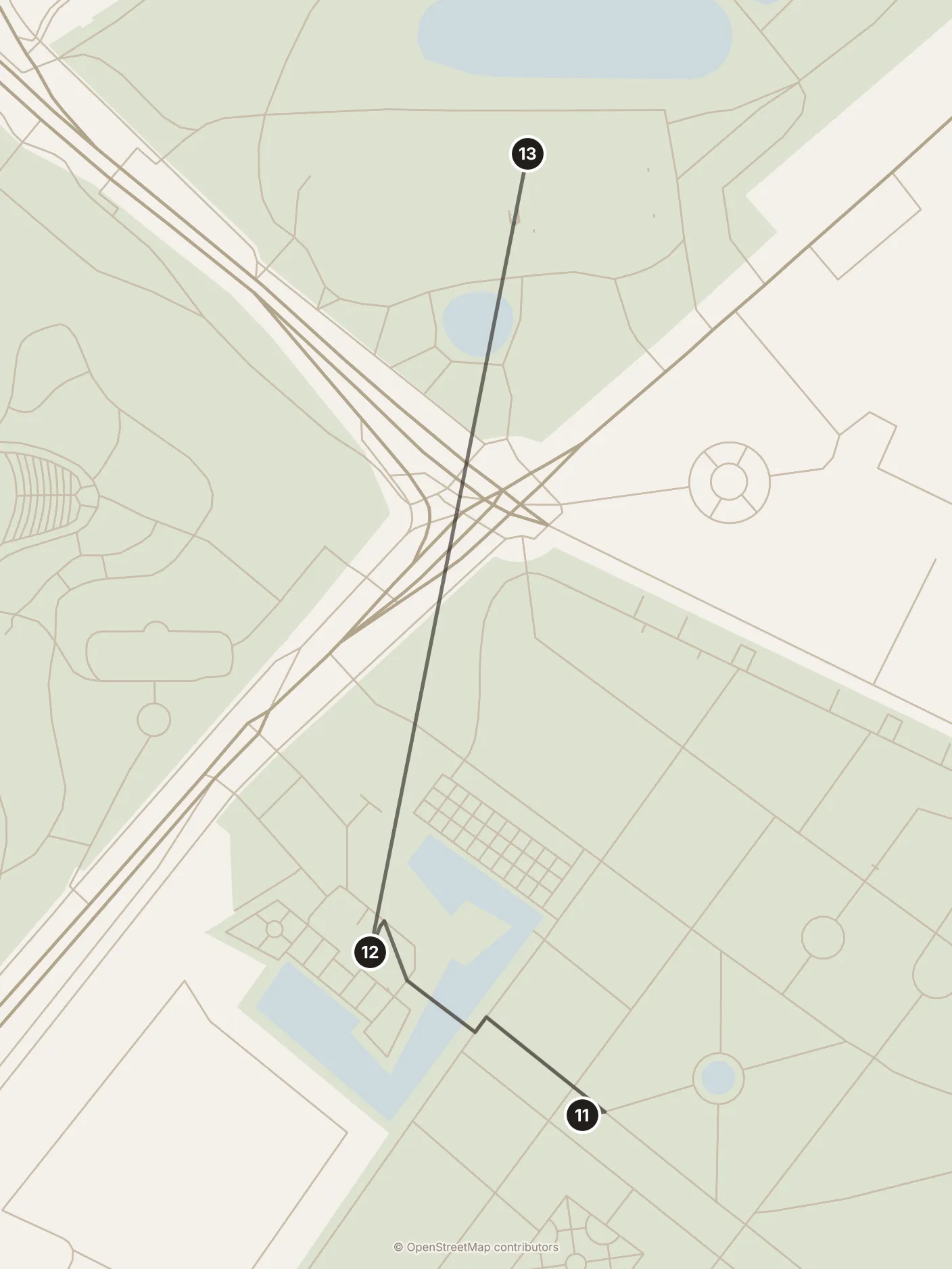
- Morning
- 11King's Garden
- 12Rosenborg Castle
- 13Statens Museum for Kunst
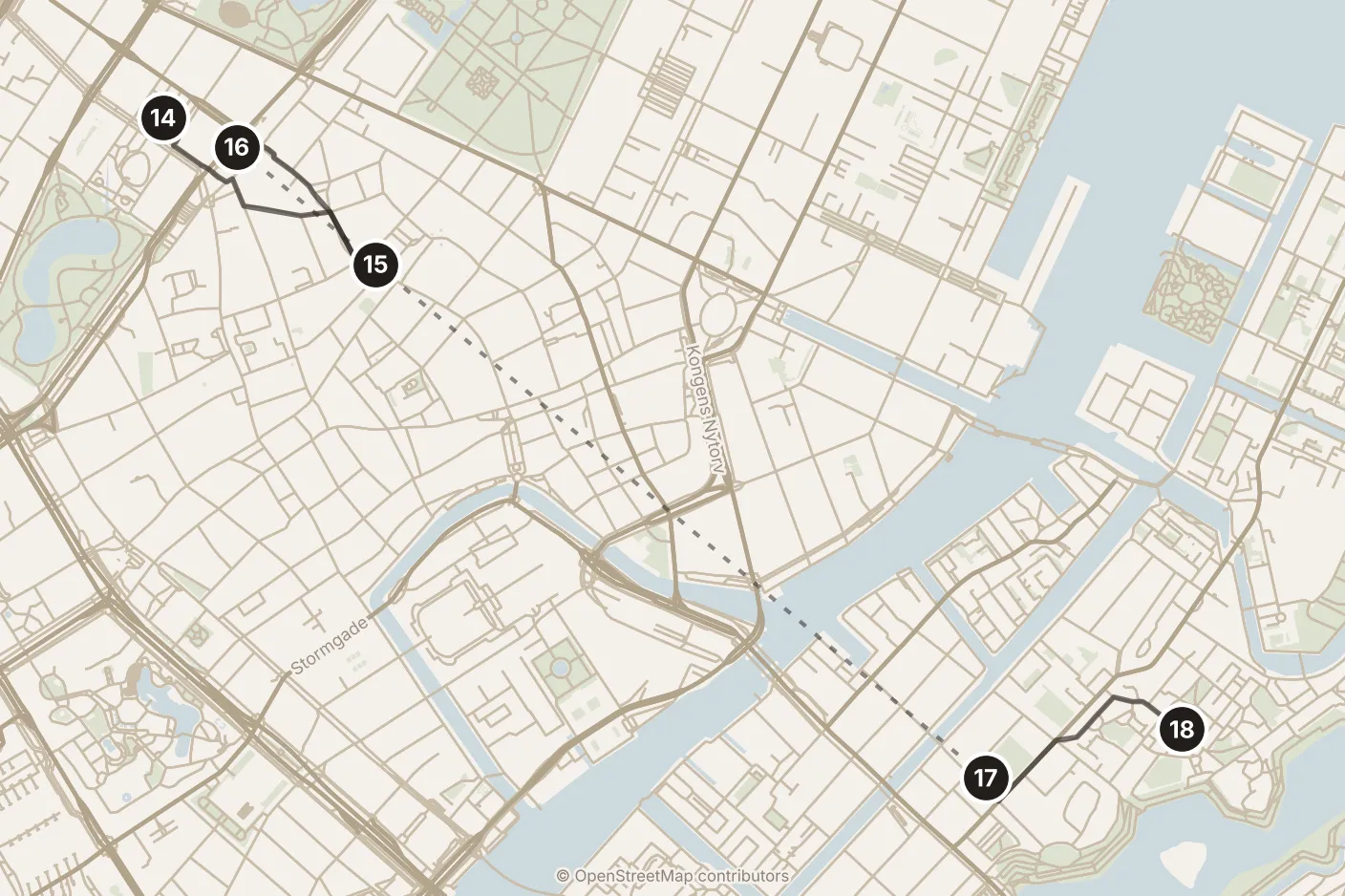
- Afternoon
- 14Torvehallerne
- 15Round Tower
- 16Nørreport station
- 17Church of Our Saviour
- 18Christiania
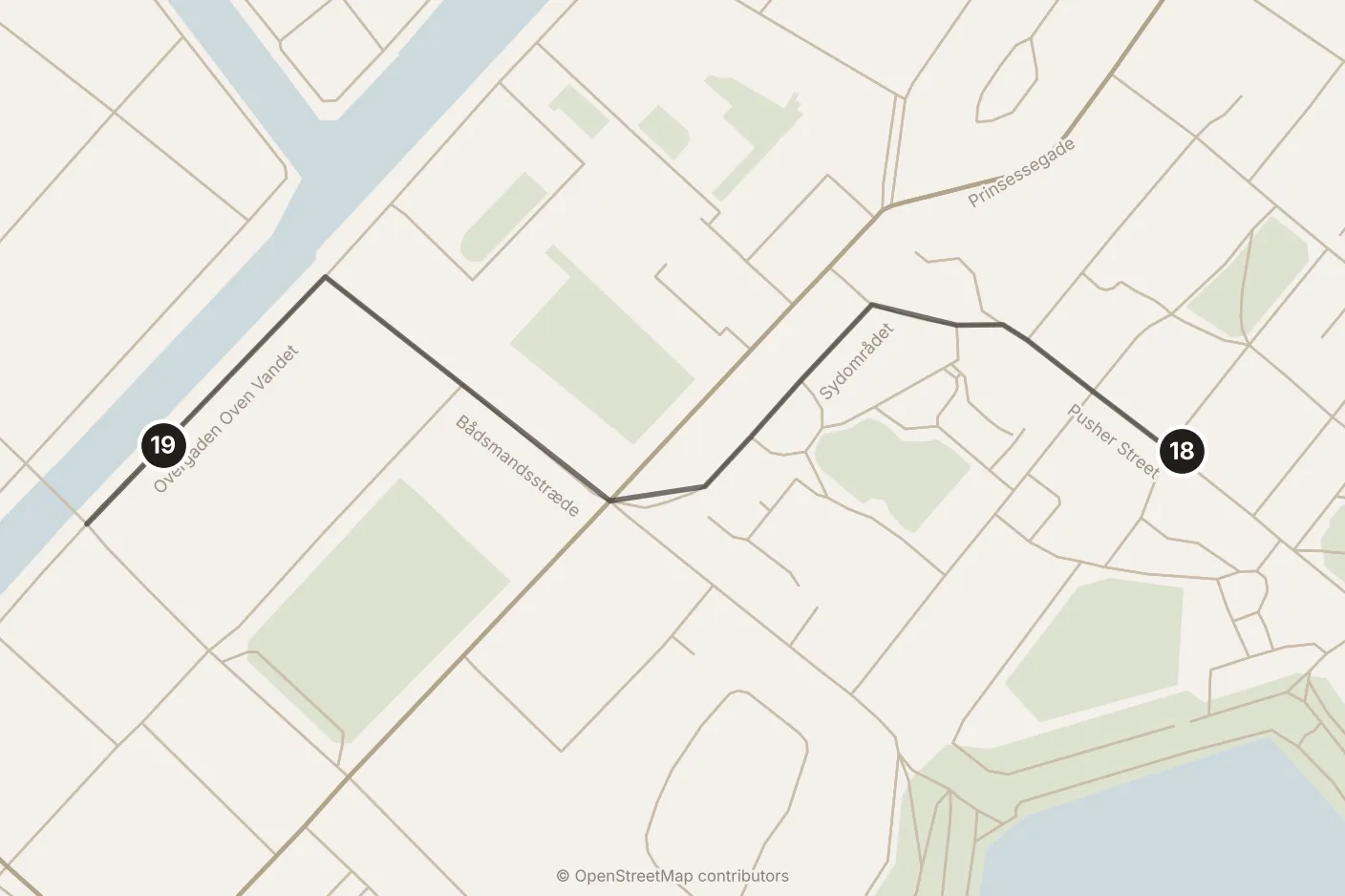
- Evening
- 19Christianshavn
Today starts around Nørreport, in the quarter of royal gardens and museums, and finishes across the harbor in Christianshavn. The metro carries you over the water in the middle, so the day never doubles back.
Morning
Start in the King’s Garden, the oldest royal garden in the city, with Rosenborg Castle at its edge. Nørreport station, on the M1 and M2 metro and most trains, is about five minutes away.
Rosenborg is a small red-brick Renaissance castle built by Christian IV in the early seventeenth century and used as a royal home for about a hundred years after. The rooms are dark and crammed, which is the charm: Christian IV’s own study and the room he died in are there as they were. Two things make it worth the ticket. The Knights’ Hall at the top holds the coronation thrones, one made of narwhal tusk, guarded by three life-sized silver lions. And in the basement treasury are the crown jewels and the regalia, including Christian IV’s own crown. Give it an hour and a half, and go straight down to the treasury first if the house is busy; it is the room with the line.
From the castle, Statens Museum for Kunst, the national gallery, is about seven minutes north, across the road at the far end of the garden quarter. It is an old palatial building joined to a white modern extension by a long glass hall, and you need only three things in it: the Danish Golden Age rooms, with their small, clear early-nineteenth-century paintings of the city and its people; the gray interiors of Hammershøi, which are the reason many people come; and the French twentieth-century rooms, which hold one of the most important Matisse collections outside France. Among the older European paintings, look for the Mantegna. Skip the rest. Give it an hour and a half, or an hour if you take only the Danish rooms and the Matisse.
The national gallery is the stop most likely to be shut a day a week. Check which day before you set out; if it falls on yours, give Rosenborg the extra time and walk the garden before lunch instead.
Afternoon
Walk south-west to Torvehallerne, about fifteen minutes, beside Nørreport station: two glass market halls of fish, meat, cheese and produce, with counters to eat at. Smørrebrød, the open-faced rye sandwich, is the lunch to have here, and an hour is generous.
The Round Tower is nine minutes south-east through the old streets. Christian IV built it in the 1630s and 1640s as an astronomical observatory, and it is still one: the dome at the top holds a working telescope. There are no stairs. A wide brick spiral ramp winds up inside the tower, wide enough that the story says Peter the Great rode a horse up it, and halfway up a door opens onto the old library hall above Trinitatis Church. At the top is a platform with a view over the rooftops of the old town. Three-quarters of an hour is enough, and it is the stop to drop if the day is running late, because it is indoors and the next one is not.
From the tower, walk eight minutes back to Nørreport station and take the M1 or M2 metro two stops to Christianshavn. The Church of Our Saviour is four minutes from the station, and you will see it before you find it: a dark baroque spire with a staircase winding around the outside of it, up to a gilded figure on a globe at the very top. The climb is several hundred steps; the inside part is an old timber tower, and the final stretch is open to the air, narrowing as it goes. Give it forty-five minutes including the descent. It is the most exposed climb in the city and it is not one to do in rain or strong wind; check that the tower is open that day before you build the afternoon around it.
This is the stop the day is built around, so count back from it. Rosenborg, the gallery, lunch and the Round Tower come to about four and three-quarter hours inside, plus about forty-five minutes of walking and the metro; call it five and a half hours before you are at the foot of the spire, not counting the treasury line at Rosenborg or the line at the tower door, which in summer is the longer of the two. In June that leaves you any morning start you like. In December, with dark before four, you would need to start by nine and the doors will not let you; so in winter drop the Round Tower and give the gallery only its hour, and the climb comes back into daylight.
Christiania is six minutes on from the church: the self-governing commune set up in a former military area in 1971, a patch of workshops, painted wooden houses and lakeside paths that has been negotiating its relationship with the state ever since. Pusher Street, for decades an open cannabis market, began to be dug up by residents and the authorities in 2024 after deadly shootings; residents have long asked visitors not to photograph people or run there, so read the signs at the entrance and follow them. Walk through to the lakes at the back, which is the part most visitors miss, and allow an hour.
Evening
Stay in Christianshavn. Its canals, lined with houseboats and old warehouses, are the quietest waterside in the center after dark, and the streets around the metro station are where to eat. The M1 and M2 run from Christianshavn back to Kongens Nytorv and Nørreport in a few minutes.
With a third day

The third day leaves the city: the coast line runs north from København H along the Øresund, and two of the best things in the region are on it. Take the train to the end of the line first and work back.
The coast line, Kystbanen, takes about forty to forty-five minutes from København H to Helsingør station, with trains several times an hour. The station sits on the harbor, and Kronborg Castle is about fifteen minutes on foot along the water. It is the Renaissance castle that controlled the narrow strait between Denmark and Sweden and collected a toll from every ship passing through it for four centuries; it is also the Elsinore of Hamlet, and actors still play the play in its courtyard; it is on the UNESCO list as one of the finest Renaissance castles in northern Europe. The state rooms are large and fairly bare. The reason to go is the casemates underneath, a warren of dark, damp vaults where soldiers were kept, with the sleeping figure of Holger Danske, the legendary hero who is supposed to wake when Denmark is in danger. Give the castle two hours, give your eyes a minute to adjust in the dim casemates, and walk the outer ramparts for the view across the water to Helsingborg in Sweden, close enough to see the buildings.
The castle keeps the shorter hours of the two stops today, which is why it goes first; both publish their hours themselves, so read them the day before, and if the castle’s day turns out to be shorter than you expected, the order still holds and only the time at Louisiana grows.
From Helsingør station, the same line runs back south about ten minutes to Humlebæk station, and the Louisiana Museum of Modern Art is about fifteen minutes on foot from there. Founded in 1958 in a nineteenth-century villa, it grew into a set of low, glass-sided galleries stepping down a park to the edge of the sound, and the building and the setting are as much the visit as the art. The permanent collection is strong on postwar work, with a room of Giacometti figures looking out at the trees, and the sculpture park slopes down to the water with pieces by Henry Moore and Calder against the view of Sweden. The temporary exhibitions change several times a year and are usually the largest part of the building; see the one that is on, then the Giacometti room, then the park. Give it three hours, and leave enough light to walk the park at the end.
Louisiana is the stop most likely to close a day a week; check which before you choose the day for this trip, and if it falls on yours, give Kronborg the full afternoon and walk Helsingør’s old streets between the castle and the station instead. The train back from Humlebæk station to København H takes about thirty-five minutes.
If you would rather not leave the city, the alternative third day is south of the palace island: the National Museum, a few minutes’ walk from Christiansborg, for Danish prehistory, and the sculpture and glass winter garden of the Glyptotek beside Tivoli. Both are within ten minutes of København H, so the day starts and ends where day one did.
Practicalities
Nothing on these days must be booked weeks ahead. The only ticket worth buying online is Rosenborg’s in summer, where the treasury line is the reason; the canal boat at Nyhavn and the Tivoli entrance are walk-up, with lines on summer weekends.
Three stops can break a day as written if your date lands on their closed day or bad weather: the national gallery on day two, the Church of Our Saviour’s tower on day two, which is weather-dependent as well, and Louisiana on the third day. Days one and two may trade places freely; what cannot move is the order within each day, because both run in one direction and both end where the next leg leaves from.
The three rides in these days are the M3 metro from Østerport to København H on day one, the M1 or M2 from Nørreport to Christianshavn on day two, and the coast line, Kystbanen, between København H, Helsingør and Humlebæk on the third day. Everything else is walking, and the longest single stretch is the twenty-minute walk from København H to the palace island on day one. The city guide covers the city tickets and zones. Helsingør and Humlebæk lie beyond the central zones: a City Pass Small does not reach them (the City Pass Large and the Copenhagen Card do), so otherwise buy a ticket for the whole journey at the machine or in the app, which picks the zones from your destination.


