Copenhagen in one day: a walking loop from the station and back

Last updated 17 October 2026
Overview
Copenhagen is flat, compact and built for walking, and one day here is a loop rather than a line: it starts at Copenhagen Central Station, which the departure boards call København H, and it ends across the road from it. Nothing on this route needs a train, a bus or the metro once you are in the city. The longest single stretch is the walk down Strøget in the morning, about twenty minutes if you did not stop, and you will stop.
What one day costs you is the harbor beyond the center and the museums. The city has excellent ones, and with a single day they are the first thing to give up: the hour indoors at a collection is the hour that buys you Nyhavn, a royal square at the moment something happens in it, and a proper sit-down lunch. The one interior this day keeps is Rosenborg Castle, because what it holds cannot be seen anywhere else.
The day has one fixed point, and it is not the light. The guard at Amalienborg changes at noon, every day, as it did in 2026, and the morning is built backwards from that. The evening has a softer one: Tivoli Gardens is at its best once its lamps are lit, and the sun here sets from about twenty to four in December to just before ten at the end of June. So on a winter day you walk into Tivoli in the dark without trying, and in midsummer the lights come on long after anyone with a train to catch would want to be there. Take the evening as it falls in your month.
If you are between trains, this route was drawn for you. The station has left-luggage lockers in the main hall, toward the side exit for the metro, and the day ends at the gate of Tivoli, a couple of minutes’ walk from where you left the bag.
The day

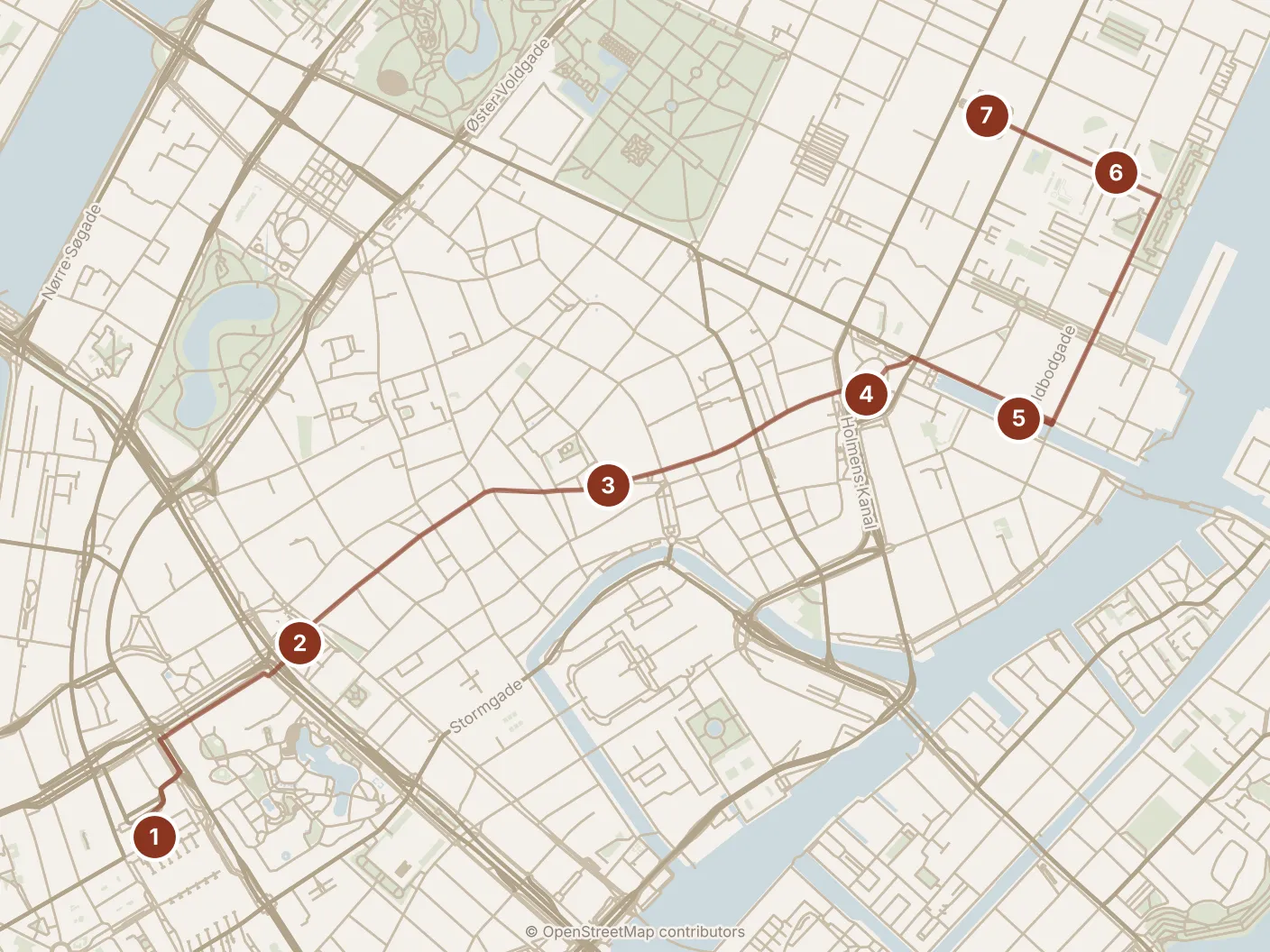
- Morning
- 1Copenhagen Central Station
- 2City Hall Square
- 3Strøget
- 4Kongens Nytorv
- 5Nyhavn
- 6Amalienborg
- 7Marble Church
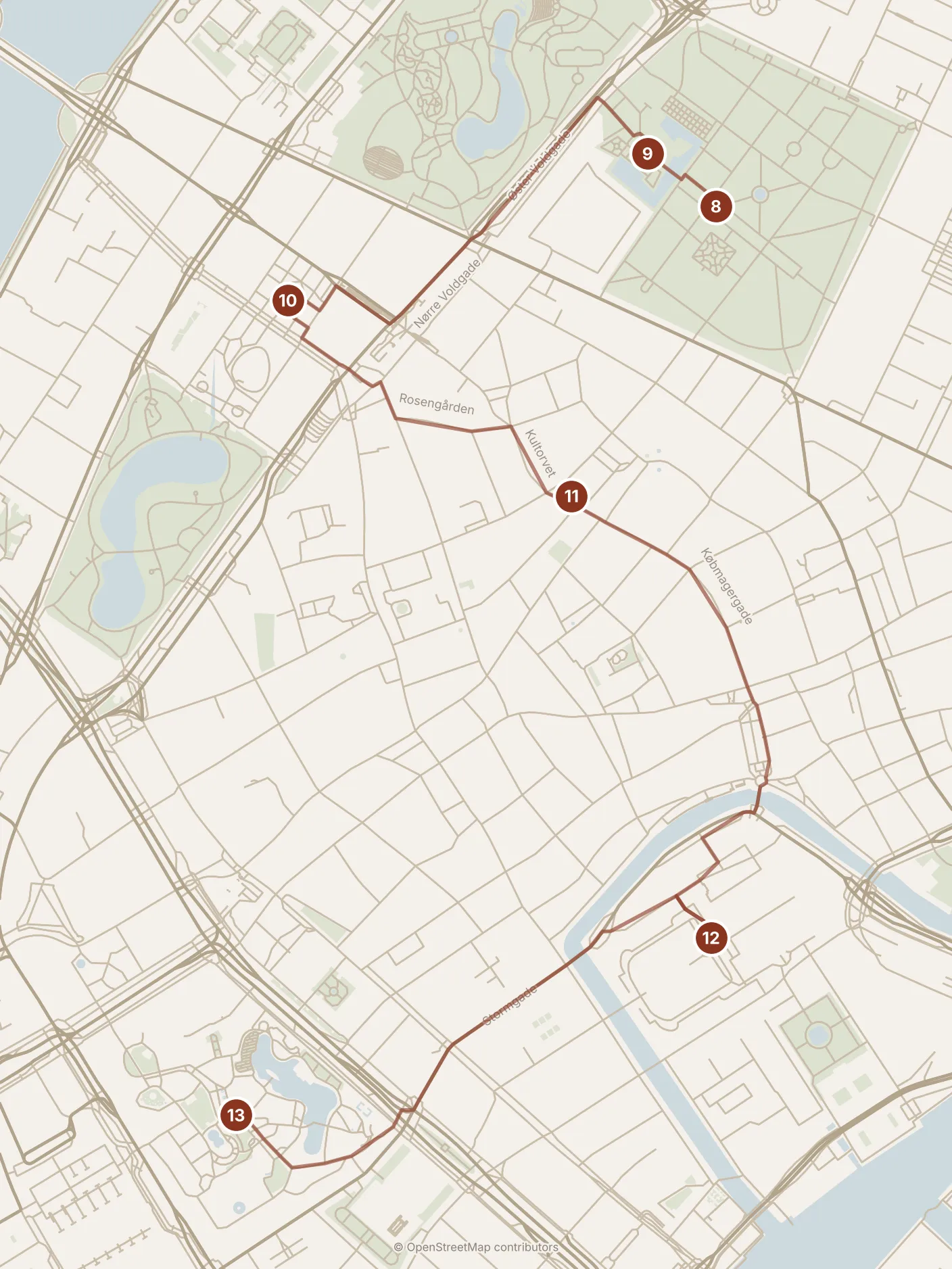
- Afternoon and evening
- 8King's Garden
- 9Rosenborg Castle
- 10Torvehallerne
- 11Round Tower
- 12Christiansborg Palace
- 13Tivoli Gardens
Morning
Leave the station by its main hall and cross the road toward the brick tower of City Hall, under ten minutes on foot. City Hall Square is the hinge of the old center: behind you is the station and the gate of Tivoli, where the day will end; ahead of you, leading off the far side of the square, is the pedestrian street the morning follows. Give the square ten minutes, no more. The building is worth a look from outside; with one day, do not go in.
Strøget is not one street but a chain of pedestrian streets and small squares running east from City Hall Square to Kongens Nytorv, a little over a kilometer of shops, churches and street performers. It is the busiest walk in the city and you should treat it as a way of getting somewhere rather than a destination: walking it end to end is about twenty minutes, and with a pastry on the way and a look into the side streets, give it forty. This is also where breakfast or a second breakfast goes, because lunch on this route comes late. A wienerbrød from a bakery on the way is the right thing to be carrying.
Strøget opens out into Kongens Nytorv, the largest square in the old city, and from its corner it is five minutes on to Nyhavn. This is the picture everyone has of Copenhagen: a seventeenth- century canal dug in from the harbor, lined on both banks with painted townhouses and old wooden ships moored along the quays. Hans Christian Andersen lived in three of its houses over the years. Give it half an hour to walk one bank out to the harbor end and back along the other, and do not eat here: the terraces are priced for the view.
From the harbor end of Nyhavn, Amalienborg is about ten minutes north along the waterfront. This is the stop the morning is built around, so work backwards from it. The guard changes at noon; before that, Nyhavn takes half an hour, Strøget forty minutes, City Hall Square ten, and the three walks between them about twenty-five. That comes to a little over an hour and three quarters, so leave the station at ten and you reach the square with a quarter of an hour in hand to find a place at the edge. If you arrive later than that, cut Strøget to a straight walk and Nyhavn to a glance from the bridge at its head; the guard does not wait. On a summer morning Strøget’s crowds slow you down, and that count does not include them.
Amalienborg itself is four identical eighteenth-century palaces around an octagonal square, with an equestrian statue of Frederik V in the middle; the royal family still lives here. The Royal Life Guards march to it through the streets from their barracks beside Rosenborg, the castle this afternoon visits, and the change itself takes place on the square. When the flag flies over the palace, the monarch is in residence and the guard comes with its band; on other days the ceremony is smaller. Stand back from the sentries’ paths and do what the guards tell you: they move fast and will tell you to step aside. One of the four palaces is a museum, and with one day it is the one to skip.
Turn away from the harbor and the Marble Church fills the end of the street, three minutes’ walk, on the same axis as the palaces and, behind you across the water, the Opera House. Its official name is Frederik’s Church, but the city calls it the Marble Church: a great green dome on a round body, and the interior is free to walk into: give it twenty minutes. The climb into the dome is guided at set times and costs the better part of an hour; skip it.
Local tip. The Little Mermaid is a little over a kilometer further north along the waterfront, and most people who walk out to see her walk straight back. With one day, spend that half hour on Rosenborg instead; the statue is small and the detour leaves you farther from everything else on this route.
Afternoon
From the Marble Church it is about fifteen minutes west across the old royal quarter to the King’s Garden, the park Christian IV laid out around his summer house in the early seventeenth century. Come in through its gates and walk the paths toward the castle; the garden is free, and on a fine day it is full of people eating lunch on the grass.
Rosenborg Castle is that summer house: small, red-brick and turreted, built for Christian IV and kept much as the kings left it. It holds the crown jewels, and that is the reason to go in. Give it an hour and spend it unevenly: follow the signs down to the treasury below ground for the crowns, the regalia and the jewels, then up to the long hall at the top of the house, where the coronation throne made of narwhal tusk stands guarded by three life-sized silver lions. The rooms between are paneled, painted and crowded with furniture, and you can walk them briskly without losing anything the day needs. Rosenborg is the one ticket on this route worth having before you arrive; see Practicalities.
Leave the garden by the west side, and Torvehallerne is ten minutes’ walk, beside Nørreport station: two glass market halls of stalls selling fish, cheese, coffee and food to eat on the spot. This is lunch, and by now it is a late one, which is the price of the noon guard. Sit down for smørrebrød, the open sandwiches on dark rye that are the Danish lunch, and give it three quarters of an hour.
From the market it is about eight minutes south-east to the Round Tower, which the city calls Rundetårn. Christian IV built it in the seventeenth century as an observatory, and instead of stairs it has a wide spiral ramp, built so that you walk rather than climb most of the way up. At the top is an open platform over the roofs and spires of the old town. Give it forty minutes; the hall halfway up holds changing exhibitions and is a short look, not a stop.
From the tower, walk south about twelve minutes to Christiansborg Palace on its island in the canals. It holds the parliament, the prime minister’s office and the supreme court, and it is the third Christiansborg on the site; under it are the excavated foundations of the castle Bishop Absalon built in the twelfth century. Beside it stands Børsen, the old stock exchange, gutted by fire in April 2024 and under reconstruction since. The palace tower is free to go up and gives the highest view in the old center, by lift, after a security check at the door. Give it three quarters of an hour, and know that the line for that check is the one thing the afternoon’s count does not include. If the tower is shut when you arrive, the Round Tower has already given you the roofs, and the courtyard and the canal bridges are free and open.
Evening
From Christiansborg, walk west across the canal and back past City Hall Square to the gate of Tivoli Gardens, about fifteen minutes. Tivoli opened in 1843 and is a pleasure garden as much as an amusement park: a lake, flower beds, concert stages, pavilions strung with lamps, and a wooden roller coaster from 1914 that still carries a brakeman on every train. Entry and rides are paid separately, and you need no ride to make the visit worth it; give it as long as you have left, and eat here or in the streets around the station. Counting from a ten o’clock start, this route reaches the gate at about half past five, which in winter is already dark and in summer is hours from it.
Tivoli opens in seasons rather than all year: a long summer season, a Halloween one in the autumn and a Christmas one into the turn of the year, and it is shut between them, longest in the first months of the year. Its own calendar says which dates. If it is closed on your day, eat in the streets around the station instead; on a Thursday, when the Ny Carlsberg Glyptotek across the boulevard stays open into the evening, its glass-domed winter garden of palms is a fine place to sit out the last hour, but on other days it closes at five.
Either way, you end where you started. The station’s main hall is a couple of minutes from the Tivoli gate, the lockers are inside it, and that couple of minutes is all the margin your last train needs.
Practicalities
The one thing worth booking is Rosenborg Castle. It sells timed tickets online and at the door, and in summer the line at the door is the reason to buy online a few days ahead; outside summer the door is usually fine. An adult ticket cost about 140 to 150 kroner when this was written, and under-18s go free. Rosenborg keeps a shorter week in the quiet months, so check its own calendar for your date before you set out. If it is shut, the King’s Garden around it is free and open, and the hour moves to the Round Tower and a slower lunch.
The whole route is on foot, and there is nothing to ride after the train that brings you in. If you are coming from the airport, the metro and the regional trains both reach the center; the regional train stops at Copenhagen Central Station itself. Tickets are a Rejsekort card or a single ticket from the machines or the DOT Tickets app, and the city guide explains the rest. If you need to leave early from the middle of the afternoon, Nørreport station is beside Torvehallerne, and the S-train from there to København H is two stops, via Vesterport.
If you are short of time, cut from the end of the afternoon. Christiansborg goes first: its view duplicates the Round Tower’s and its line is unpredictable. Then the Round Tower. Keep Rosenborg and lunch, because they are the reason the afternoon exists. If you have only the morning, walk it as written to the noon guard and the Marble Church, and walk back down to the station, about half an hour.
If it rains, the morning still works, because Strøget and Nyhavn are a walk either way. Drop Christiansborg and the Round Tower, give Rosenborg its full hour, and from Torvehallerne walk south to the Ny Carlsberg Glyptotek, about twenty minutes past City Hall Square, for the rest of the afternoon under its glass. Tivoli is across the boulevard when you come out, and the station beyond it.
The bag rules out more of this day than it looks: a case on Strøget’s crowds, up the ramp of the Round Tower and through the rooms of Rosenborg is the day spent managing the case. Leave it in the station lockers when you arrive. The route never asks you to come back for it until the end, and the end is a couple of minutes away.


