Colmar in two to three days: the old town on foot, Petite Venise at dusk, and a day on the wine route

Last updated 18 October 2026
Overview
Colmar’s old town is small enough to cross in fifteen minutes, which makes two days here a question of order rather than of reach. Day one is the northern half of the center and the reason most people come: the Isenheim Altarpiece in the Unterlinden Museum, then the churches and painted houses a few minutes south of it. Day two is the water: the old customs house, the tanners’ quarter, the covered market and the canals of the Krutenau in the morning, and Petite Venise at the end of the day, when the visitors who arrived by coach have gone. A third day leaves the town by train for Turckheim, a walled wine village ten minutes up the line, and the vineyards above it.
Everything on the first two days is on foot, and nothing needs booking. The one thing the route asks of you is about the clock rather than tickets: the old town fills with day-trippers from late morning to late afternoon, most of all in summer and through the Christmas markets, so both days put their crowded stops early or late and leave the middle for lunch and for the places the coach groups pass by.
The evening of day two is built around the light. The sun sets here from just before twenty to five in early December to about twenty-five to ten at the end of June, so take your month’s hour and use the count given in day two. In winter that puts Petite Venise before dinner, at dusk, with the quays lighting up; in June it comes after dinner.
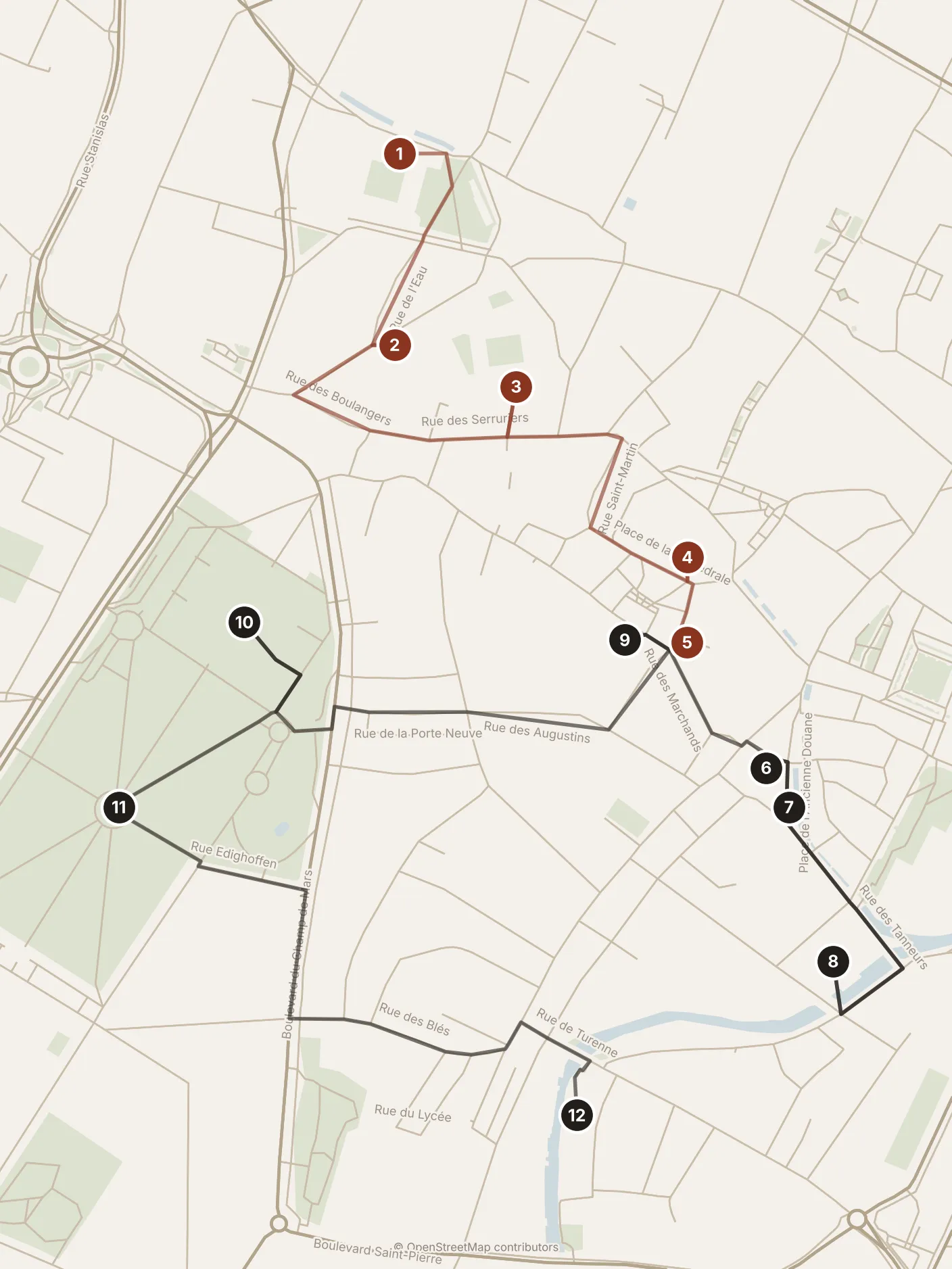
- Day one
- 1Unterlinden Museum
- 2Maison des Têtes
- 3Église des Dominicains
- 4Collégiale Saint-Martin
- 5Maison Pfister
- Day two
- 6Koïfhus
- 7Quartier des Tanneurs
- 8Marché Couvert
- Krutenau — in the prose, not on the map
- 9Bartholdi Museum
- 10Place Rapp
- 11Parc du Champ de Mars
- Pont Saint-Pierre — in the prose, not on the map
- 12Petite Venise
Day one

Today stays inside a few hundred meters of the Unterlinden Museum, and it starts at the museum because the altarpiece is the one thing in Colmar worth arriving early for.
Morning
If you come in by train, you arrive at the Gare de Colmar, the big station on the southwest edge of town. The old town is northeast of it: walk up Avenue de la République past the long green of the Champ de Mars and on to the museum, about twenty minutes on foot. If you are carrying a bag, drop it at your room first; nothing on this route is good with one, and the museum is not the place to find out.
The Unterlinden Museum is a convent of Dominican nuns founded in the thirteenth century, and you come into it through the cloister. The altarpiece is in the convent chapel. It was painted by Matthias Grünewald, with carved figures by Nikolaus of Haguenau, for the Antonite monastery at Isenheim, south of here, whose monks nursed the sick with a disease that poisoned and blackened the limbs. That is why the Christ of the Crucifixion is like no other you will have seen: green with decay, the body covered in sores, the hands clawed open. The altarpiece was made to be opened in stages, so you would only ever have seen one view at a time; here the panels stand separated so you see them all at once, and the second view, with its glowing Resurrection, is the reason to walk around to the far side of the chapel rather than stop at the Crucifixion. The third is the carved shrine of Saint Anthony with the painted panels of his temptations beside it.
Give the chapel an hour and the rest of the old building another hour: the cloister and the late medieval painting and sculpture of the Rhine country around it. The museum also has a modern wing across the square, by Herzog & de Meuron, reached by an underground passage. It is the part to skip if the morning is running short; it is the part to add if it rains in the afternoon.
This is a day with no deadline set by the light. Its hinge is the start: be at the museum when it opens, which it publishes itself, because the chapel is quiet for the first hour and full by late morning.
Afternoon
Have lunch near the museum. This is the meal for tarte flambée: it is quick, it is shared, and it leaves the afternoon free.
Then two minutes south to the Maison des Têtes, on the street of the same name, a 1609 house whose facade is covered in carved heads and masks, more than a hundred of them, grimacing out at the street. It is a building to look at from outside; give it ten minutes and the camera.
Five minutes further, the Église des Dominicains, the Dominican church, is a tall, bare Gothic hall whose glass is medieval and whose single picture is the reason to go in: Martin Schongauer’s Madonna of the Rose Bower, painted in 1473 and set in front of the choir, the Virgin on a lawn inside a trellis of roses alive with birds. There is a small entry charge. Give it half an hour. The church keeps seasonal hours of its own, which the town’s tourist office publishes; if it is shut in your month, the altarpiece has already given you the century, and the half hour goes to Saint-Martin.
From there it is three minutes south to the Collégiale Saint-Martin, the big Gothic church of the town, built of red Vosges sandstone with a roof of glazed colored tiles. Everyone calls it the cathedral, though it is not one. It is a working church: walk around it during a service rather than through it. Twenty minutes inside is enough.
Then down to the corner of Rue des Marchands and Rue Mercière, two minutes away, for the Maison Pfister: built in 1537, painted all over, with a wooden gallery running around its upper floor. It is the most photographed house in the town and it deserves it. The day’s walking adds up to under two kilometers, including the walk from the station.
Local tip. If the morning ran long, cut the Dominican church before anything else this afternoon: the altarpiece and Schongauer are the same century seen twice, and the houses and Saint-Martin are what you cannot see anywhere else.
Evening
Stay in the streets around Saint-Martin. By early evening Rue des Marchands has emptied, and the painted houses you shared with a crowd at three o’clock are yours. Eat in a winstub, the Alsatian wine tavern, and order the choucroute garnie, or the baeckeoffe if you asked for it when booking, with a glass of Riesling or Pinot Gris. Kitchens close earlier than in a big city, so do not walk around for long first.
Day two

Today runs south and east from the old customs house to the water, and its hinge is at both ends: the canals are at their best before the coaches arrive and after they leave.
Morning
Start at the Koïfhus, the old customs house, built in 1480 and the oldest public building in the town, with the same glazed tiles on its roof as Saint-Martin. Colmar was one of the ten free towns of the Decapolis; the upper floor of this building was the town’s meeting hall. In the square beside it, the fountain with the statue of Lazarus von Schwendi is by Frédéric Auguste Bartholdi, who was born a few streets away and whom the afternoon is about. Ten minutes here is enough.
Two minutes south-east is the Quartier des Tanneurs, the tanners’ quarter: tall, narrow timbered houses with open lofts under their roofs, where the hides were hung to dry, along a little arm of the Lauch. This is the stretch that fills first, which is why it goes first. Give it twenty minutes of walking slowly.
Then across to the Marché Couvert, the covered market, a nineteenth-century brick and iron hall on the bank of the Lauch, two minutes on. The boats of the market gardeners used to unload straight into it from the water. Today it is the place to see what the region eats in one room: Munster cheese from the valley west of town, kougelhopf, charcuterie, the season’s vegetables. Give it half an hour, and buy breakfast if you have not had one. It does not trade every day of the week, so check that it is open on your morning; if it is not, the morning loses one stop and nothing else.
Out of the market you are on the Quai de la Poissonnerie, the fishmongers’ quay, at the edge of the Krutenau, the old quarter of the market gardeners. The flat-bottomed boats that take visitors along the Lauch leave from landings on these quays, and the morning is the time to take one, before the line forms. The tickets are sold at the landing. Give the ride and the wait together under an hour.
Counted from the start, the morning is about two and a half hours, and every walk in it is a couple of minutes; aim to begin at the Koïfhus early, at the hour your hotel serves breakfast rather than after it.
Afternoon
Lunch in the Krutenau, then walk back up into the old town, about five minutes, to the Bartholdi Museum on Rue des Marchands, in the house where the sculptor was born. Bartholdi designed the Statue of Liberty, and the museum holds the models and drawings that show it changing on its way to New York, along with the rest of a career spent filling his home town with monuments. Give it an hour. Like the Dominican church it keeps hours and closing days of its own; check them before the day, and if it is shut, the afternoon simply starts at the next stop.
From the museum it is about five minutes west to Place Rapp, where the statue of Jean Rapp, the general from Colmar who served Napoleon, was Bartholdi’s first public monument. The Parc du Champ de Mars opens beside it: a long, shaded nineteenth-century park, and the honest use of it is a bench. This afternoon is deliberately short. It is the middle of the day, the canals are at their fullest, and the point is to be somewhere else until they empty.
Evening
This is the stop the day is built around. Petite Venise wants the last half hour of daylight and the first of the lamps, so work backwards from your month’s sunset: from the Parc du Champ de Mars it is about twelve minutes on foot, south-east, to the Pont Saint-Pierre, the bridge from which the canal, the timbered houses and the gardens along the water line up as they do in so many photographs. Leave the park three quarters of an hour before sunset and you are on the bridge with time to spare. In December that is a little before four; in June it is after dinner.
From the bridge, walk the water north toward Rue de Turenne and back into the Krutenau, where you were this morning, now quiet. Give it an hour. The waterside terraces are priced for the day’s crowd; eat a street or two back from them.
With a third day

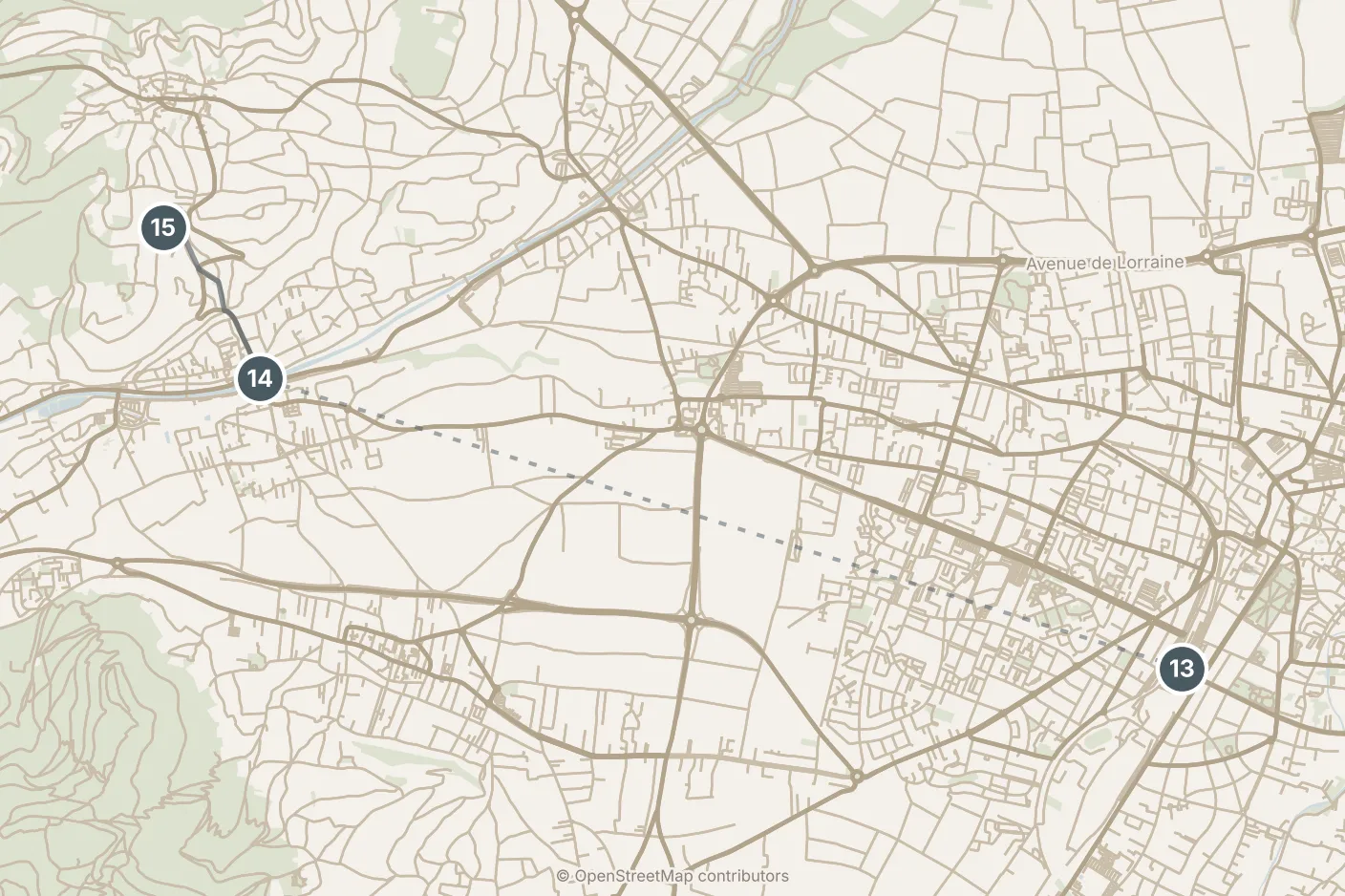
- With a third day
- 13Gare de Colmar
- 14Turckheim
- 15Brand vineyard
The third day leaves the town for the wine route, and it does it by train. From the Gare de Colmar, the regional TER line toward Munster reaches Turckheim in about ten minutes; buy the ticket at the station machines or in the SNCF Connect app before you board. It is the wine village closest to Colmar on the railway, which is why it is this one and not a more famous name.
Turckheim is a walled village on the Fecht, entered through fortified gates a few minutes on foot from its station. Inside are the timbered houses of a place that lived by wine, a small main square, and the family estates whose tasting rooms are the reason to come: tasting is often free or close to it if you buy a bottle, and the custom is to buy one if you have tasted several. Give the village an hour and a half, and taste in the morning rather than after lunch.
Behind the village the slope rises straight into the Brand vineyard, one of the best-known in Alsace, and a path climbs through the vines. Give it an hour up and back. The view is the reason the day exists: the village below, the Colmar plain spread out flat toward the Rhine, and the Vosges behind you. It is a real climb in summer heat, so take water and do it before midday.
Then the train back, and the afternoon is yours. With more appetite for the day, stay on the train up the valley to Munster, the town the cheese is named after, and come back to Colmar from there. With a car instead, the alternative to Turckheim is Eguisheim, a short drive south-west, whose lanes run in rings around the old castle at its center; the vineyard walk goes, and the day keeps its shape. Have a glass of Gewurztraminer or Crémant d’Alsace with dinner either way.
Practicalities
Nothing on these days needs booking ahead outside the Christmas market season, when the town is at its fullest and every stop has a line.
Three stops keep hours of their own and are the ones to check before you set out: the Unterlinden Museum, which closes one weekday, and the Dominican church and the Bartholdi Museum, which also close on some days and through parts of the winter. If the museum’s closing day falls on your day one, swap the two days: day two is streets, water and a market, which mostly do not care, and the Bartholdi Museum, which keeps its own closing days, goes on whichever of the two days it is open. The cost is that day two’s quiet early morning becomes your first impression, which is no hardship. Many shops close on Sundays, which matters only to the covered market.
Days one and two are walked end to end; the longest single stretch is the twenty minutes from the station to the Unterlinden Museum on the first morning. The third day needs only the TER ticket to Turckheim, or to Munster if you go on up the valley; for everything else about the trains, the passes and the buses to the other villages, see the Colmar guide.


