Colmar in one day: the Isenheim Altarpiece, the old town and Petite Venise at dusk

Last updated 18 October 2026
Overview
Colmar is the rare town where one day sees the heart of it properly rather than in a hurry. The old center is small enough to cross on foot in a quarter of an hour, and everything on this route sits inside it: the station at one end, a single walk in and a single walk out, and nothing in between that needs a bus or a ticket machine. What one day costs you is the wine route. Eguisheim, Riquewihr and the other villages are the reason people stay longer, and a day that tries to add one of them to the town ends up doing both badly. Leave them for another trip.
What this day is built around is two things the town does better than anywhere near it. The first is the Isenheim Altarpiece in the Unterlinden Museum, which is the one sight that would justify the journey even if the streets were ordinary. The second is the reverse of a sight: the canal quarters in the hour when the day visitors have gone. Colmar is crowded from late morning to late afternoon, so the shape of the day follows the crowd — indoors with the altarpiece while the coaches arrive, the old town after lunch, and Petite Venise last, when it empties.
That last stop is the one that does not wait, and it is counted from the light. The sun sets in Colmar from just after half past four in early December to just after half past nine at the end of June. Everything before Petite Venise below comes to about six and a half hours, walking included, so take your month’s sunset, subtract an hour for the last of the daylight, and count back six and a half from there: that is when to be walking out of the station. In midwinter the sum says the museum door at opening, and even then you will reach the canals around dusk; in June the sum leaves you the whole morning spare, and the right use of it is not a later start but a longer lunch and the optional stops below. The count models the time you spend inside the places and nothing else — not a line at the museum desk, which in the Christmas market weeks is the largest thing it leaves out.
The bag decides more than it should. This article cannot vouch for a left-luggage service at Colmar station; ask at the station’s ticket office the moment you arrive, because the answer changes the day. If there is nowhere to leave a case, the morning is the part it rules out: a museum may refuse a large bag at its cloakroom, so ask at the desk before you buy, and the old town after it is cobbles and narrow lanes, fine with a backpack and tiresome with wheels. Without a place for the bag, a reader between trains should do the museum only if the desk takes the case, then walk the old town in the order below and cut the Krutenau, which is the furthest point from the station and the one stop that adds distance rather than replacing it.
The day

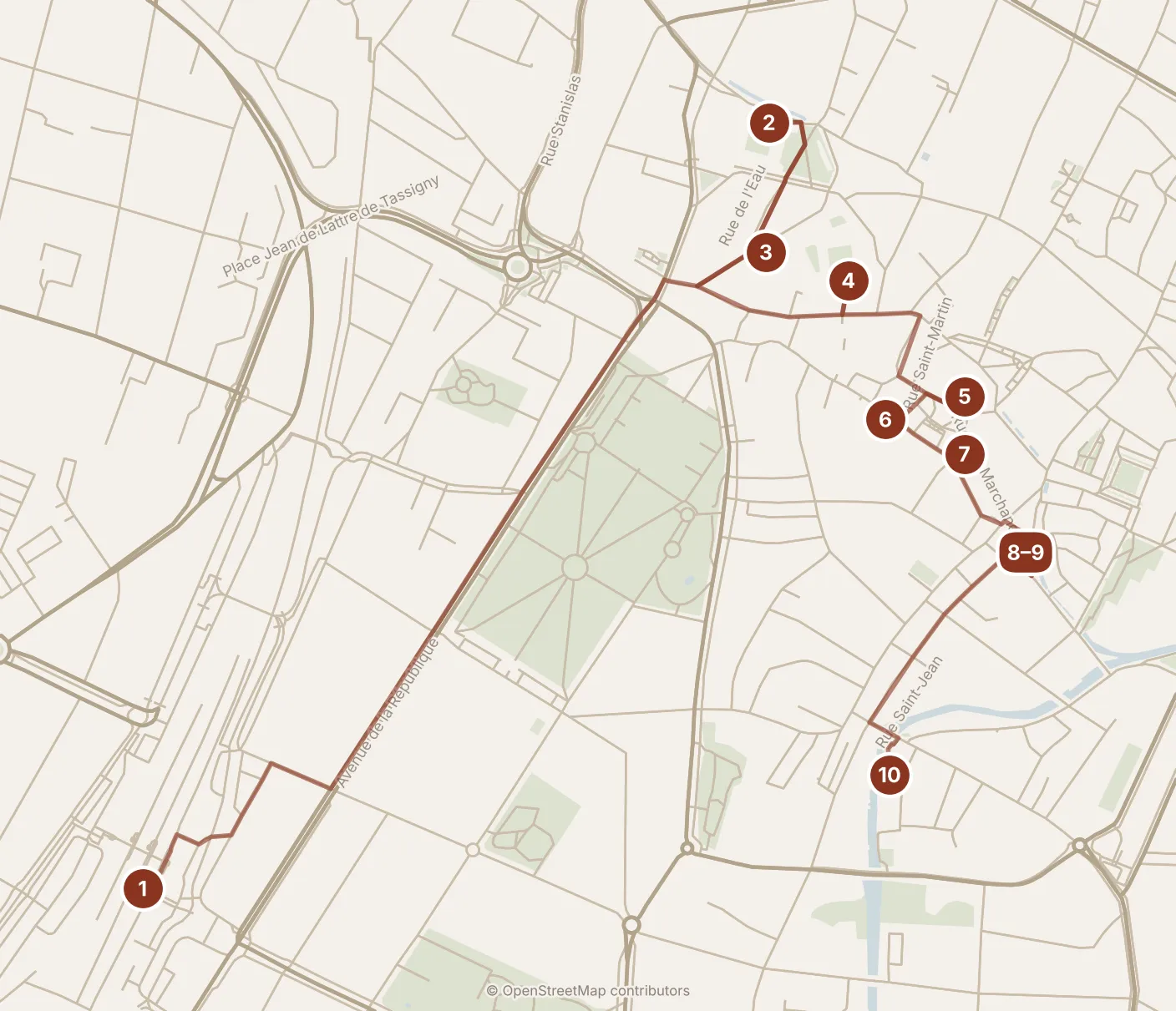
- The day
- 1Colmar station
- 2Unterlinden Museum
- 3Maison des Têtes
- 4Dominican church
- 5Collégiale Saint-Martin
- 6Rue des Marchands
- 7Maison Pfister
- 8Koïfhus
- 9Quartier des Tanneurs
- Krutenau — in the prose, not on the map
- 10Petite Venise
Morning
Arrive at Colmar station, which sits to the southwest of the old town, and walk northeast to the Unterlinden Museum. It is about a kilometer in a straight line and nearer twenty minutes on the streets; the town’s buses, the Trace network, are no faster over that distance, and from here to the end of the day there is nothing you need to ride. The walk takes you through the nineteenth-century town first, which is plain, and the change into the old center is abrupt.
The museum is a thirteenth-century convent of nuns, with a cloister you walk around before anything else, and a modern wing added in 2015 across the square, reached by a gallery underneath it. Go to the convent chapel first and spend the first hour there. It holds the Isenheim Altarpiece, its shrine carved by Nikolaus of Haguenau around 1500 and its panels painted by Matthias Grünewald in the 1510s, for a hospital whose monks nursed the victims of a disease that rotted the skin. That is why the Crucifixion looks the way it does: the body of Christ is green-gray and covered in sores, the hands are clawed, and it was painted to be looked at by patients who had the same marks. The altarpiece was built to fold, so it showed different faces on different days; the panels are now displayed apart, so you can see every view at once, from the Crucifixion through the Resurrection — a figure rising in a burst of colored light, which is the strangest painting in the room — to the carved shrine at the center with Saint Anthony enthroned.
Give the altarpiece an hour and the rest of the convent the second one: the cloister, the old masters around it, and the rooms of Alsatian life upstairs. Skip the modern wing if the morning is short; it is a good building, but it is the part of the visit that has nothing to do with the reason you came.
Local tip. If you have to choose inside the museum, choose the chapel and the cloister and leave the rest. The altarpiece is the hour that cannot be had anywhere else; everything after it is the museum of a good provincial town.
Two minutes away, in the street behind the museum, the Maison des Têtes is a facade and nothing more: a merchant’s house of 1609 whose front is covered in about a hundred carved heads and masks, grimacing, laughing and pulling faces. Five minutes in front of it is the right amount.
From there it is four or five minutes southeast to the Dominican church, a tall, bare Gothic building with fourteenth-century glass and one painting that matters: Martin Schongauer’s Madonna of the Rose Bower, painted in Colmar in 1473, the Virgin in red against a gold ground and a trellis full of birds. It has a small entry charge of its own and keeps a season, so it is the stop on this route most likely to be shut in winter; if it is, the morning simply ends at the Maison des Têtes, and nothing after it moves. Give it half an hour.
Afternoon
The Collégiale Saint-Martin is four minutes south, the big sandstone church at the heart of the old town, usually called the cathedral though it is not one. Look at the roof as you cross the square to it, patterned in glazed colored tiles, then give the inside twenty minutes; it is a working church, so on a Sunday morning the visit waits for the service to finish.
Lunch goes here, in the lanes around the church, and it should be a sit-down one in a winstub, the traditional wine tavern, for an hour and a quarter. A tarte flambée is the quick, cheap choice and choucroute garnie the one that settles the afternoon. Book nothing; eat at noon rather than one, because kitchens here close earlier than a reader from a big city expects, and in the busy months the noon crowd is what decides whether you sit down at all.
From the church, Rue des Marchands runs south, and the corner where it meets the next street down is the Maison Pfister of 1537: painted panels, a wooden gallery along the upper floor and a corner turret, the most photographed house in town. The street itself is the old merchants’ spine, half-timbered all the way, and the birthplace of Bartholdi, the sculptor of the Statue of Liberty, is a museum a few doors along it. That museum is the first optional stop on this day: take it if the summer sum above has left you hours in hand, and walk past it otherwise.
At the bottom of the street is the Koïfhus, the old customs house of 1480, with another roof of colored glazed tiles and a fountain by Bartholdi in the square in front. It is a civic building rather than a visit; ten minutes is enough. Walk east out of its square and in two minutes you are in the Quartier des Tanneurs, the tanners’ quarter, where the houses are tall and narrow and their top floors open, because that is where hides were hung to dry. Thirty minutes covers the Koïfhus and the tanners together, unhurried.
Evening
Cross the Lauch into the Krutenau, two or three minutes south. This was the quarter of the market gardeners, who brought their produce in by boat to the nineteenth-century covered market beside the fishmongers’ quay; it is still a working food hall, worth twenty minutes for the stalls and the cheese of the Munster valley, if it is still open when you get there; in summer it will usually have closed by this hour. If it is shut, nothing breaks; walk the fishmongers’ quay instead and go on.
Then follow the river south into Petite Venise. This is the stop the day was counted toward, and the reason it comes last is the crowd as much as the light: from late morning to late afternoon these few hundred meters of canal, flowers and painted houses are the most crowded place in Colmar, and by the last hour of daylight the coach parties have gone. Walk it slowly from bridge to bridge. The bridges are where the views are; the quays are where the terraces are, priced for the people who have just left. Stay into the dark if you can, when the houses are lit.
If you are catching a train, Colmar station is due west of the southern end of Petite Venise, about a kilometer on the streets: allow seventeen or eighteen minutes on foot, more with a bag, and leave a margin, because it is the only leg of the day with a deadline in it.
Practicalities
Nothing on this day has to be booked. The one paid stop that matters is the Unterlinden Museum, whose ticket is sold at the door and online; the full ticket was in the twelve-to-fifteen-euro range in 2026, and in the Christmas market weeks, and on any weekend from June to August, buying online is the way to skip the line at the desk that the count above does not include. The museum opened at nine in 2026, which is the hour a midwinter day is built back from; if it has moved, build the morning back from the new one.
The day as written has one closure that would break it. The Unterlinden Museum is shut one day a week — Tuesday in 2026 — and publishes its own hours and closing days; read them the week before. If your day falls on that one, the morning becomes the old town in the order above, done slowly while it is still empty, and the afternoon goes to Turckheim, a walled wine village on the branch line to the Munster valley, under a quarter of an hour by regional train from Colmar station: you leave from where you arrived, walk its single loop of walls and gates in an hour or two, and come back for Petite Venise at the end of the day as planned. The Dominican church keeps a season of its own, as above, and is the one stop the day loses gracefully. On a Sunday the shops are shut and the lanes are quieter for it; the churches and the covered market are the only stops that change.
If you are short of time, the cut goes in this order: the Krutenau first, then Rue des Marchands beyond a look at the Maison Pfister, then the Dominican church. What does not go is the altarpiece — give it its hour even on a four-hour stopover — and the walk back through Petite Venise to the station, which is on the way.
Every leg of this route is walked. The two longest are the ones at the ends, about twenty minutes from the station to the museum and the same from Petite Venise back; between them, no stretch is more than five minutes. The town’s buses and the regional trains are covered in the parent city guide, along with how to reach Colmar from Strasbourg, Basel and the airports.


