Chicago in two or three days: the Loop's lobbies, the river by boat, and a third day on the lake

Last updated 8 August 2026
Overview
Two days is the length at which Chicago stops being a skyline and starts being a set of rooms. The Loop — the rectangle of downtown inside the elevated railway that gives it its name — is about a mile across, and the buildings in it that decided what a tall building would look like are still standing, still working, and still open at the bottom. A shorter visit sees them from the sidewalk. Two days gets you inside the light courts and the corridors, and then out onto the water, which is the only place from which the whole argument reads in order.
So day one is the Loop on foot and the Art Institute given a proper afternoon rather than a squeezed one; day two is the river by boat and the mile of Michigan Avenue north of it, ending four hundred meters above the street. Neither day is long on distance. Day one walks about four kilometers in total and day two under two, because on day two the ninety minutes that matter most are spent sitting down on a boat.
One decision comes before everything else, and it is which weekday day one lands on. Three of its five morning stops are lobbies inside working office buildings, open because the offices are, and the museum that fills its afternoon was shut on Tuesdays in 2026. That makes day one a Monday, Wednesday, Thursday or Friday, and it makes a Saturday-and-Sunday city break the one shape this route cannot serve as written. Day two takes any day of the week. The full rules, and the fix for a weekend, are set out at the end of this article.
Day two is the day with a deadline in it. Its last stop is an observation deck, and what an observation deck is for is the half hour on either side of sunset, when the grid comes on below and the lake stays black. Chicago’s sunset moves further across the year than most visitors expect: twenty past four in the first week of December, half past eight at the solstice, a swing of more than four hours. Take your own month’s hour. Everything on day two below the tower comes to about five hours, walking, the meal and the boat included, so subtract five from your month’s sunset and that is when to start. In December there is no boat and the hour on the Riverwalk stands in for its two, so the day is four hours rather than five: from a sunset at twenty past four that puts you at the first stop at about twenty past twelve, which is the neatest the arithmetic ever gets. From April onwards the sum runs out long before the light does, and the fix is not to start in the middle of the afternoon: begin around midday as though it were winter, take the day as written, and go up after dinner. In 2026 the deck was still admitting people at ten at night, which is what makes the summer version work at all; if that hour has moved, the operator publishes it, and nothing else on the day moves with it.
That five hours counts the time inside the places, the meal, and the walking between them, and nothing else. What it leaves out on this route is the bottom of the tower — the ticket check and the elevator line on a clear evening — which belongs in your plan as a separate line rather than folded into the total.
This route needs one thing you cannot walk around, and it is a way to pay a transit fare: there are two rides inside these two days — the circuit of the elevated on day one’s evening and the run back to Union Station at the end of day two — plus whichever train brought you from the airport, and more if you ride out to dinner on day one, add the third day, or take any of the shortcuts at the end of this article. The city guide covers the fare card and how it works. The one number worth knowing before you land is that boarding at O’Hare costs double the standard rail fare, and O’Hare is the only station on the network where that is true — the fare from Midway, and from everywhere else, is the ordinary one.
Finally the bag. Day one begins at Union Station and finishes four blocks from where it started, so wherever you leave the case you are never crossing town for it — but leave it before nine, because the three lobbies are the stops on these days that a suitcase genuinely spoils. You are walking into somebody’s place of work past a staffed desk, and a case turns a two-minute welcome into a conversation. Union Station has a baggage room and it is the railway’s own, run for the railway’s own ticketed passengers; it is not a public left-luggage counter and the morning should not be built on the assumption that it will take your bag. If you are staying in the Loop or just north of it, the room you have booked will hold the case before check-in, and that answer works here — for a visitor with two days and a bed — in a way it does not for someone changing trains.
Day one

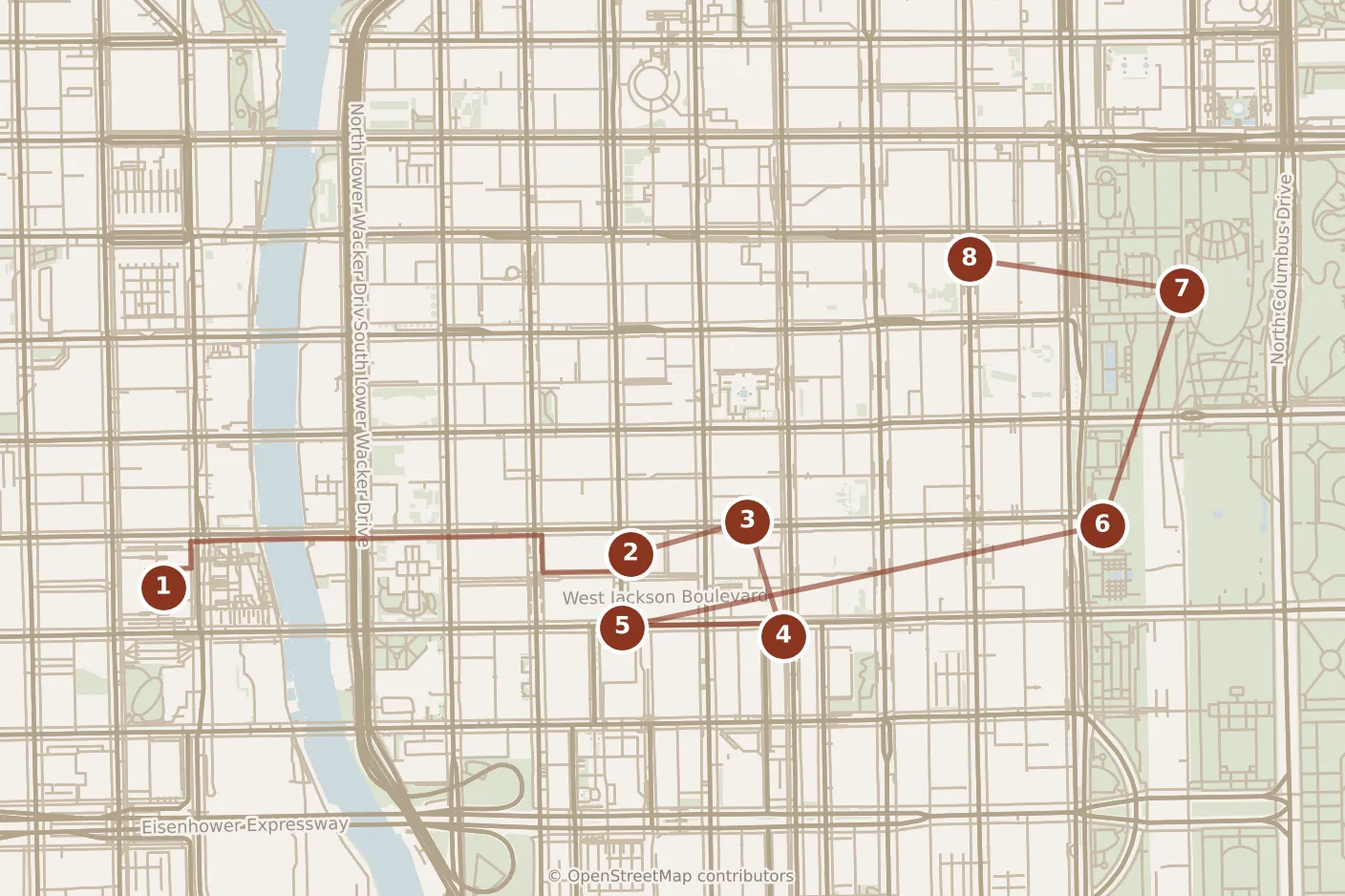
- Day one
- 1Union Station
- 2Rookery Building
- 3Marquette Building
- 4Monadnock Building
- 5Chicago Board of Trade Building
- 6Art Institute of Chicago
- 7Millennium Park
- 8Washington and Wabash station
Everything between the station and the museum sits inside four hundred meters of LaSalle Street and Dearborn Street, and everything after the museum is inside Grant Park. The day works west to east across the Loop and comes back on itself once, for the five minutes west along Jackson Boulevard to the Board of Trade — whose foot you walk past on the way in from the station, and which is taken last because it is the one of the four you look at rather than enter.
This day has no moment that depends on the light; it has two doors instead. The lobbies are open because the offices are, and the Art Institute of Chicago admitted nobody before eleven in 2026. So the morning is bounded at both ends — it cannot start before the working day and it has to be finished by eleven — which leaves just under two hours, and that is almost exactly what the four buildings are worth. Nine o’clock, then. If the museum’s hour has moved, build the morning back from the new one; the four buildings do not care what order you take them in.
From nine, the whole day as written comes to about six and three quarter hours and puts you back on the street at a quarter to four. That total counts the time inside the places, the meal, and the walking between them, and nothing else — not the ticket desk at the museum, and not the fact that the museum is a building of nearly a million square feet where crossing from one wing to another is itself five minutes of the three hours.
Morning
If you arrive by train, you arrive at Union Station on Canal Street, and you will come out of it through the Great Hall — the vaulted waiting room under the skylight, which is still a waiting room and still full of people using it as one. Give it ten minutes and settle the luggage question while you are standing in it. Then east on Jackson Boulevard, over the river, thirteen minutes to the Rookery Building. If you have flown in, skip the station altogether: the Blue Line from O’Hare and the Orange Line from Midway both land you within a few minutes of it — at Jackson, five minutes away, and at Quincy, three. The Great Hall then keeps until the day you leave, because it is thirteen minutes west of the Board of Trade and the morning goes east from there; walking back for it would cost the better part of half an hour on foot.
The Rookery Building, on LaSalle Street, is from 1888, by Daniel Burnham and John Root, and from outside it is a dark fortress of granite and brick. Inside is a two-story light court roofed in glass, and the lobby under it was rebuilt by Frank Lloyd Wright between 1905 and 1907 in white marble with gold tracery — the only work of his in the whole Loop. Do not stop at the marble. Look up and find Root’s oriel staircase, an ornamental double stair that lifts out of the second floor and spirals up the light well on its own, twenty years older than the room it stands in and entirely unlike it. That is the thing a quick look misses. Twenty minutes.
Three minutes east, at the corner of Dearborn Street and Adams Street, the Marquette Building of 1895 by Holabird and Roche has the best free interior in the city and almost nobody in it. Over the entrance are four bronze reliefs by Hermon MacNeil showing the expedition of Jacques Marquette through the lakes, the last of them his burial; the revolving door is framed by carved panther heads. Inside, the balcony rail running round the two-story lobby carries a mosaic frieze by the Tiffany studio, telling the same story in lustred glass, mother-of-pearl and semi-precious stone. It was restored over four years to 2006 by the foundation that owns the building. Fifteen minutes, all of it spent with your head back.
Three minutes south down Dearborn Street, the Monadnock Building is the argument of Chicago architecture standing in a single block, and you can walk through it. The north half, 1891, Burnham and Root again, is a load-bearing brick wall six feet thick at the sidewalk and eighteen inches at the top, which is the economic limit of building that way and the reason nobody did it again. The south half, 1893, by Holabird and Roche, is a steel frame doing the same job with a fraction of the material. One corridor runs the length of both, so you walk out of the end of one era and into the beginning of the next without a door between them. Fifteen minutes.
Five minutes west along Jackson Boulevard is the Chicago Board of Trade Building of 1930, by the same Holabird and Roche practice under its later name, and this one you look at rather than enter. It closes the end of the LaSalle Street canyon — the only street in the Loop with a period at the end of it — and on top of its forty-four stories stands a thirty-one-foot aluminum figure of Ceres by John Storrs, holding wheat, facing down the street at the traders below. It is the best piece of Art Deco in the city and it is free from the sidewalk. Ten minutes, then a quarter of an hour east along Jackson Boulevard and one block north on Michigan Avenue.
Local tip. All four of these are working buildings, not museums, and three of them you go inside. There is a desk in each of those lobbies, the first floor is yours and the elevators are not, and asking at the desk rather than walking past it is the difference between fifteen minutes and none. If the morning slips, the Board of Trade is the stop to drop: it is the only one of the four that is entirely visible from the street, and you walk past its foot anyway.
Afternoon
The Art Institute of Chicago is the second largest art museum in the country and holds about three hundred thousand objects, so the useful skill here is subtraction. Give it three hours and spend them like this. First the Impressionist and post-Impressionist rooms, which are the reason the collection is famous: more than thirty paintings by Monet, six of them from the haystack series, and Georges Seurat’s A Sunday on La Grande Jatte, which is larger than any reproduction prepares you for. Then the American rooms for Edward Hopper’s Nighthawks and Grant Wood’s American Gothic, both smaller in the flesh than anyone expects.
The third hour is the one a shorter visit never has, and the way to spend it is to pick exactly one of the museum’s eccentric collections and ignore the rest. The Thorne Miniature Rooms are sixty-eight interiors built at one inch to the foot, lit from outside their own windows, and they are either the strangest thing in the building or a corridor of dolls’ houses, depending entirely on the person. Marc Chagall’s America Windows are three panels of blue glass made for the museum itself. The arms and armor is a genuine armoury rather than a case of swords. Take one. Skip the Modern Wing altogether — it is effectively a second museum bolted to the side, and if it is what you came for, it replaces the other two rather than following them.
Come out onto Michigan Avenue at about two and eat late; this is an office district and the line has gone by then. A Chicago-style hot dog is the fifteen-minute version and it is dragged through the garden — mustard, relish, onion, tomato, a pickle spear, sport peppers, celery salt, no ketchup, and the last of those is not a joke here. Save the deep-dish pizza for tomorrow evening: it is baked to order and it takes the better part of an hour to arrive.
Seven minutes north is Millennium Park. Cloud Gate is the reason most people come — a hundred and ten tons of stainless steel by Anish Kapoor, welded from a hundred and sixty-eight plates and polished until the seams vanished, with a concave chamber underneath that inverts the whole skyline. Walk under it as well as around it. Behind it, Frank Gehry’s Jay Pritzker Pavilion throws ribbons of brushed steel over a lawn strung with a trellis of loudspeakers, and the Crown Fountain’s two glass towers project the faces of a thousand residents and spit water at the sidewalk every few minutes in the warm months. Then take the thing the crowds walk past: the Lurie Garden, two and a half acres of prairie perennials behind a tall hedge at the southern end of the park, which is the quietest corner of it. Forty-five minutes for those four. Gehry’s serpentine pedestrian bridge over Columbus Drive is worth crossing for the view back at the Loop rather than for anything on the far side, but it is ten minutes there and back on top of the forty-five, and it is the first thing to leave out if the afternoon is tight.
Evening
There is one more thing to do on day one and it costs a single fare. Walk six minutes west to the station at Washington and Wabash and ride the elevated round the Loop. The Brown, Orange and Pink lines all make a complete circuit of the rectangle before they leave it, so take whichever comes first and stay on longer than feels right: you get the four sides — Lake Street, Wabash Avenue, Van Buren Street, Wells Street — at third-floor height, passing office windows and fire escapes and the backs of buildings nobody photographs. Get off at the one at Washington and Wells, which is the same street you started from and ten minutes’ walk back east along it. Twenty minutes, and after dark it is the best twenty minutes in the city for the money.
Then dinner. The Loop thins out after office hours; the warehouse blocks one stop west of it are where people eat, and so is the restaurant district immediately north of the river. Both are covered in the city guide, and the one north of the river is about ten minutes on foot from where the train put you down, while the warehouse blocks are a good twenty — which is what the one stop west is for.
Day two

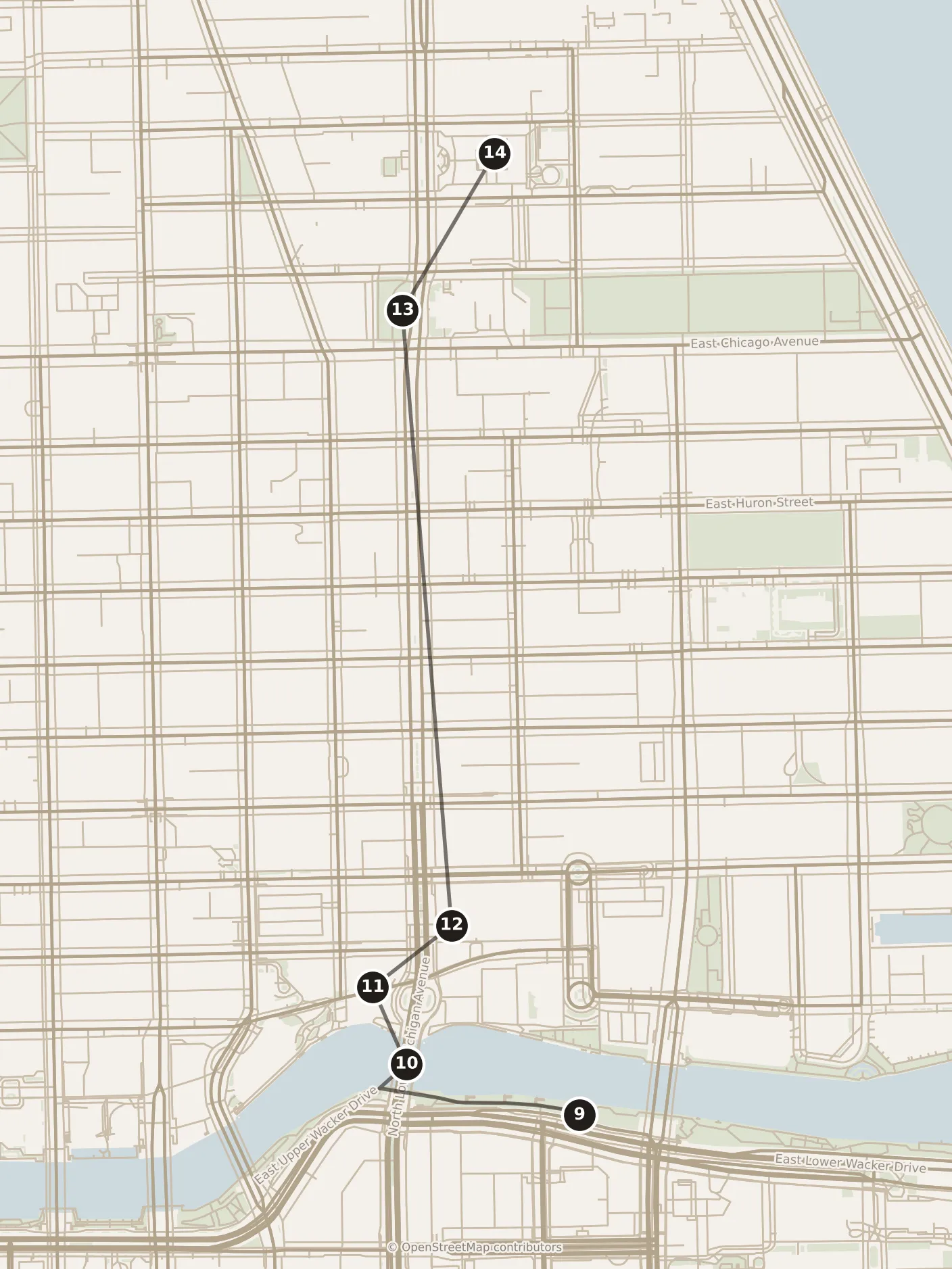
- Day two
- Chicago Architecture Center — in the prose, not on the map
- 9Chicago Riverwalk
- 10Michigan Avenue Bridge
- 11Wrigley Building
- 12Tribune Tower
- 13Chicago Water Tower
- 14875 North Michigan Avenue
Today runs north, in a straight line, and it starts on the water. Everything after the boat is a single walk up Michigan Avenue with five stops on it, about a kilometer and a half in total, ending at the top of the last one.
Morning
Start at the Chicago Architecture Center, at the corner of Michigan Avenue and Wacker Drive, on the south bank of the river inside a black Mies van der Rohe office block called One Illinois Center. It exists to explain the city and its main exhibit is a scale model of the whole downtown, three-dimensionally printed, several meters across, with every building in the central area on it. An hour there before the boat is not a preliminary; it is what turns the next ninety minutes from a parade of facades into something you can follow, because you have already seen the plan the boat is about to drive through.
The boat leaves from the Riverwalk directly below, on the south bank at the south-east corner of the Michigan Avenue bridge — down a stair from street level, under an awning. The Architecture Center runs it with its own volunteer guides and it is ninety minutes, which is published and fixed rather than a recommendation: out along the main branch, up the north branch, back down the south. Give the boarding half an hour on top and treat the whole thing as two hours of the day rather than an hour and a half.
It is the best two hours on these days and the reason is structural. This is where the tall building was worked out, and the city has spent a hundred and forty years since arguing with itself about it on two banks of one river; from the water you get the argument in chronological order, which no sidewalk gives you. It is a seasonal operation — there are no sailings in deep winter, and the 2026 season ran from spring into November. If your dates fall outside it, the walk along the Riverwalk from the lake to its western end and back is about an hour, free, and covers the same water at eye level; it is not the same thing and it is the honest substitute.
Local tip. Buy the deck ticket for this evening now, online, rather than at the door tonight. The online price was lower than the gate price in 2026 and it buys a timed slot, which is the difference between watching the sun go down from the ninety-fourth floor and watching it go down from the line. On the summer version, book that slot for after dinner rather than before it: deep-dish arrives when it arrives, and the slot is the one thing in the evening you can lose by twenty minutes.
Afternoon
Up the stair from the dock and you are on the Michigan Avenue bridge, formally the DuSable Bridge since 2010 — a double-deck bascule of 1920 at the point where the city began. Cross it north. On your left as you come off it, the Wrigley Building of 1924 is clad entirely in white glazed terracotta, still washed by hand to keep it that color, with a clock tower modeled on the Giralda in Seville and clock faces nearly six meters across. Walk between its two towers to the small plaza behind, which overlooks the river and which most of the people photographing the front never find. Ten minutes.
Two minutes across the avenue is Tribune Tower, the winner of an international competition in 1922 that drew more than two hundred and sixty entries and paid fifty thousand dollars for first place — won by John Mead Howells and Raymond Hood with a neo-Gothic tower, while Eliel Saarinen’s second-placed design went on to influence far more buildings than the winner did. The visit is the wall. Set into the stone at street level are fragments brought back from famous structures around the world, each one labeled with where it came from: the Parthenon, the Great Wall of China, the Great Pyramid, the Taj Mahal, Notre-Dame. The newspaper left in 2018 and the building is apartments now, so the lobby is not yours; the wall is, and it is free, and it takes twenty minutes to read properly.
A quarter of an hour north up Michigan Avenue, through the department stores, brings you to the Chicago Water Tower — a small limestone castle of 1869 by William Boyington, standing on its own plaza in the middle of the shopping. It was the only public building in the burned zone to survive the fire of 1871, and the detail nobody tells you is what happened opposite: the pumping station’s roof, which was not limestone, caught and fell into the pumps below, taking with it the water supply that was supposed to fight the fire. The tower itself held no machinery, only a standpipe forty-two meters tall, which is why it came through. It now holds a small city-run gallery of work by local photographers and artists; the pumping station it served is still standing across the street. Twenty minutes. This is also where to eat, and give the meal three quarters of an hour: it is the one stop on the day that people forget to allow for, and the deck is not a place to be hungry in, because there is nothing above the ninety-fourth floor but the view.
Evening
Four minutes further north is 875 North Michigan Avenue, which everyone still calls by its old name and which is the more interesting of the city’s two great towers to look at from outside. It is 1969, by Bruce Graham and Fazlur Khan, three hundred and forty-four meters, and the enormous cross-braces running over its face are not decoration — they are the structure, moved to the outside, which is the invention that made building this high economic. The observation floor is the ninety-fourth, three hundred and fourteen meters up, and there is a separate paid attraction on it where a bank of windows tilts you thirty degrees out over the street.
This is the stop the day was built around, and the reason to be here rather than at the taller tower across the Loop is that from here the Loop is in the picture. You are standing north of the skyline looking back at it, with the lakefront curving away below and Lake Michigan filling everything east — a black plane with no far edge, against a grid of lights that goes to the horizon in the other three directions. That contrast exists for about half an hour, once the lights are on and before the water disappears. Give the whole visit an hour.
Deep-dish pizza belongs to this evening rather than to any lunch on these days: it is an inch of crust built like a pie shell, cheese under the sauce instead of over it, and it is baked to order, so it arrives when it arrives. In winter, when the light goes at half past four, it is the meal after the deck. In summer, when you are going up after dinner, it is the meal before — and it is the reason the summer version needs the deck’s late hours rather than merely enjoying them.
If you are heading for a train afterwards, walk south to Chicago Avenue and then west along it, ten minutes, to the Red Line’s Chicago station. Take it south to Jackson and change there for one stop on the Blue Line to Clinton, which comes up five minutes from Union Station’s Canal Street doors.
With a third day

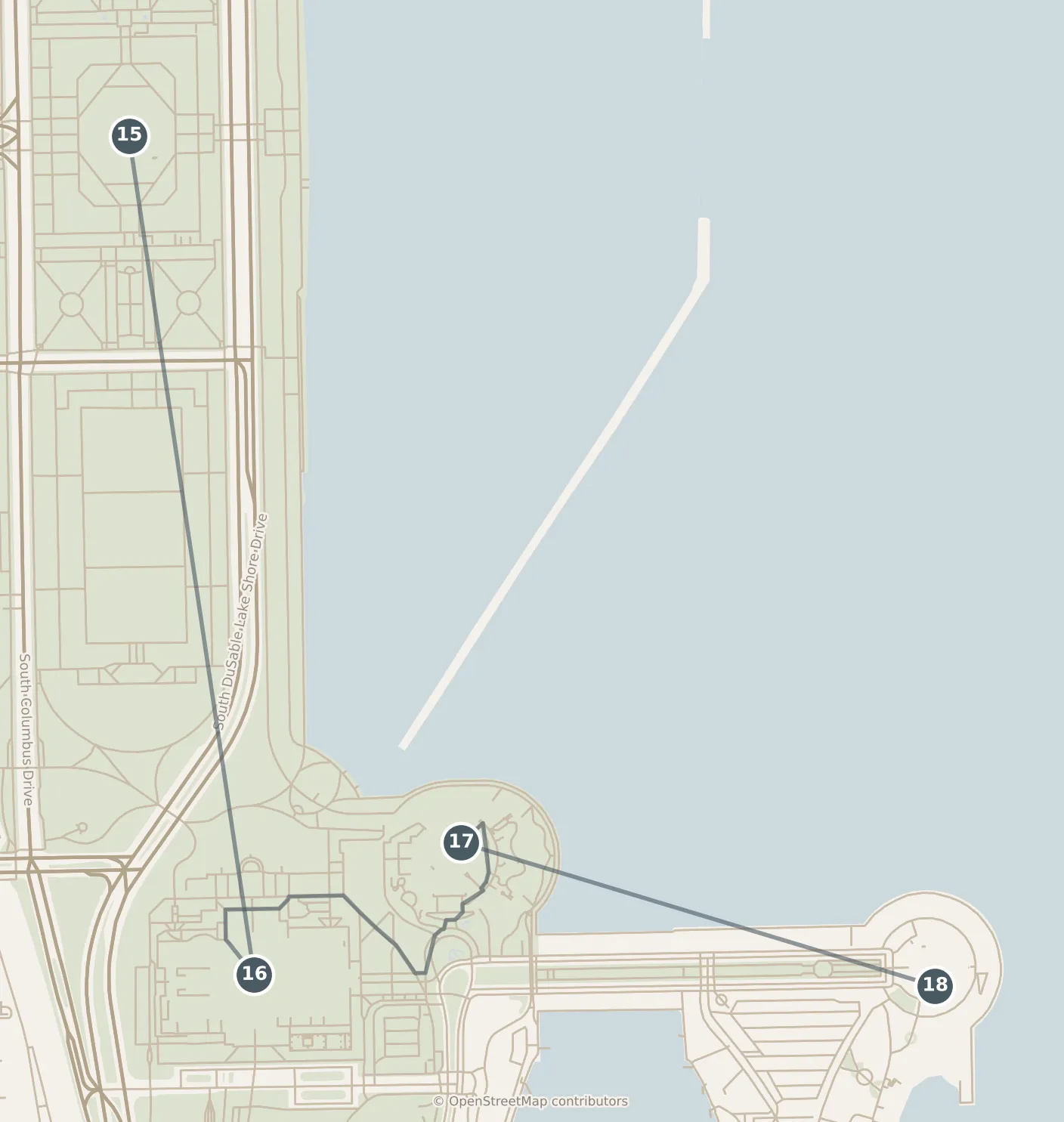
- With a third day
- 15Buckingham Fountain
- 16Field Museum of Natural History
- 17Shedd Aquarium
- 18Adler Planetarium
Give the third day to the Museum Campus, and put it in the middle rather than on the end.
It goes second because day one finishes at the top of Grant Park and this day starts by walking down the length of it, which is the one seam in the trip where two days join up on foot. Head south from Millennium Park about a quarter of an hour to Buckingham Fountain, modeled on the Latona fountain at Versailles, which throws its center jet some forty-five meters straight up and runs from about May to the middle of October — outside those months it stands dry and there is no reason to stop. Then twenty minutes further south, across Roosevelt Road, and you are at the museums.
Three of them sit on one peninsula and the day as written goes inside two. The third is the planetarium, and whether you go into it or only walk out to it for the view is a decision to take now, because one of this trip’s weekday rules hangs on it. The Field Museum of Natural History, in a 1921 building from Daniel Burnham’s practice, holds twenty-four million specimens, and the honest advice is to take three things and leave the rest: the tyrannosaur called Sue, the largest found at the time it was excavated, which was moved upstairs into the Griffin Halls of Evolving Planet in 2018 and is no longer what you meet in the main hall; the Egyptian rooms, built as a walk-in replica tomb you descend into, with twenty-three human mummies in it; and the gem hall. Two hours.
Six minutes east, the Shedd Aquarium of 1930 is a Beaux-Arts octagon with Doric columns and five million gallons of water inside it. The reason to go is the Oceanarium: its main tank, Whale Harbour, is backed by glass walls that look out over Lake Michigan itself, so the water in the tank appears to run straight into the water of the lake behind it. The large circular reef tank has been out of service since 2023 pending replacement; check what has reopened and plan the visit so that the answer does not matter. Ninety minutes.
Twelve minutes further east along the causeway is the Adler Planetarium of 1930, the first in the western hemisphere, and it sits far enough out into the lake that the walk to it is the point: the view back at the whole skyline from the water’s edge around it is the photograph of Chicago that everybody has seen. That view is free, it is on a public path, and it is best in the last hour of light. Front to back this day comes to about five hours from the top of Grant Park, so in the short half of the year you can simply count five hours back from your month’s sunset and get both the museums and the skyline: in December that puts you at the fountain around half past eleven. From about April the sum stops working, because the planetarium shut at four in 2026 and the light does not go until much later — so take the museums from the morning and come back out to the water afterwards, which costs nothing and needs nobody’s door to be open.
The planetarium itself kept an unusual week in 2026 — open in the daytime from Thursday round to Tuesday, and on Wednesday shut all day and open through the evening instead. That makes Wednesday either the day that breaks this or the best day to do it: on a Wednesday, take the Field Museum and the aquarium first, walk out for the skyline as the light goes, and go in afterwards. Check that one thing before you set out, and if the arrangement has changed, nothing else on the day moves.
Inserting this day rather than appending it moves two things and no more. The boat, which is the only booking on the trip, moves to the third date, so fix it after you have fixed your arrival day rather than before. And the weekday rules re-derive: with the museums in the middle, a Monday arrival gives Monday in the Loop, Tuesday on the lake, Wednesday on the river, and nothing collides. Append it instead and the same Monday arrival puts the museum day on the Wednesday, which is the planetarium’s odd day — workable, as above, but only if you know it is coming. If your boat booking cannot move, append and read that paragraph again.
Practicalities
Only one thing on these days has to be arranged before you travel, and it is the boat: the sailings sell out on weekends and in the evenings, and the ninety-minute guided one was in the fifty-to-sixty-dollar range in 2026. Book it the day you fix your dates, and book it for a sailing that leaves you the afternoon. It is sold by the Architecture Center itself, which is also the building you walk into an hour before it. The observation deck does not need booking weeks out, but it was in the thirty-to-forty-dollar range in the same year, more expensive at the door than online, with the tilting windows sold separately on top of that. The Art Institute is walk-up and separately ticketed. So is the Architecture Center’s own exhibition — the hour before the boat is not part of the cruise ticket, even though the same people sell both: its admission was in the ten-to-twenty-dollar range in 2026, and a few dollars if you buy it together with the cruise. And if you take the third day, its three museums are ticketed separately again, and none of them is covered by anything else on this route. The Loop’s four buildings, the bridge, the Water Tower gallery, Millennium Park and the fountain cost nothing at all.
The weekday rules matter more here than the bookings, and there are three of them, plus one permission. Day one must miss Tuesday, because the Art Institute was closed that day in 2026 and it is three hours of the afternoon. Day one must also miss Saturday and Sunday, because three of its five morning stops are lobbies inside working office buildings and an office building keeps office hours — this is the rule that is easiest to check and easiest to forget. The museum day must miss Wednesday if you are going inside the planetarium, or rather must be inverted on it, for the reason above — and if you are only walking out to it for the view, that rule does not apply to you at all. Day two takes any day of the week there is, which is the permission that makes the rest of this workable: it is the one that can be moved to the front without breaking anything, so when the arithmetic fails, it goes first.
So: arrive on a Monday, Wednesday, Thursday or Friday and the days run in the order written, whether you have two of them or three. Arrive on a Tuesday and lead with day two; day one goes to the Wednesday and nothing else moves. Arrive on a Sunday and do the same; day one goes to the Monday. In both of those the museum day takes whichever date is left, which means it stops being the middle day, and that costs only the walk down Grant Park. The arrival that genuinely needs three days to survive is Saturday — the river on the Saturday, the lake on the Sunday, the Loop on the Monday — because on two days both of yours are weekend days.
The trap is the commonest city break there is: a Friday-night arrival for Saturday and Sunday only. Both of your days are weekend days, day one cannot be either of them, and no reordering fixes it, because there is no weekday in the trip to move it to. That version keeps day one’s afternoon and evening — the Art Institute, Millennium Park, the elevated circuit — and replaces the morning of lobbies with the Chicago Cultural Center on Washington Street, five minutes north of the museum: free, civic rather than corporate, with two large stained-glass domes, and the one grand interior in the Loop that is not somebody’s office. It opens at ten, every day of the week, and that hour is the point: the weekend morning starts at ten rather than nine and runs an hour rather than just under two, which is enough, because this is one building and not four. It stands between the museum and the park, so it displaces nothing and adds no walking you were not already doing. It closes only for public holidays; if you land on one, the weekend morning becomes the same four buildings from the sidewalk — the Board of Trade closing LaSalle Street, the Rookery’s granite front on it, and the Monadnock’s brick wall round on Dearborn Street, which is six feet thick whether the door is open or not.
If you are short rather than rearranged, cut in this order. First the Chicago Board of Trade, which is ten minutes and is entirely visible from a street you cross anyway. Then the third hour in the Art Institute, which was the surplus to begin with. Then the walk up Michigan Avenue on day two: from the dock it is nine minutes on foot to the Red Line at Lake, two stops north to Chicago, and seven minutes east along Chicago Avenue to the Water Tower — about twenty-five minutes saved, at the cost of the Wrigley Building and Tribune Tower, which are the two stops on day two you can lose without losing the day. Do not cut the boat and do not cut the deck: between them they are the two hours these days exist for.
Everything else is walking. Day one is about four kilometers across the whole day and its longest single stretch is the quarter of an hour from the Board of Trade east to the museum. Day two is under two kilometers on foot, and its longest stretch is the same quarter of an hour, north from Tribune Tower to the Water Tower. The third day is the only one with real distance in it — roughly an hour of walking spread over the length of Grant Park and the museum peninsula — and if the wind is off the lake, the Red, Green and Orange lines all stop at Roosevelt, which is a quarter of an hour’s walk from the Field Museum and skips the whole park.


