Chicago in one day: the Loop on foot, the river, and the tower at dusk

Last updated 4 August 2026
Overview
Chicago is an enormous city with a very small middle, and one day works here because of the second fact rather than in spite of the first. Everything below sits inside the Loop and the few hundred meters of river just north of it. The whole route is about six and a half kilometers on foot, an hour and a half of actual walking, and only one stretch of it is longer than twenty minutes.
What a single day costs you is the neighborhoods, and it costs you every one of them. The parts of the city people move here for are two or three train stops out in every direction, and a day that goes to fetch one of them spends two hours traveling and arrives with nothing left. It also costs you the Museum Campus, the run of big lakefront museums south of the center, which is a full day on its own and is not a half-day version of itself. Give both up cleanly at the start rather than at four in the afternoon.
Two hours of this day are decided for you. The Art Institute of Chicago admitted nobody before eleven in 2026, and it is shut on Tuesdays — so the morning is built backwards from eleven, and if that hour has moved, build it backwards from the new one. Two hours is roughly what the free half of the Loop is worth, which puts the start at about nine. The Chicago Cultural Center, which the morning reaches third, does not open first thing either, which is the second reason nine is early enough and eight is not: get up any earlier and you will be standing outside two closed doors.
The other fixed point is not an institution and nobody can revise it. The last stop is a window on the hundred and third floor, and what it wants is the half hour either side of sunset, when the grid comes on underneath and the lake goes black. The sun sets here from about twenty past four in the first week of December to half past eight at midsummer, so take your own month’s hour and work with it. From a nine o’clock start, everything above the tower comes to about eight hours, walking included, which puts you at its foot at around five.
That eight hours counts the time you spend inside places and the time you spend between them, and it counts nothing else. On this route the omission has a name: the screening and the elevator line at the tower, which on a summer evening is the longest single wait of the day and belongs in your plan as a separate line rather than inside the total. The other thing the arithmetic will not do for you is match the light. In deep winter the boats are not running, which removes an hour and a half, the cruise less the riverside walk that replaces it, and lands you at the tower at about half past three with dusk at twenty past four — the neatest the sum ever gets. From late spring the light runs well ahead of the route, and at midsummer you arrive nearly four hours early. Do not pad the middle to close that gap: take one of the sailings after five instead, so the cruise gets the low sun, or spend the surplus on the lakefront, which the city guide covers and this day has no room for.
Finally the bag, because you are carrying one. This day begins and ends at Union Station, which is the only shape that really matters: whatever you do with the luggage, you are not hauling it across town and you are not walking back for it in the wrong direction at nine at night. Do settle it before you start. The tower has no lockers of its own, and the last hour of this day is a bad hour to be holding a rucksack in an elevator line.
The day

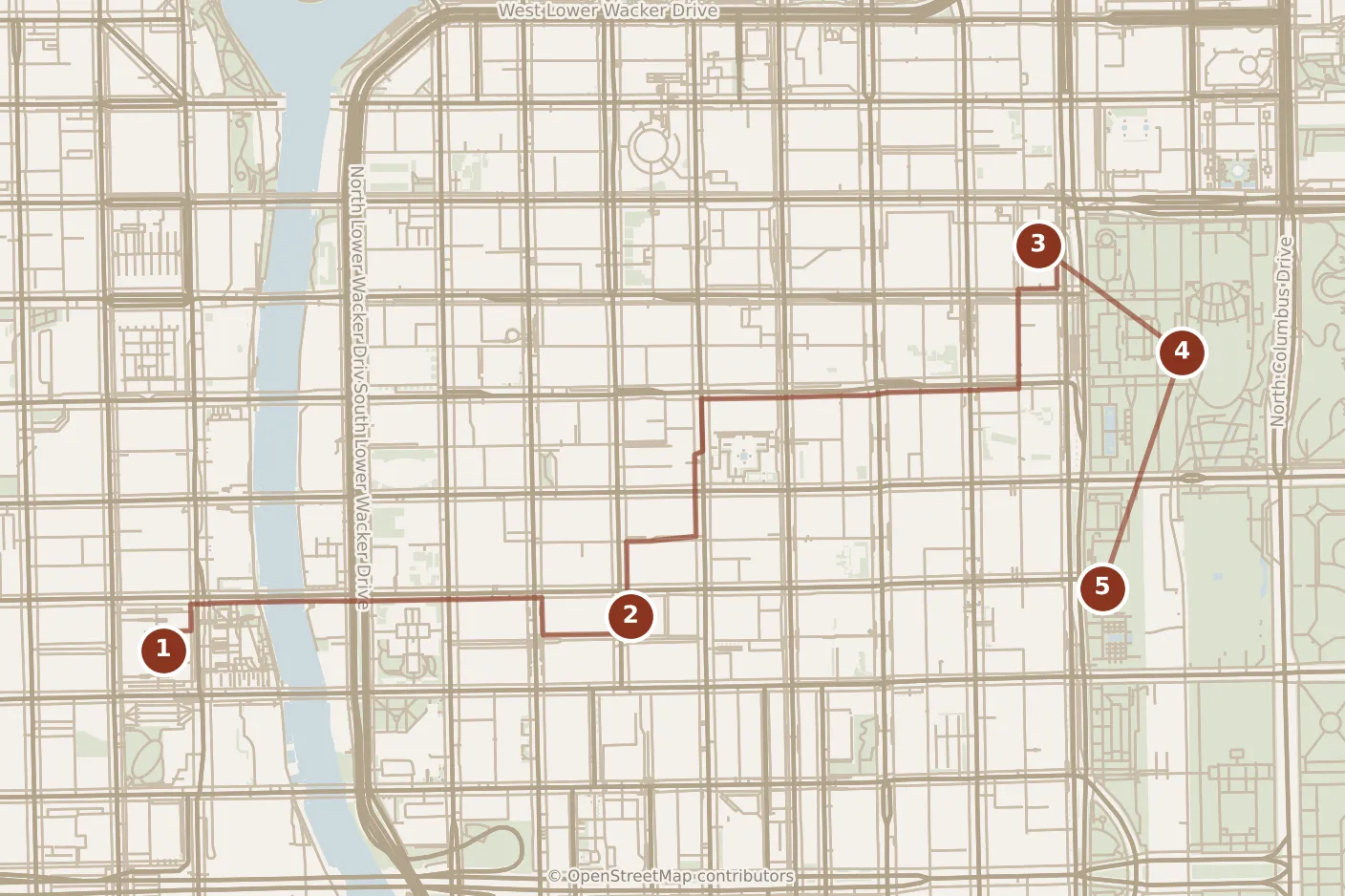
- Morning
- 1Union Station
- 2Rookery Building
- 3Chicago Cultural Center
- 4Millennium Park
- 5Art Institute of Chicago
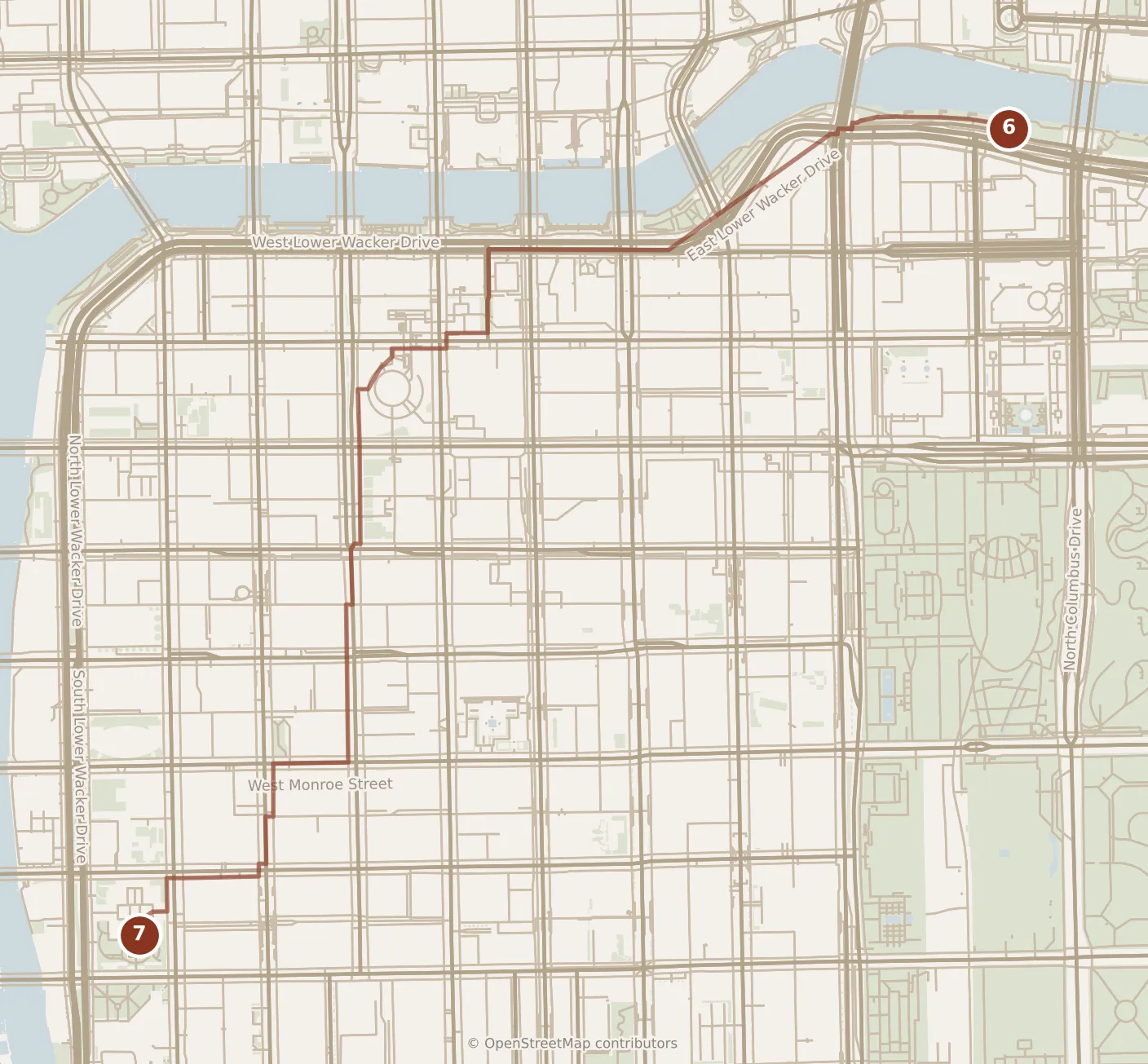
- Afternoon and evening
- 6Chicago Riverwalk
- 7Willis Tower
Morning
Begin inside Union Station rather than walking straight out of it. It opened in 1925, built by the firm Daniel Burnham founded, and the Great Hall is one of the great interiors of the country: a waiting room of two thousand square meters, thirty-four meters to the ceiling, travertine columns with gilded capitals, and enormous wooden benches still used for exactly what they were made for. The barrel-vaulted skylight over it was blacked out during the war and patched for sixty years afterwards; a rebuild finished in 2019 put the daylight back, and the room now reads the way it was drawn. Two grand staircases run up out of the hall, and one of them is the staircase the pram bounces down in The Untouchables. Do not spend the morning establishing which. Twenty minutes.
From the hall it is about a quarter of an hour east, over the river and into the financial district, to the Rookery Building on LaSalle Street. It is 1888, by Daniel Burnham and John Root, and it is the oldest high-rise left standing in the city: outside, a fortress of dark red granite and brick. Inside is a light court roofed with a skylight of five thousand panes, and the lobby and staircase under it were remade by Frank Lloyd Wright in 1905 in white marble incised with gold — the only work of his anywhere in the Loop. Fifteen minutes standing still and looking up is all it takes. There are two ways in and they are not equally reliable: a ticketed guided tour of the court, three quarters of an hour, on weekday mornings; and, when the building allows it, simply walking into the lobby off LaSalle Street for nothing. This is a working office and it keeps office hours, so the weekend is when the stop is most likely to be shut altogether. Check that one thing before you build the morning on it, and if it is closed, walk up LaSalle Street anyway, because the canyon of bank fronts either side does a good deal of the same work for free.
Local tip. If both ways in are open, take the free one. The tour is the better experience and it is three quarters of an hour plus the waiting, and the extra half hour over the lobby is exactly the Cultural Center — you cannot have both of them and still be at the museum for eleven.
Another quarter of an hour, north and east, brings you to the Chicago Cultural Center on Washington Street. It went up in 1897 as the city’s first public library and a memorial to the Civil War dead, and it is free. Two stained-glass domes: the one in Preston Bradley Hall, which the city calls the largest Tiffany dome in the world, and a second, somber one over the memorial rotunda. Half an hour, and most of it is two staircases and two ceilings. Nothing here needs a ticket or a plan.
Five minutes further and you are in Millennium Park. Cloud Gate is the reason most people come: a hundred tonnes of welded stainless steel by Anish Kapoor, finished in 2005, with no visible seams and a concave underside that turns the skyline inside out. The plaza around it was fenced for a year of repairs and reopened in June 2024. Behind it the Jay Pritzker Pavilion, Frank Gehry’s bandshell, throws ribbons of brushed steel over a lawn strung with a trellis of speakers; and the Crown Fountain, two glass towers projecting the faces of a thousand residents, spits water at the sidewalk in the warm months and stands dry the rest of the year. Half an hour.
Then seven minutes south to the Art Institute of Chicago, which is where the eleven o’clock comes from. Give it two hours and give up on completeness before you go through the door, because the building is far larger than two hours. The way to spend them is the Impressionist rooms — more than thirty paintings by Monet alone, one of the best collections of that work outside France — and then the American ones, for Edward Hopper’s Nighthawks and Grant Wood’s American Gothic, which are smaller in the flesh than anybody expects. The Modern Wing is effectively a separate museum bolted to the side. If that is what you came for, take it instead of the other two rather than after them.
Afternoon
You come out onto Michigan Avenue at about half past one, which is a good hour to eat in an office district because the rush is over. Eat an Italian beef standing at a counter: thin-sliced beef piled on a roll and dunked back into its own gravy, ordered wet, eaten leaning forward, and there is no dignified way to do it. A Chicago-style hot dog is the faster version of the same idea. Deep-dish pizza is the famous one and it is the wrong lunch for today — it is baked to order and it will eat the boat.
Twenty minutes north brings you down onto the Chicago Riverwalk, which runs along the south bank a level below the street, under the bridges rather than over them. This is the afternoon, and the reason to be down here is the architecture cruise. The dock is at the southeast corner of the Michigan Avenue bridge, at the top of a stairway under a black awning. The cruise is ninety minutes — a published, fixed length, not a recommendation — out along the main branch, up the north branch and back down the south, with a volunteer guide naming buildings continuously the whole way. Boarding is fifteen minutes before departure and you are asked to be there half an hour before, so treat the whole thing as two hours of your day rather than an hour and a half.
It earns them. This is the city where the tall building was worked out, and it has spent the hundred and forty years since arguing with itself about it on both banks of this river, and from the water you see the argument in order, which you cannot do from any sidewalk. If you take one paid thing on this route, take this.
The boats are a seasonal operation — March to November in 2026 — so a January visit has no cruise at all. That version of the afternoon walks the Riverwalk instead, end to end and back, about forty minutes, free, and then arrives at the tower earlier, which in December is exactly what you want.
Evening
From the dock it is half an hour west to Willis Tower: along the Riverwalk while it lasts, then round the bend of Wacker Drive with the river on your right, then two blocks south. It is the longest single stretch of the day and it is a good walk, the free sequel to the one you just paid for. If your legs have finished, five stops on the Pink Line, clockwise round the Loop from the station at State and Lake to Quincy, leave you two blocks from the entrance instead; the Purple does the same run at weekday rush hours.
The Skydeck is on the hundred and third floor, four hundred and twelve meters up, the highest observation deck in the United States. Four glass boxes called the Ledge cantilever a little over a meter out from the face of the building, floor included, so you stand on nothing above a quarter-mile drop. They have a line of their own, separate from the one for the deck, and it is that second line rather than the view that decides how long you are up there. Give the whole thing an hour.
This is the stop the day is built around, and the reason is the lake. On three sides the city runs flat to the horizon and keeps going after the horizon, a grid of lights with no edge to it; on the fourth there is simply nothing, a black plane where Lake Michigan starts. That contrast is the whole view, and it only exists in the half hour when the lights have come on and the water has not yet gone invisible. Everything above comes to about eight hours from a nine o’clock start, which puts you here at about five; if your month’s sunset is later than that, the surplus goes at the end of the day and not into the start, which the opening hours have already fixed.
Then down, and out onto Jackson Boulevard, and seven minutes west across the river to Union Station and the departure boards. That is the entire distance between the last view of the day and your train, and it is why the day runs in this direction rather than the other.
Practicalities
Two things on this route have to be arranged before you travel, and the first is the cruise. The sailings sell out on weekends and in the evening, refunds are not offered, and the ninety-minute guided one was in the fifty-to-sixty-dollar range in 2026. Book it the day you fix your date, and book it for a departure that leaves you the half hour to walk west afterwards. The other is the tower: it sells timed half-hour slots and those go too at sunset in summer, and it was in the thirty-to-forty-dollar range in the same year; the museum is walk-up and separately ticketed. Nothing else on the day costs anything, apart from the Rookery tour if you take it instead of the free lobby.
Otherwise the route needs almost nothing in your hand. It is walked end to end, with no fare to pay and nothing to tap, unless you take the five stops between the river and the tower. If you do, the city guide has the fare card and how it works — this page assumes you have not read it and does not repeat it.
Tuesday is the one weekday that breaks this day as written, because the museum closes and two hours go missing from the middle of it. If your single day is a Tuesday, do not try to replace it with something at the same distance: take an earlier sailing, walk the Riverwalk end to end before it, and give the tower a second hour rather than a first. The Rookery is the other stop with a risk attached and it is a different one — an office building keeps office hours, so a weekend is when to check rather than assume.
If you are flying in rather than arriving by train, the order needs almost no rewriting — but the bag does, because in this version Union Station comes at the end rather than the start, so settle it wherever you are staying before you begin. Both airport trains put you within a few hundred meters of the second stop — the Blue Line from O’Hare at Jackson, the Orange Line from Midway at Quincy — so start there and pick up Union Station and the Great Hall at the end instead, on your way to nowhere in particular.
Last, one thing that is about this route rather than about the climate. Almost all of the day is a short hop between interiors, with one exception: the half hour of open riverside and bridge deck at the end, walked in the dark and into a west wind. Between December and March that stretch is the part of the day people regret, and those five stops on the elevated line stop being an alternative and become the sensible choice.


.jpg)