Chengdu in two or three days: the west side, then the pandas and the shrine, with a third day out at Sanxingdui

Last updated 8 August 2026
Overview
Chengdu repays a second day more than most cities its size, and not because there is a second tier of monuments to work through. Almost everything worth seeing here is a place you sit down in — a walled garden, a temple courtyard, a shrine with a bamboo passage, a museum with fifteen galleries — and a single day makes you walk through all of them at the same speed. The second day is what lets you stop.
So these two days deliberately leave the middle of the city alone. Kuanzhai Xiangzi, People’s Park, Tianfu Square, Chunxi Road, Daci Temple and the covered bridge at Anshun Bridge are the one-day route through Chengdu; they sit within a few metro stops of one another and can be picked up in whatever spare time these two days leave you — though the park and the temple on that list keep daylight hours, and only the rest of it is an evening. What a second day actually buys is the west — the poet’s garden, the provincial collection, the largest Taoist temple in the southwest — and the room to give the pandas a morning instead of a slot.
One absence shapes all of this and has to be said out loud. The Jinsha Site Museum, built over the Bronze Age settlement that is the reason anyone in Chengdu talks about Shu at all, closed on 5 December 2025 for a rebuilding program, and has published 30 April 2027 as its reopening date. Check what has reopened before you plan around it; while it is shut, the city’s own account of what stood here before the rest of China arrived is behind a hoarding, and that is the entire argument for the third day below, which goes out to the place the Jinsha objects are the sequel to. The other omission worth arguing about is Wenshu Monastery, north of the center. It loses to Zhaojue Temple on day two, which is larger, on the way back from the pandas, and a working temple rather than a sight.
One thing on these two days has to be booked before you travel, and it is the panda base. Nothing else on them certainly does: the provincial museum on day one may admit on a free reservation of its own, and the shrine on day two sells its own ticket for the day you go — both are two minutes on their own pages rather than a plan. A third day adds a train seat to buy before the day and, if the museum out there wants a reservation, one more to settle. Its full name is the Chengdu Research Base of Giant Panda Breeding, and that is the name to search with: entry is by real-name online reservation, made through the base’s own channel and matched to the passport you hand over at the gate, bookable fourteen days ahead in 2026, and adult admission was in the fifty-to-sixty-yuan range that year; the buggy that runs the site is a separate ticket, sold at the gate. Anything offering that ticket under another name is a reseller. If your dates fall inside one of the national holiday weeks, book on the first day the window opens rather than at leisure. How you pay for anything at all in this country — the phone apps, the awkwardness of foreign cards — is the city guide’s subject, and for a first visit it is not optional reading.
Day one moves on nothing between its stops: it is walked from the cottage gate to the last of the evening. Day two moves twice between its stops, both times on Line 3, with the base’s shuttle bus in front of the first. That is the whole of the transport in this article, the third day’s train aside.
The light runs late here for the longitude, because the whole country keeps Beijing time. The sun goes down a few minutes past six at the very end of November, which is the earliest it sets all year, and a few minutes past eight around midsummer, which is the latest. Only one moment on these two days wants the dark — Jinli, the lantern lane along the shrine wall, where day two ends — and the count at the end of day two is worked against both ends of that band already, so there is nothing to do with these numbers here.
You are not the reader of the one-day article: you have a room, so the bag is not a problem in the middle of a day and there is nothing here to plan around it. It becomes one exactly twice. If you arrive by train on the morning of day one, leave the case at the station you arrive at rather than carrying it west: day one’s first stop is the better part of an hour from Chengdu East Railway Station, which is not a journey to make twice. And on the panda base morning, carry nothing you would not want on you for three hours: the site has run to well over two hundred hectares of wooded hillside since the 2022 extension, and it is walking as much as looking.
Which leaves the first leg, the one nobody describes. From Chengdu East Railway Station, Line 2 runs west across the whole city; change at Chengdu University of TCM and Sichuan Provincial People’s Hospital, where Lines 2, 4 and 5 meet. From there two ways in, and neither is wrong: Line 5 one stop south to Qingyang Taoist Temple and Line 13 one stop west to Du Fu Thatched Cottage, which leaves seven minutes on foot; or stay for Line 4, one stop west to Caotang Road North, and twenty minutes on foot south. Two changes and a short walk, or one change and a long one — with a case that is the whole of the decision. Either way it is the better part of an hour from the platform, so a same-morning arrival makes day one late; if your train gets in after the middle of the morning, settle the order of the days when you book the base rather than on the platform, because that booking carries a date.
Guanghan North railway station, Sanxingdui Museum — not on the walking map; you get there by train.
Day one

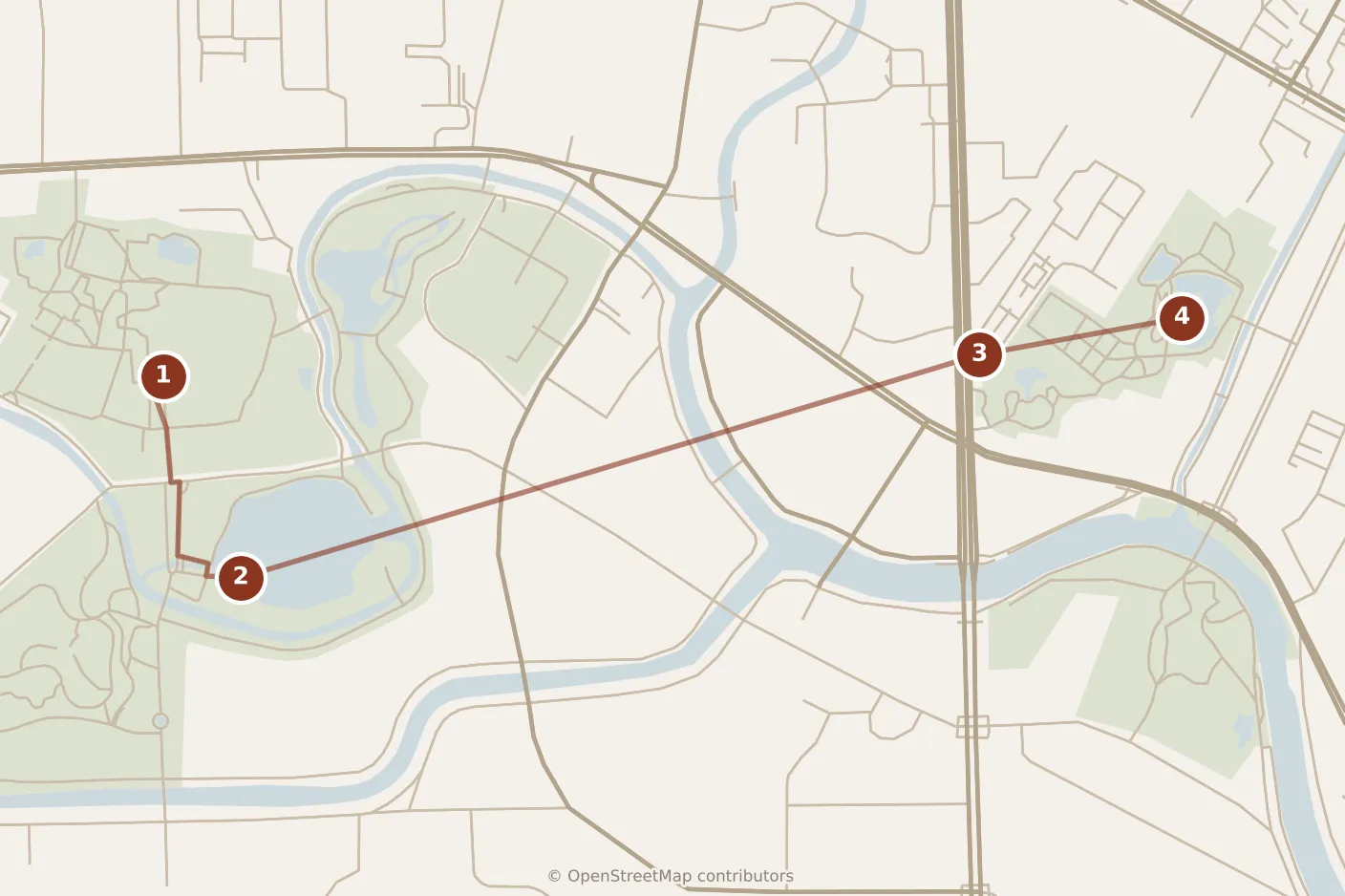
- Day one
- 1Du Fu Thatched Cottage
- 2Huanhuaxi Park
- Sichuan Museum — in the prose, not on the map
- 3Qingyang Palace
- Qintai Road — in the prose, not on the map
- 4Chengdu Culture Park
The west side, and everything below sits within a kilometer and a half of the same creek. It goes first because it teaches you the order the city was made in — a Tang garden, then the province’s own account of what came before and after it, then the temple the district is named for — and because it is the only day here with no fixed hour at the start of it. Nothing on it depends on the light, so the count runs forward from the start rather than back from an hour: be at the cottage gate when it opens, not for any rule of the building but because the two hours after opening are the only ones in which a garden built for solitude is quiet.
Morning
Du Fu Thatched Cottage is twenty-four acres of walled garden on the Flower Rinsing Creek, built round the ground where the Tang poet lived for four years from 759 and wrote some two hundred and forty poems, among them the one about his roof being torn off by the autumn wind. There is no ninth-century building here — what you walk through is a Ming ground plan of the early sixteenth century, restored again in 1811 — and that is the point rather than a disappointment: a thatched hut has been rebuilt inside the grounds, plainly and small, and the walk out to it through halls, bamboo and water is the argument the place is making about what a poet’s house is for. Two things to aim at. The Hall of Great Poets holds a mural sixteen meters long showing the scenes of two of his poems, with statues of twelve other poets ranged in front of it; and the excavated Tang remains uncovered on the site are the only physical evidence in the garden that anybody lived here at all, which is worth ten minutes precisely because everything else is a reconstruction. Give the whole thing two hours and you will have walked the plan without hurrying.
Huanhuaxi Park begins where the cottage’s wall ends, and it is free, gateless and the opposite kind of place: an open park along the same creek, full of people doing nothing in particular at eleven in the morning, which is the local art form. Doing nothing here has a mechanism, and it is the same one all over this city: a cup of tea buys the chair, it is refilled for as long as you sit in it, and nobody expects it back. Three quarters of an hour. Lunch is on the streets along its edges rather than inside the park, and mapo tofu is what to order; which of the shopfronts is not something this article can decide for you, so decide it on which room has people in it. Give lunch an hour; nobody here eats faster than that.
Afternoon
The Sichuan Museum stands on the far side of the same park, about ten minutes’ walk from where you were sitting. It is the largest general museum in the southwest, founded in 1941 and in this building since 2009: three hundred and fifty thousand objects, of which some three thousand three hundred are out at any one time across fifteen galleries. Fifteen is more than anyone should attempt, and the useful thing to say is which four. Take the stone and brick rooms, where Han funerary bricks show salt wells, harvests and banquets pressed into clay by people who were not making art; take the bronzes of Ba and Shu, which are the nearest thing the city now offers to what the closed museum across town would have shown you; take the ethnic and folk galleries, which are Tibetan and Qiang and are the only place on these two days where western Sichuan appears at all; and find the Ziyang skull, some twenty-five thousand years old and the oldest thing in the building. Skip the ceramics and the calligraphy without regret unless they are why you came. Two hours, entered well before the afternoon is out: this is the one building on day one that stops admitting a good while before it closes, which is why it comes before the temple and not after.
Local tip. The museum and the temple are twenty minutes apart and only one of them has a cut-off. If you have started late and cannot do both properly, the temple is the one that waits: take the galleries first and let the temple have whatever is left, rather than the order that feels more natural and loses you the collection outright.
Qingyang Palace is the largest Taoist temple in the southwest and has stood on this ground, under one name or another, since the Tang. The legend it rests on is that Laozi arranged to meet his disciple here and delivered the Daodejing, and the temple has been rebuilt around that claim ever since. Three things to find: the Bagua Pavilion, an octagonal hall on a square base with dragons carved up its stone columns; the pair of bronze goats in front of the main hall, one of which has a single horn and, looked at properly, borrows a part from each of the twelve zodiac animals; and the woodblocks of the Taoist canon the temple still keeps, which are why scholars come. Three quarters of an hour is honest. It is a working temple with people burning incense in it, and the courtyards behind the main axis are where the city sits down.
That is six and a half hours standing still and a little over half an hour of walking between the four stops and lunch — call it seven hours from the cottage gate to the temple gate. The number covers time inside the places and nothing else. It does not include the door check at the provincial museum, where a bag scanner and an identity check are normal and the line is longest in the first hour, and it does not include the ticket desk at the cottage. If the day is running short, the stop that goes is Huanhuaxi Park: it is the only one whose value is the sitting rather than the thing, dropping it buys back three quarters of an hour earlier in that same day, and the museum is then five minutes along the road from the cottage’s exit instead of ten. Lunch is unaffected — it happens on those same streets whether or not you have walked the park.
Evening
Seven hours from the cottage gate leaves you at the temple long before anyone in Chengdu eats, and that is not a fault in the plan. Spend the gap in the temple’s back courtyards rather than at a table; that is what they are there for, and it is the same hour the whole day has been building towards.
Qintai Road runs north-east from the temple’s shoulder along the edge of Chengdu Culture Park, and it is where dinner is: a rebuilt street of dark timber and stone that makes no claim to be old, lined with restaurants. Do not count on a crowd — on an ordinary weekday evening it can be quiet, and that is not a failure of the plan. The park is the other side of it, five minutes from the temple gate, and it holds the evening’s one real decision — its teahouse theater is where you can see Sichuan opera without leaving the west side, and the park’s name is what to search under. The tourist-facing version is a variety hour rather than a full opera: face-changing, in which a performer sheds one painted silk mask after another with no visible movement, and alongside it fire-breathing, hand-shadow puppetry and a comic sketch. Be honest with yourself about what it is: face-changing is genuinely local, and the rest is filler around it.
The honest negative: this is the one evening on these two days that depends on a private operator rather than a public institution, so find out whether a performance is on before you build the evening around it, and buy the seat that same afternoon — this is not something to arrange before you travel, and it is not the booking named at the top. If there is no performance, nothing is lost that cannot be replaced where you stand: Qintai Road is still where you eat, and the lit gate of Qingyang Palace is five minutes back the way you came. Leaving is the way you arrived — Qingyang Taoist Temple on Lines 5 and 13 is a few minutes west of the park.
Day two

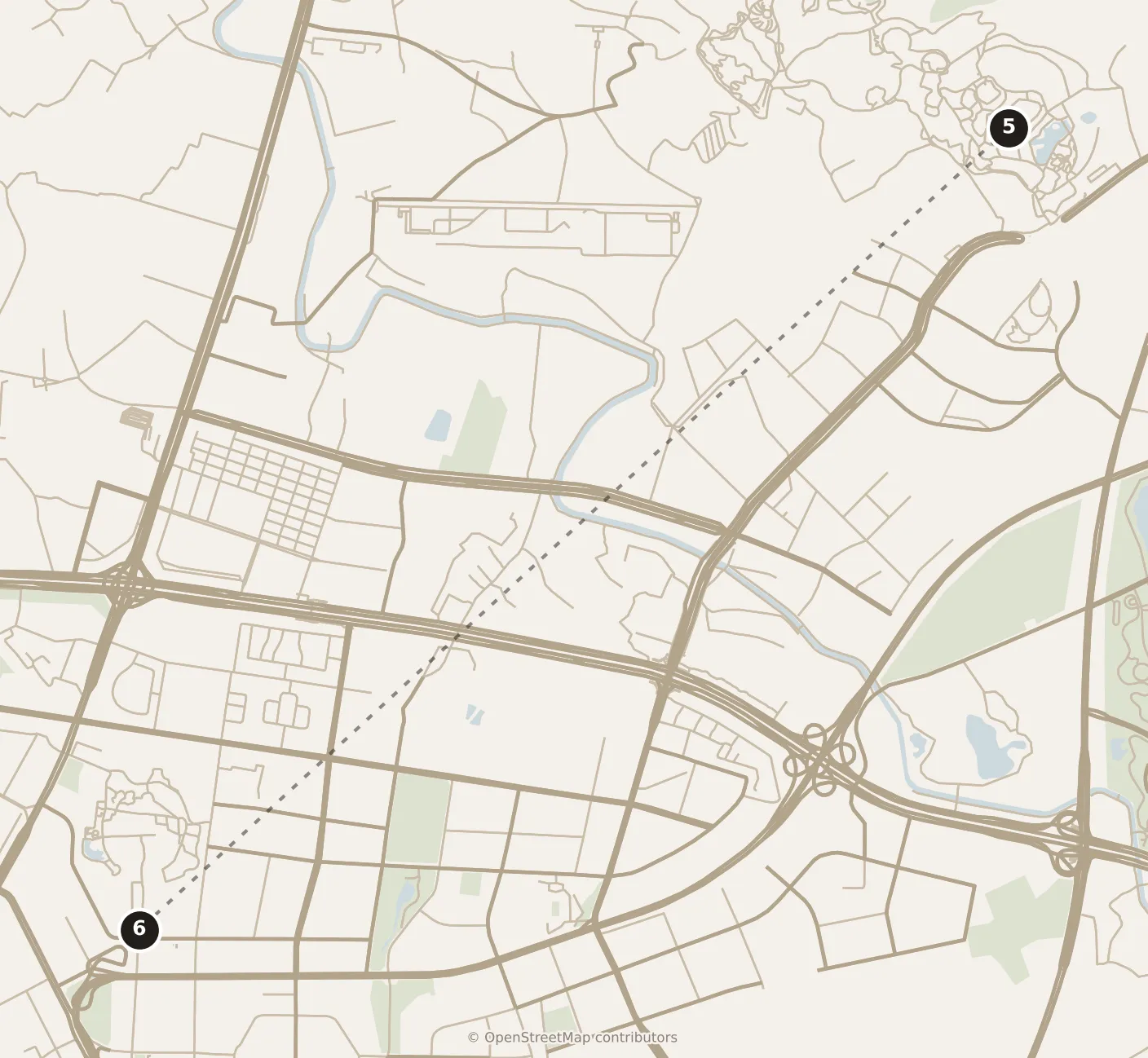
- Morning
- 5Chengdu Research Base of Giant Panda Breeding
- 6Zhaojue Temple
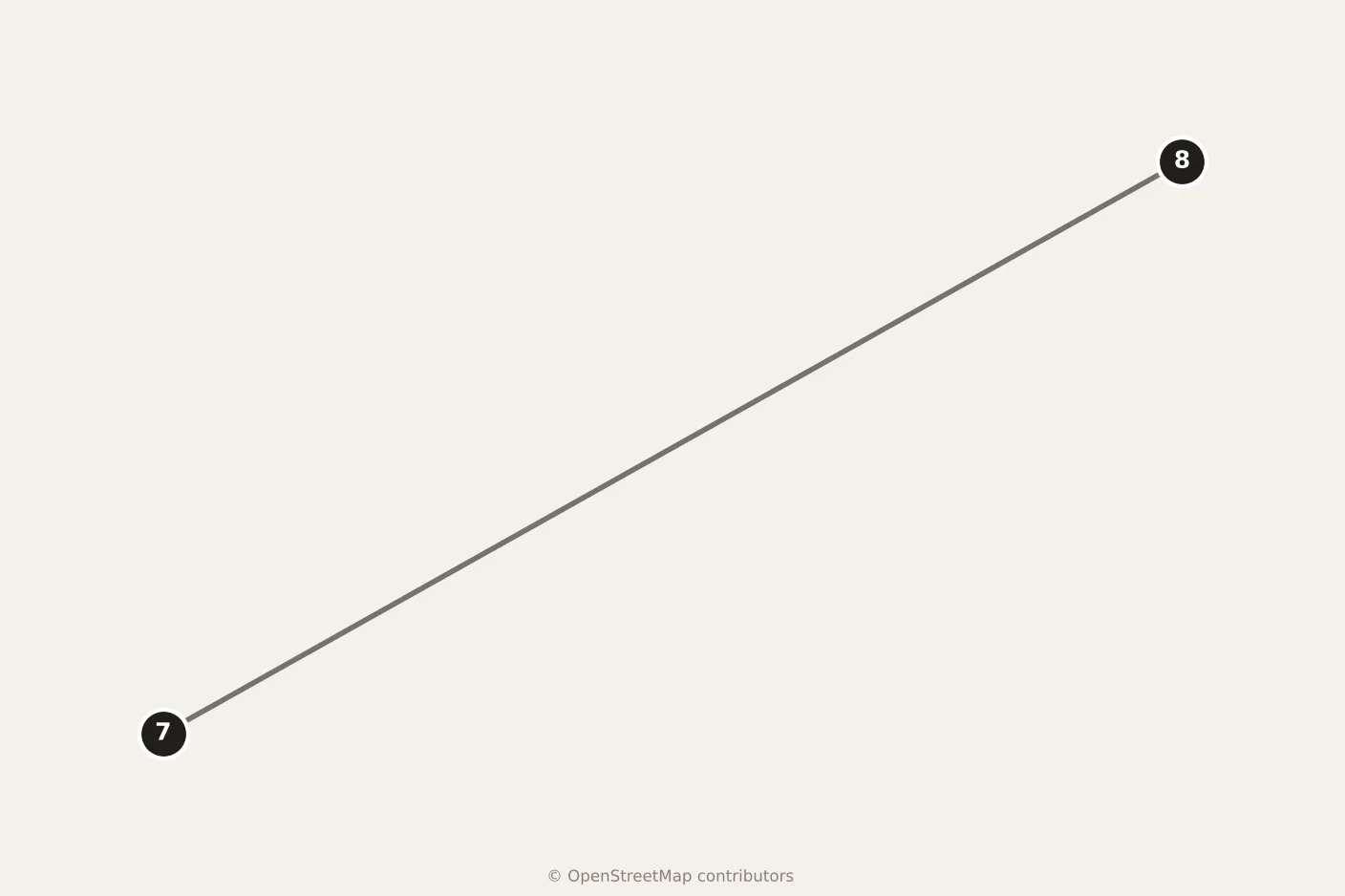
- Afternoon and evening
- 7Wuhou Shrine
- 8Jinli
The long day, and the one with a fixed point at each end: a gate that opens early on the northern edge, lanterns in the south-west, and everything between running downhill on one metro line. Nothing on it closes for a day a week — a breeding center, a working monastery, a shrine that is a public park with a ticket, and a street.
Morning
The hour this day rests on is the base’s, and it is the only clock time in this article. In 2026 the panda base sold two tickets for the same day: a morning one admitting from half past seven between March and October, and from eight from November to February, in both cases until noon; and an afternoon one admitting from noon onwards. Take the morning ticket and build the day forward from whatever the opening hour has become by the time you go. The reason is the animals rather than the gate — they are awake and eating while it is cool and have largely stopped by the middle of the morning, and no institution can revise that.
Local tip. The morning ticket and the afternoon ticket are two tickets for the same site at the same price, and only one of them is worth having. If the morning is sold out for your date, the honest move is to change the date rather than take the afternoon: an afternoon at the base is a long walk round a wooded park past sleeping animals.
Give the base three hours. Since the extension opened in 2022 the site has more than tripled and now runs to well over two hundred hectares of hillside, so the first decision is whether to walk it or take the buggy and the second is the order. Do the giant panda enclosures first while it is cool, then the red pandas, which are on the same ticket, awake for far longer, and better company than their reputation. Take the map at the gate: the enclosures are strung out across the hill and walking it blind is how three hours disappear. Flash photography and feeding are both forbidden here and the rule is enforced — this is a research institution that admits visitors, not a zoo that does research.
Then the first of the day’s two movements. Shuttle bus 408 back to Panda Avenue on Line 3, taken from whichever gate the walk has left you at, then two stops south on Line 3 to Zhaojuesi Road South, and a little under twenty minutes on foot from there: three quarters of an hour in all, and the reason the next stop is here rather than anywhere else in the city.
Zhaojue Temple was founded in the Tang as Jianyuan, renamed later in the same dynasty, and designated in 1983 one of the national key Buddhist temples of the Han regions. Among its abbots was Yuanwu Keqin, who compiled the Blue Cliff Record — which makes this one of the ancestral houses of the whole Chan and Zen tradition — and the painter Zhang Daqian lived and worked here. What you walk through now was almost entirely rebuilt, and the reason is worth naming rather than dating: in the Cultural Revolution the Red Guards stripped the place, its sutras, records and statues destroyed or carried off, and the grounds were absorbed into a public park. The main hall has three Buddhas across the altar and eighteen arhats round the walls. So come for the scale and the incense rather than for old timber. An hour and a quarter. It is a working monastery with a resident community, and as in Chinese temples generally, photography is not permitted inside the halls; the signs say so and the attendants enforce it, so put the phone away at the threshold rather than after being told.
Afternoon
The second movement, and the longer one: Line 3 south again, most of the length of the city, from Zhaojuesi Road South to Gaoshengqiao, then about twenty minutes on foot north-east. Lunch happens before that walk rather than on it: eat around the station exit rather than hoping that twenty minutes towards a shrine produces a table. Fuqi feipian — sliced cold beef and offal under chili oil — is the thing to look for, and an hour is right. That puts the whole first half of the day, both movements and lunch included, at a shade under seven hours from the base gate.
Wuhou Shrine is the best single complex of buildings in Chengdu, and the one shrine where a ruler and his own chancellor are worshipped inside the same walls, which is what makes it the best known of the several temples in China to Zhuge Liang. Liu Bei, who declared himself emperor here in the third century, is buried under a grassed mound within the grounds; Zhuge Liang, his chancellor and the reason anyone still comes, has the hall that gives the place its name. The layout is the argument: you pass through the emperor’s hall to reach the minister’s, and the minister’s is the one people leave offerings in. Two things beyond the axis. A long covered corridor down each side is lined with painted statues of Three Kingdoms figures with name-boards under them, which is a cast list you can walk along. And somewhere on the way out there is a passage between two curving red walls with bamboo leaning over it, which is the most photographed thing on this route; you will find it by following the people with cameras, which is the only honest direction anyone can give you for it. Give the shrine two and a half hours. If you would rather not, an hour and a half taking only the two main halls and the tomb mound is a fair trade and loses nothing you would miss.
The shrine has a gate, a ticket and a window that stops selling well before the doors shut. Jinli next door has none of the three. That, and not the light, is why the shrine comes first. One warning, because it is the shrine’s own: it says it has never authorized anybody to sell its tickets over the internet. Buy through its own channel rather than from a ticket site, and find that channel before the day rather than trusting the window — the base’s arrangement, where the gate serves the people who could not book online and nobody else, is the ordinary one here. Finding the channel is an errand for the night before; the ticket is for the day you go, and it is not the booking named at the top.
Evening
Jinli is a lane of rebuilt Qing shopfronts running along the shrine’s east wall, and it is the most touristed hundred meters on this route. It is also worth an hour and a half, on one condition: come to it once the lanterns are lit, and treat it as somewhere to eat standing up rather than somewhere to discover anything. The snack stalls are the point — the crackers, the cold jellies, the skewers — and the small stage halfway along does short opera turns for whoever has stopped.
Now the count, because this day’s shape is unusual. Three hours at the base, an hour and a quarter at the monastery, an hour over lunch and two and a half at the shrine: seven and three quarter hours standing still, with an hour and a half of moving threaded between them. Nine and a quarter hours in all, which is the count to the mouth of the lane — Jinli’s own hour and a half sits on top of it. The run out to the base gate from wherever you slept is not inside the number either, and it is the one to set the alarm by: reckon the better part of an hour from anywhere central, the shuttle included. What else it leaves out is the base’s own entry check, where a real-name booking is matched against your passport at the gate and the line at opening is the longest of the day.
Set that against the band in the Overview and the two ends of this day do not sit comfortably together, which is worth saying rather than smoothing over. At the very end of November the base opens at eight rather than half past seven, and nine and a quarter hours from there drops you into the lane about three quarters of an hour before the light goes, which is exactly right. At midsummer the same day, started at half past seven, puts you there over three hours early, and the two rules pull apart: the base wants the earliest start it will give you, and Jinli wants the last of the light. The trade is real and it goes one way — keep the early start, because the animals are the reason the day exists, and spend the surplus on the shrine and on lunch rather than on a sixth stop. Both were built for a long afternoon.
And if you cannot start at opening at all, the stop that goes is Zhaojue Temple. It is the only one on this day that is not the reason you came; dropping it saves close to two hours on this same day — an hour and a quarter inside it, and the rest in the extra hop and the walks at either end of it — and Line 3 then runs from Panda Avenue to Gaoshengqiao in one ride with nothing in between.
At the end, Wuhou Shrine station on Line 10 is three minutes from where the lane comes out, and Line 10 runs south from there to Gaoshengqiao, where Lines 3 and 5 meet it. Which is worth knowing in the other direction as well: after lunch at the Gaoshengqiao exit, that same change puts you at the shrine without the twenty minutes on foot. The afternoon is written as a walk because it keeps day two on one line; take the ride instead if the day is running late.
With a third day

Give the third day to Sanxingdui, and append it rather than slot it in. The two city days are a west day and a north-to-south-west day that between them cover their ground on foot; a forty-kilometer day dropped between them separates nothing that needs separating, and putting it last means a reader who has had enough of museums can simply not go and will have lost nothing load-bearing. There is one case for moving it, and it is a closure rather than a preference: day two is the only one of the three that shuts on nothing, so whichever of your days is a Monday has to be day two, wherever that falls in the order — which may well push Sanxingdui into second place, or first. Nothing else changes when it does. The two city days do not depend on each other in either order.
The reason this is the third day and not a fourth museum in town is the sentence at the top of this article. Sanxingdui is the Bronze Age culture of the Chengdu plain, excavated in earnest from 1986 and radiocarbon-dated to the twelfth and eleventh centuries BC, and the Jinsha site inside the modern city is understood to be where its people moved afterwards. With the Jinsha museum shut, the objects that make sense of the whole story are all at the other end of that move. And they are unlike anything else in Chinese archaeology: bronze masks well over a meter across with the pupils pushed out on stalks, a standing figure two and a half meters tall on its own plinth, and bronze trees with birds in them, made by a people whose writing, if they had any, nobody has yet read.
It is a train day, and it starts where you would leave the city from. The intercity trains from Chengdu East Railway Station run north to Guanghan North railway station in well under an hour; seats on them are reserved and sold against your passport, like the train that brought you into the city, so buy the outward leg before the day rather than turning up for it. The museum gate is about seven kilometers beyond the station by taxi, and that leg is the one part of the day with no alternative worth writing down — easy enough on the way out, and the half to plan is the way back, when a museum empties at one time and the cars at the gate are already spoken for. Leave before closing rather than with everybody else. The new hall opened on 26 July 2023 with fifty-four thousand square meters of floor and close to six hundred objects shown for the first time, and it is where everything named above now lives; treat the older buildings on the site as a bonus rather than a plan. Give the new hall three hours. Take the excavation-pit displays first, before the crowd builds behind you, and leave the jade and the pottery until the end — they are the last thing you will have appetite for and the first thing that would eat the morning.
Two practical points, both of the kind that ruin a day out. Read the Sanxingdui Museum’s own page before you fix this day, for two things: whether it wants a reservation — most Chinese public museums now do, and if it does, it is the second thing this day asks for in advance, after the train seat above — and which day of the week it closes. Either can end the day before it starts. A large museum that closes one day a week is the commonest way a day trip in this country collapses, and if it falls on yours the honest answer is to move the third day rather than substitute something, because the whole point of going out is inside that building. The mountains and the great river Buddha south of the city are the other kind of third day — both an hour to ninety minutes out by high-speed train, so neither needs a car — and they are the city guide’s subject rather than this article’s.
Coming back you arrive at the station you would leave from, which is the one convenience of putting this day last: if your train out of Chengdu is that evening, the bag has sat at Chengdu East Railway Station all day and you never crossed the city for it.
Practicalities
One dated booking for two days, one page to check, and two more things to settle before the third. The panda base is the only thing on days one and two that is certain to need reserving before you travel — real-name, matched to your passport at the gate, opening fourteen days ahead in 2026 — and turning up without it is the single way day two breaks completely. The window at the gate sells only to visitors who cannot pay online, and only while tickets last. The other two belong to the third day alone: the outward train seat, reserved and sold against your passport like any intercity seat here, and a Sanxingdui reservation if the museum wants one. The provincial museum on day one is free; whether it wants a reservation of its own is worth two minutes on its own page before you go, because most Chinese public museums now admit on one — if it does, that is the page to check, and it is free either way.
The closures, and the method rather than the answer. Day one is the museum day: the provincial collection is the one stop in the two city days that plausibly keeps a weekly closing day, so find out which day that is before you fix the order, and if it lands on yours, day one still stands — the cottage, the park and the temple do not close, and the museum’s two hours go into a slower morning at the cottage and a longer sit in the temple courtyards. The third day carries the same risk for the same reason. Day two closes on nothing at all, which is what makes it the answer to the whole question: whichever of your days is a Monday, make it day two. The trap is a Sunday arrival with a Monday start, which lands day one as written on the one weekday that can hollow it out. Days one and three may trade places freely and day two may go anywhere — but settle all of that before you book the base, because that booking carries a date and the order stops being free once it is made.
Between the stops this article names, day one uses nothing but your feet and day two uses one metro line and one shuttle bus; the third day is one intercity train and one taxi. Getting to the start and away at the end is a separate matter, and here it is. To day one: Line 2 west from Chengdu East Railway Station, change at Chengdu University of TCM and Sichuan Provincial People’s Hospital, Line 5 south to Qingyang Taoist Temple, Line 13 west to Du Fu Thatched Cottage — or, from anywhere on Line 4, Caotang Road North and twenty minutes on foot south. Away from day one: Qingyang Taoist Temple again. To day two: Line 3 north to Panda Avenue, then shuttle bus 408 from Exit A to the base. Away from day two: Wuhou Shrine station on Line 10. Day three: Chengdu East Railway Station to Guanghan North railway station, and a taxi at the far end.
The ticketed places on these days publish their own hours and closing days, and those pages are what to read the week before rather than any schedule copied elsewhere. If an hour has moved, the days above still work from the new one: day one runs forward from whenever the cottage opens, day two forward from whenever the base’s morning ticket admits, and the only things that depend on a cut-off at all are the order inside day one’s afternoon and, on day two, the shrine before Jinli.


