Chengdu in one day: the pandas first, then the old lanes, the teahouse and the river

Last updated 3 August 2026
Overview
Chengdu is not a city of monuments and does not pretend to be, which makes one day here easier to plan than it looks. There is no cathedral you will regret missing and no gallery that needed a whole morning to itself. There is exactly one thing that has to happen at a particular hour, and everything else is a matter of walking slowly through the middle of a very flat, very large city.
That one thing is the pandas. The breeding base is out on the northern edge, and the animals are awake and eating while it is cool and largely asleep by the middle of the morning — a fact about the animals rather than about opening times, which is why it is safe to plan around. So this day is built forwards from being at the gate as early as you can manage, and everything else follows from that. It costs you the morning: the base is twelve kilometers from Chengdu East Railway Station, and the round trip out to it is the largest single block of time on this page. Book the ticket before you travel, though in 2026 bookings opened only fourteen days ahead — so book on the day yours opens, whatever that lead time has become. The window at the gate sells to visitors who cannot pay online, and only while tickets last.
What a single day costs you is the run of museums and shrines out west and south. Wuhou Shrine and the Jinli lane beside it, the Jinsha Site Museum and the Sichuan Museum are all out that way, and the afternoon below already runs west to east, so reaching any of them means turning back against it. Wenshu Monastery, north of the center, is the omission worth arguing about; it loses to the teahouse, on the grounds that you can only sit down once.
The last stop is a covered bridge over the Jin River, and it is worth seeing lit, which is the only part of this day that depends on the sky. The sun goes down here between just after six in the first week of December and a little after eight in the last week of June. Take your month’s hour from that band: the walking below finishes comfortably before it in every month, by something between two and four hours, and that gap is dealt with at the end of the day below rather than filled with a ninth stop.
One last shape, and it is the useful one. Left luggage is at Chengdu East Railway Station; this day starts there and ends back down the same metro line, so nothing below asks you to come back for the bag in the middle of it. Do the base without one in particular — it is a large wooded site with real walking on it, and it is the last place on this route you want a rucksack.
The day

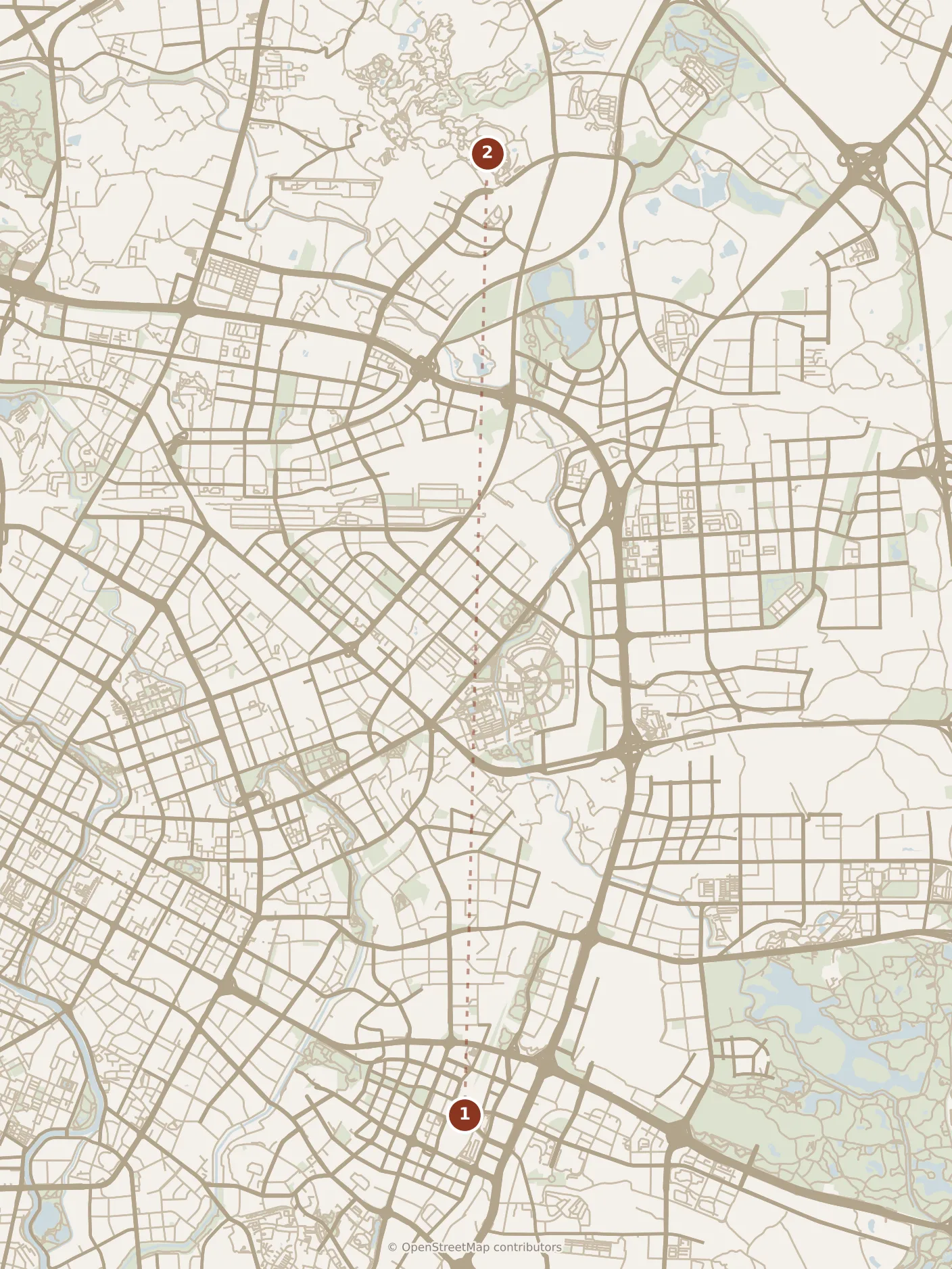
- Morning
- 1Chengdu East Railway Station
- 2Chengdu Research Base of Giant Panda Breeding
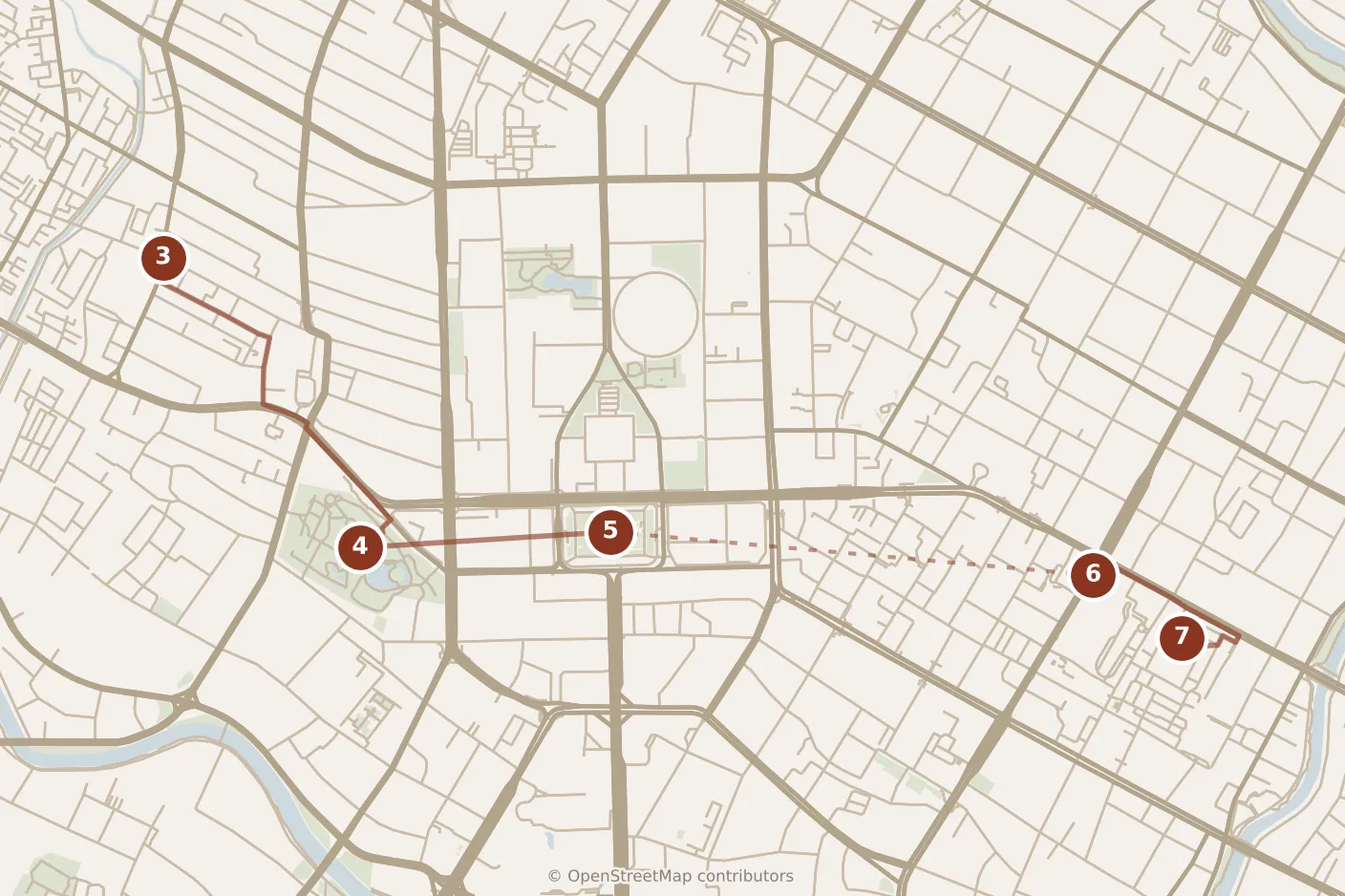
- Afternoon
- 3Kuanzhai Xiangzi
- 4People's Park
- 5Tianfu Square
- 6Chunxi Road
- 7Daci Temple
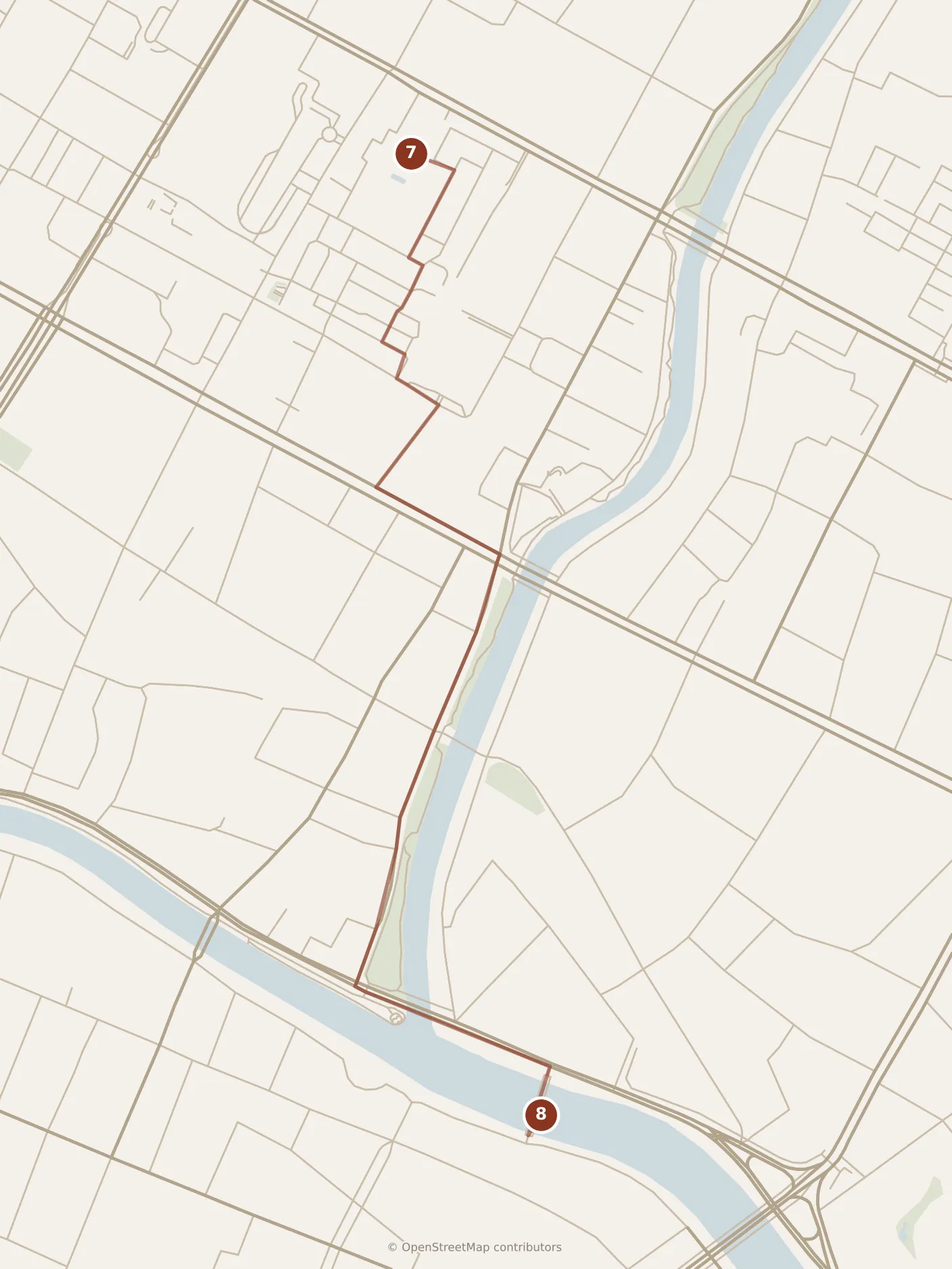
- Evening
- 8Anshun Bridge
Morning
Start at Chengdu East Railway Station, because that is where the bag goes and because the base sits almost exactly due north of it — the same longitude, twelve kilometers up — so the ride out is a straight run rather than a crossing of the city. Take a taxi for this one leg. It is the only place on the day where the money buys you anything, and at that hour the roads are on your side. The metro alternative is Line 2 westbound to Chunxi Road, then Line 3 north to Panda Avenue, and even then you are still a few kilometers short of the gate: shuttle bus 408 from Exit A covers the last of it, to the south gate.
Give the pandas two hours. Do the giant pandas first, while it is still cool, and the red pandas — which are on the same ticket — afterwards. Take the map at the gate: the site is large and wooded, the enclosures are spread across it, and walking it blind costs you the second half of your two hours. Two hours is enough to see the animals doing something, which is the whole point of coming and which stops being available as the morning goes on. If you have half a day you will use it; with two hours you will not feel cheated.
Come back on the metro rather than by road. The traffic that was not there at dawn is against you by late morning, and this leg has no deadline attached to it. Shuttle bus 408 back to Panda Avenue, Line 3 south to Chengdu Second People’s Hospital, then Line 4 west to Kuanzhaixiangzi Alleys, which puts you two minutes from the lanes.
Afternoon
Kuanzhai Xiangzi is three parallel lanes of restored Qing courtyard housing — a wide one, a narrow one, and a third behind them named after a well — now full of tea shops, courtyard cafés and snack counters. Three quarters of an hour. It is heavily touristed and by the middle of the day it looks it, so take it as a set of restored streets to walk down rather than somewhere you will discover anything, and at that length it is a good three quarters of an hour instead of a disappointing two.
Then twenty minutes south-east on foot to People’s Park, which is the middle of this day and the reason it is shaped the way it is. The teahouse under the trees is genuinely unlike anywhere else: a bamboo chair, a lidded cup refilled from a long-spouted kettle for as long as you stay in it, mahjong and cards at the next table, and someone working along the tables with a handful of thin metal tools, offering to clean your ears. Give it an hour and a half and take lunch there — dan dan noodles and small bowls are sold inside the park, and the streets around its edge do the same thing sitting down.
Local tip. Jinli is the other rebuilt Qing lane everybody mentions, and it is the same idea as Kuanzhai Xiangzi done again two kilometers to the south, beside Wuhou Shrine. Take one of them, not both: they are forty minutes apart on foot, and the second one teaches you nothing the first did not.
Fifteen minutes east to Tianfu Square, which you cross rather than visit — a very large paved rectangle with a twelve-meter statue of Mao Zedong standing at one end, arm raised, on a base that lifts the whole monument to thirty, and the provincial science museum behind him. A quarter of an hour. It earns its place because it is the hinge between the older western side of the center and the commercial eastern side, and because you would walk through it anyway.
From there take Line 2 one stop east to Chunxi Road rather than walking it, which is half an hour of shopfronts and traffic lights and buys you nothing. Chunxi Road and the low-rise Taikoo Li blocks running east off it are the busiest ground in the city, and Daci Temple sits in the middle of them: a working Buddhist temple, dark timber halls, incense, with a designer shopping district built right up against its walls. That collision is the most Chengdu thing on this route, and the two halves of it together are worth three quarters of an hour. The temple is the only stop after the base with a gate and hours of its own — if it is shut when you arrive, the blocks around it were half the reason to come east.
Evening
From Daci Temple walk south for about half an hour, picking up the Jin River on the way and following it down, to Anshun Bridge. What stands there is not old — the present bridge was finished in 2003 — and it does not matter: it is a three-arch covered bridge with a restaurant inside it, it is lit after dark, it doubles itself in the water, and the riverside strip of bars and restaurants beside it is where a good part of the city spends its evening. Give the river an hour.
Then add the day up, because its shape is unusual and the total is what you actually plan on. Two hours at the base, three quarters of an hour in the lanes, an hour and a half over tea and lunch, a quarter of an hour crossing the square, three quarters at the temple and its blocks, an hour at the river: six and a quarter hours standing still, with a little over an hour of walking threaded between them. Near enough seven and a half hours of stops and walking — and neither ride is inside that number. The run out and the run back are longer by road than the twelve kilometers on the map, and they are the part of this day that can double. That, rather than any claim about opening hours, is the argument for the early start: it is the only slack the day has.
Which means you will usually reach the river before the light has gone, by the two to four hours the band above gives you. Do not spend that gap on a ninth stop. Spend it earlier — a second cup in the park, a longer wander in the lanes — because the two best half hours on this route are both in the middle of it, and a riverbank at dusk is in any case the one place today where sitting and waiting costs you nothing.
Then Dongmen Bridge station is a quarter of an hour back north along the bank from the bridge, and Line 2 runs east from it to Chengdu East Railway Station and your bag. That is the whole of the end of the day, and it is why the bridge goes last: it is the only stop on this route that is already pointing at the station you leave from.
Practicalities
The one thing that has to be arranged before you arrive is the panda base ticket. Entry is by online reservation in your own name, matched to the passport you hand over at the gate, and the window at the gate is a thin fallback — it sells only to visitors who cannot pay online, and only while tickets last. Turning up without a booking is the single way the day breaks completely. Adult admission was in the fifty-to-sixty-yuan range in 2026. The rest of the route — the lanes, the park, the square, the shopping streets, the bridge — costs nothing to walk into, and the base ticket is the only admission on the day — the taxi out, the metro, and tea and lunch in the park are the rest of what you spend. How the metro is paid for, and how you pay for anything at all in this country, is the city guide’s subject, and for a first visit it is not optional reading.
This route is unusually closure-proof, which is worth knowing if your one day lands on a Monday: streets, a park, a square and a bridge do not shut, and the base is a zoo rather than a museum. Two things can still catch you. Daci Temple has a gate and hours of its own, so check that one before you fix the order of the afternoon; if it is shut, the blocks around it still carry the hour. And the base during a national holiday week is a different proposition altogether — the city guide names the weeks to avoid, and on this particular day the difference is between seeing pandas and seeing the backs of the people looking at them.
Moving between the stops this article names is a taxi, three metro lines and a shuttle bus, and the transfers are the only fiddly part, so they are worth writing down before you set out. Out: a taxi from Chengdu East Railway Station to the south gate — or, by metro, Line 2 west to Chunxi Road, Line 3 north to Panda Avenue, shuttle bus 408 from Exit A. Back: the shuttle to Panda Avenue, Line 3 south to Chengdu Second People’s Hospital, Line 4 west to Kuanzhaixiangzi Alleys. After that the afternoon is on foot as far as Tianfu Square, one stop on Line 2 to Chunxi Road, and on foot again to the end. Home: Dongmen Bridge on Line 2, east to Chengdu East Railway Station.
If you are staying in the center rather than passing through, nothing about the day changes except its two ends. Join it at the base, finish it at the bridge, and take Line 2 back to wherever you are sleeping instead of out to the station.


