Cape Town in two or three days: the mountain, the island and a day down the Cape Peninsula

Last updated 21 October 2026
Overview
Cape Town is not a walking city the way an old European center is. The things worth seeing sit around a mountain rather than inside a grid, and the honest shape of a short stay is three pieces: the mountain and the old town below it, the harbor and the island off it, and the peninsula running south to the point. Two days covers the first two properly. The third day is the peninsula, and it needs a car, which is why the title says so.
Inside each day you walk — the City Bowl from the museum to the garden to Bo-Kaap, the harbor from the ferry to the gallery — but between the pieces you ride. Ride-hailing apps are how most visitors make those short hops, and they are the sensible choice after dark, when walking between districts is not what residents do either. The city’s own buses are MyCiTi, paid with a myconnect card bought at the larger stations; its airport route was suspended when this was written, so arrive by ride-hailing car, and the parent guide covers the rest of how the buses work.
Two things decide the order before you read the days. The first is wind. The cableway up Table Mountain stops when the wind is high or the cloud sits on the summit, and that is a fact of the place, not a warning: it can happen on any day of the year. So the mountain is the stop that floats. If day one dawns clear, take it as written. If it does not, swap day one’s morning with whichever later morning is clear, and do the rest of day one in the afternoon as planned. The second is sea: the ferry to Robben Island is also cancelled in a heavy swell, and day two says what to do then.
Both evenings below are built around the last light, on a hill and then on the sea front. The sun sets here from about a quarter to six in early June to just after eight in early January, so take your month’s hour and count back from it as each day explains.
Kalk Bay, Boulders Beach — not on the walking map; you get there by scooter, bike or car.
- With a third day · Morning
- Kalk Bay — in the prose, not on the map
Cape Point — not on the walking map; you get there by scooter, bike or car.
Chapman's Peak Drive — not on the walking map; you get there by scooter, bike or car.
- With a third day · Evening
- Chapman's Peak Drive — in the prose, not on the map
Day one

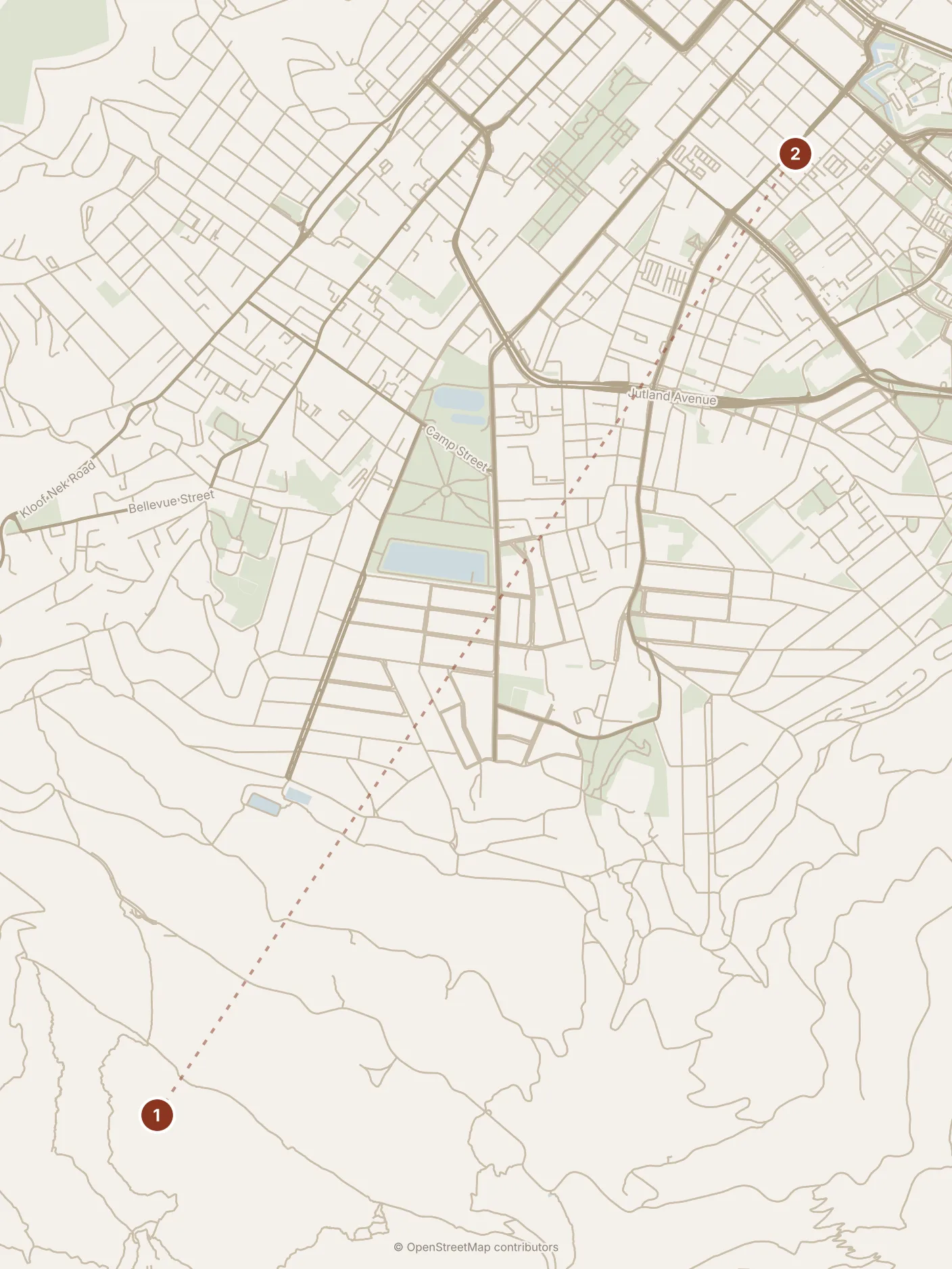
The ride on to stop 2, by taxi, not on foot.
- Morning
- 1Table Mountain Aerial Cableway
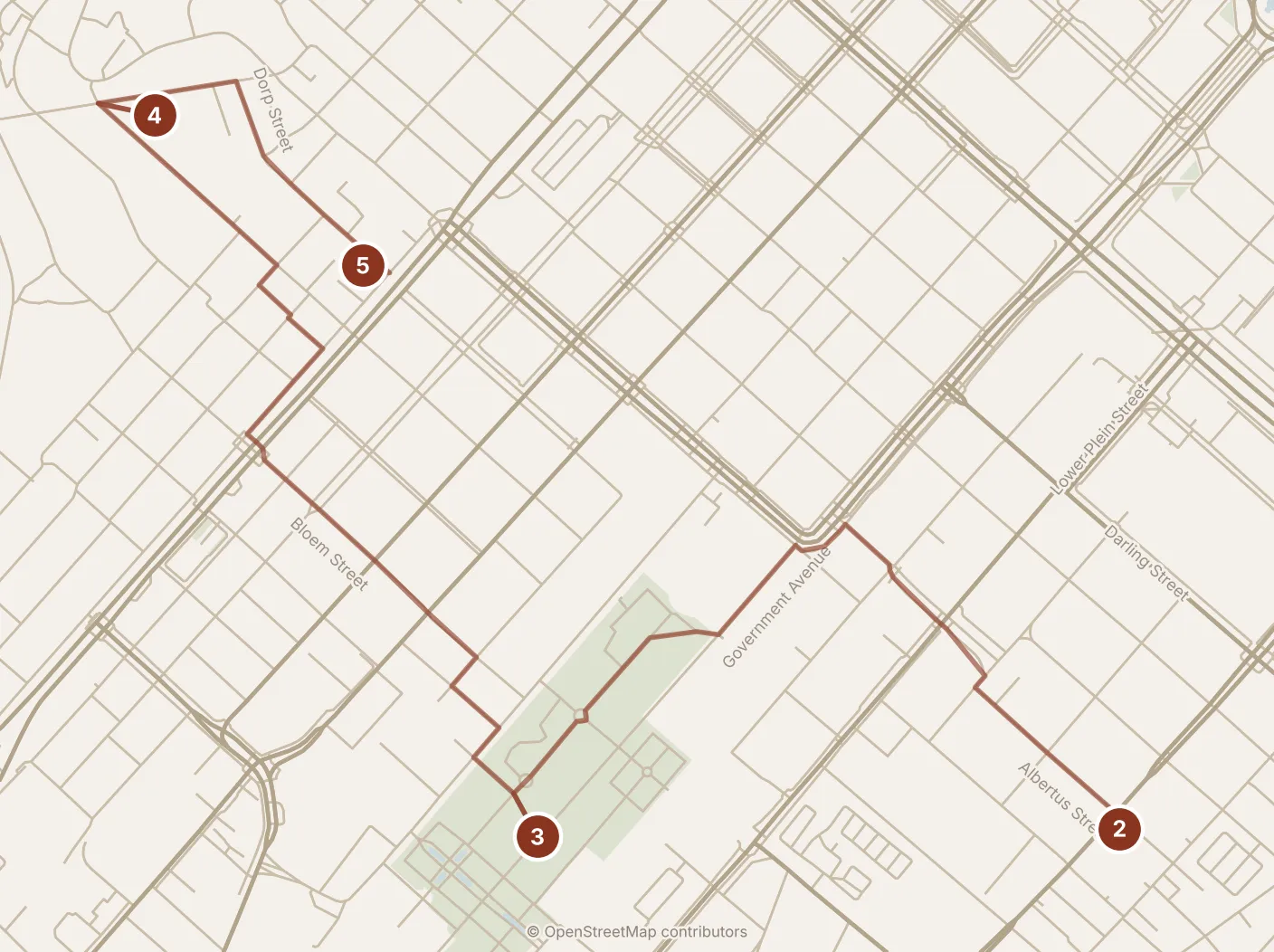
- Afternoon
- 2District Six Museum
- 3Company's Garden
- 4Bo-Kaap
- 5Auwal Mosque
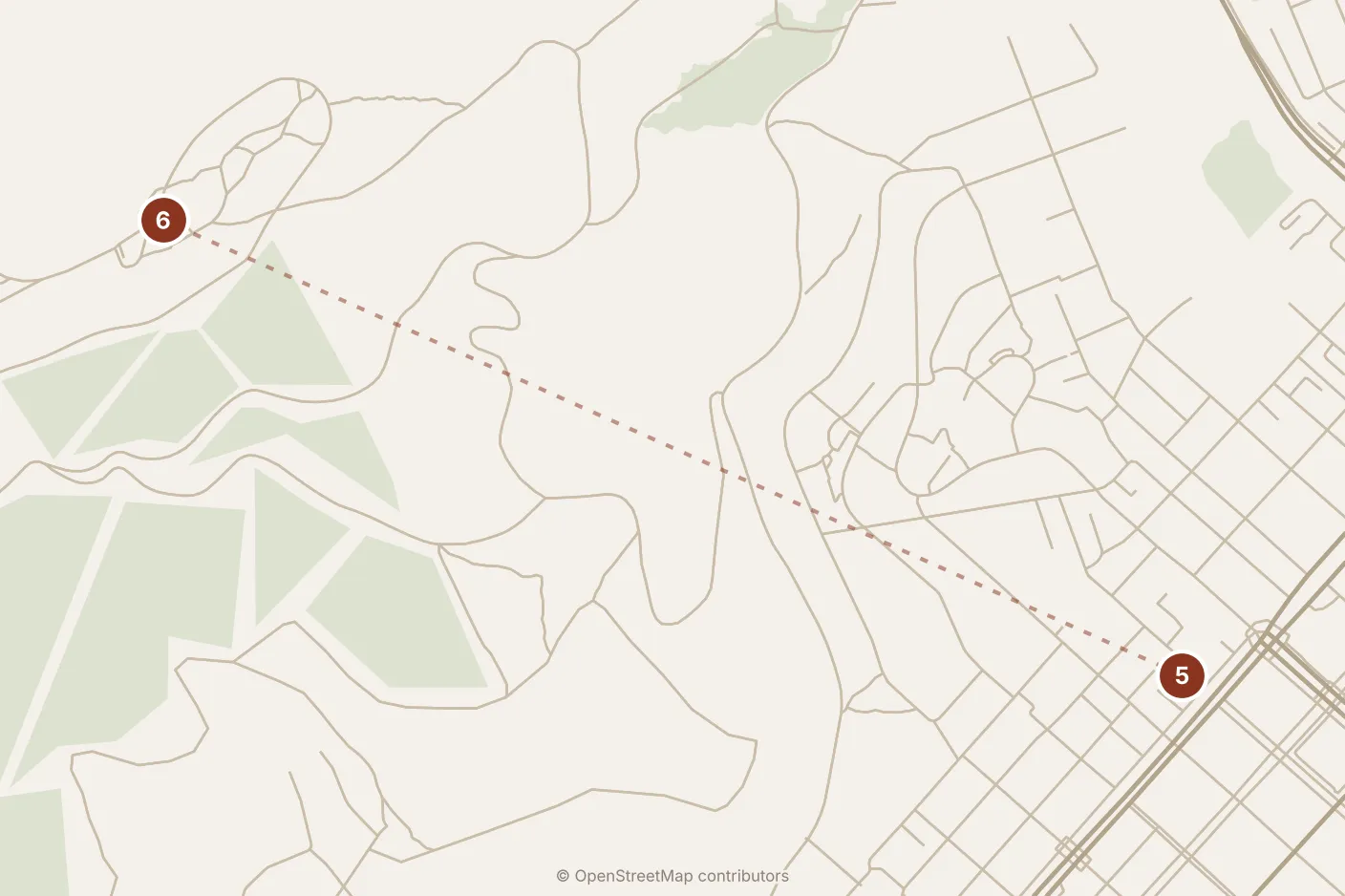
The leg out of the center: from stop 5 by taxi, not on foot.
- Evening
- 6Signal Hill
The mountain first, then down into the oldest part of the city, which is compact enough to walk end to end in an afternoon, then up again for the evening.
Morning
Get to the lower cable station on Tafelberg Road as early as the cableway runs. A ride from the City Bowl takes about a quarter of an hour; the road climbs from Kloof Nek along the mountain’s front to the station. Tickets are sold online and at the station, and the line at the station is the reason to buy online: an adult return bought online is R475 for the year from July 2026. The car rotates on the way up, so everyone gets the whole view without fighting for a window.
The top is a flat sandstone plateau, not a peak, with short paved paths looping from the upper station to the edges. Walk the loop to the side that looks down on the City Bowl and the harbor, then the side facing the Twelve Apostles, the run of buttresses dropping to the Atlantic, with Lion’s Head below you and Robben Island out in the bay. Give the top an hour and a half and go down. The longer walks across the plateau are for people with a whole day and a map.
The alternative to the cable car is the climb up Platteklip Gorge from Tafelberg Road, a staircase of rock straight up the front face with no shade. It is the shortest way up on foot and it is not a casual walk: do it only if you hike at home, carry water, and start in the cool. If the cableway is stopped for wind, the climb is not the workaround — the top is the place the wind is.
Local tip. If the summit is under cloud when you wake, do not go up hoping it lifts. Swap this morning with a clear one later in the trip; everything else on day one works in any weather.
Afternoon
Ride down into the center to the District Six Museum on Buitenkant Street. District Six was a mixed neighborhood on the slope east of the center; under the Group Areas Act it was declared white in 1966, its people were moved out to the flats far from town, and the houses were bulldozed. The museum is a former church, and its floor is a large hand-drawn map of the vanished streets on which former residents have written where their homes stood. Give it an hour. It is small and it is the thing that makes the rest of the city legible. It opens Monday to Saturday, 9:00 to 16:00, closed on Sundays, and asks visitors to book a slot ahead.
From the museum it is about fifteen minutes on foot west to the bottom of the Company’s Garden, entered along Government Avenue. This is the oldest garden in the country, laid out by the Dutch East India settlement to grow vegetables for passing ships, now an oak-shaded avenue running uphill past the back of Parliament with the Iziko South African Museum at its top end. Walk the avenue up and back and give it forty-five minutes. The museum at the top is worth a visit only on a wet afternoon; on a dry one, skip it and keep the time for what follows.
From the garden’s lower end, walk west along Wale Street, across Buitengracht, and the street starts to climb into Bo-Kaap — about twelve minutes. This is the old Cape Malay quarter, the houses painted in flat bright colors along steep cobbled streets, with the mosques that make it the historic heart of the city’s Muslim community. A block off Wale Street on Dorp Street is the Auwal Mosque, built at the end of the eighteenth century and generally held to be the oldest in the country. Bo-Kaap is a neighborhood people live in, not a backdrop: the colored houses are homes, and photographing residents on their own steps without asking is the thing that has made visitors unwelcome here. Dress modestly if you go near a mosque door, and do not enter one during prayer.
This is the place for a late lunch — Cape Malay food, bobotie or a curry, in a small dining room on one of these streets. Give it an hour.
Evening
Ride up Signal Hill, ten to fifteen minutes from Bo-Kaap by the road that climbs around Lion’s Head to the flat top. This is the stop the day is built around, and it wants the half-hour before sunset: the city and the harbor on one side, the Atlantic and the sea front on the other, and Table Mountain behind with the light going off it. Work backwards: from leaving the mountain to standing here, the afternoon above comes to about five hours — the ride down, the museum, the walk, the garden, the climb into Bo-Kaap and lunch — so leave the cable station about five and a half hours before your month’s sunset. The count does not include the line for the cable car going up, which on a clear summer morning can be the longest single wait of the day. If it costs you an hour, cut the garden, not the museum.
Come down by ride when the light has gone. The top is a car park on an open hill, and nobody walks down it in the dark.
Day two

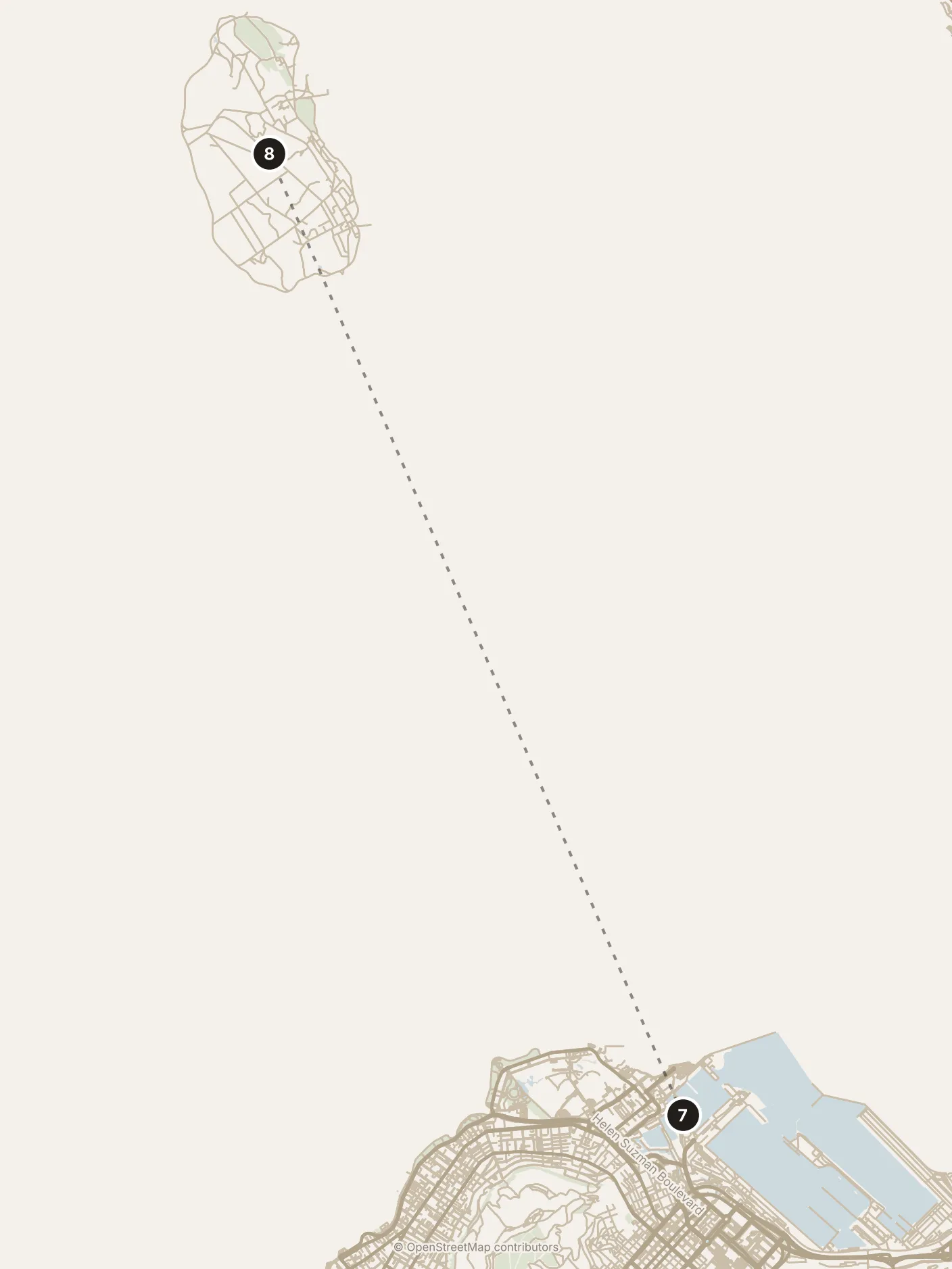
- Morning
- 7Nelson Mandela Gateway
- 8Robben Island
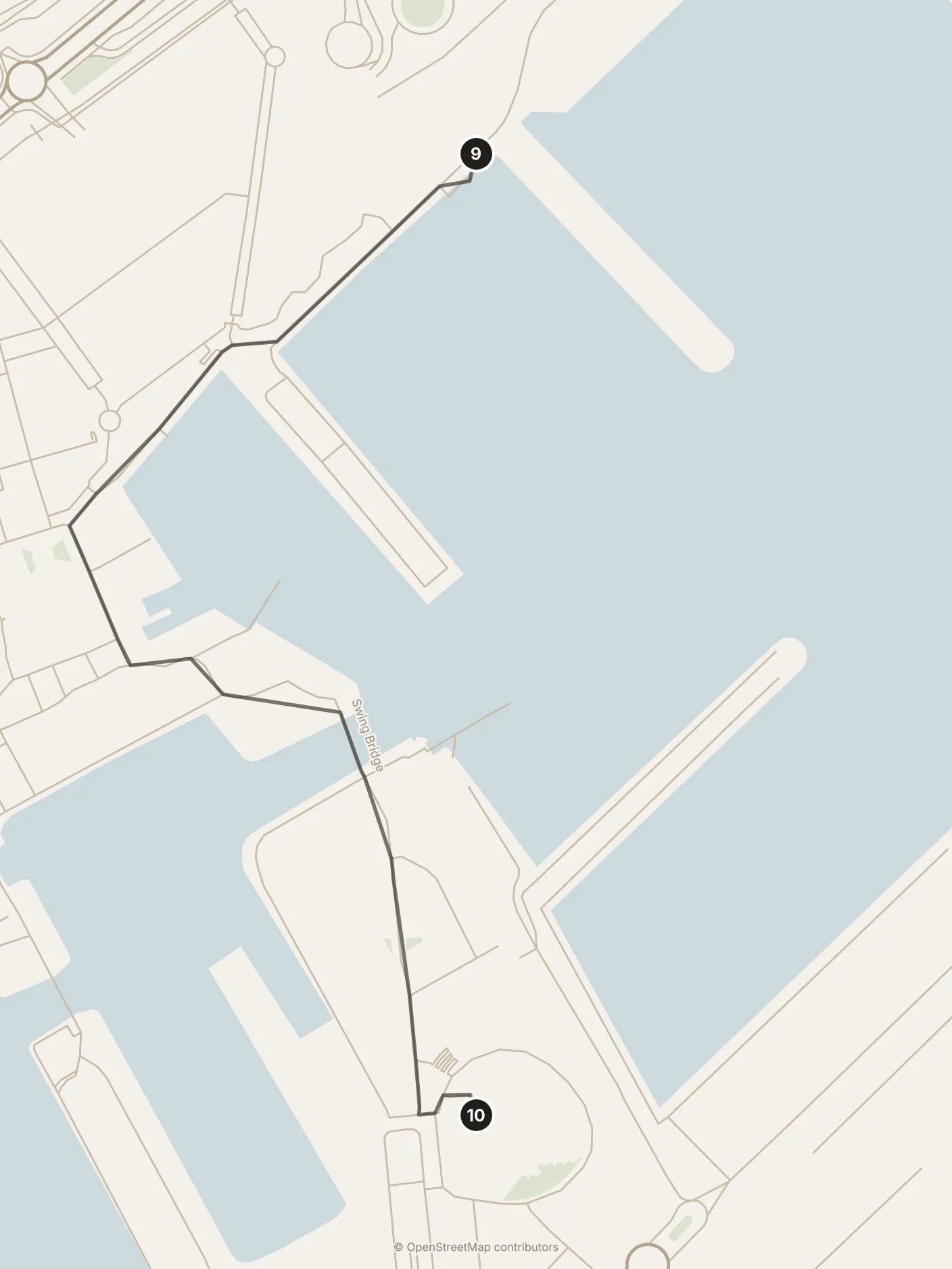
- Afternoon
- 9V&A Waterfront
- 10Zeitz MOCAA
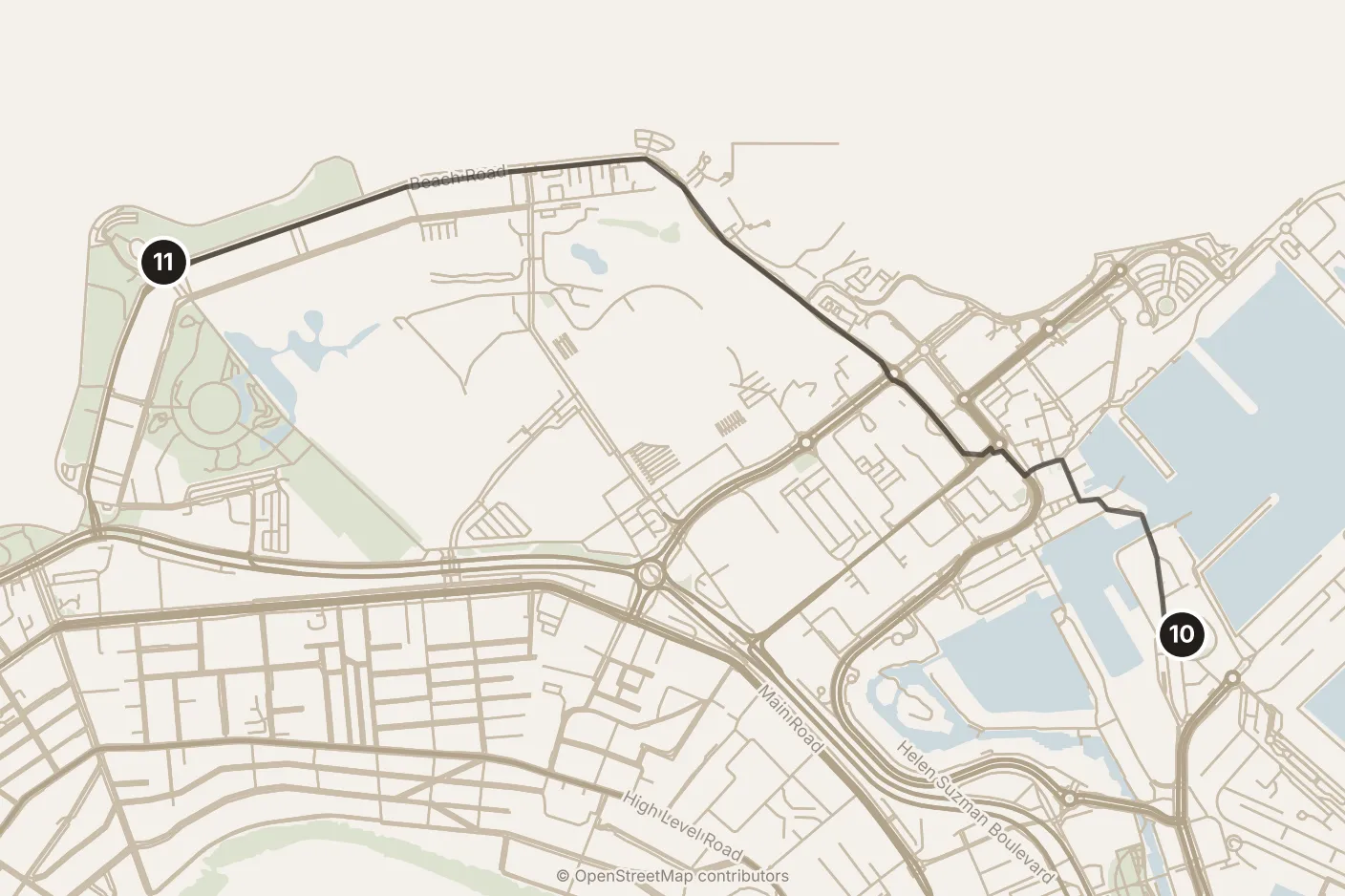
- Evening
- 11Green Point Lighthouse
- Sea Point Promenade — in the prose, not on the map
The harbor, and the island the harbor looks at. The morning is fixed by a ferry, so this is the day you plan backwards from a ticket rather than from the light.
Morning
The boats to Robben Island leave from the Nelson Mandela Gateway beside the Clock Tower, at the old end of the V&A Waterfront; a ride from the City Bowl takes ten minutes. Tickets are sold by the Robben Island Museum itself, online, and in summer they can run out weeks ahead, so this is the one thing on the route to book before you travel. Arrive half an hour before your departure. The whole visit — crossing out, the tour, crossing back — runs to about three and a half to four hours, and it is a fixed tour, not a site you wander.
The island was a prison for most of the twentieth century and Nelson Mandela was held here for eighteen of his twenty-seven years. The tour has two halves. A bus goes round the island past the limestone quarry where prisoners worked in a glare that damaged their eyes, and past the house where the leader of another banned party was held alone. Then a guide, often a former political prisoner, takes you through the maximum-security block and to Mandela’s cell, which is small enough that most people go quiet in the corridor. That second half is the reason to come, and it is the one part of the day that will not be the same in ten years, because the men who guide it are growing old.
The ferry is cancelled in a big swell, and the museum says so on the morning. If it is, the morning goes to the Two Oceans Aquarium at the Waterfront, five minutes’ walk from the Gateway, and the afternoon runs as written. Try the island again on day three’s morning, and give day three’s peninsula drive the next clear day instead.
Afternoon
You land back by early afternoon at the Clock Tower. Lunch is at the Waterfront, which is a working harbor turned into a shopping and eating district; it is easy and not cheap, and fish on the quays is the obvious meal.
Then walk about ten minutes across the Waterfront to the Silo District and Zeitz MOCAA, the museum of contemporary art from Africa and its diaspora, opened in 2017 inside a concrete grain silo. Thomas Heatherwick’s studio cut the atrium out of the silo’s tubes, so you stand in the middle of the building looking up at curved concrete sections sliced open like a cross-section of a honeycomb. That atrium is worth the visit by itself. The collection rotates across several floors; give it ninety minutes, take the floors that hold you, and do not try to see them all.
Evening
Walk out of the Waterfront west toward Mouille Point and the red-and-white striped Green Point Lighthouse, about forty minutes on foot from the silo, or a five-minute ride if the afternoon has been long. From there the Sea Point Promenade runs south along the Atlantic, a paved sea front with grass behind it and the sea breaking on rocks below. Walk it toward Sea Point as the sun drops into the ocean in front of you; this is the evening’s hinge, and it wants the last hour of light. Count back: the gallery, the walk out and the start of the promenade come to about three hours from the end of lunch, so finish lunch three hours before your month’s sunset.
The water here is the cold Atlantic, and the rocks below the promenade are not a beach; swim only at a beach with lifeguards, between their flags. Take a ride back from the promenade at the end; it is a short trip to the Waterfront or the City Bowl.
With a third day

Give it the peninsula, and give it a car: down the False Bay side to the penguins, out to the point, and back up the Atlantic side on the cliff road for the last light. There is a train, Metrorail’s Southern Line to Simon’s Town, but it does not reach the point and its reliability is the reason visitors do not plan a day around it. Without a car, take the alternative at the end of this section instead.
Morning
Drive south past Muizenberg along the edge of False Bay, about forty minutes, to Kalk Bay, a working fishing harbor where boats land their catch on the quay and the main road is lined with junk shops and old buildings. Stop for half an hour and coffee.
Then another fifteen minutes south through Simon’s Town to Boulders Beach, part of Table Mountain National Park, where a colony of African penguins nests among the granite boulders. Paid boardwalks run over the nesting area and down to a viewing platform; the birds are a few feet away. Stay on the boardwalks — the penguins are endangered and protected, and the rangers mean it. Give it an hour.
Afternoon
Cape Point is half an hour further, inside the reserve gate of the national park. From the car park a funicular, the Flying Dutchman, takes you up to the old lighthouse, or you walk the path in a quarter of an hour; from the top you look down the last cliffs of the peninsula. Give it two hours, including the short drive to the sign at the Cape of Good Hope, the rocky headland a little west, which is the one everyone photographs.
Baboons live here and at the car parks, and they know that bags and open car doors mean food. Keep windows shut, eat in the car, and never feed them: it is against the park’s rules, and a baboon that has learned it is eventually put down. The reserve publishes its gate hours itself, and they are shorter in winter; read them before you set out, because the gate closing is what decides when you leave the point, and the drive north needs the light.
Evening
Drive north up the Atlantic side through Noordhoek and onto Chapman’s Peak Drive, a toll road cut into the cliff above the sea, with a pull-in at the top. This is the hinge of the day and it wants the hour before dark, with the sun in front of you over the water. Count back: from the point, the drive to the start of the cliff road is about forty minutes, and the reserve, the penguins and the harbor above add up to about five hours, so leave the city about seven hours before your month’s sunset. The count does not include the line at the Boulders gate, which on a summer weekend is the slowest part of the day.
Chapman’s Peak Drive closes for rockfall risk after heavy rain or in strong wind. If it is shut, go back the way you came along False Bay and keep the sunset for the beach front at Muizenberg. Otherwise come down into Hout Bay and drive back to the city around Camps Bay, under the Twelve Apostles, about forty minutes.
Without a car, give the day to Kirstenbosch National Botanical Garden on the eastern slopes of the mountain, a twenty-minute ride from the center. Founded to grow the plants of southern Africa, it is laid out up the mountainside, with the Boomslang, a curved steel walkway through the treetops. Give it three hours, and it rests on no hour of the day at all.
Practicalities
Book before you arrive: the Robben Island ferry, from the Robben Island Museum, days or in summer weeks ahead, and a slot at the District Six Museum. Buy the cableway ticket online on the morning you go up, once you know the cars are running: it spares you the line but not the wind. If you hire a car for the third day, book it with the trip.
The days are built to move. The mountain floats to whichever morning is clear. Day two must fall on a day the ferry sails, which is a matter of weather rather than the calendar, so when the swell cancels it, swap days two and three. The District Six Museum is the one stop here that closes a day a week, on Sundays — if day one lands on a Sunday, swap days one and two, since the harbor and the island do not care — and it asks you to book a slot. Nothing else on the route depends on the weekday.
Inside each day the walking is short: the longest stretch on foot is the forty minutes from the silo to the lighthouse on day two, and a ride replaces it if you would rather. Every transition between the pieces — mountain to center, Bo-Kaap to Signal Hill, the City Bowl to the Waterfront — is a short ride, and after dark that is how you move.


