Cape Town in one day: the mountain first, the city below it, and Signal Hill at sunset

Last updated 21 October 2026
Overview
One day in Cape Town is a day spent around one mountain, and the order is decided by the mountain rather than by you. Table Mountain goes first, because the cableway stops in high wind and cloud can settle on the summit within the hour; a morning attempt that fails can be tried again in the afternoon, while an afternoon attempt that fails is simply lost. Everything after it is the city at the mountain’s foot, walked, and the day ends on Signal Hill, the low shoulder to the west, watching the sun go into the Atlantic.
What a single day costs you is everything outside the city bowl. Robben Island is a half-day on its own, from the ferry to the end of the tour; the beaches beyond Camps Bay, the peninsula and the winelands are each a day. None of them fit, and pretending otherwise is how a one-day itinerary turns into a day spent in traffic.
The legs here are short in distance and steep in practice. The city center is compact and flat enough to walk, but the mountain and Signal Hill sit above it on roads nobody should walk up with a day this full, so the rides up and down are by ride-hailing car and everything in between is on foot.
The day is built around the sunset, so you need its hour. In Cape Town the sun sets from about a quarter to six in early June to just after eight at the start of January — summer here is the northern winter. Take your month’s hour and count back the durations below.
The day

- Morning
- 1Cape Town station
- 2Table Mountain Aerial Cableway
- Afternoon
- 3Bo-Kaap
- 4Company's Garden
- 5District Six Museum
- Evening
- 6Signal Hill
- 7Cape Town station
Morning
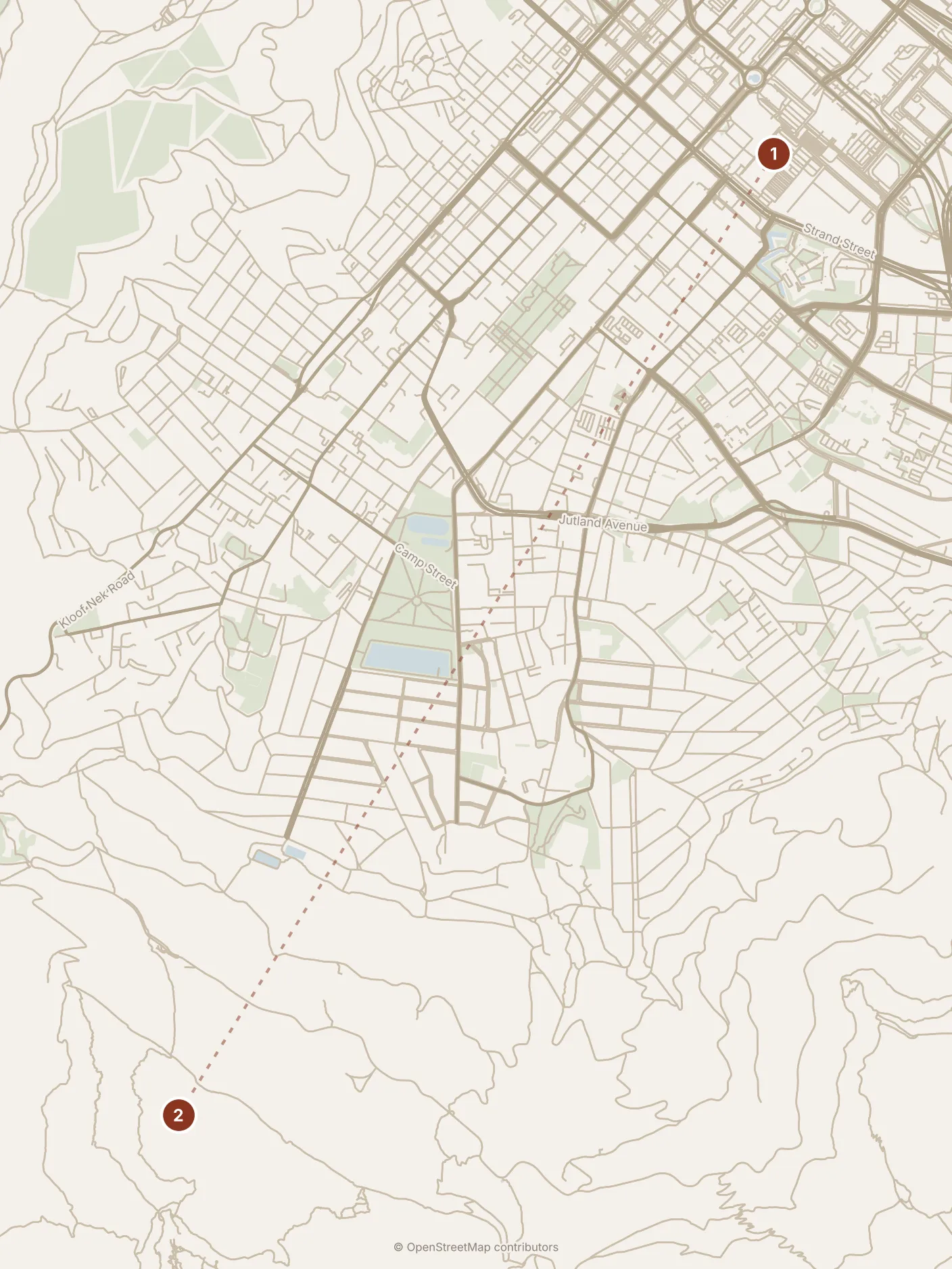
The day starts in the center, at Cape Town station, where long-distance trains come in. If you are coming from the airport instead, take a ride-hailing car: MyCiTi’s airport bus was suspended when this was written. From the center, the lower station of the cableway is a quarter of an hour by ride-hailing car up Tafelberg Road. The MyCiTi bus goes as far as Kloof Nek, but that leaves a long uphill walk to the cars, and this is not the day for it.
The Table Mountain Aerial Cableway is the stop the morning is for. The car turns a full circle on its way up, so everyone gets every view; the ride is a few minutes. At the top, the paved paths along the front edge look down on the whole city bowl, across Table Bay to Robben Island, and round past Lion’s Head to the Twelve Apostles running south above Camps Bay. Give the top an hour and a half. If the summit is clear and you have the legs, the path out to Maclear’s Beacon, the highest point of the mountain, is the walk worth taking; give it an hour there and back and drop it the moment cloud comes in, because then it is a walk through fog to a pile of stones.
The cableway sells its tickets online on its own website and at the lower station. Buying online skips the ticket line, not the line for the car, which in summer is the largest thing this day’s arithmetic leaves out. It also posts whether the cars are running, and that is the one thing to read before you leave the center: if it says the wind has stopped them, do the city half first and come back to the mountain after lunch.
Afternoon
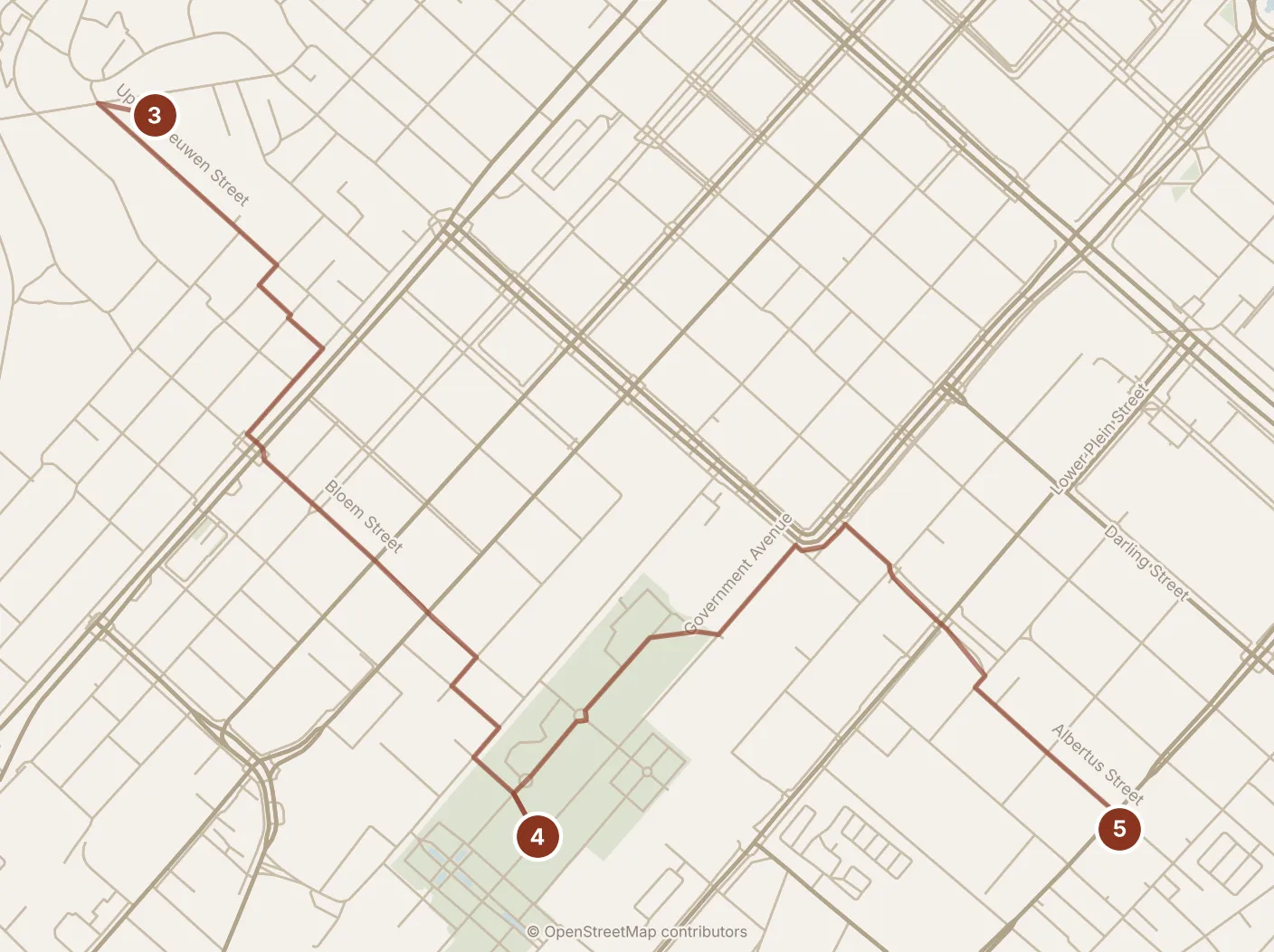
Take a ride straight down to Bo-Kaap, a quarter of an hour. This is the hillside quarter of steep cobbled streets and houses painted in flat, loud colors, home since the eighteenth century to the Cape Malay community, descended largely from enslaved people and political exiles brought from Southeast Asia. Walk the grid above Wale Street for forty-five minutes and have lunch here: Cape Malay cooking is the reason to eat in this quarter rather than anywhere else, and bobotie or a curry with rotis at a table is the meal of the day. These are people’s homes and the mosques are working ones; the people on the doorsteps are not part of the view, so ask before you photograph anyone.
From Bo-Kaap walk down Wale Street, crossing the main road, past St George’s Cathedral to the foot of Company’s Garden — about twelve minutes. The garden began as the Dutch East India Company’s vegetable plot for passing ships in the 1650s and is now the shaded avenue at the heart of the old center. Walk it uphill under the trees for three quarters of an hour; the Iziko South African Museum stands at its top end, and on a day as short as this one it is the indoor stop to give up.
From the garden it is about fifteen minutes east on foot to the District Six Museum on Buitenkant Street. District Six was a mixed inner-city neighborhood declared a white area in 1966, after which some sixty thousand people were removed and their houses bulldozed. The museum, in a former church, holds the street signs, the maps on which former residents marked their own houses, and their testimony. Give it an hour. The Castle of Good Hope is a few minutes further on; leave it unless you have time to spare.
Evening
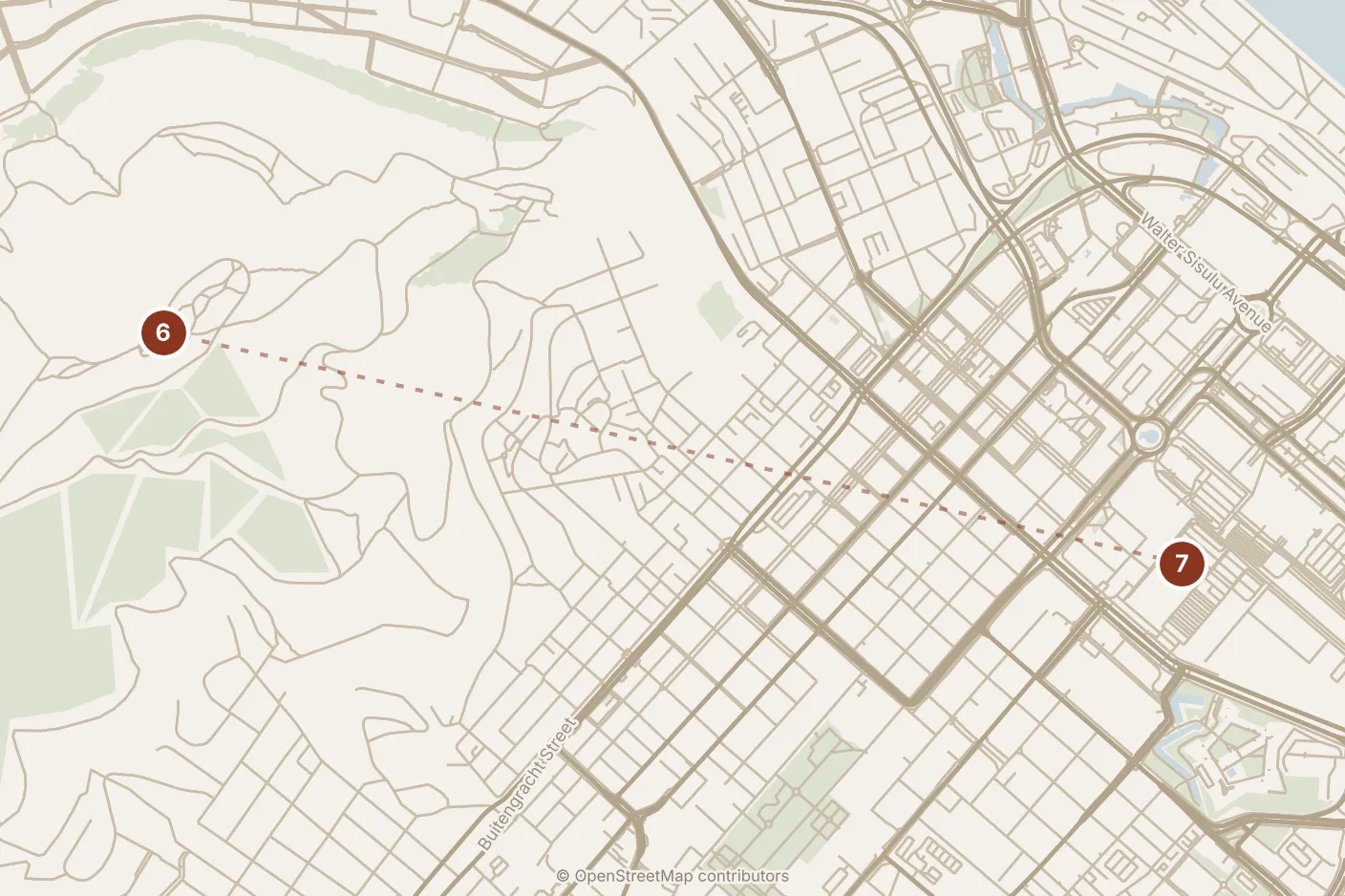
Signal Hill is the stop the day is built around, so work backwards. It wants half an hour before the sun goes, and everything above it — the mountain, the rides, Bo-Kaap with lunch, the garden, the walks and the museum — comes to about seven and a half hours, which in June means being at the cableway by half past nine. In January the sunset leaves hours to spare, but the District Six Museum closes at 16:00, so the museum sets the start, not the sun: be at the cableway by nine in any month, and spend a summer surplus after the museum, at the Castle of Good Hope or on a slower walk, before going up to Signal Hill. The count does not include the line for the cableway, which on a summer day can be the longest single item.
From the District Six Museum it is about twenty minutes by ride-hailing car up to Signal Hill. The sun goes straight into the sea, with Lion’s Head beside you and the city lights coming on below. Take a ride down again rather than walking it after dark; Cape Town station is about a quarter of an hour away by road, which is the margin to keep if you have a train or a flight to catch.
Local tip. If the day is running late, cut the garden, not the museum: the garden is a walk you can take on any visit, and District Six is the hour that explains the rest of the city.
Practicalities
Two things are worth booking. The cableway: an adult return bought online is R475 for the year from July 2026, more at the ticket office. Buy it online for the day you are here, not further ahead: the ticket is no use if the wind closes the cars, and the cableway’s own site says how a weather closure is handled. And the District Six Museum, which asks visitors to book a slot ahead.
There is no left-luggage office on this route that we would send you to, and that changes the day. The summit paths and the cobbled climb through Bo-Kaap are the two stops that are bad with a case. A reader holding one should keep the rides door to door, stay on the paved front edge at the top instead of walking out to the beacon, and see Bo-Kaap from its lower streets before going straight on to the garden, which is flat.
The District Six Museum opens Monday to Saturday, 9:00 to 16:00, and is closed on Sundays; if your day is a Sunday, or it is shut for a holiday, the Castle of Good Hope, a few minutes further along the same way, keeps the afternoon. If rain or wind keeps the cableway shut all day, the day still works without it: Bo-Kaap in the morning, the garden with the Iziko museum at its top, and District Six after lunch, with Signal Hill kept for the evening if the cloud lifts.


