Buenos Aires in one day: the historic center, San Telmo, Recoleta and Palermo

Last updated 3 August 2026
Overview
Buenos Aires has no old town, and a day here goes wrong when it is planned as though it had one. The city is flat and enormous, laid out on a grid that repeats for kilometers in every direction, and the things a visitor comes for are not in one place. No amount of good walking joins them up.
So this day is three walkable pockets with two short rides between them, and it runs in one direction: east across the historic center, south into the oldest barrio, then north twice, and never back. Each pocket is walkable end to end; what is not walkable is the space between them. And what separates them is character as much as distance — they are three different cities, and a day inside only one of them has seen a district rather than Buenos Aires.
What this costs you is most of the famous list, and the list is worth naming so that you can disagree with it. The museums go first: they are good, and an hour indoors is the hour that would have bought you the avenue, the market and a lunch sitting down. The parks go with them, because they lie beyond the last stop and they are for people with a second day. And La Boca goes too. Caminito is one short painted street, it sits on its own with nothing else within walking distance, the blocks around it are not ones to drift into by accident, and on a single day the round trip out and back costs you half of it in exchange for a photograph you have already seen. With three days, go. With one, do not.
What you get instead is a city rather than a set of sights: the square where the country’s politics still physically happen, an avenue built by people who wanted to live in Madrid, a market hall of 1897, and a walled town of marble that is the strangest place in Buenos Aires and the one you will still be turning over on the flight home.
One note on the shape. The last stop is not a monument but a neighborhood, and it is there because the evening in this city begins far later than most visitors plan for. A day that finishes at seven has finished before Buenos Aires has started. This one is built to hand you over to it.
The day

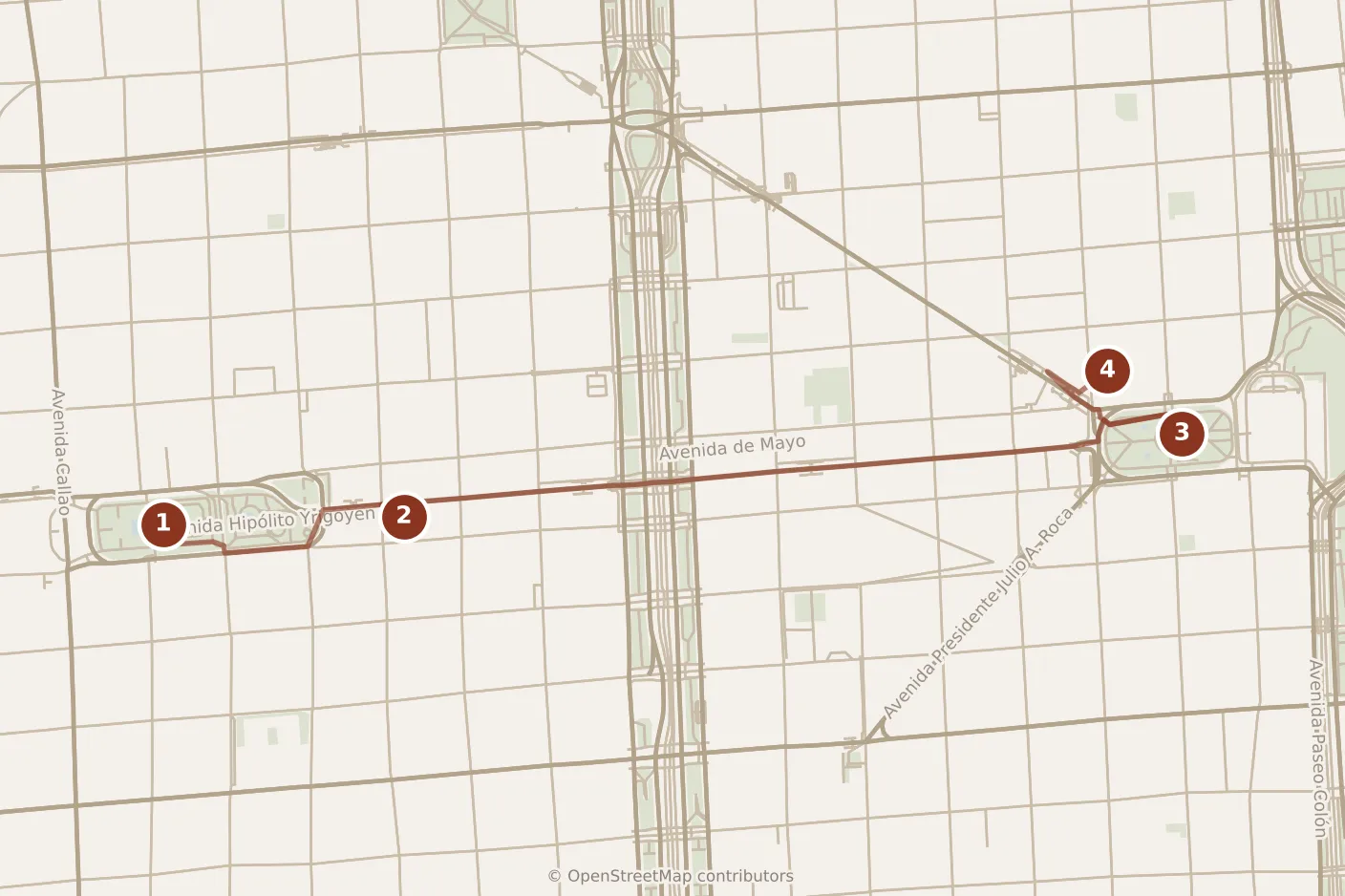
- Morning
- 1Plaza del Congreso
- 2Palacio Barolo
- 3Plaza de Mayo
- 4Catedral de Buenos Aires
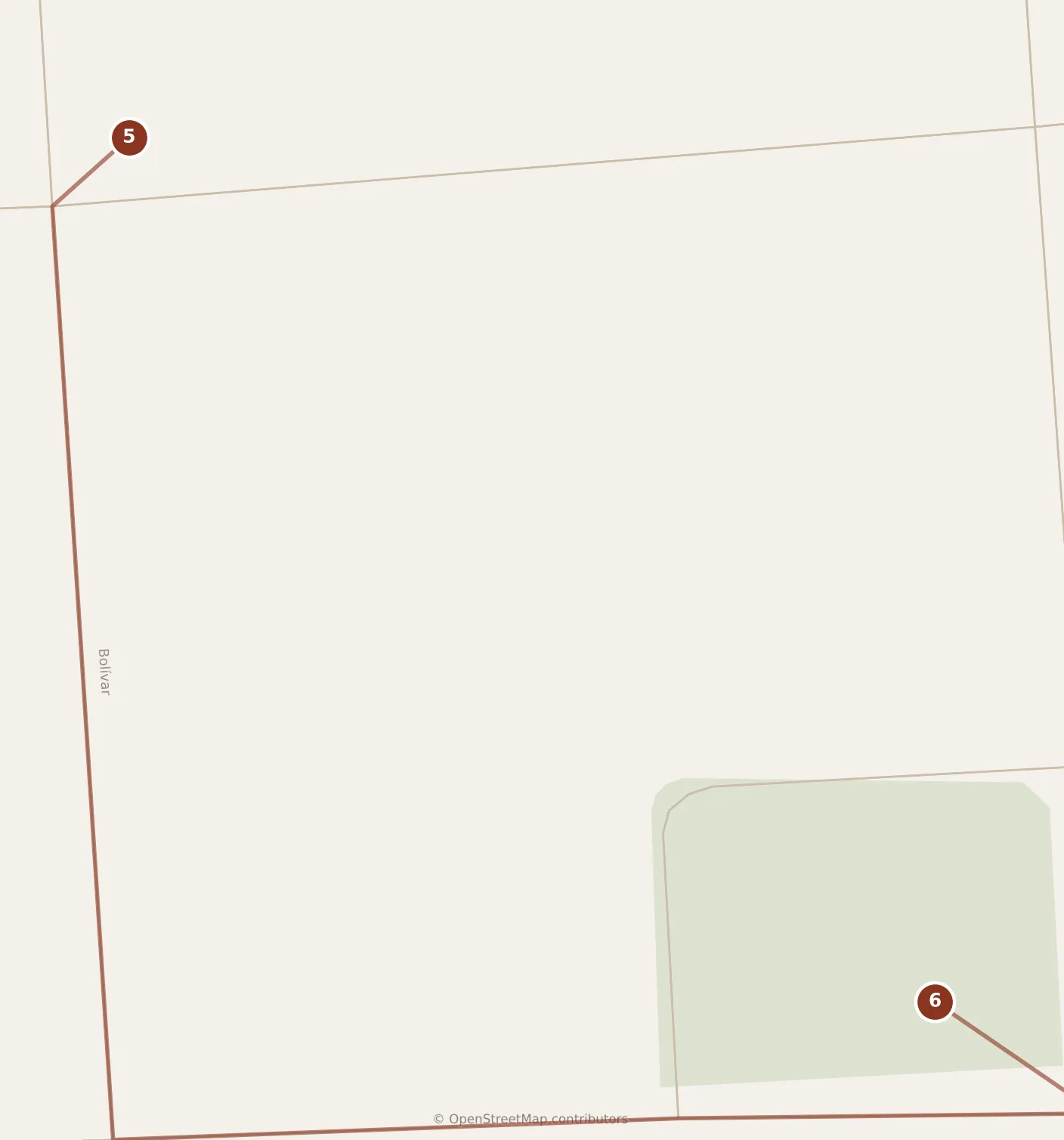
- Afternoon
- 5Mercado de San Telmo
- 6Plaza Dorrego
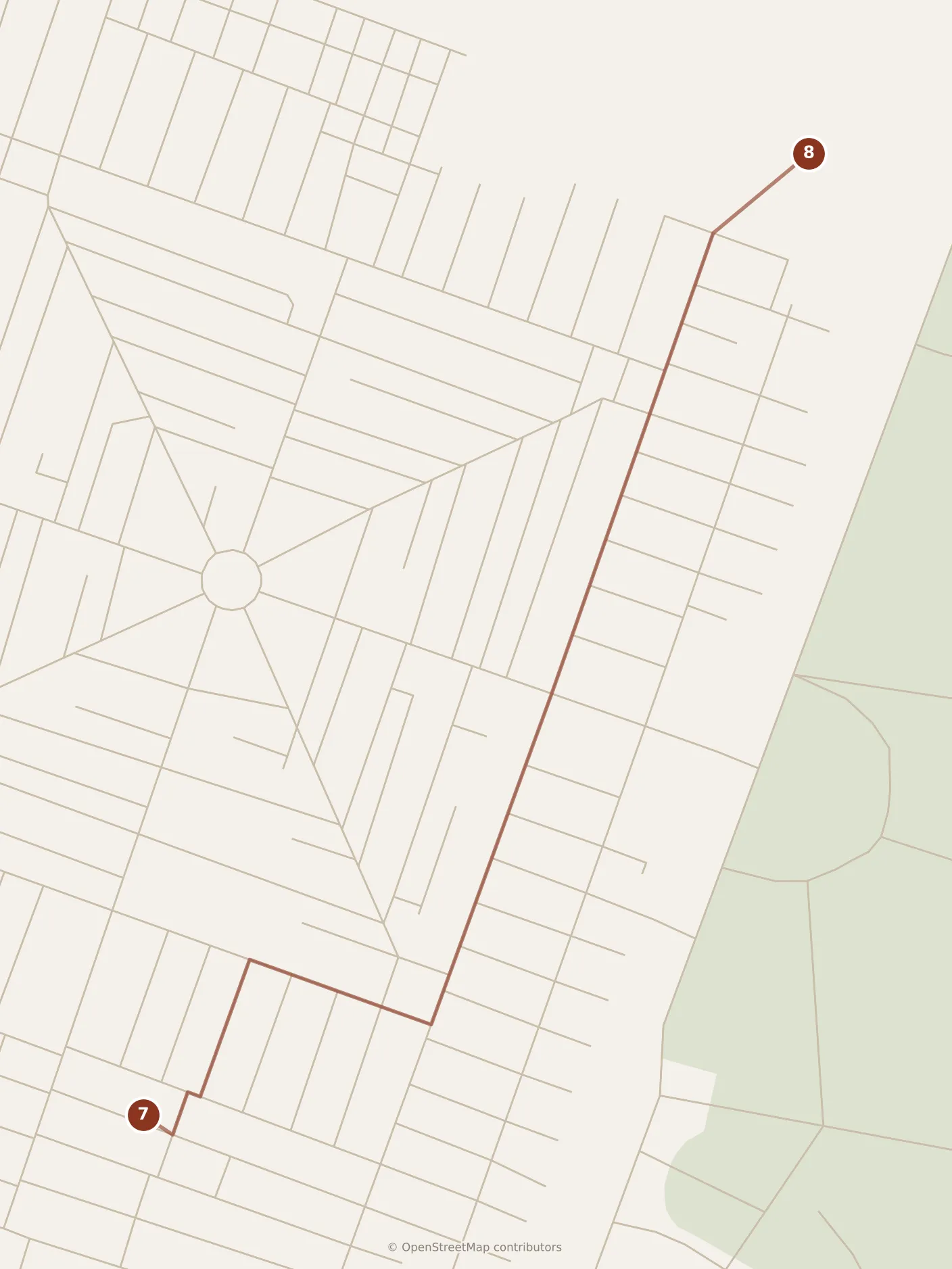
- Afternoon
- 7Cementerio de la Recoleta
- 8Basílica Nuestra Señora del Pilar
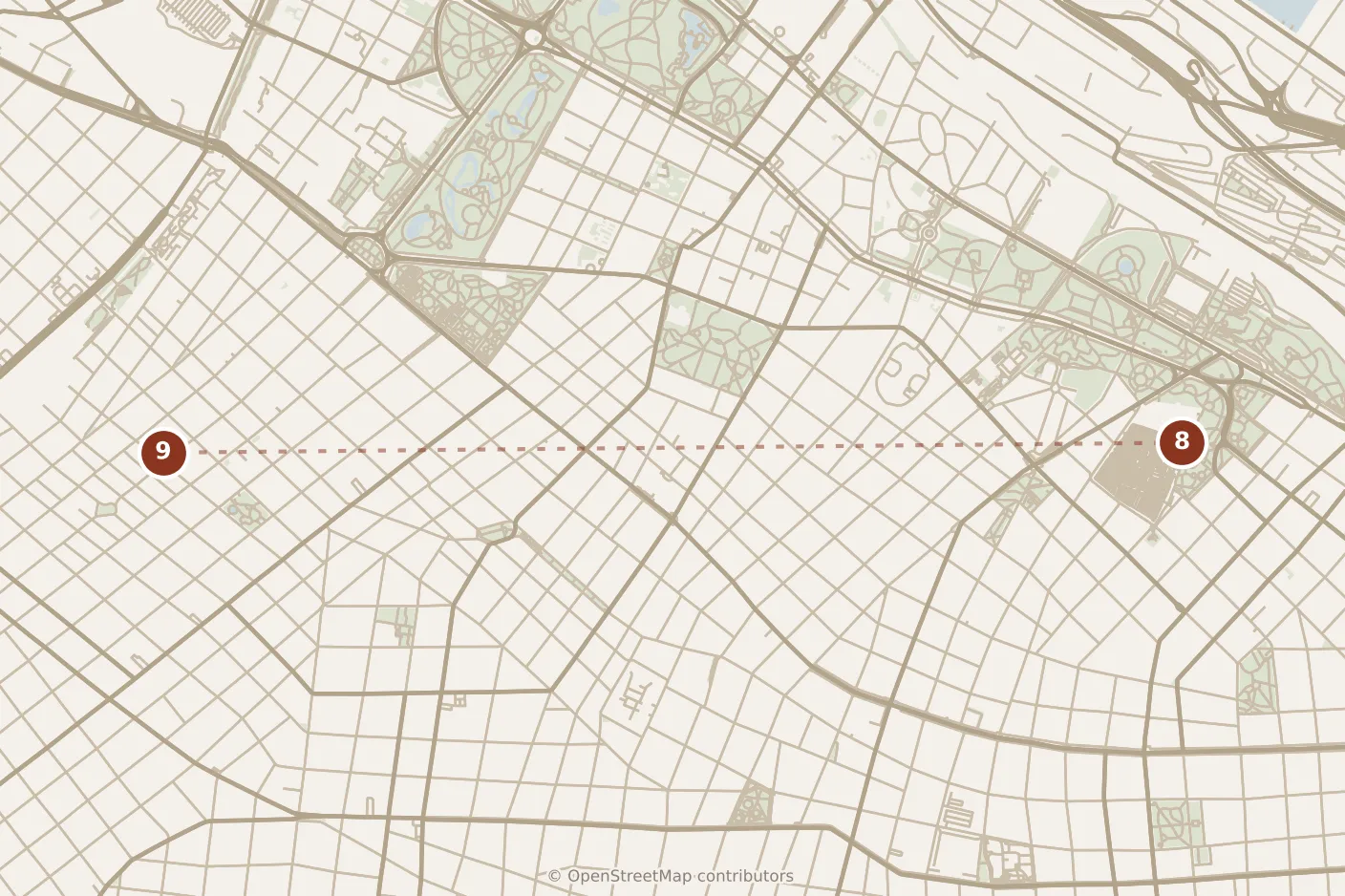
The leg out of the center: from stop 8 by taxi, not on foot.
- Evening
- 9Palermo Soho
Morning
Start at Plaza del Congreso, which is the western end of everything below. It is a long open square with the Congress building closing it at one end: a domed gray palace finished in 1906, put up when the country was rich enough to build as though it expected to stay that way. A bronze cast of Rodin’s Thinker sits at that end of the square, and set into the ground nearby is the monolith from which every road distance in the country is measured. Fifteen minutes is enough. This stop is an opening statement rather than a visit, and its real job is to put you at the top of the avenue facing the right way.
Eight minutes east along Avenida de Mayo is Palacio Barolo, finished in 1923 and for years afterwards the tallest building in South America. It is built as a reading of Dante’s Divine Comedy: a hundred meters for the hundred cantos, hell at the bottom, purgatory through the middle floors, paradise at the top, and a working lighthouse above that. Its architect, Mario Palanti, put an almost-twin across the water in Montevideo — the Palacio Salvo — and the two lighthouses were built to answer each other across the Río de la Plata. The entrance hall is free to walk into and repays ten minutes on its own; the climb to the lighthouse is a ticketed guided tour and is the only thing on this route you would have to book in advance.
From there the avenue itself is the stop, so walk the twenty-five minutes east and let it take that long. Avenida de Mayo was cut through the old city in the 1890s by a council that wanted a European capital, and what survives is a run of ornate facades, glass domes and Spanish cafés with marble counters and mirrored walls. Sit down in one of them for a cortado and medialunas, which is the standard porteño morning; give the tower and the coffee half an hour between them. Under your feet the whole way runs the oldest line of the Subte, opened in 1913 and the first underground railway in the southern hemisphere.
The avenue ends at Plaza de Mayo, and this is the twenty minutes of the day that are about the present rather than the past. The Casa Rosada — the pink presidential palace — closes the eastern end; the low whitewashed building at the western end is the Cabildo, the colonial town hall, and it looks lopsided because it is — arches were cut off both its wings when the avenues were driven through, in the 1890s and again in the 1930s. In the middle stands the Pirámide de Mayo, the oldest monument in the city, and painted on the paving in a ring around it are white headscarves. They are for the Madres de Plaza de Mayo, who have walked that circle every Thursday since 1977 and have not stopped. There is a museum inside the Cabildo; on a single day, skip it. The square is the thing.
Three minutes across it is the Catedral de Buenos Aires, which does not look like a cathedral at all: the front is a Greek temple of twelve columns under a carved pediment, which is what a confident nineteenth century did to a church here. Inside, in a chapel off the nave, is the tomb of José de San Martín, the general whose armies carried independence from Spain across half a continent, and there are soldiers standing beside it in the uniform of the regiment he founded. Twenty minutes, and then walk south.
Afternoon
Twenty-five minutes down Defensa takes you out of the government city and into San Telmo, which is the oldest surviving part of Buenos Aires and looks it: cobbles, tall shuttered windows, antique shops, and houses that were grand until a yellow fever epidemic in 1871 sent the money north and left the south to everybody else. That one fact explains this barrio, and it explains Recoleta later in the afternoon.
Lunch is at the Mercado de San Telmo, an iron and glass market hall of 1897 that fills the inside of a whole block, so its entrances are doorways in ordinary streets rather than a front. Some of it still sells fruit, meat and cheese to people who live here; most of it has turned into counters where you eat standing or at a shared table. Give the market and lunch together an hour and a half, and eat sitting down — the temptation with one day is to buy something and keep walking, and this is the wrong city for that economy. A choripán is the cheap and correct answer if you want one.
Three minutes further south is Plaza Dorrego, a small square of plane trees and tables, the second-oldest square in the city and the center of the barrio’s antique trade. Twenty minutes covers it and the shops around it. On a Sunday it is not this at all: the street market fills Defensa for the best part of a kilometer and the square becomes a crowd.
Local tip. Two stops on this route will each swallow an hour more than they are given: lunch in the market and the cemetery below. Only one of them has a gate that shuts. If the morning has run long, take the time out of lunch rather than out of Recoleta — a market you leave early is still a market, and a cemetery you reach late is a wall.
Then a ride north, twenty minutes when the traffic behaves. This is the one point in the day where the car does something the walking never does and carries you back past the center you crossed this morning. It cannot be helped, and it is why the order is this way round rather than the reverse: you are heading for the one stop on this route with a gate that shuts.
The Cementerio de la Recoleta is a walled town of roughly four and a half thousand vaults on gridded lanes, and the scale of it is the shock. It opened in 1822 on ground that had been a monastery garden, the families who left the south after 1871 built here, and what they built are houses — marble and granite, doors with glass in them, staircases visibly going down, some polished and some with the roof gone and a tree growing through. Dozens are protected as national monuments. Evita is here, and her vault is a plain black one on a narrow lane rather than a grand one; you will find it the way everyone does, by the flowers on the door and the people already standing in front of it. Give the place an hour and a half and do not try to be systematic about it — the lanes are a grid, you cannot get lost, and wandering is the correct method.
This is the stop the day is built around, and it is the only one with a gate. Everything above it comes to a little under five hours: fifteen minutes at the first square, half an hour for the tower and the coffee on the avenue, twenty in Plaza de Mayo, twenty in the cathedral, an hour and a half over the market and lunch, twenty on Plaza Dorrego, a little over an hour of walking in five stretches, and the twenty-minute ride. Check the cemetery’s closing time before you fix your start, and count that back from it.
That count is the time you spend inside places plus the time you spend walking between them, and it is not the length of the day. It leaves out the ticket window at the gate, which is the one line on this route. It leaves out lunch overrunning ninety minutes, which here it will. And it treats the ride north as twenty minutes, which is what it is in the middle of the day and is not what it is at six in the evening. If your day starts late, the two things to drop are the first two: begin at Plaza de Mayo instead and you have bought back the better part of an hour without touching anything after it.
Next door, three minutes at most, is the Basílica Nuestra Señora del Pilar, which was here before the cemetery and is the reason the cemetery is where it is — the ground was the friars’ garden. It is white, low and colonial, finished in 1732, and after ninety minutes of marble it is a relief: one nave, a silver altarpiece, and a small museum in the cloister upstairs. Fifteen minutes.
Evening
A fifteen-minute ride north-west puts you in Palermo Soho, and the day changes register completely. This is low houses, plane trees, cobbled side streets and a grid of restaurants, bars and small shops around Plaza Serrano, where several streets meet in a knot of sidewalk tables. There is nothing to see here in the sense the rest of the day has meant that word, and that is the point: you have spent a day among the governed and the dead, and this is where the living city eats.
Do not arrive hungry at seven. Kitchens fill late here and a table at nine is an early one, so the hour before that is for a drink and for walking the streets around the square, which is genuinely the thing to do — half of what is good in Palermo Soho is a shopfront you notice rather than one you were sent to. Be aware that you are further out here than at any other point in the day: whatever the way back is, it is longer from this stop than from any of the others.
Practicalities
The first thing to sort before you set off is not a ticket. This route never uses the Subte — it walks three pockets and rides between them twice — so a visitor with a single day in Buenos Aires does not, unusually, need to track down a transit card before starting. What you do need is a way of paying for two rides across town: a ride-hailing app with a card attached to it, or cash in a taxi. Everything else about how this city is paid for and moved around belongs to the parent city guide, which is where to read it.
The only booking on this route is optional, and it is the guided climb to the lighthouse at the top of Palacio Barolo: it is ticketed, it runs to a schedule, and it is not something to turn up for on the day. The one compulsory ticket is the cemetery, which charges foreign visitors; it can be bought online beforehand or at the entrance, where the window takes cards and not cash. Online is worth it if your day is tight, because that window is where the line on this route forms.
What is most likely to break the day as written is a closed door rather than a closed day. Two of the stops are church interiors, and churches keep hours of their own and shut for services — on a Sunday morning, for much of the morning. Check those two before you fix the order rather than finding out on the step: the cost of being wrong is fifteen or twenty minutes each, not the day, and the route walks past both either way. The stop where being wrong would be expensive is the cemetery, and that is the one the count above tells you to work backwards from.
A Sunday changes the day rather than breaking it, and mostly for the better. The street market runs down Defensa from near Plaza de Mayo to Plaza Dorrego, which turns the twenty-five-minute walk into San Telmo into an hour and merges the two afternoon stops into one long one. If your single day is a Sunday, start earlier, or drop Plaza del Congreso and Palacio Barolo — that is the same hour recovered, and it is the cheapest hour on the route to lose. Both of those bring the cathedral forward into the part of the morning it is most likely to be shut, so the hour a Sunday costs you is bought back at the risk of that twenty minutes; there is no order that avoids both.
Two things about the order. It never doubles back on foot, so falling behind costs you the end rather than the middle, and the end is a neighborhood, which is the most forgiving thing on the list to lose. And the walking is modest for a city this size: six stretches in all, of which two are about twenty-five minutes — down Avenida de Mayo into Plaza de Mayo, and down Defensa into San Telmo — one is eight minutes, and the other three are three minutes each.


