Budapest in two or three days: inside the Parliament, the three synagogues, and the castle hill taken from its northern end

Last updated 8 August 2026
Overview
A single day in Budapest is spent outdoors, and rightly: the river, the bridges, the ridge and the hill above it are free, they need no ticket and no hour, and they are what the city is for. What a second day buys is doors. The Parliament, which can only be entered on a booked tour with a fixed slot in it. The three synagogues of a quarter that a day trip has no time to reach at all. And two unhurried hours in the picture gallery inside the palace, which is exactly the trade a one-day visitor has to refuse in order to keep the light at the end.
So the days below split by bank and by kind. Day one stays in Pest and is interiors and squares: one guided tour, one memorial square with two monuments arguing across it, and an afternoon in the streets between Dohány utca and Kazinczy utca. Day two crosses under the river and takes the castle hill from its northern gate downhill to the water — the opposite of the direction almost everyone walks it — and ends in a sixteenth-century bath, with the walk back over a bridge at the end of it. Neither day goes back over ground the other has used.
There is exactly one thing to book before you travel, and it is the first stop of day one, which is usually but not always your first morning — see the weekday rules at the end. In 2026 the Parliament tour was priced by passport rather than by age: in the seven-thousand-forint range for an EEA passport, and roughly double that outside it, for a guided visit that runs to forty-five minutes. Book it as soon as you have dates, and check your date against the visitor center’s own calendar rather than against the ordinary opening hours — the building is in ceremonial use on the national days and the tours are not the priority then. A third day adds a second booking only if you want to be inside the opera house.
Day one has one deadline in it and it is at the far end of the day: the synagogue complex, which shuts in the afternoon and shuts earlier still on a Friday. So the day is built forward from whatever tour slot you were given, and the honest advice is to take the earliest offered, because the afternoon holds more than the morning does and the afternoon is the part that can run out. Reckoned end to end it comes to a little under five hours, tour door to first courtyard, with lunch inside it. Day two is the one anchored to the light, and the anchor is its last stretch. The walk down from the palace through the terraced garden front and then south along the Buda embankment is where you see the whole ridge you have just spent the day on, from below, with Pest going on across the water — and it wants the last of the light. The earliest the sun goes down here is a few minutes short of four, in the second week of December; the latest is a quarter to nine, in the last week of June. Five hours of swing between the two ends of the year, so take your own month’s hour and count back from it.
The count is this. Everything on day two from the first square to the bottom of the gallery stairs comes to about five and three quarter hours with lunch inside it, and the descent and the embankment are another forty minutes on top. You want to be leaving the gallery with roughly three quarters of an hour of daylight still in hand, which puts the start six and a half hours before sunset: a little after nine in December, and a quarter past two in June, which is a start time nobody wants. That is the latest start the day tolerates, not the hour to aim for. In summer, and in any month where counting back lands you past the morning, begin in the morning as written and spend the surplus inside — an hour longer in the gallery, or the church tower, or the museum next door.
That sum is time spent inside places and on the sidewalk between them, and it models nothing else. It does not include the airport-style screening at the Parliament, which is a quarter of an hour on its own, nor the ticket desk at the gallery, nor the twenty minutes it takes to change and lock up at the bath, which sit on the far side of the count entirely. Give each day an hour of slack over the arithmetic.
The bag matters here in one specific place, and it is the first stop. The Parliament has no cloakroom and no lockers, large bags do not go through its screening, and there is nowhere on Kossuth Lajos tér to leave one — so a reader who lands early and starts day one before a room is available must deal with the case before the tour, not after it. Both main stations have left-luggage provision, at Keleti pályaudvar and at Nyugati pályaudvar — check the current hours, and that it is still staffed, before you build a booked morning around it. If you arrive by train, leave the bag before you get on the metro rather than after: from Keleti it is four stops back the way you came, and that detour costs forty minutes there and back on a morning that has a booked slot in it. At the other end, note that whichever day is your last ends at a bath and so ends damp — a bad last stop for anyone with an evening train. On two days that is Rudas Baths, on the Buda bank, half an hour and a river from Keleti.
The first leg. From Keleti pályaudvar the M2 platform is under the station forecourt: four stops — Blaha Lujza tér, Astoria, Deák Ferenc tér, Kossuth Lajos tér — and about eight minutes, and you come up on the square with the Parliament in front of you. From Nyugati pályaudvar take the M3 two stops to Deák Ferenc tér and change to the M2 for one stop, or walk it in under twenty minutes if you are not carrying anything. From the airport the 100E bus runs to Deák Ferenc tér on a fare of its own that no ordinary ticket or travelcard covers — a pass-holder still pays a supplement for it — and from there it is one stop on the M2 or twenty minutes on foot.
The airport bus aside, the one thing this route asks of you that the Parliament ticket does not cover is a way of paying for the metro. It uses it four or five times over two days and half a dozen over three, which is under what a multi-day travelcard needs to pay for itself: at that rate a block of single tickets is the cheaper answer, and the card only wins if you expect to ride a good deal more than this itinerary asks. How tickets are bought and validated on the BKK network is in the city guide, and the inspectors are real.
Day one

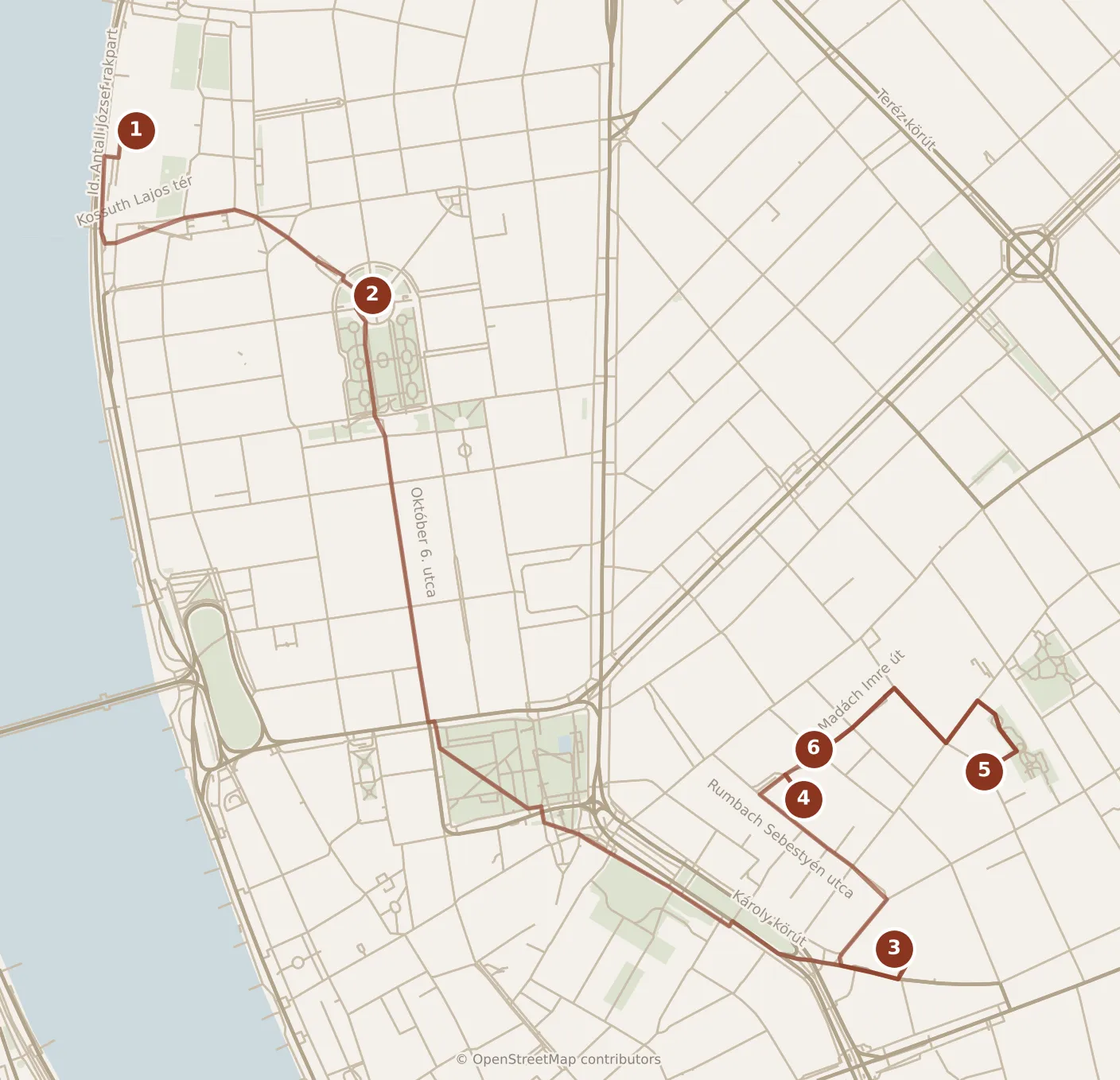
- Day one
- 1Hungarian Parliament Building
- 2Szabadság tér
- 3Dohány Street Synagogue
- 4Rumbach Street Synagogue
- 5Kazinczy Street Synagogue
- 6Gozsdu Courtyard
Everything today is in Pest and almost all of it is under a roof. The morning is the north end of the flat city — government, banks, monuments — and the afternoon is a twenty-five-minute walk south-east into a quarter that looks nothing like it.
Morning
Start at Kossuth Lajos tér, and go to the right door. The visitor entrance to the Hungarian Parliament Building is not in the river facade that everyone photographs; it is on the square, on the landward side, and it has a screening you should allow a quarter of an hour for before your slot.
The building took from 1885 to 1904 and was Imre Steindl’s, and the numbers are the point of it: two hundred and sixty-eight meters along the water, six hundred and ninety-one rooms, twenty-nine staircases, and a dome of ninety-six meters. What the forty-five minutes actually show you is a fraction of that — a ceremonial staircase, the sixteen-sided hall under the dome, and one debating chamber — and the fraction is the experience. You climb one flight of red carpet and gilt and understand that there are twenty-eight more of them you will not see.
In the domed hall, under guard, is the Holy Crown of Hungary, which has been kept here since 2000. It is small, it is visibly bent at the cross on top, and it is the object the whole building is arranged around. You do not linger over it; the tour moves.
Local tip. Take the earliest slot the booking offers you. Nothing else on this day has a door that shuts early except the synagogue complex, and the synagogue complex is the one thing here you cannot move to another afternoon — so every hour the tour eats from the front of the day comes out of the back of it.
Eight minutes south-east is Szabadság tér, and give it half an hour, because it is the strangest public space in the city. Until 1897 this was the Újépület, an enormous barracks and prison where Lajos Batthyány was shot in 1849; it was pulled down and the square laid over it. At the northern end stands the Soviet war memorial of 1946, railed off and still tended, and repeatedly the subject of demands that it be moved elsewhere. At the other end of the same square is the memorial the state put up in 2014 to the victims of the German occupation — Hungary as the archangel Gabriel, an imperial eagle coming down on him — and on the sidewalk directly in front of it is the counter-memorial that went up in answer: photographs, suitcases, stones and handwritten cards laid out by members of the public and replaced, by the public, ever since. Two monuments about the same year, three meters apart, disagreeing in the open. The square around them is banks and embassies and a playground, and children run through the argument all afternoon.
Afternoon
Walk twenty-five minutes east and south across the middle of Pest and eat before you go in — the quarter you are heading into is where lunch is, and the next stop takes an hour and a half.
The Dohány Street Synagogue is the largest in Europe: seventy-five meters by twenty-seven, with seats for nearly three thousand, built between 1854 and 1859 to Ludwig Förster’s design in a Moorish style with two onion-domed towers and an organ, which is not what most synagogues look like and was not meant to be. This is a working synagogue and not a monument, so men cover their heads inside and both sexes cover shoulders and knees; it closes for Shabbat every Saturday and on the major Jewish holidays, and it shuts early on Friday afternoons.
Three things come with the ticket and you should take all of them. The Hungarian Jewish Museum, attached at the side, was built in 1930 on the plot where Theodor Herzl’s family house had stood. The courtyard is a cemetery holding around two thousand people who died in the ghetto in the winter of 1944 and 1945 — Jewish practice does not put a graveyard beside a synagogue, and the fact that this one is there is the whole history of that winter in one sentence. And behind it, in the Raoul Wallenberg Memorial Park, is Imre Varga’s weeping willow in steel, whose leaves carry names. Walk under it rather than round it.
Five minutes north is the Rumbach Street Synagogue, and it is the one people miss. Otto Wagner built it in 1872, early in a career that went in an entirely different direction afterwards: an octagonal hall under a dome, decorated as an homage to the Dome of the Rock in Jerusalem, in blue and gold and ochre. It stood derelict for sixty years and reopened in June 2021 after a full restoration. Half an hour, and the point of it is the ceiling.
Five minutes on again, Kazinczy utca holds the third of the quarter’s synagogues, the Orthodox one, built just before the First World War and set into the block so completely that its gate reads as a gap between tenements rather than as a front. You can look at it in ten minutes from the street, and it is worth the ten minutes for the contrast: three synagogues within four hundred meters, built by three congregations who disagreed with each other.
Evening
The Gozsdu Courtyard runs the whole depth of the block between Király utca and Dob utca — seven linked courtyards under archways, put up in 1901 and 1902 as tenement housing and now a continuous covered lane of tables. Walk through it end to end before you decide where to sit; it is genuinely a passage and not a square, and it looks different from each end.
Around it is the quarter the city calls its ruin bars: bars set up inside courtyards and half-derelict pre-war buildings, furnished out of whatever was left in them. They are loud, they are not a secret, and they are still the reason this district is what it is. Gulyás is the dinner to have somewhere in here on a cold night — it is a soup, and it arrives as one.
Day two

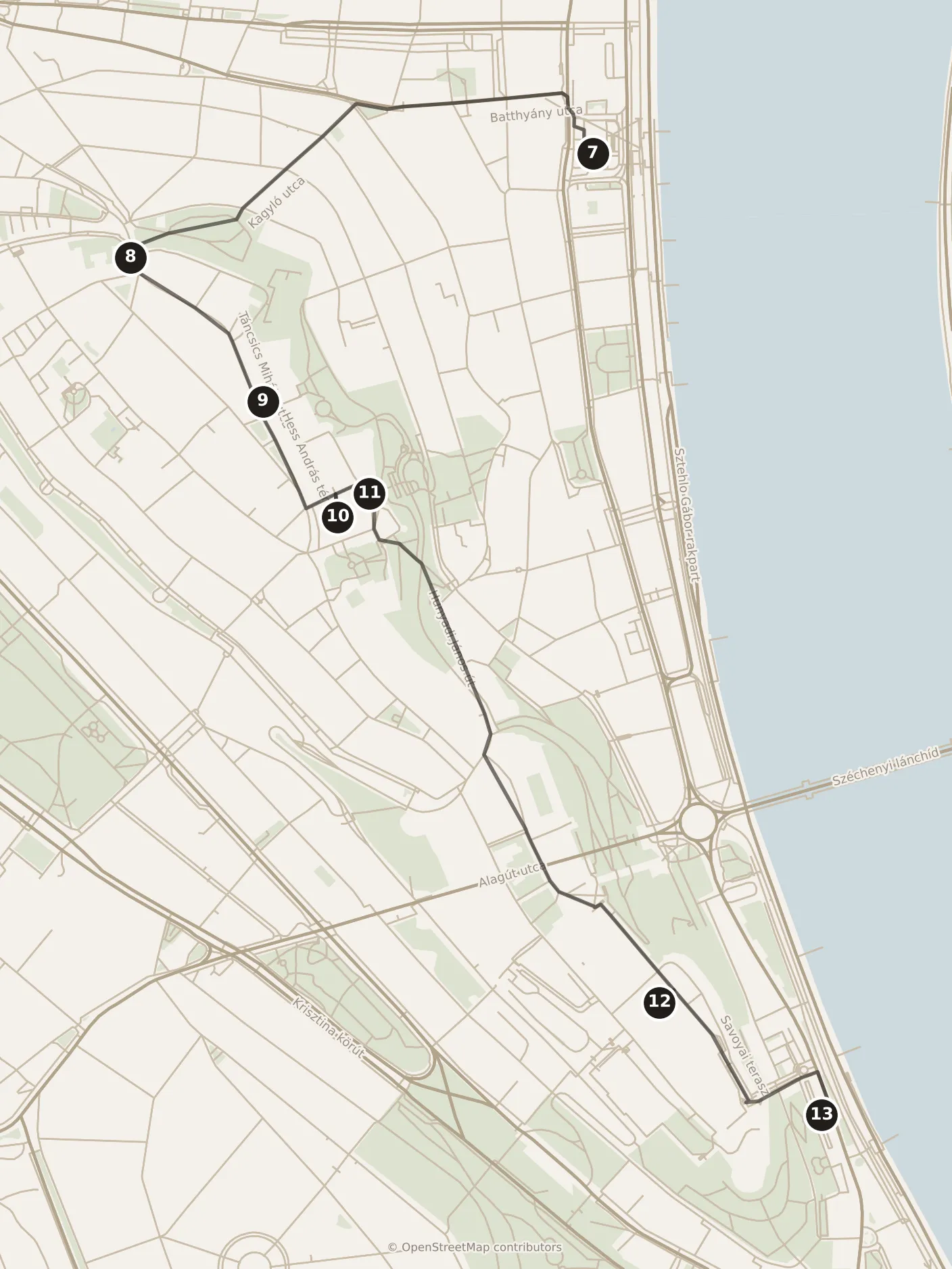
- Morning and afternoon
- 7Batthyány tér
- 8Vienna Gate
- 9Táncsics Mihály utca
- 10Matthias Church
- 11Fisherman's Bastion
- 12Hungarian National Gallery
- 13Várkert Bazár
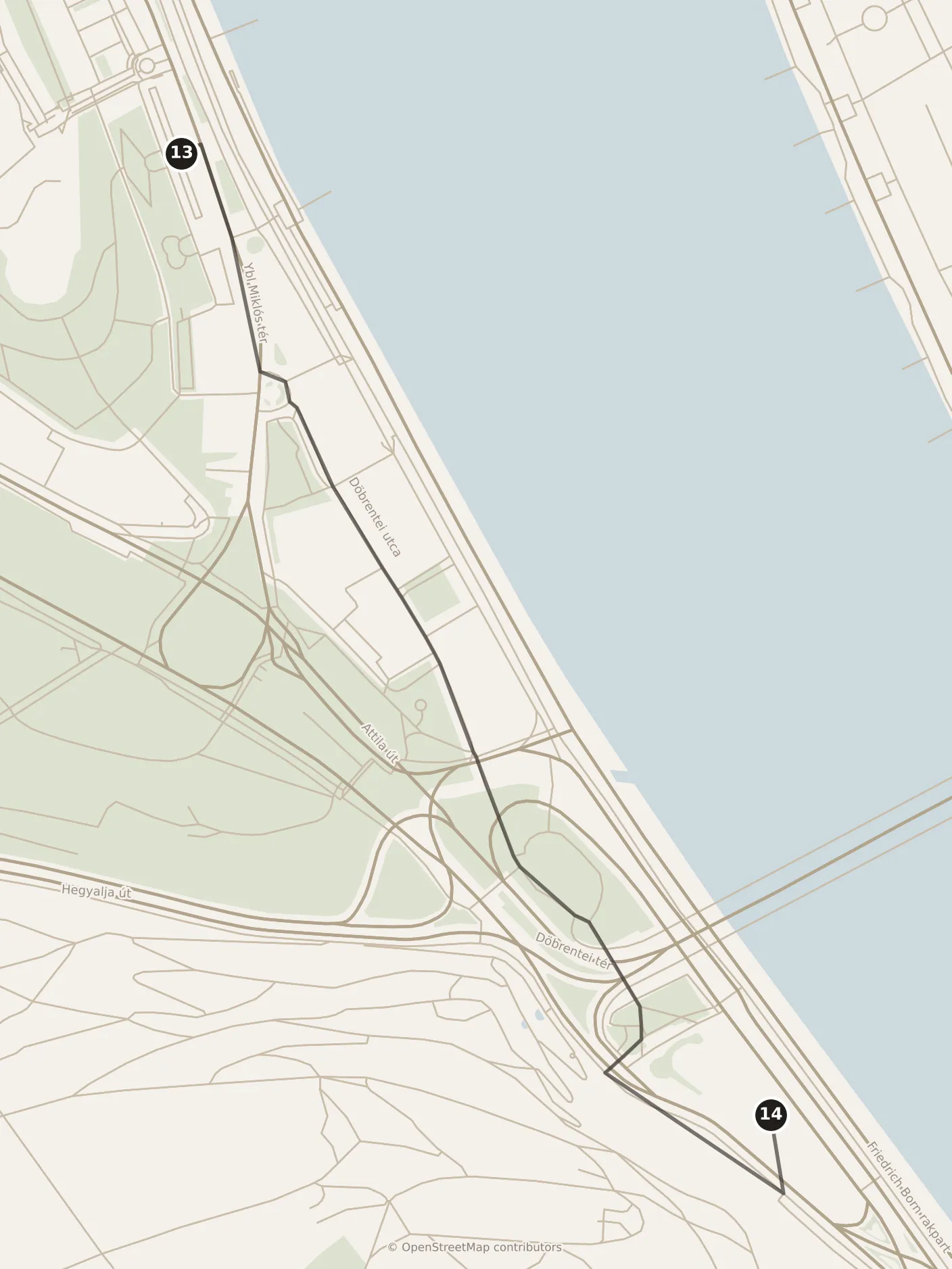
- Evening
- 14Rudas Baths
Today is one hill, taken downhill. Almost everyone walks the castle ridge south to north and ends on the terraces at dusk; going the other way puts the empty end of the hill in your morning, the palace gallery in your afternoon, and the river at your feet at the end instead of a bus line.
The direction is not arbitrary. The one stretch of the day that wants the light is its last one, and that stretch is at the southern end, on the water — so the day has to finish there. And there is one hour on this hill that fixes the rest of the order: in 2026 Matthias Church stopped admitting visitors at five in the afternoon, and gave its Sunday mornings over to services. It is the only door up here that shuts in the late afternoon, so it cannot be the last interior of the day, which is exactly what it becomes if you come up at the southern end and walk north. Put it in the morning and nothing left on the hill has a deadline after it. If you look the hour up and find it has moved, the rule survives: whichever of the church and the gallery shuts earlier is the one that goes first.
Morning
From Deák Ferenc tér the M2 runs under the river: two stops, Kossuth Lajos tér and then Batthyány tér, about four minutes. Come out on the square and turn to face the water, because this is where the Parliament is seen head-on rather than at an angle — the whole two hundred and sixty-eight meters of it, squared up across the river, and it costs nothing. Fifteen minutes, and take them for the shape of the thing rather than the light: from this bank the morning sun is behind it and the facade is its own silhouette. Behind you the square has a twin-towered Baroque parish church and the old brick market hall, and the suburban H5 line that runs up the Danube to Szentendre starts from the same platforms.
Then the climb: fifteen minutes up the hill’s northern flank to the Vienna Gate, which is the back door of the walled town and the quiet one. The arch standing there now went up in 1936, for the two hundred and fiftieth anniversary of the recapture of Buda from the Ottomans in 1686. Give the gate and the square inside it a quarter of an hour, then take Fortuna utca or Országház utca south and turn into Táncsics Mihály utca.
Give these lanes twenty minutes and walk them slowly, because the thing to see is not on any facade. The house fronts are eighteenth-century, rebuilt after the sieges; the houses behind them are medieval. Look into the arched gateways as you pass: many of them have stone benches recessed into the side walls in pairs of pointed niches — fourteenth-century seats, cut for the servants of whoever was calling, and left in place through every later refacing above them. Once you have seen one you will find them all the way down the street.
The lane ends four minutes short of Matthias Church. Most people come for the painted interior and are right to: Frigyes Schulek rebuilt the whole thing between 1874 and 1896 and had Bertalan Székely and Károly Lotz cover every surface with pattern and figure, with altarpieces by Mihály Zichy, so that no wall is left plain and the effect is closer to a carpet than a cathedral. With a whole morning you can also do the two parts a rushed visit gives up. The Ecclesiastical Art Collection starts in the medieval crypt underneath and comes up through the galleries — carved stone from the church’s own Gothic phase, and replicas of the coronation regalia whose original sits across the river under the Parliament dome. And the south bell tower, rebuilt around 1470, is the oldest thing standing here; it is a separate ticket and a separate climb, and worth it only if you have not already had a high view of this city. Three quarters of an hour inside without the tower.
One minute away is the Fisherman’s Bastion. Schulek built this too, between 1895 and 1902, and he built it as a frame for his own church rather than as a fortification — which is why it looks medieval and defends nothing. Half an hour. What matters in the morning is the crowd you have not met yet: the arcades and the stairs down its river front are where the view of Pest actually is, and at this hour they are still walkable rather than lined up, which they will not be by the middle of the day. The lower terraces cost nothing; only the upper ones are ticketed, and from the lower ones you are looking at the same river.
Afternoon
Eat on the hill, then walk fifteen minutes south along the ridge to the palace and the Hungarian National Gallery, which has occupied a section of it since 1975. Two hours, and here is how to spend them.
Give the first hour to the Gothic hall of winged altarpieces. These are the carved and painted retables of fifteenth-century parish churches from the far edges of the old kingdom, lifted out whole and reassembled indoors — three and four meters tall, wings open, gilt saints in ranks, standing in a row down a long room in a light they were never built for. There is nothing else like the concentration of them anywhere. Give the second hour to two painters: Mihály Munkácsy, whose Christ before Pilate is a wall in itself, and Tivadar Csontváry, whose Ruins of the Greek Theatre at Taormina is the strangest thing in the building. The twentieth-century floors are the ones to let go if the day is running.
Local tip. One museum here, not two. The Budapest History Museum is a hundred meters away in the same palace and holds the medieval royal rooms and cellars that survived under the courtyard — genuinely good, and a second full stop. Doing both is what turns the walk down to the water from a lit one into a dark one, and the walk down is the part of this day that depends on the hour.
Leave the gallery and go down rather than back. The Várkert Bazár is the terraced Renaissance Revival garden front that steps from the palace to the embankment: begun in 1875 to Miklós Ybl’s design, left to fall down for most of the last century, rebuilt and reopened in 2014, with stairways and an elevator running the whole height of it. Give the descent twenty-five minutes, because you will stop on the terraces: this is where the hill you have spent the day on stands up behind you and Gellért Hill closes the view south.
Evening
A quarter of an hour south along the embankment, at Döbrentei tér where the Elisabeth Bridge lands, is Rudas Baths. It was founded in 1571 or 1572 under Sokollu Mustafa Pasha, the Ottoman governor of Buda, and the room that matters has not changed shape since: an octagonal pool under a dome pierced with small colored windows, four smaller pools in the corners, and a temperature range across the house that runs from ten degrees to forty-two. Bring a swimming costume and a towel.
One thing here a visitor cannot guess and will be stopped by: the old Ottoman section is single-sex on most weekdays and mixed on the weekend, and which day belongs to which is not a thing you can reason out. It is published by the baths themselves — check that one fact before you fix which day is day two, not the night before, because turning up on the wrong day does not shut you out of the building, it just puts you in the modern pools instead of the domed one, which is the entire reason to come here rather than anywhere else.
When you are done, the simplest way back into Pest is over the Elisabeth Bridge on foot, a quarter of an hour, which lands you at Ferenciek tere and the M3. If you have a train, allow half an hour from the bath door to Keleti pályaudvar: one stop on the M3 to Deák Ferenc tér, then three on the M2.
With a third day

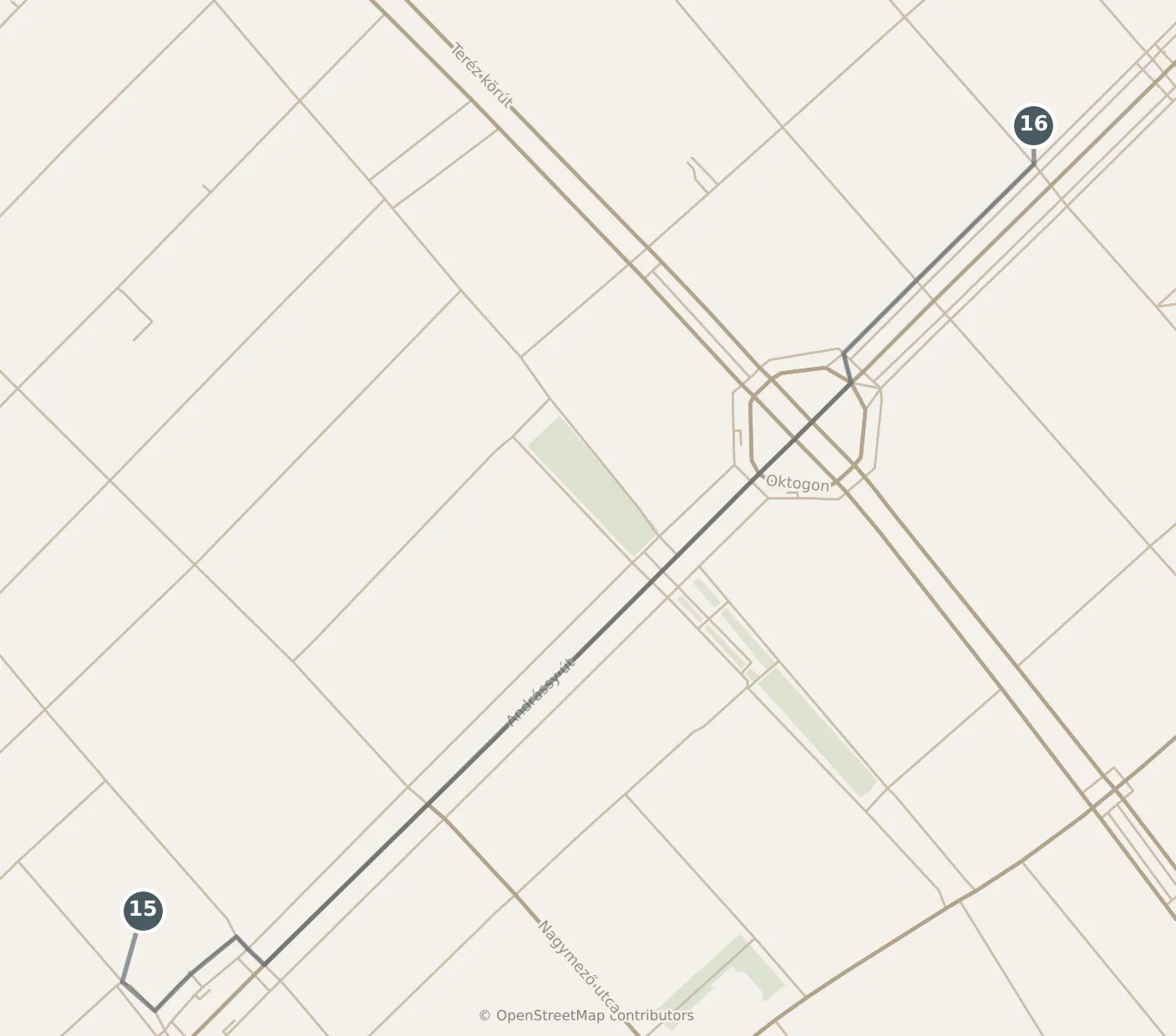
- With a third day · stops 15–16
- 15Hungarian State Opera House
- 16House of Terror
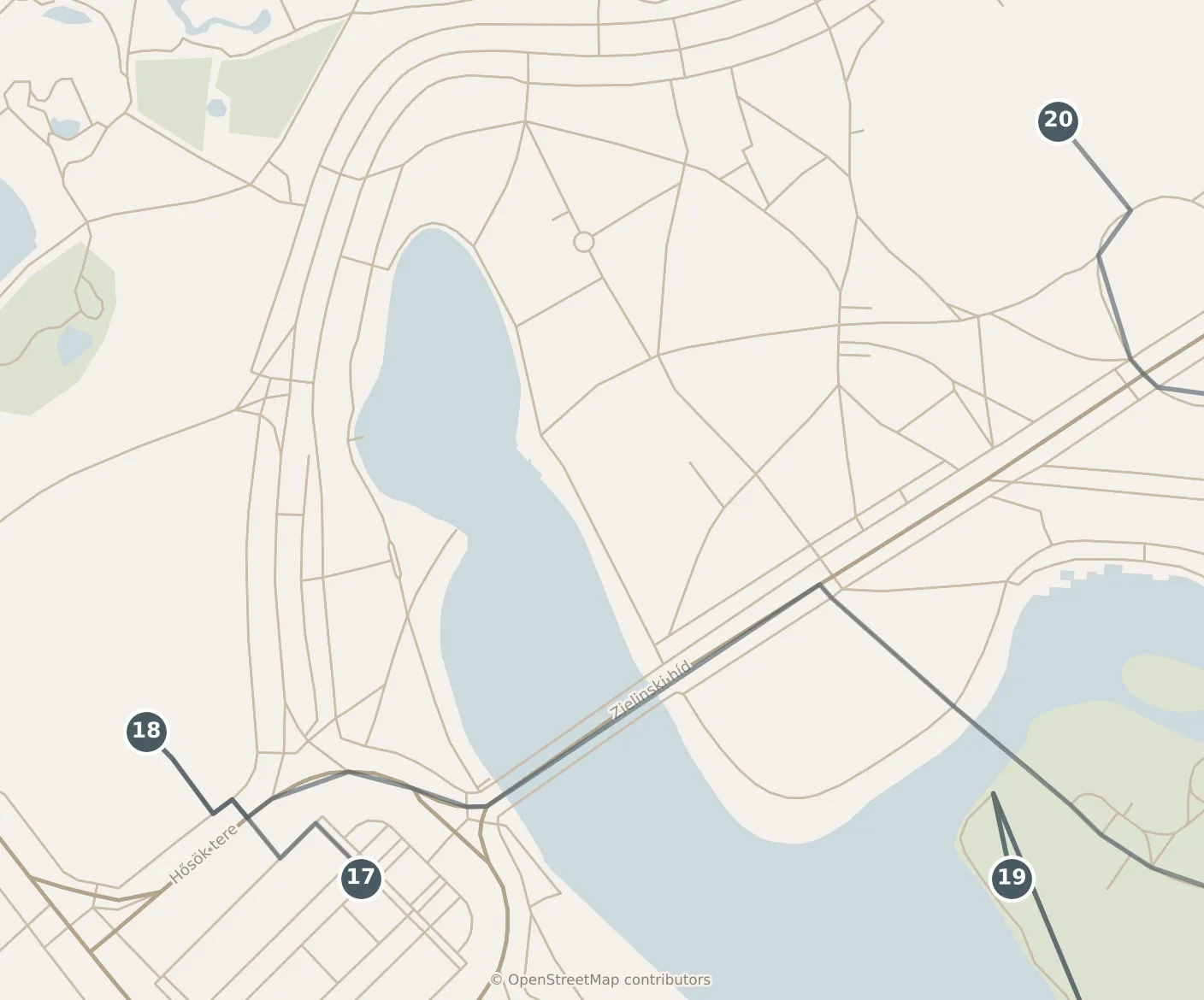
- With a third day · stops 17–20
- 17Heroes' Square
- 18Museum of Fine Arts
- 19Vajdahunyad Castle
- 20Széchenyi Thermal Bath
The third day is appended rather than inserted, and it goes to the one axis the two days above never touch: Andrássy út and the park at the end of it. No stop in day one or day two changes position if you add it, because it shares no ground with either — which is precisely the argument for putting it third rather than between them. One thing does change, and it is the bathing. Take Széchenyi Thermal Bath at the end of this day and give day two’s evening back to the embankment and a dinner on the Buda side; do both baths only if you actively want the Ottoman one and the grand one as two different experiences, which they are. Note what that does not change: day two’s count and its light are built on the descent through the terraces and the walk south along the water, and both survive the swap intact, because they were always the stretch that wanted the light and only the door at the end of them has moved. The way back into Pest is the same too — the Elisabeth Bridge lands at Ferenciek tere whether or not you got wet first. The Monday rule does not change: whichever of your dates is the Monday still has to be day one, exactly as on a two-day trip.
Walk twelve minutes up Andrássy út from Deák Ferenc tér to the Hungarian State Opera House, Miklós Ybl’s again, built 1875 to 1884. Half an hour outside it, and if you want in, it is a guided tour, or in season a seat at a performance — and a seat high in the house is usually the cheaper of the two ways into the same auditorium, which is the procedural answer nobody gives you.
Thirteen minutes further up, at number 60, is the House of Terror. The building was the headquarters of the Arrow Cross in 1944 and then of the communist secret police, and it became a museum on 24 February 2002. The black steel eave that projects over the sidewalk is cut through with letters. Inside, the route runs down to the reconstructed cells in the basement, and it is the basement that people remember. An hour and a half, and it is a hard hour and a half.
From Vörösmarty utca take the M1 three stops to Hősök tere. The line itself is a stop: it opened on 2 May 1896, the first electrified underground on the European mainland and the second oldest in the world after London’s, and it is UNESCO-listed. The stations are shallow, tiled and wood-panelled, and the carriages are small enough to read as a tram that went underground.
Heroes’ Square, half an hour. The Millennium Monument was largely finished by 1900: a column with the archangel Gabriel on top holding Stephen’s crown in one hand and a double apostolic cross in the other, and at its foot Árpád and six other mounted chieftains, the Magyar leaders who brought their people onto this plain. The two curved colonnades behind hold fourteen Hungarian rulers and figures — the last five niches on one side held Habsburgs until they were replaced after the Second World War. The slab at the front is universally called the tomb of the unknown soldier and is not a tomb; nobody is buried under it.
One of the two large buildings flanking the square is the Museum of Fine Arts, built 1900 to 1906 by Albert Schickedanz and Fülöp Herzog. An hour and a half, and be selective: three and a half thousand Egyptian objects, and around three thousand old master paintings of which seven hundred came from the Esterházy collection in one purchase. Take the Spanish rooms — El Greco, Velázquez, Goya — and the Esterházy pictures, and let the rest go. This is the ninety minutes to give up entirely if you would rather have the water in daylight.
Eight minutes into the park is Vajdahunyad Castle, and it is a joke that outlived its punchline. Ignác Alpár built it in 1896 out of wood and cardboard for the millennium exhibition, as a single collage of Hungarian buildings — a Romanesque chapel, a Gothic keep modeled on Hunyad castle, a Renaissance wing, a Baroque wing — meant to stand for a summer. People refused to let it be taken down, so it was rebuilt in stone and brick between 1904 and 1908 exactly as it was. Half an hour in the courtyards, which are free, and find the hooded bronze of Anonymus, the unnamed chronicler of king Béla’s court, by Miklós Ligeti. Inside is the Museum of Hungarian Agriculture, which is larger than it sounds and not the reason you are here.
Seven minutes north, Széchenyi Thermal Bath. Győző Czigler’s, opened on 16 June 1913, neo-Baroque in mustard yellow, the largest medicinal bath in Europe: three outdoor pools and fifteen indoor ones, fed by two springs at seventy-four and seventy-seven degrees, the deeper drilled past twelve hundred meters. Two hours, and this is where the swimming costume and towel are needed if you have moved the bathing off day two. The outdoor pools are the ones — sit in thirty-eight-degree water in the open air with the steam going up past the colonnades, which is best in the cold and is the single most Budapest thing available. Chess is played on floating boards in the corner of the big outdoor pool and has been for decades. Buy a kürtőskalács from a stall on the way out.
The whole day as written is about seven hours before you eat, which is longer than either of the other two with their lunches inside them, so start any cutting with the Museum of Fine Arts. The M1 goes back to Deák Ferenc tér from Széchenyi fürdő, which is the station at the bath’s own door.
If you would rather leave the city altogether on a third day, the H5 suburban line from Batthyány tér reaches Szentendre in about forty minutes — the town is outside the city boundary, so a Budapest travelcard does not cover the last stretch and you buy a supplement for it — and it is a Baroque riverside town you can walk in an afternoon. It replaces this day entirely rather than compressing it, and what you give up by taking it is the M1, the square and the water, which is a real loss on a first visit.
Practicalities
What to book. One thing over two days: the Parliament tour, whose slot is fixed and whose price in 2026 depended on your passport rather than your age. The third day adds a second only if you want to be inside the opera house, by tour or by ticket. Everything else on these three days is bought at the door.
The weekday rules, and the trap. Four rules, and everything else will take any date in any order.
Day one is the only one of the three that survives a Monday — nothing on it closes then — and it is the one that cannot be a Saturday, because the synagogue complex is most of its afternoon and it is shut for Shabbat. It also closes on the major Jewish holidays, which do not fall on the same dates each year, so that is a check against a calendar rather than a rule. On a Friday day one works, but the complex closes early, so it is the morning that gives way and not the afternoon: take the earliest tour slot offered, cut Szabadság tér to a quarter of an hour, and be at the Dohány door as soon as you have eaten. Moving Szabadság tér to the end of the day instead does not work — it stands twenty-five minutes west of the quarter and the evening is in the quarter, so it costs the better part of an hour of walking back and forth on the shortest of the three days.
Day two and the third day both have to miss the Monday. The Hungarian National Gallery is the reason day two is a second day and not a repeat of the first, and it closes on Mondays, as does the Budapest History Museum beside it; the Museum of Fine Arts on the third day does the same, and the House of Terror is a state museum of the same kind, so treat it as the one hour on that day to check. Between themselves those two days will take any date and either order, with one exception, and it is the fourth rule: day two ends in the Ottoman hall at the bath, which is single-sex on most weekdays and mixed on the weekend. If you are two and want to be in the domed pool together, day two wants a Saturday or a Sunday. On a three-day trip that takes the swap above, the Ottoman bath drops out altogether and this rule falls away with it. Where the weekend cannot be had — a two-day trip landing on a Monday and a Tuesday, with the Monday already committed to day one — the two rules genuinely compete, and the trade is the domed pool separately on the weekday against the modern pools together. Check the baths’ own calendar before you fix your dates, because which weekdays belong to which sex is not a thing you can reason out.
So: put your Monday on day one. If you arrive on a Saturday or a Sunday that means starting with day two, and if that lands day two on the Sunday, slide one door and nothing else — take the Vienna Gate, the lanes and the Fisherman’s Bastion in the morning, eat on the hill, and go into Matthias Church at the start of the afternoon with the gallery after it. The order and the direction are unchanged; only the church moves, because its Sunday mornings belong to services.
The trap is the Sunday arrival taken in the obvious order: day one on the Sunday, day two on the Monday, and the gallery that day two exists for is closed. Széchenyi does not close a day a week, and if you find that it has, the park itself, Heroes’ Square and Vajdahunyad’s courtyards are all open and free.
What to cut when the day is short. On day one the first thing to go is the Hungarian Jewish Museum inside the Dohány complex, because the synagogue, the courtyard cemetery and the willow are the part of that ticket you cannot get anywhere else; the second is the Rumbach, and it hurts. On day two the first cut is the Budapest History Museum, which goes without argument because it is the second of two museums a hundred meters apart, and the second is the church tower. The last thing to cut on day two is the hour in the Gothic hall of altarpieces, because that hall is the reason the day exists. On the third day cut the Museum of Fine Arts, in full, and keep the water.
If it rains on day two. The castle ridge is a bad place in weather and you will know it by the time you reach the Fisherman’s Bastion. From there it is six minutes downhill on the western side of the hill, on Lovas út, to the Hospital in the Rock: a hospital dug into the natural caves under the castle from 1939, which took up to six hundred wounded during the siege of 1944 and 1945 in rooms built for seventy, was used again in 1956, and then spent forty-five years as a classified civil-defense bunker before opening as a museum in 2007. It is seen only on a guided tour, about an hour long, and it is cold down there, so take a layer. It replaces the church tower and the half hour of standing about on the open terraces, which are the two parts of the morning only worth doing dry — but it is not a free swap, because the tower was never inside the day’s count and the walk down Lovas út and back up is a quarter of an hour of its own. Reckon on the best part of an hour going into a day that is counted back from sunset, and take it out of the gallery’s second hour. What ends the day is under a roof on a two-day trip: the gallery is indoors and the bath is better in rain than out of it. On a three-day trip you have moved the bath to the third day and day two now ends with the embankment and a walk to dinner across the river, which is the version the weather actually spoils — so on a wet day leave the bath where it was and let the third day take the rain instead.
If the synagogues are shut — a Saturday you could not avoid, or a holiday you did not know about — you are standing on Dohány utca with an afternoon. Walk eleven minutes south down Múzeum körút to the Hungarian National Museum, the national collection in a Greek revival block of the 1840s standing in its own garden, whose front steps are where the country commemorates its 1848 revolution every March. It takes the whole afternoon and leaves the evening in the quarter untouched. One combination defeats this: a Jewish holiday falling on a Monday, when the National Museum is closed as well. Then take the third day’s park instead — the M1 from Deák Ferenc tér to Széchenyi fürdő, a quarter of an hour — and put day one somewhere else in the trip.
Getting between the stops. Day one is walked end to end, about three and a half kilometers, all of it flat. Day two uses the M2 once, from Deák Ferenc tér to Batthyány tér, and is then on foot for about four kilometers — one climb of about seventy meters at the start and a long descent at the end, on cobbles the whole length of the ridge. The third day is two short walks up Andrássy út, three stops on the M1, and a few hundred meters inside the park. If the climb from Batthyány tér is more than you want, the Buda Castle Hill Funicular runs from Clark Ádám tér to the palace end in about a minute and a half on ninety-five meters of track, and it takes a fare of its own rather than an ordinary ticket — but it lands you at the wrong end for this day’s order, and you would pay the fifteen minutes back twice over.


.jpg)
