Budapest in one day: down the Pest bank, up Gellért Hill, and along the ridge to the castle

Last updated 4 August 2026
Overview
Budapest is two old cities either side of a river, and one day here is decided almost entirely by how many times you cross it. The answer is once, and then once more on foot on the way home. Pest, on the flat east bank, is where the grand nineteenth-century city was built, and everything worth your morning sits within a few hundred meters of the water. Buda, on the west, is two hills: a view on one and a castle on the other. So the day below walks Pest downstream, crosses in the middle of the afternoon, and then goes south to north up the Buda side, uphill once and never back.
What a single day costs you is the interiors, and two in particular. The first is the inside of the Hungarian Parliament Building, which is seen only on a guided tour at a fixed time slot — and a fixed slot is a nail driven through the middle of a day that has to move. The second is the pair of large museums inside the palace on Castle Hill. Both are skipped below for the same reason: an hour indoors is the hour that would otherwise have bought the climb, the market and the light at the end.
The thing that actually fixes the shape is a door. Matthias Church, the last interior on this route, admitted no visitors after five in the afternoon in 2026, and it keeps shorter hours at the weekend, when services have the building back. That one hour is what everything else is built backwards from. Add up the recommendations below — three quarters of an hour in the basilica, half an hour on the Parliament square, a quarter of an hour at the shoes, an hour and a quarter over lunch in the market, half an hour of climbing, forty minutes on the summit, forty in the castle courtyards, and the walking between them — and it comes to about six and a half hours from the basilica door to the church door. So a start by nine gets you inside with time to look at it. If you find the hour has moved, build the day back from the new one: the method survives the number.
That sum is the time you spend inside places and walking between them, and it models nothing else. It does not include the line for the elevator up the basilica dome, which is the one real bottleneck on this route, nor the wait at the market’s food counters in the middle of a summer day. Give the day an hour of slack over the count and it will hold.
The Fisherman’s Bastion comes last because it is the one stop with no door to shut. Whether you reach it in daylight or after dark is a question of the month rather than of your planning: the sun sets here between just before four in the middle of December and a quarter to nine at midsummer. Follow the count in December and you arrive on the terraces in the dark, with the whole of Pest picked out across the water, which is the best version of this day there is. Follow it in June and you arrive in broad afternoon light with four hours of it left. The answer then is not to sit on a wall until nine. Take the view as it comes, go down and eat in Pest, and walk back up for twenty minutes after dinner — go up late enough and even the upper terraces cost nothing, and there is nothing to reopen.
The day starts and ends on the same square, Deák Ferenc tér, which is three stops on the M2 from Keleti pályaudvar and its left-luggage office, and is also where the airport bus puts you down. That symmetry is the useful part: you collect the bag at the end and it is already on the way to the train. Do not carry it round. Gellért Hill is a hundred and forty meters of climbing on switchback paths, and it is the one stop here that a wheeled bag makes genuinely miserable.
The day

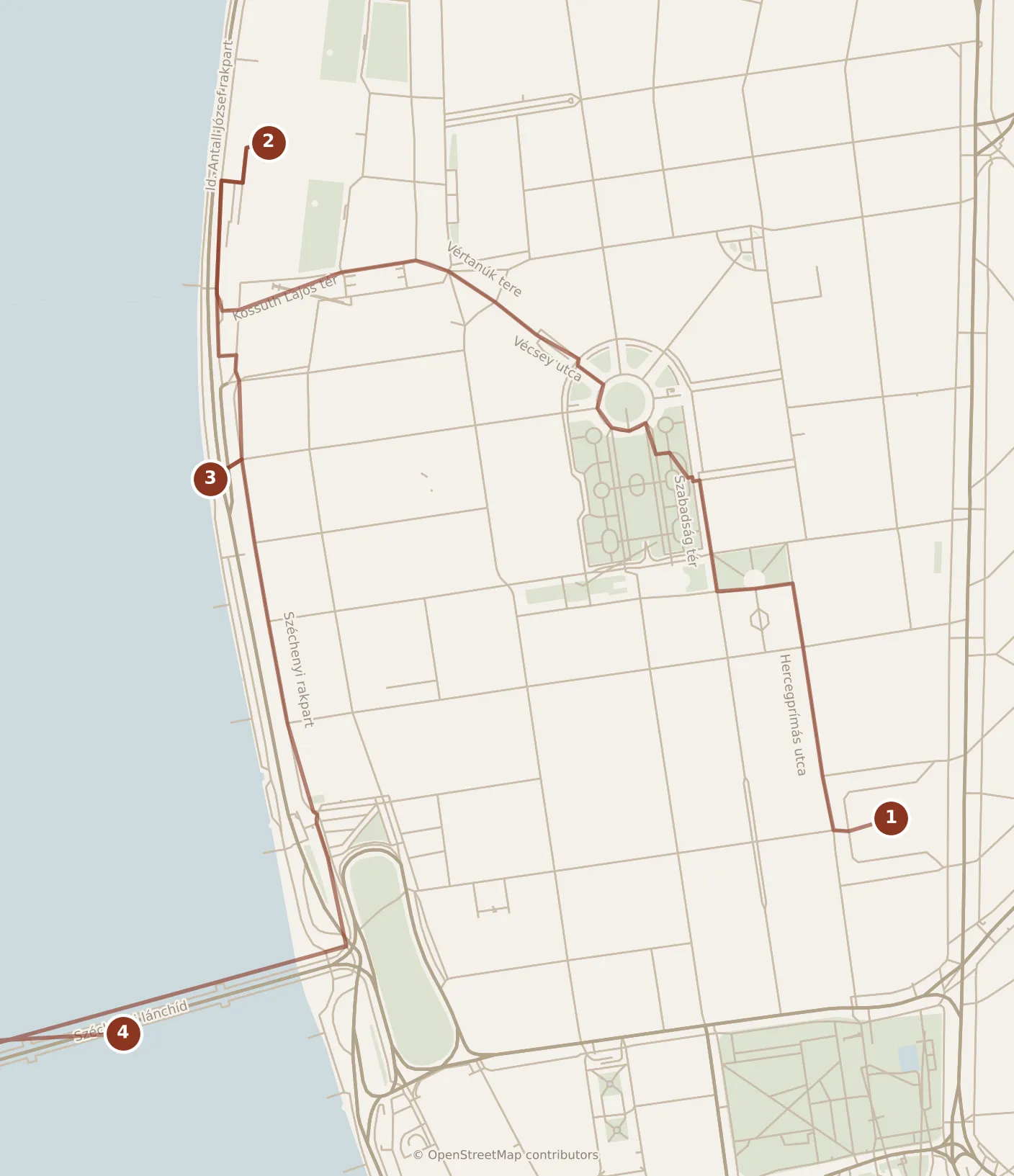
- Morning
- 1St Stephen's Basilica
- 2Hungarian Parliament Building
- 3Shoes on the Danube Bank
- 4Széchenyi Chain Bridge
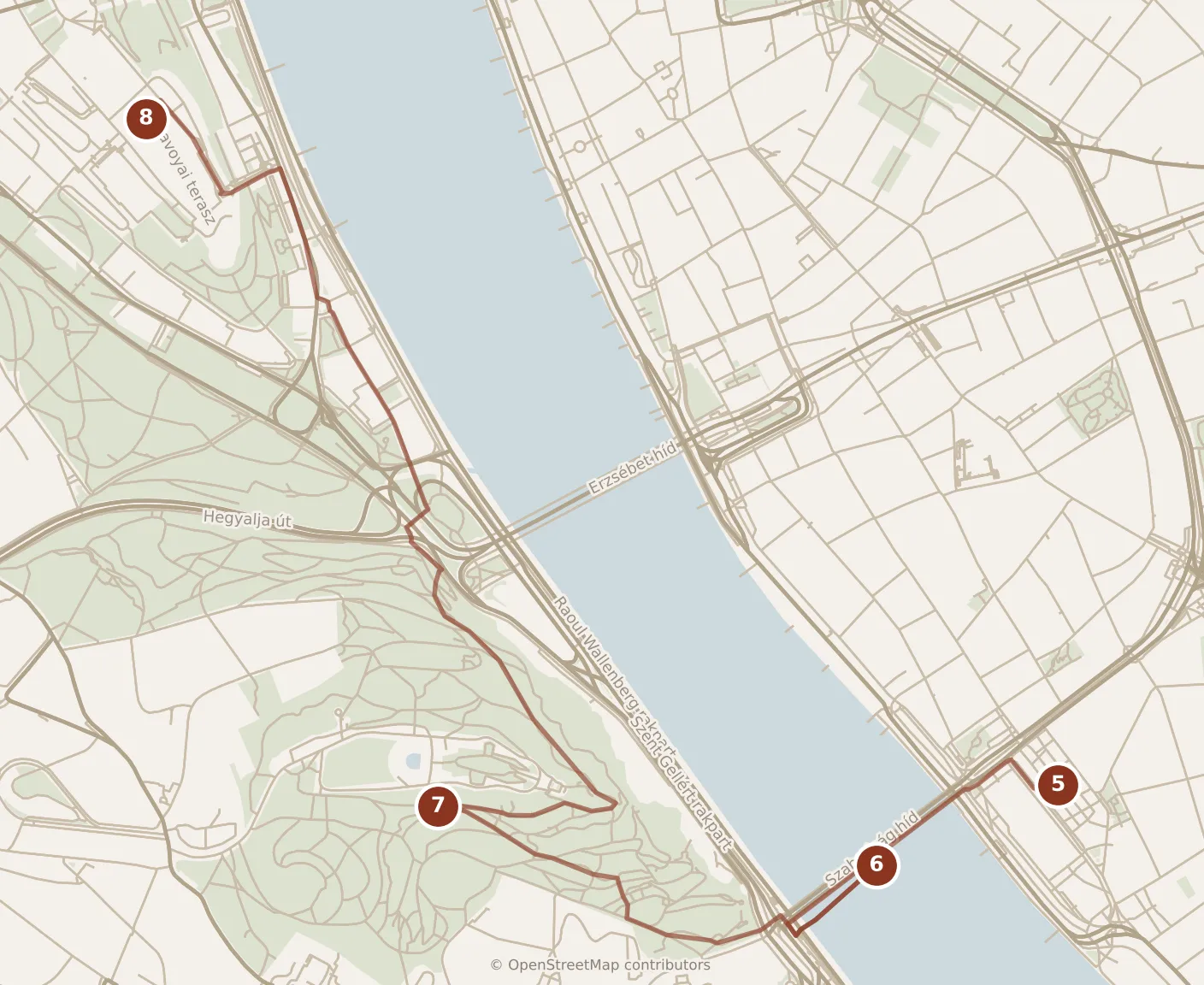
- Afternoon
- 5Great Market Hall
- 6Liberty Bridge
- 7Gellért Hill
- 8Buda Castle
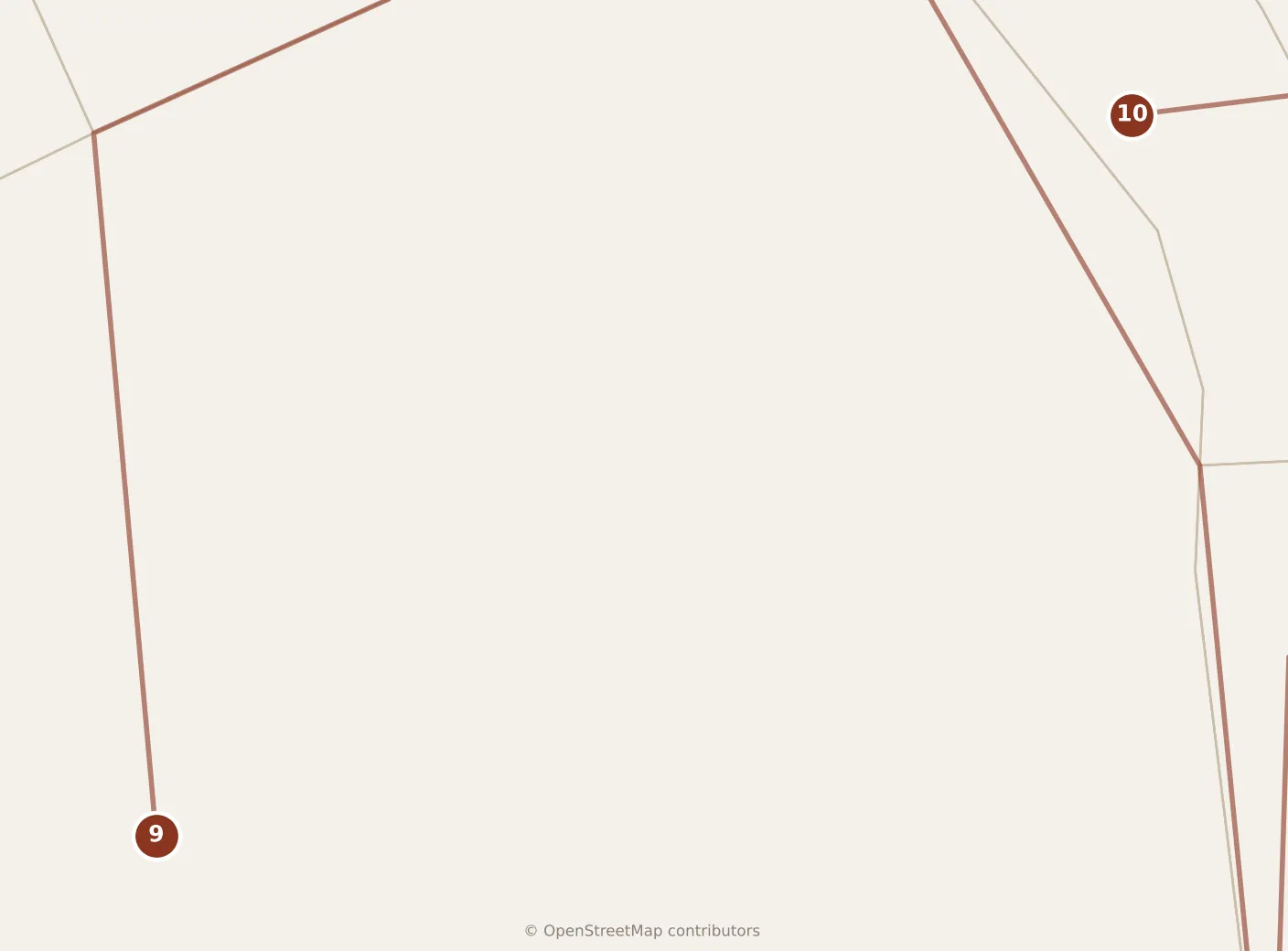
- Evening
- 9Matthias Church
- 10Fisherman's Bastion
Morning
Come up at Deák Ferenc tér and walk seven minutes north to St Stephen’s Basilica. It was begun in 1851 and not finished until 1905, and it is the largest church in Budapest. Its dome stands at ninety-six meters, exactly level with the dome of the Parliament across town, and for generations nothing in the city was permitted to be built higher than the two of them — the spiritual and the worldly capital, drawn level by regulation.
Two things inside are worth the three quarters of an hour. One is the mummified right hand of the king the church is named for, dead nearly a thousand years and kept in a glass reliquary in a chapel of its own. The other is the terrace round the base of the dome, reached by an elevator or by three hundred and sixty-four steps. It puts you above the flat grid you are about to walk out of, with the hills you will be standing on this evening closing the far end of it.
Eighteen minutes north-west, through the government quarter, is Kossuth Lajos tér and the Hungarian Parliament Building. Give the square half an hour and walk round to the embankment side, because the river facade is the one the building was designed to be seen from: a long gray-white wall of gothic pinnacles under a red dome, laid along the water. Seeing it from outside is not a consolation prize here. It is the intended view, it is free, and you will get it a second time this evening from the far bank with the lights on.
Local tip. If the inside of Parliament is what you came to Budapest for, book the tour before you travel and rebuild this day around the hour you are given, rather than hoping to fit it in. Then take the swap honestly: a morning that includes the tour will not also reach the top of Gellért Hill and get into the church before it shuts. Trade the hill for it, keep the market and the castle, and go up to the terraces after dinner instead.
Seven minutes south along the embankment, set into the stone at the water’s edge, is Shoes on the Danube Bank: sixty pairs of shoes cast in iron, men’s, women’s and children’s, left where they were stepped out of. In the winter of 1944 and 1945 the Arrow Cross militia shot several thousand people, most of them Jewish, into the river from this bank, having first made them take off their shoes, because leather could be sold. The memorial went up in 2005 and it needs a quarter of an hour, most of which you will spend noticing the sizes.
Eleven more minutes downstream brings you to the Pest end of the Széchenyi Chain Bridge, which opened in 1849 as the first permanent crossing of the Danube in the country, and until then the two cities on the two banks were two cities. It was designed by an English engineer, William Tierney Clark, and built under a Scottish engineer of the same surname, Adam Clark, who has the square at the far end named after him — the square you will come off the bridge into tonight. It was taken apart and rebuilt between 2021 and 2023 and given back without private cars on it. Look at it for ten minutes and do not cross yet.
Instead, board tram 2 at Széchenyi István tér and ride four stops to Fővám tér, which takes about six minutes. This is the one ride in the day and it is also a sight: the line runs the whole length of the Pest embankment with the castle hill facing it across the water, and National Geographic ranked it seventh among the world’s most beautiful tram lines in 2012.
Afternoon
You come off the tram at the Great Market Hall, which opened in 1897 to a design by Samu Pecz: ten thousand square meters under an iron frame, with a roof of patterned Zsolnay tiles that were put back during the restoration of the 1990s after half a century of neglect and war damage. Give the building and lunch an hour and a quarter together.
There are three floors and they are three different places. The first floor is the serious one — paprika in every grade, sausage, Tokaji — and it is where a thing bought is a thing worth carrying home. The basement is the one most visitors never find: fishmongers, pickle stalls, barrels of cabbage, and no souvenirs at all. The gallery upstairs is food stalls and trinkets, and it is where lángos is eaten standing up over a paper tray. Eat there, ignore the trinket half, and go down to the basement before you leave.
Six minutes south, the Liberty Bridge takes you across: pale green ironwork with bronze birds perched on the tops of its masts, and low enough over the water that you get the length of the river in both directions as you walk it. On the far side the ground goes straight up.
Gellért Hill stands a hundred and forty meters over the river — two hundred and thirty-five above sea level — and it is named after a bishop whom legend has the pagans of the day putting into a barrel and rolling down it in 1046. The paths switchback all the way, so the seven hundred meters between the bridge and the summit on a map is nothing like the distance you actually walk: reckon on half an hour of climbing, and take it slowly, because this is the only real effort in the day.
Forty minutes at the top. The Liberty Statue is fourteen meters of bronze on a twenty-six meter pedestal, put up in 1947 and inscribed to the liberating Soviet heroes; after 1989 the Russian text was taken off and the dedication rewritten to everyone who died for Hungary’s independence and freedom, and two of the four figures that originally stood around the base were taken away to Memento Park on the edge of the city. Behind it is the Citadella, the fortress put across the summit in the nineteenth century to hold guns over both towns, which reopened on 5 April 2026 after years of building work. But the reason to be up here is neither of them. This is the one place where the whole city resolves at once: both banks, the bridges laid out in order upstream and down, the Parliament flat along the far side, and the castle ridge to the north that you are about to walk.
Getting to it takes a little over twenty minutes, and apart from the walk home at the end it is the longest continuous stretch of the day: down the north side of the hill into the Tabán, the green hollow between the two hills, across the road at the bottom, and up the castle’s southern approach. It is downhill and then uphill, and it is the point at which you will be glad the bag is at the station.
Buda Castle is a rebuild and does not hide it. The palace was the last position held in the siege of the city between December 1944 and February 1945, and artillery fire left it roofless and burnt out. Forty minutes here, all of it outdoors: the Lions Court, whose arched gateway is guarded by four lions; the Matthias Fountain, a bronze hunting party — king, hounds, a fallen stag — spilling down an artificial cliff in one of the forecourts; the Turul, a bronze bird of prey with a sword in its claws, on a pillar at the end of the ironwork rail on the river side; and the long terrace over the Danube, which is where the palace hands the river back to you. The two big museums inside the palace are the day’s other deliberate omission. A state program called Hauszmann has been rebuilding parts of this quarter since 2019 and is scheduled to run to 2030, so expect scaffolding somewhere in it whenever you come, and plan the day so that which corner it is standing on does not matter.
Evening
Fifteen minutes north along the ridge, through the lanes of the old town, is Matthias Church, and this is the interior the whole count was built backwards from. Officially it is the Church of the Assumption of the Buda Castle; everyone calls it after the king. The Ottomans took Buda in 1541 and used it as a mosque until 1686. What you walk into now is the nineteenth century’s answer to that: between 1874 and 1896 Frigyes Schulek rebuilt it and had the whole interior painted — wall, pier and vault — in dense repeating patterns and figures, so that not one surface is left plain. The effect is closer to a carpet than to a cathedral, and half an hour is the right amount of time for it. Schulek also gave it the roof, a field of glazed tiles in diamonds and zigzags that you can pick out from the Pest bank. Two kings were crowned in here, Franz Joseph in 1867 and Charles IV in December 1916, the last coronation the country held.
One minute away, and the reason the church comes first, is the Fisherman’s Bastion. Schulek built it too, between 1895 and 1902, in a white neo-Romanesque that looks medieval and is not: seven pointed towers for the seven chieftains who led the Hungarian tribes onto the plain in 895, on top of a stretch of the old castle wall that the fishermen’s guild was once responsible for defending, which is where the name comes from. What it is, in use, is a viewing terrace with arcades and staircases, and what it looks at is the whole of Pest across the river — the Parliament almost directly opposite, the bridges downstream, Margaret Island upstream. Stay as long as the light and the season give you.
Then the way back, which is a walk rather than a problem. Steps and a lane drop off the castle hill to Clark Ádám tér in about a quarter of an hour, and from there you cross the Chain Bridge on foot — the crossing you deliberately did not make this morning, saved for the end, with the water black underneath and the Parliament lit up upstream the whole way over. Sixteen minutes more through the streets of Belváros puts you back at Deák Ferenc tér, so about forty minutes from the terrace to the metro. Three stops on the M2 and you are at Keleti pályaudvar with the bag.
Practicalities
The one thing this route needs that you do not already have in your hand is a transport ticket. It uses public transport three times — the metro in from the station, the one tram ride along the embankment, the metro out — and three one-way tickets at five hundred forint each is the whole of it, comfortably under the two thousand seven hundred and fifty a twenty-four-hour travelcard cost in 2026. The pass only starts paying its way at six rides, and the city guide covers how tickets are bought and validated here.
Nothing else on the day has to be booked before you travel. The Parliament tour is the single exception and is the reason to decide about it early rather than on the morning, because its slot is fixed and the rest of the day is not. The tickets you buy on the day itself are all bought at the door, and there are three of them. The basilica sells the nave and the terrace round the dome separately — two thousand six hundred forint and five thousand in 2026, or six thousand eight hundred for both. Matthias Church was three thousand four hundred, and its tower another four thousand on top of that. The Fisherman’s Bastion charges seventeen hundred for its upper terraces, and it is the only one of the three you can have for nothing, by going up late enough.
Sunday is the day this route breaks, and it breaks in three places, the first of them before you have walked anywhere. In 2026 the basilica’s nave admitted nobody before one in the afternoon on a Sunday, though the terrace round the dome kept its ordinary hours; the market hall does not open on a Sunday at all; and the church gives its morning over to services. Check that first hour and build the morning forward from it, the way the rest of the count is built backwards from the church. Saturday is the other one to check before you fix the order, because the market and the church both keep short afternoons — the market closing early and the church closing to visitors around the middle of the day. If your single day falls on either, check those hours before anything else and reorder around them. Sunday is the one that moves the route: take the dome terrace when you arrive and give the reliquary up, because a count started at the nave’s Sunday opening puts you at the church long after it has shut; eat inland from the promenade before you board the tram and treat the market hall as a building to look at; and take the church late rather than early. Saturday moves the route less: the market comes at the middle of the day either way, and what a Saturday decides is whether the church is still open when you reach it. If the church is shut when you reach it, the Bastion beside it is not, and the trade is that you lose one interior and keep the view.
A Monday, by contrast, this route survives entirely. Whatever the two museums in the palace do with the start of the week, this day has already given them up.
Underfoot it is close to nine kilometers, which is more than it sounds and less than it feels, because it is flat for the first half and then not. Everything before the Liberty Bridge is level sidewalk. Everything after it is a hundred-and-forty-meter climb, a descent, a second short climb and then a ridge, all of it on cobbles once you are on the castle hill. Shoes matter more here than in most cities on this site. If the hill is more than you want, the day still works without it: stay on the Pest bank to the Chain Bridge, cross there, and go straight up to the castle, which takes that bridge out as well as back — you lose the best view in Budapest and you gain an hour, which is a poor trade in good weather and a sensible one in rain.


_2015-02.jpg)
