Bratislava in two or three days: the old town, the castle hill, and Devín

Last updated 8 August 2026
Overview
Almost everyone who comes here comes for a day, and the day works. Staré Mesto is small enough that you finish walking its length before you have finished deciding what to look at, which is the whole argument for the place and also the whole reason people leave saying there was not much to it. Two days do not buy more of the same town. They buy the difference between walking past these buildings and going inside them, and they buy the two things a single day has to leave standing: the hill above the northern edge of the center, and the far bank of the river.
So the days split by what they ask of you rather than by district. Day one is the walled town, gone into — Michael’s Gate and its tower, the Old Town Hall, the Primate’s Palace, the Old Market Hall and the Blue Church a kilometer east that day trips do not reach — with the walk in taken over the hill, so that you see the shape of the city before you are standing inside it. Day two is the ground beside and beneath it: St Martin’s Cathedral, where the kings of Hungary were crowned, the Jewish quarter two different regimes removed a generation apart, the Chatam Sofer Memorial that survived the first of them, Bratislava Castle at proper length, and the crossing to the other bank at the end of the light. A third day goes ten kilometers west to Devín, where the border is, and comes back for the Slovak National Gallery, the one large interior the first two days leave out.
One thing here has to be arranged before you travel, and only one. The Chatam Sofer Memorial on day two is a working Jewish burial ground rather than a museum: you go in with a guide from the city’s Jewish religious community — the Židovská náboženská obec, which keeps the site and takes the reservations itself — and the visit is arranged in advance by telephone or email rather than at the gate. Admission was in the ten-euro range in 2026, with concessions. Nothing else on these three days is booked. As written the route is walked end to end except for the ride out to Devín and back, which is one bus taken twice — but the days also offer a tram at either end of day one, a bus up the hill if you would rather not climb it, a bus in from the far-bank station, and a train north if a Monday takes Devín off you, so how much transport you buy depends on how many of those you take. The network is IDS BK: tickets from the machines at the stops or in the IDS BK app, validated on board. The parent city guide covers how they work.
Only day two is decided by the light, and if you are still deciding whether to come at all, this paragraph and the next will keep: read the days first and come back for the arithmetic once the dates are yours. The sun goes down here as early as a minute before four in the first week of December and as late as a few minutes before nine in the last week of June: a five-hour swing between the two ends of the year, and enough to change what that day is. Everything on day two above the crossing — the canons’ street, the cathedral, the museum on Židovská, an hour for lunch, the memorial, then the castle with its treasury, its garden and its terrace, and just over an hour of walking to join them — comes to about seven hours. Take your month’s sunset and count back seven, and that is when to start. From a ten o’clock start it puts you in the middle of the bridge at about five.
That count models the time you spend inside things and nothing else. It does not include the ticket desk at the castle, and it does not include the wait at the memorial, where you are let in at the hour you were given and arriving early costs you exactly what you arrived early by. At the December end of the band the arithmetic simply fails: seven hours before a four o’clock sunset is nine in the morning, and the castle does not open until ten. Nothing rearranges that. In the dark months cross the bridge anyway and cross it after dark — the castle and the cathedral are floodlit, the far bank is the only place you see the two of them in one line, and the park behind the bridgehead is the part that needs daylight. Turn round on the bridge instead and you have the best part of an hour back.
Day one begins at the main station because of the hill rather than because of the trains, but if you are arriving that morning it is also where the bag goes, and this day does not come back for it — so check that the left luggage at Hlavná stanica is working before you build the morning on it, because a station’s lockers are the kind of thing that closes without notice. The day ends two kilometers south on the promenade, and tram 1 runs from Námestie Ľudovíta Štúra all the way back up to the station, nine stops and about a quarter of an hour. The first fifteen minutes of the morning are a climb, and they are the one stretch of these three days a wheeled case ruins outright. If your ticket names Bratislava-Petržalka instead — the Vienna services use both stations — you land on the far bank, bus 80 brings you to the northern edge of the old town, and that puts you at the gate rather than at the top of the hill. Start day one at the gate and take the hill separately, in daylight: it is outdoors and it is free, but it is a working cemetery before it is a viewpoint, and whether it keeps hours is worth checking before you go up.
Day one

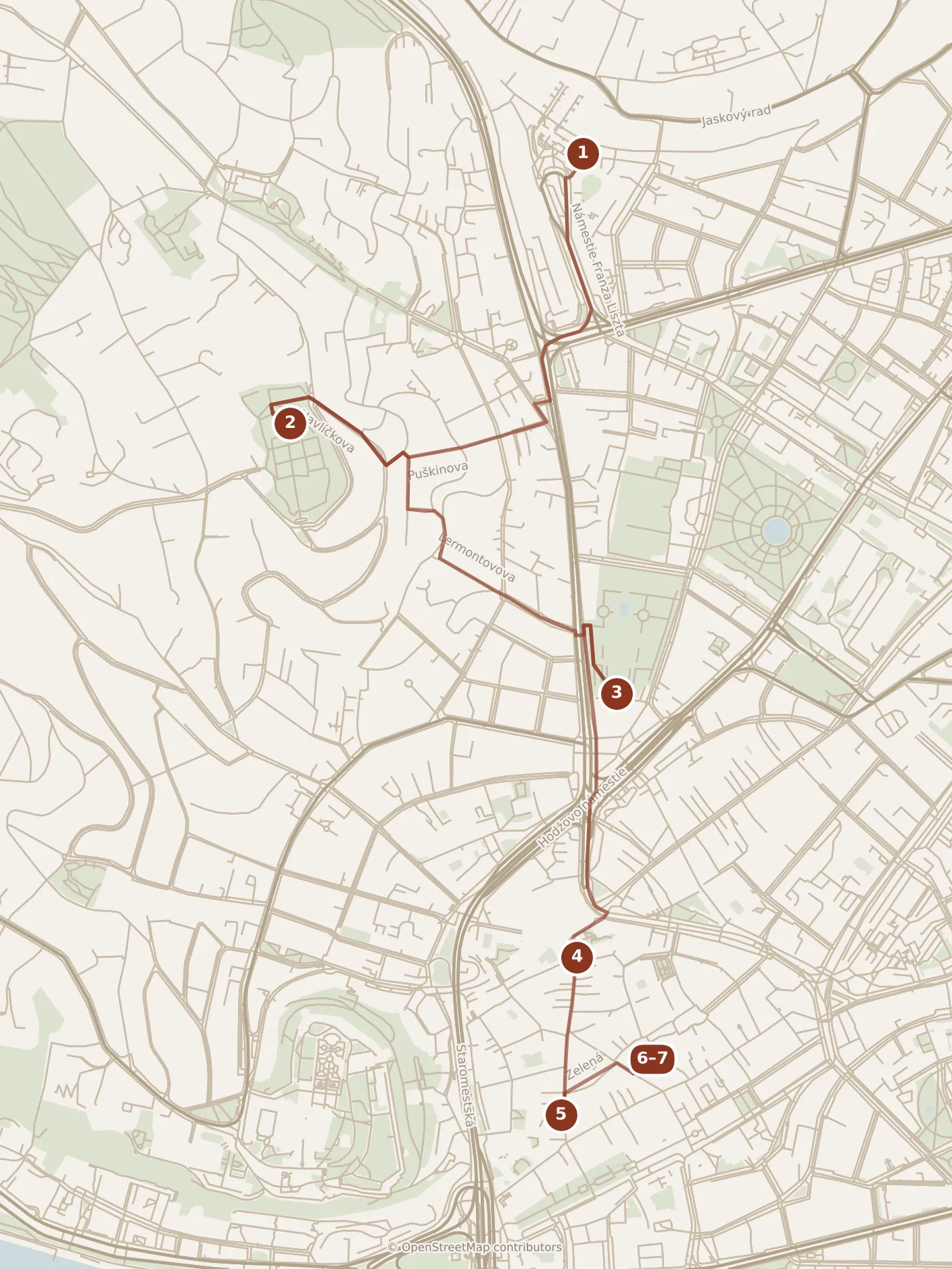
- Morning
- 1Bratislava hlavná stanica
- 2Slavín
- 3Grassalkovich Palace
- 4Michael's Gate
- 5Universitas Istropolitana
- 6Hlavné námestie
- 7Old Town Hall
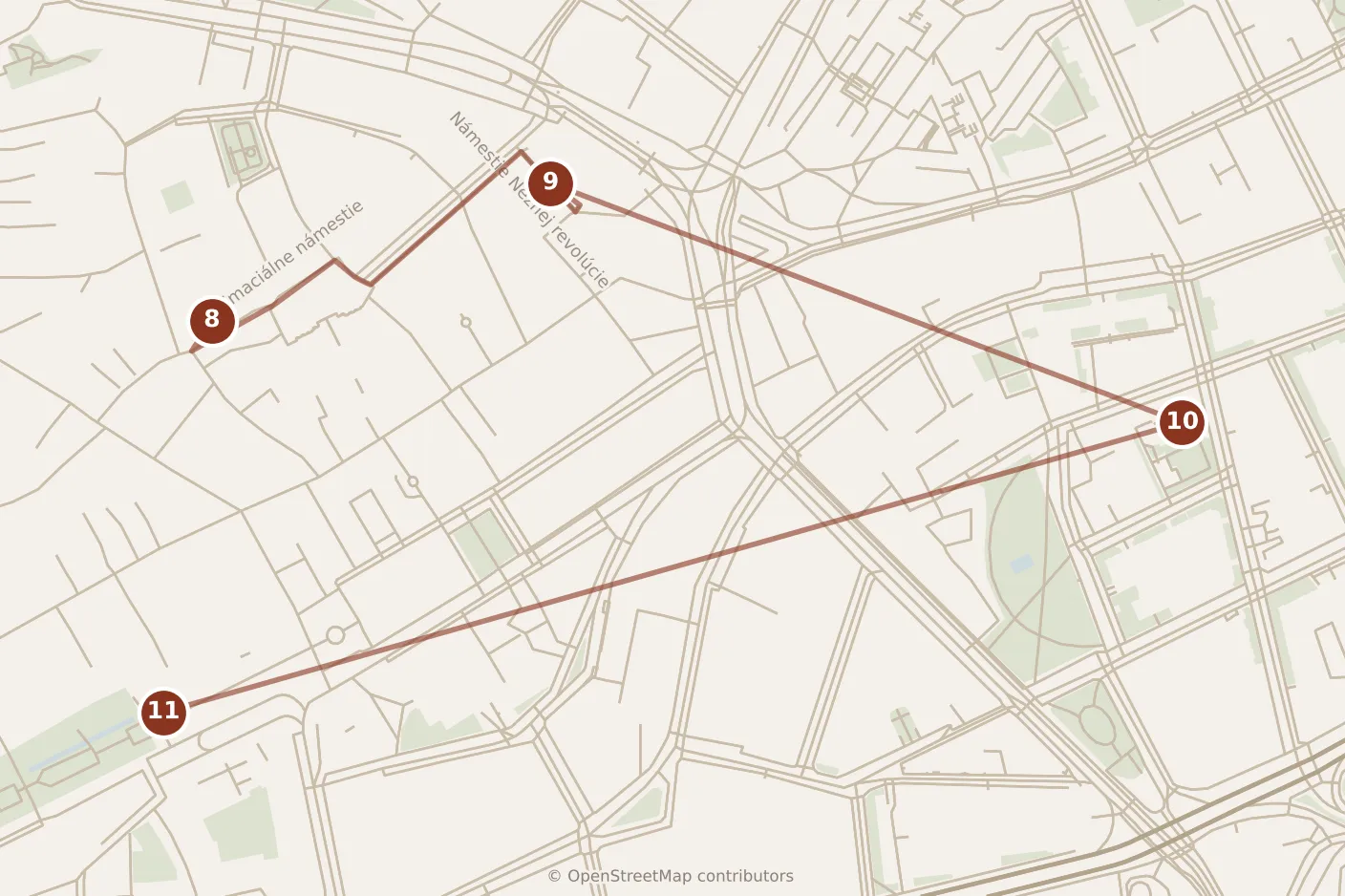
- Afternoon and evening
- 8Primate's Palace
- 9Old Market Hall
- 10Blue Church
- 11Hviezdoslavovo námestie
Morning
Walk in from Hlavná stanica over the hill. It is about fifty minutes on foot to the main square that way against a little over half an hour straight down Štefánikova, so the detour costs a quarter of an hour of walking, and what it buys is that you arrive in the old town already knowing where it sits. Tram 1 does the same journey in a quarter of an hour if the weather has decided otherwise; get off at Poštová, which is four minutes from the gate, and you have skipped the two stops below.
A quarter of an hour up and west from the station is Slavín, the memorial and military cemetery to the Soviet soldiers killed taking the city in the spring of 1945, finished in 1960. It is unapologetic 1950s state architecture — a tall pylon with a soldier on top, standing over a terrace of mass graves — and there is no ticket. It is a cemetery before it is a viewpoint: the terrace you cross to reach the parapet is the graves, and people come up here to lay flowers on them. Half an hour. What you came up for is the view south over the parapet: old town roofs, the castle on its own hill to the right of them, the river behind, and the panel blocks stretching away beyond the river. That is the geography of the next two days in a single look, and having had it, you will spend the rest of the trip knowing which way the water is.
Fifteen minutes down the other side through the embassy streets brings you to Grassalkovich Palace, built in 1760 for a Hungarian count and the president’s residence now. The front of it is the less interesting half. Go round to the garden behind, a public park where the surrounding streets eat their lunch when the gates are open — it sits behind a head of state’s residence, so read a closed gate as normal rather than as bad luck. A quarter of an hour is right.
Ten minutes south and you are under Michael’s Gate. The point of it on this trip is that you go up. The tower was taken apart and put back between 2021 and 2022 and reopened in September 2023 with an exhibition about itself: the building read from the bottom upwards through its own layers, the barbican outside, the bells and the clock mechanism, and at the top an open gallery over the roofs of the lane you are about to walk down. Three quarters of an hour. In 2026 it opened at ten and shut on Tuesdays, and that ten o’clock is what the morning is counted from — leave the station at nine and you are under the arch at about half past ten with the hill already behind you. If the hour has moved, count the walk in back from the new one: it is an hour and a half from the station with the two stops above in it.
Six minutes down Michalská and Ventúrska, at number three, stands the house of the Universitas Istropolitana — the university Matthias Corvinus had founded here in 1465, the only one the Kingdom of Hungary held while it lasted, and it lasted about twenty-five years. It is a school of theater and film now, so the street is as far as you get. Ten minutes outside it is the right amount: a Renaissance front with a courtyard behind it on a lane that is otherwise all baroque, and once you have seen it you start noticing how much older this street is than it looks.
Three minutes on, the lane opens into Hlavné námestie, which is the town’s square and smaller than that makes it sound. Half an hour standing in it before you go into anything. Then the Old Town Hall on the far side: walk through the arcaded courtyard, which is free and is also the way through to this afternoon’s palace, and take the city museum upstairs. An hour, and twenty minutes of that hour is the tower.
Local tip. The climb up the town hall tower is the twenty minutes on this day you can most afford to lose. Slavín gave you the same city from higher up three hours ago, and cutting the climb is what gives the Primate’s Palace back its full forty minutes if the morning has run over.
Afternoon
Eat in the lanes north and east of the square rather than on the square itself, where the frontage is what you are paying for. The tell, standing in a lane with two doors to choose between, is the menu: a short one, priced, in Slovak before it is in anything else, against a laminated card in six languages and somebody at the door inviting you in. An hour, sitting down.
A minute from the town hall courtyard is the Primate’s Palace, and the two halves of it cost different amounts. The inner courtyard is free to walk into and holds a fountain of a saint killing a dragon in the middle of it; upstairs is the mirrored hall where the city council still meets and where the peace treaty of December 1805 was signed, and the rooms of portraits and English tapestries around it. Forty minutes, and it is shut on Mondays.
Four minutes east, on the far side of the ring, is the Old Market Hall — glass and iron, opened in 1910 to a design by the city engineer Gyula Laubner, dark for most of the century after that, and taken over in 2013 by a civic association that runs it now. What you find inside depends entirely on the day, and the program has changed more than once since the association took it over, so read what the hall says for your own date before you plan a lunch around it. On a Saturday it is usually a food market through the middle of the day, farmers and small producers on the floor, and that is the day to aim day one at if your dates give you the choice — but on that day take the hall before the palace and let it have the lunch hour above, because the day as written reaches it at about a quarter to three, by which time a middle-of-the-day market is over. On any other day it is a hall with a canteen and whatever else is on. Half an hour either way. Whichever day you get, the thing this city calls its own is the bratislavský rožok, the crescent filled with poppy seed or walnut — a bakery purchase rather than a restaurant one, so it belongs in a morning or in a hall like this and not at dinner.
Eight minutes further east, across the traffic and into the quieter grid of nineteenth-century streets, is the Blue Church. Ödön Lechner built it between 1908 and 1913 and dedicated it to Elizabeth of Hungary, and the whole thing is blue: the walls, the glazed roof tiles, the mosaics. The plan is an oval and the tower is round, not quite thirty-seven meters, and the effect from the sidewalk is of a building that has been iced rather than built. It is Art Nouveau taken as far as it will go, and it is also a working parish church rather than a monument, which is the honest part: its doors follow its services and not any visiting hours, and a good share of the people who walk out here find it locked. The parish publishes its Mass times, as the cathedral’s does, and reading them the week before is what turns a coin flip into a plan. Fifteen minutes is what it deserves from the outside, the walk east through ordinary streets is half of what you came for, and if the door is open you have had a piece of luck rather than a broken plan.
Evening
Thirteen minutes back west along Dunajská returns you to the old town at Hviezdoslavovo námestie, which is where the day ends and where you should stay for it. Day two finishes on the far bank with nothing around you but a park, so spend this evening in the streets rather than on a view.
The lanes between the square and Panská are where the eating is, and the thing that separates a second evening from a first is that you can now choose by street instead of by menu. In the cold half of the year the plate to look for is kapustnica, the smoked sauerkraut soup, which is a meal rather than a starter and which the city eats hardest in the weeks before Christmas. If you have come in summer, the same streets put their tables outside, and the hills north of the city are white-wine country. Not every door in these lanes pours them — this is the most walked stretch in the city and a good deal of the frontage sells whatever is cheapest — so ask what is local and what is open by the glass before you sit down, and where nobody can answer, walk on. Where they can, a glass at a time is how you find out what you like in two evenings.
Day two

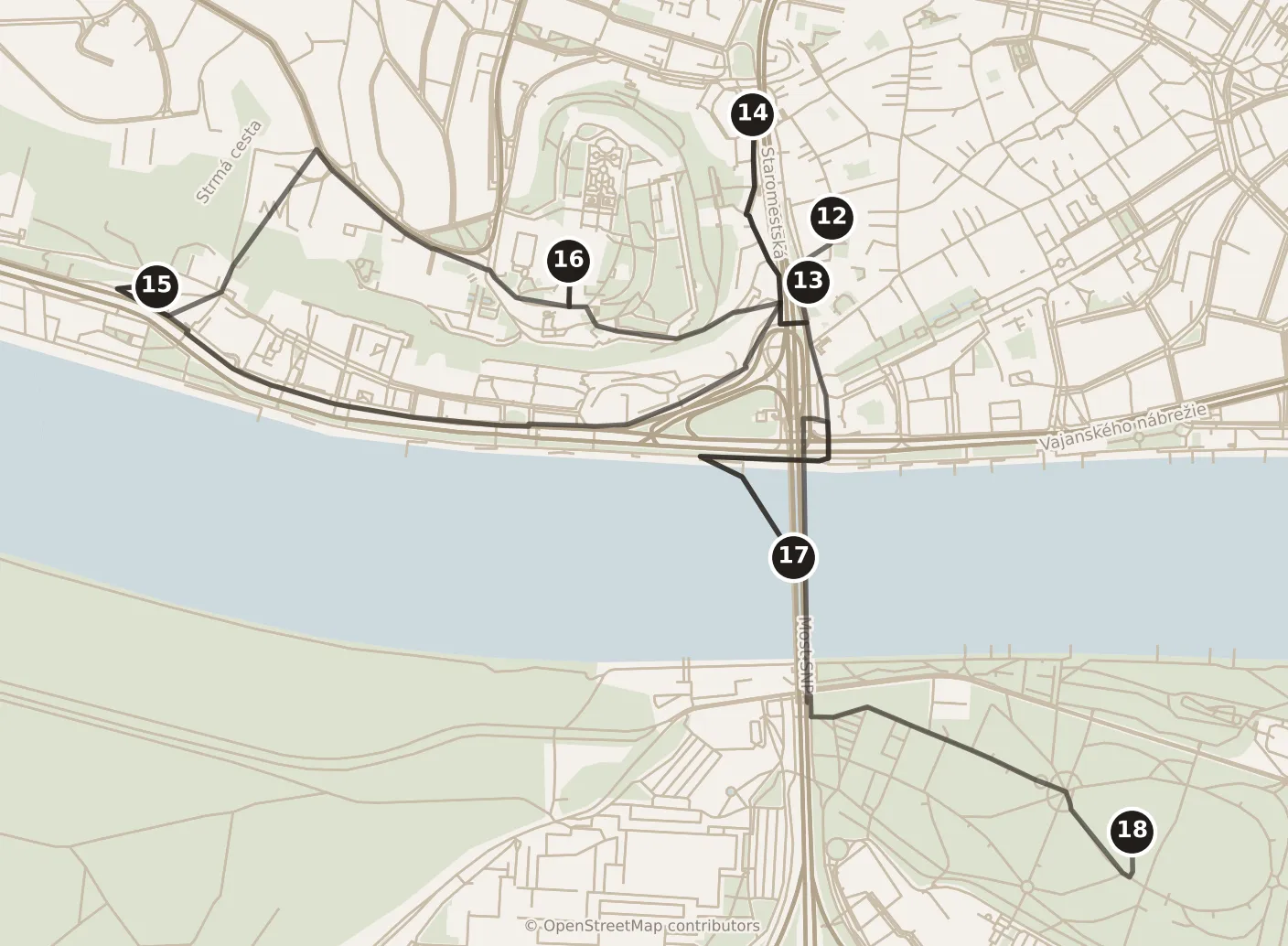
- Day two
- 12Kapitulská
- 13St Martin's Cathedral
- 14Museum of Jewish Culture
- 15Chatam Sofer Memorial
- 16Bratislava Castle
- 17Most SNP
- 18Sad Janka Kráľa
Morning
Begin on Kapitulská, five minutes from the main square and one street back from everything on day one. It is the one lane in the old town that still reads as the town before the eighteenth century: canons’ houses, no shopfronts, an unbroken wall on one side, and brass crowns set into the paving that mark the route the coronation procession took through the streets. Ten minutes, walked slowly, and it puts you two minutes from the cathedral door.
St Martin’s Cathedral is where the kings of Hungary were crowned for two hundred and fifty years, and the crown on the top of the tower says so from a distance. Inside, give it forty minutes and look for the side chapel with a silver casket in it: it holds the body of a seventh-century patriarch of Alexandria, brought here in the seventeenth century, which is a stranger thing to meet in a parish church than any amount of coronation history. Two things govern the visit. It is a working parish church, so it admits nobody during a service and closes to visitors in the middle of the day; and on a Sunday the morning belongs to Mass from end to end. The parish publishes its own visiting window and its Mass times; read them the week before, and if the window has moved the day still works from the new one, because everything after the cathedral is either outdoors or on an appointment.
Come out and the ground tells the rest of the morning by what is not on it. Two regimes removed this quarter a generation apart. In 1943 the Slovak State demolished most of the old Jewish cemetery under the castle rock to drive a road tunnel through it; between 1969 and the early seventies the approach road to the new bridge took the Neolog synagogue and most of the quarter around it. The Holocaust memorial on Rybné námestie, on the ground the synagogue stood on, carries an image of the building. Ten minutes, and they are the ten that make sense of the two stops after them.
Five minutes up Židovská is the Museum of Jewish Culture, in one of the handful of houses of the quarter still standing. It is small, it is the national museum’s, and forty-five minutes in it is the best-spent three quarters of an hour of the trip once the street outside has done its work. It keeps Shabbat and is shut on Saturdays, and the same calendar governs the festivals, so check the dates you actually have rather than the weekday alone. This is the one closure on the route that no amount of rearranging argues with.
Eat before you go down to the river, up here in the lanes around Židovská and Panská: there is nothing to eat at the memorial and nothing at all on the climb after it. An hour. Bryndzové halušky is the plate to have once, and having it before eighty meters of ascent is a decision you will feel.
Then eighteen minutes west along the embankment, under the castle rock, to the Chatam Sofer Memorial. It is a river walk on the map and a walk beside a main road on the ground — the road that took the cemetery you are going to, which makes it the right approach rather than a poor one. You are let in at the hour you booked, with a guide, and you stay with them: this is a burial ground and not an exhibition. Long trousers and covered arms are asked of everyone, and men cover their heads, as at any Jewish cemetery. What you go down into is the surviving corner of the cemetery the tunnel took — twenty-three graves of Pressburg rabbis around the tomb of Moses Sofer, whose school made this town one of the great centers of orthodox learning in Europe — roofed over in 2002 by a low concrete chamber built to protect them. The rest of the cemetery is the road over your head. Three quarters of an hour.
Local tip. The memorial is the only thing on these three days that you have to be somewhere for at an hour somebody else picked, so book it first and build the day around whatever slot you are given. A morning slot and the day runs exactly as written above, unless it is a Sunday, when the closures below decide the order instead. An afternoon one and you invert it: the castle first from ten, then down the hill to the memorial and up into Židovská, with the cathedral last when it reopens after the middle of the day. Either order finishes near the water, which is where you want the light.
Afternoon
From the memorial the castle is eight hundred meters on the map and eighty meters of climb, which makes it twenty minutes rather than the twelve the distance suggests, and all of it is up. You have seen this hill already, from Slavín on day one, and the reason it gets an afternoon rather than an hour is what is on the lower floor. The national museum’s history galleries above are a walk-through and you can take them as one. The treasury is not: it holds a woman seven and a half centimeters tall, carved out of mammoth ivory about twenty-two thousand years ago and ploughed up in a field at Moravany. An hour and three quarters for the two together, most of it downstairs.
The baroque garden behind the stables takes twenty minutes and is better than it looks, partly because of who plumbed it: Johann Wolfgang von Kempelen, the court engineer behind the chess-playing automaton that toured Europe for eighty years, designed the water system that fed this hill. The parliament sits in the modern block on the south side and is not part of the visit.
Then the terrace above the river, fifteen minutes. The castle museum shuts on Tuesdays; the grounds and the terrace do not, so a Tuesday costs you the treasury and not the view.
Evening
Down the eastern side of the hill, eleven minutes, and out on to Most SNP. The bridge answers to two names — Most SNP and Nový most, which is the one on the stop below it — and day three leaves from underneath it, so read them as one structure. Cross it on the lower deck, which is a public footway, costs nothing and takes ten minutes. The whole point of this crossing is the direction you are facing, which is backwards.
Twelve minutes from the far bridgehead is Sad Janka Kráľa, laid out between 1774 and 1776 and one of the oldest public parks in Europe. It is a formal wedge of avenues with a neo-Gothic tower standing in it — the top of an early fifteenth-century Franciscan church tower, moved here, knocked about by the earthquake of 1897 and rebuilt by Frigyes Schulek. Half an hour, and the honest limit goes here: Petržalka behind the park is a housing estate of a hundred thousand people and a place to live rather than a district to tour, so what this bank gives an evening is the park, the view back, and the paid elevator up the pylon of the bridge you have just walked over. The park is one reason to cross and the view back is the other.
Then turn round and walk back over, which is a little over twenty minutes into the old town and the only time on these three days that the whole city is in front of you at once — castle on the left of the frame, cathedral spire below it, the roofs between them. In the long half of the year this is the hour the day was counted for. In the short half it is dark by now, everything named above is floodlit, and it is arguably the better version. Either way the evening after it is the first evening’s lanes again, with the difference that you now know which streets they are.
With a third day

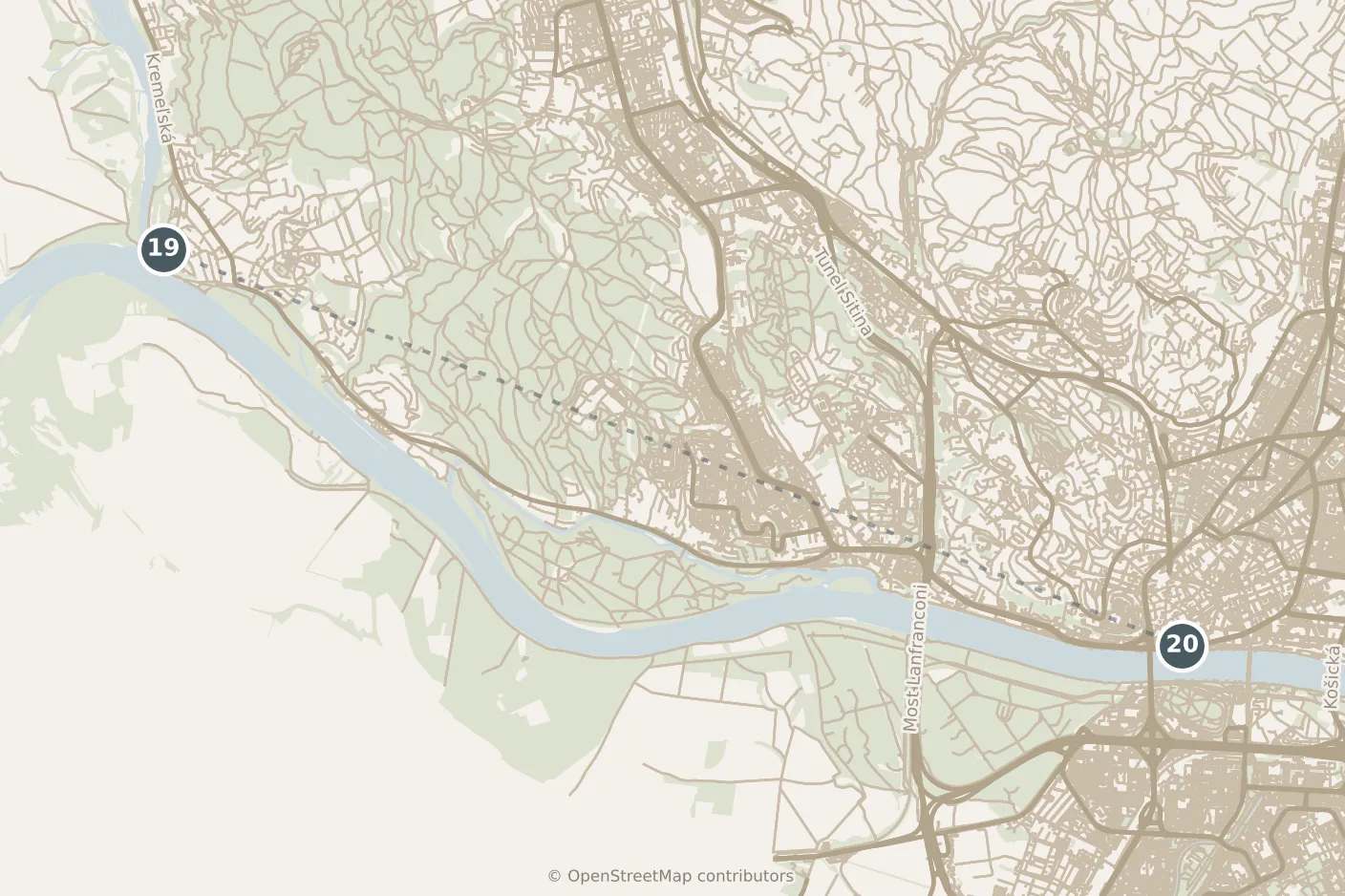
- With a third day
- 19Devín Castle
- 20Slovak National Gallery
The third day is appended rather than inserted, and the reason is not that it is the weakest. It is that Devín only lands properly after two days of the castle in town: one of them is a rebuilt royal residence with a treasury in it, the other is a broken rock on a border, and the second is much more interesting once you have stood on the first. Two things move it earlier. The first is weather: Devín is a hill in the open with a single small exhibition on it, and day two is three roofs and a bridge, so if one of your days is forecast wet, make that one day two and take Devín on the dry one. The second is a set of dates whose closures leave no other order, as a Saturday-to-Monday visit does. Nothing else shifts if you do: apart from the bridgehead, where day two crosses and day three catches its bus, the three days share no stop, no meal and no booking.
Bus 29 leaves from the Nový most stop under the bridge, which is where the stop’s name comes from, and runs half an hour west along the river to the castle gate. Devín stands on a rock where the Morava comes into the Danube, it was a frontier fortress for a thousand years before anyone here spoke of a country, and it was blown up in 1809 by Napoleonic troops on their way out and never rebuilt. What you walk is therefore ruin rather than building: three levels of it over six hectares, a well sixty meters deep cut through the rock, a single tower left standing on its own pinnacle, and an exhibition of a few hundred excavated finds in the middle castle. Two hours, and the upper terrace is what you climbed for — two rivers meeting, and Austria on the other side of both.
Below the gate, outside the ticket line and free, is the Gate of Freedom: a pierced concrete gateway with a torn mesh inside it, unveiled in November 2005 for the roughly four hundred people killed trying to leave Czechoslovakia between 1945 and 1989. This water was the Iron Curtain, the whole bank was a closed military zone within living memory, and twenty minutes here is the part of the day that changes what the ruin above means. It is also the reason to make the trip even if the castle itself is shut.
One hour governs the day and it moves with the season, so do not count from a fixed one. The city museum runs the site and publishes the season’s hours itself: read them for your own dates, subtract whatever gap it keeps between the last ticket and closing, and take a bus that lands you there with two clear hours in front of you. In the winter months that means a morning bus rather than an afternoon one, and it is also when to check that the site is open at all before you build a day on it — an open-air ruin on a rock keeps a season, not merely a shorter afternoon. If the answer for your week is no, the paragraph above still stands on its own: the gate below, the confluence and the path under the rock are outdoors, free and open.
Back on the 29, and then the one large interior days one and two leave out. The Slovak National Gallery is seven minutes’ walk east of where the bus drops you, on the embankment, and it reopened in 2022 after a reconstruction that took the best part of two decades. The building is half the visit: Vladimír Dedeček’s concrete bridging wing of 1977, slung over an eighteenth-century barracks, is one of the most argued-about buildings in the country and you can now see why from inside it. The collection’s strength is the medieval altarpieces brought in from village churches, and they are what to give the time to. An hour and a quarter. With lunch, the whole day comes to about five and three quarter hours, which puts you back in the center with the evening still in front of you and, by the third one, a lane already chosen.
If the day is short, the gallery is what goes; Devín does not compress and the bus home is the same length whatever time you catch it. And if your third day is a Monday, both the castle and the gallery are shut, so take one of two plans rather than half of this one. Ride out anyway for the Gate of Freedom, the confluence and the riverside path below the rock, and accept that it is an hour and not a day. Or go the other way: the S50 from Hlavná stanica runs north into the Small Carpathians, and Svätý Jur and Pezinok are both on it — small walled wine towns with cellar doors opening on to the street and vineyards starting where the houses stop. The hillside and the walk between the two keep no hours at all. Individual cellars keep their own, and Monday is the likeliest day for one of them to be shut, so treat it as a day for the ridge rather than for the tasting.
Practicalities
The one booking. Only the Chatam Sofer Memorial. The city’s Jewish religious community, the Židovská náboženská obec, keeps it and takes the reservations itself, on the telephone number and the email address the memorial publishes on its own site. Do it as soon as your dates are fixed rather than when you arrive, because the slot you are given decides the order of day two. Nothing else on these three days is decided by it, and nothing else decides that order either, with one exception: on a Sunday the cathedral has a say in it too, and the Sunday bullet below says how the two settle.
Which day goes where. Three weekdays close something, and they close different days.
- Monday takes the city museum in the town hall, the Primate’s Palace, the gallery on the embankment and Devín Castle. That is day one’s two big interiors and the whole of the third day. Day two survives a Monday completely intact, so if one of your days is a Monday, make it day two.
- Tuesday takes the tower at Michael’s Gate and the castle treasury and museum. It costs day one three quarters of an hour and day two an hour and three quarters, and both days still work — the castle grounds, the garden and the terrace are open on a Tuesday and so is everything else on day one. Give Tuesday to day one, where it removes the smaller thing.
- Saturday takes the museum on Židovská and, with it, any chance of the memorial: both keep Shabbat, and a Jewish festival falling inside your dates closes them on some other weekday, which is worth checking once. Saturday must not be day two. On day one it is a gain rather than a loss, because Saturday is the likeliest day for the Old Market Hall to be a market.
- Sunday closes nothing, but the cathedral’s morning belongs to Mass, so a Sunday day two runs in the inverted order described above — castle first, cathedral last. That order wants an afternoon slot at the memorial, so ask for one when you book. If a Sunday day two is given a morning slot the two rules cannot both be kept as written: take the memorial at the hour you were given, the castle after it, then Židovská, and the cathedral last of all when it reopens.
The rest may trade freely: day one and the third day will take any date except a Monday, with day one first where the dates leave you the choice. On a Saturday-to-Monday visit they do not: the Monday has to be day two, so the weekend takes the other two, and the arrangement is day one on the Saturday (the likelier market day at the hall) and the third day on the Sunday. That puts Devín before the castle in town, against the reason the third day is appended at all; the closures leave no other order, and what it costs is a little of the third day’s point and nothing else. The visit that quietly breaks is the two-day Saturday-and-Sunday: Saturday cannot be day two, so day two lands on the Sunday, and the cathedral is what has to move.
What to cut when short. Day one: the town hall tower first, then the Blue Church, which costs a quarter of an hour of extra walking and a locked door as often as not. Day two: the baroque garden, and then the park across the water — stop in the middle of the bridge and turn back, which returns the best part of an hour. The third day: the gallery.
Distances. Day one is about five kilometers and the first two and a half of those are the walk in from the station, so the town half of it is short. Day two is about six and a half kilometers with eighty meters of climb in the middle, and it holds the longest walk of the trip: a little over twenty minutes back from the park, over the bridge and into the old town, with the climb from the river to the castle gate just behind it. The third day is a bus, a hill and seven minutes on the embankment.
Moving between the stops. Days one and two are walked end to end as written. The third day uses bus 29 from the Nový most stop and back. Tram 1 links Hlavná stanica with Poštová at the top of the old town and with Námestie Ľudovíta Štúra at the bottom, which is the line to know at the beginning and end of a stay; bus 147 climbs from Hodžovo námestie towards Slavín if you would rather not walk up, and from the center on foot that hill is about a quarter of an hour and all of it up. Lines here have been renumbered before now, so put the two stop names into the IDS BK app rather than trusting a number printed months before you travel.


