Bratislava in one day: gate, square, coronation cathedral, castle hill

Last updated 4 August 2026
Overview
Bratislava is small in a way that settles the shape of a day before you have chosen anything. Staré Mesto is about fifteen minutes across on foot, the castle stands directly above its western edge, and the route below runs north to south in nearly a straight line — station, gate, square, palace, cathedral, hill, river — and never turns back on itself. Ride the first leg and the walking between the stops is nearer four kilometers than three — and that counts neither the twenty minutes it takes to cross the castle grounds nor the leg back to the tram at the end.
That compactness is also why so many people arrive with a round-trip ticket to Vienna in their pocket and leave saying there was not much to it. There is enough here for a day. There is not enough for a day spent indoors, which is the mistake this route is built to avoid: it takes one palace interior, one cathedral and one castle, and gives up the rest. Devín, ten kilometers west where the Morava meets the Danube, is a half-day of its own and does not compress. The Blue Church is a kilometer east of everything else on this list and keeps its doors to the rhythm of its services. Slavín and the panel-block sea across the river belong to a second visit, and naming a fourth museum here would be easy and useless.
One hour genuinely decides the order. In 2026 St Martin’s Cathedral admitted visitors from nine until half past eleven and again from one until six, and not at all during a Mass — which on a Sunday takes the whole morning, since Masses run at nine, half past ten and noon. So build the morning back from that: the three stops above the cathedral come to about an hour and twenty minutes of looking and a quarter of an hour of walking, and you want half an hour inside the cathedral itself — so be at Michael’s Gate by half past nine, and at nine if you also want the tower and the museum on the square — an hour that comes out of the palace rather than out of the morning’s slack. The parish publishes both the visiting window and the Mass times on the cathedral’s own site; if you find the hours have moved, build the morning back from the new ones instead. If your day is a Sunday, run the morning without the cathedral, eat early, and take it at one o’clock on the way to the hill.
The second thing that will not wait is the light, and the stop it belongs to is the castle terrace above the Danube. The sun sets here from just before four in December to just before nine at the end of June. Everything above the terrace — ten minutes at the gate, half an hour on the square, forty in the palace, half an hour in the cathedral, an hour over lunch, two hours on the castle hill, and a little under half an hour of walking between them — comes to about five and a quarter hours. Count that back from your month’s sunset. In December it lands at a quarter to eleven, which is already too late for the cathedral’s morning window, so in the short half of the year start at nine anyway and give the extra hour and three quarters to the hill, which can absorb it. From about April onwards the sum stops binding altogether: the sun is still up long after every door on this route has shut, the terrace becomes a late afternoon rather than a deadline, and the light lands instead on the bridge and the embankment, which do not close.
That count models the time you spend inside the places and nothing else. It does not include the ticket desks, and it does not include the twenty minutes the castle’s own grounds take to cross from the gate on the hill to the terrace above the river.
Nothing on this day has to be booked before you travel. The one thing to have in your hand is a city transport ticket if you mean to ride the tram at either end of the day rather than walk; the parent city guide explains how those are bought and validated. Leave the bag at Hlavná stanica, where left luggage is: this day begins and ends within one tram line of it, and the climb to the castle is the stop you cannot do holding a case.
The day

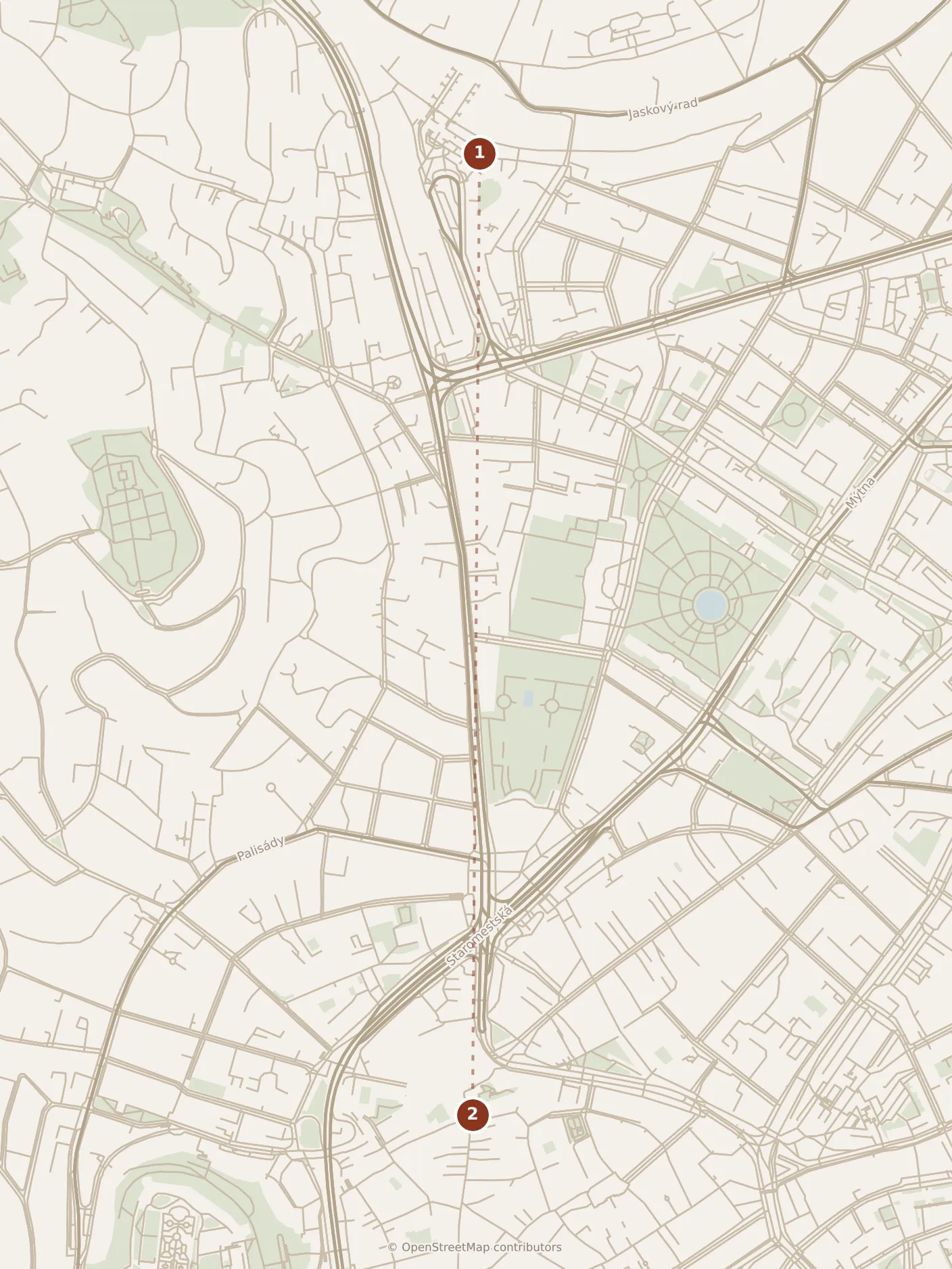
The ride on to stop 2, by tram, not on foot.
- Morning
- 1Bratislava hlavná stanica
- Morning
- 2Michael's Gate
- 3Hlavné námestie
- 4Old Town Hall
- 5Primate's Palace
- 6St Martin's Cathedral
- Afternoon and evening
- 7Bratislava Castle
- 8Most SNP
- 9Hviezdoslavovo námestie
- 10Slovak National Theatre
Morning
Tram 1 runs from outside Hlavná stanica down to Poštová in five stops, and Poštová is four minutes from the gate. On foot it is about half an hour, most of it downhill along Štefánikova, and that walk is worth having only if the weather is good and the day is long.
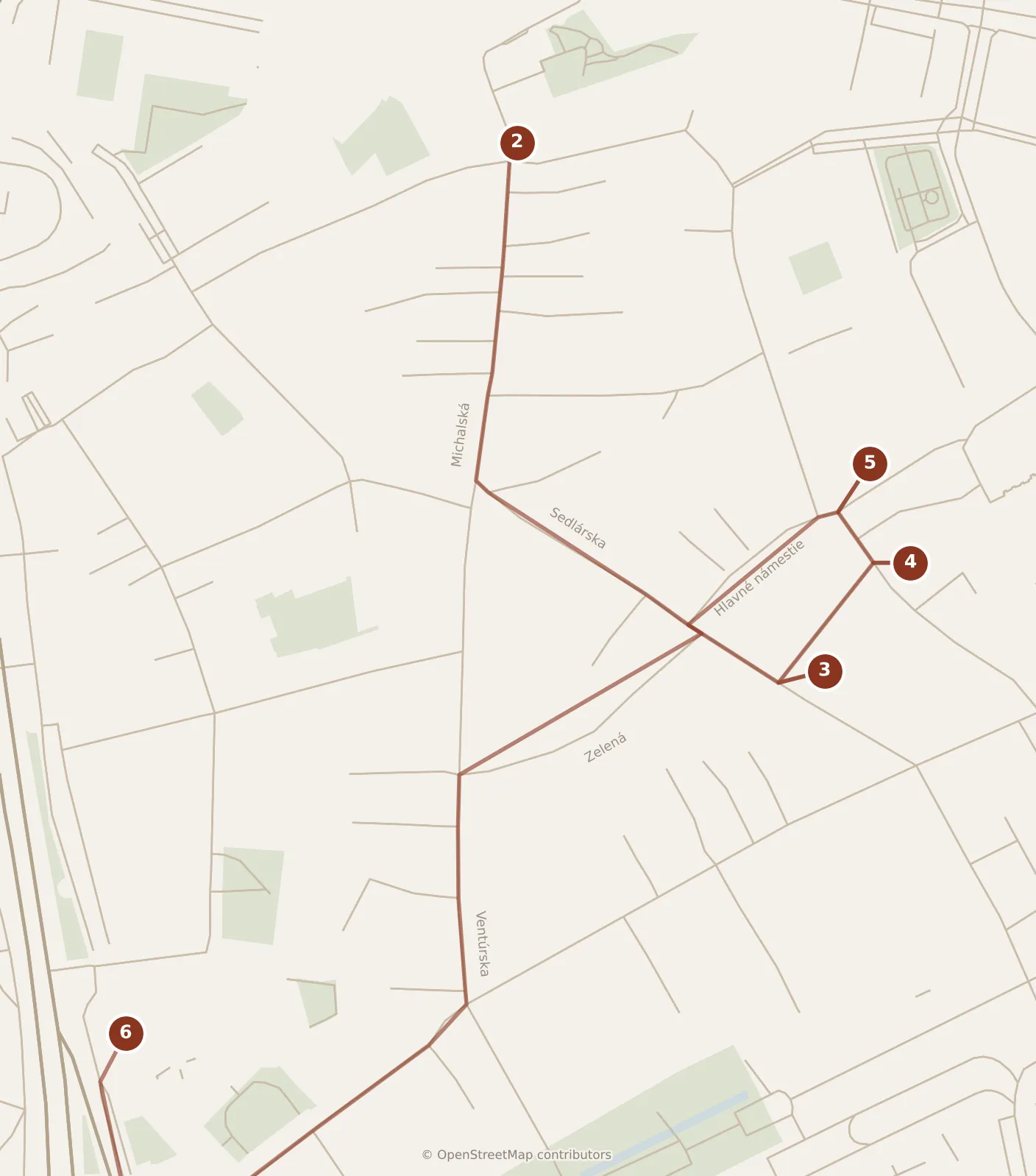
Start under Michael’s Gate. It was built around 1300 and it is the only one of the town’s four medieval gates still standing — the others, on the east, south and west sides, are gone entirely. What you are looking at is mostly the baroque rebuilding of 1758, which is why a gate of about 1300 ends in a green onion dome with St Michael and his dragon on top, fifty-one meters up. Stand in the passage and look back through it: the arch frames the whole length of the street the town was entered by, and that view is the reason to start here rather than anywhere else. Ten minutes, no ticket, and the weapons collection stacked up the seven floors of the tower is the first thing this day gives up.
Four minutes down Michalská and you are in Hlavné námestie, which is smaller than its name suggests and is the better for it. Roland’s fountain in the middle went up in 1572 on the order of Maximilian, crowned in this town, and it was the city’s first public water supply rather than an ornament. The Old Town Hall filling one side is a fifteenth-century splicing-together of three separate houses, with a tower of about 1370 — the oldest town hall in the country. There is a cannonball lodged in its masonry, fired during Napoleon’s bombardment of the town in 1809 and deliberately left where it struck; finding it is a two-minute game and nobody will tell you where to look. The arcaded courtyard is free and you walk straight through it into the next square. Inside is the Bratislava City Museum, founded in 1868 and the oldest in the city, with its rooms of town history and a cellar of torture instruments, and a tower you can climb for the view down onto the roofs you are standing among. Half an hour on the square is right. The museum and the climb are a good hour more, and this is the day’s real trade: take them and the palace goes.
Through the courtyard is the Primate’s Palace, pink, flat-fronted and neoclassical, finished in 1781 by Melchior Hefele for József Batthyány, archbishop of Esztergom. A cast-iron cardinal’s hat sits on top of the front, which is the sort of detail you see only once somebody has mentioned it. Forty minutes inside, for two things. The Hall of Mirrors is where the Peace of Pressburg was signed in December 1805, weeks after Austerlitz — the treaty that ended the War of the Third Coalition and led, within the year, to the dissolution of the Holy Roman Empire. And on the walls hang six English tapestries telling the story of Hero and Leander, woven in the 1630s at Mortlake near London, found walled up during the restoration of 1903 and unknown to anyone before that morning.
Seven minutes west along Laurinská and Panská — you will pass a bronze workman climbing out of a manhole at the crossing, which everyone stops to photograph and which takes four seconds — brings you to St Martin’s Cathedral on Rudnayovo námestie. This was the coronation church of the Kingdom of Hungary from 1563 to 1830: eleven kings and eight queens crowned in it, Maria Theresa among them in 1741. The gilded crown on its cushion at the top of the eighty-five-meter tower is a replica and weighs about three hundred kilos. The church was built into the town wall, which is why the tower reads more like a bastion than a spire. Give it half an hour: the lead equestrian St Martin by Georg Raphael Donner, cutting his cloak in half, and the free nave, are the whole of what a day needs. Then step outside and look at what runs past the door. That four-lane road was driven through in the early 1970s to carry traffic onto the new Danube bridge, and it took most of the old Jewish quarter with it, the Neolog synagogue included; the Holocaust memorial on Rybné námestie, a little further down towards the river, carries an image of the synagogue that stood there until 1969, and the bridge that road was built for is where this day ends.
Afternoon
Eat before you climb, in the lanes between the square and the cathedral rather than on the square itself, where you are paying for the frontage. An hour, sitting down. Bryndzové halušky is the plate to order if you have never had it, and it is heavy enough that the hill afterwards will feel like a decision.
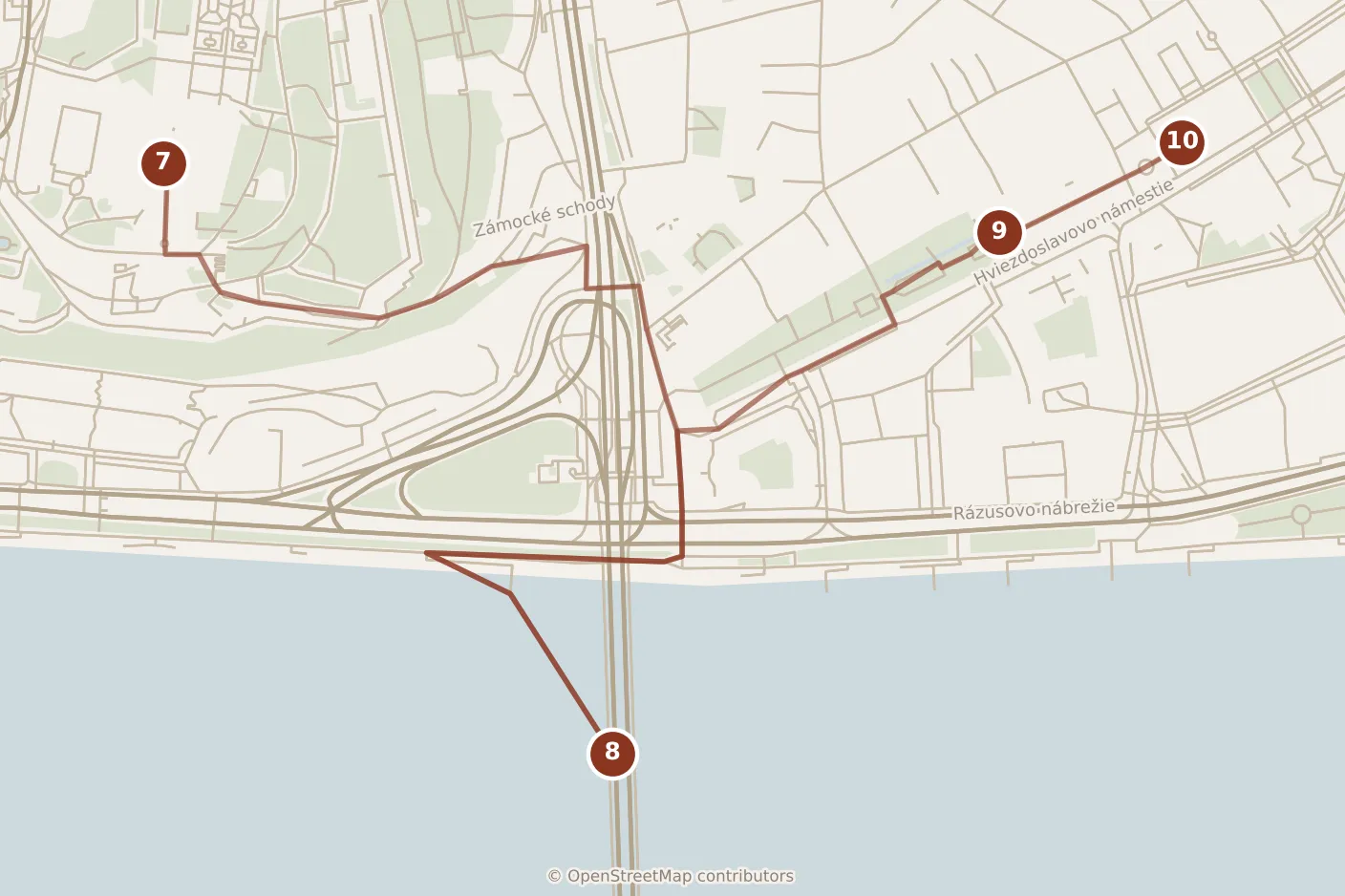
The castle is three hundred and fifty meters from the cathedral door and the climb turns that into ten minutes: across the road by the footbridge, then up Zámocké schody. Give the hill two hours and do not spend all of them indoors. What you are climbing to is a rectangular white block with four corner towers, one of them — the Crown Tower, squatter and rounder than the other three — a great deal older than everything around it. The whole thing looks like nothing else in central Europe, and the reason is that it is essentially a reconstruction. Maria Theresa turned it into a residence in the 1760s, it burned in 1811, and it stood as a roofless ruin above the city for nearly a hundred and fifty years until rebuilding began in the mid-1950s. Inside is the Slovak National Museum’s historical collection, four floors of it; an hour is the right amount, taken on the state rooms and the views out of their windows, and the temporary shows are what you walk past. The baroque garden behind was put back in the 2010s and takes twenty minutes.
Then the terrace above the river, which is what the day has been walking towards. From it you have the Danube, the bridge with its saucer, the gray grid of Petržalka on the far bank, and on a clear day Austria to the west and the Small Carpathians running north. The grounds themselves stayed open until ten at night in 2026, so this view is available at any month’s sunset even though the museum below it shuts in the late afternoon — which is the only reason the terrace can be the day’s last daylight stop in December as well as in June.
Evening
Come down the eastern side of the hill and out onto Most SNP, the bridge of the Slovak National Uprising, ten minutes. It was built between 1967 and 1972, has a single pylon and one plane of cables, and carries a restaurant and an observation deck in the saucer at the top, ninety-five meters up by its owners’ reckoning — the deck’s operator and the signs towards it call it the UFO, which is the word to ask for. Its lower level carries a footway and a cycle lane, so crossing it on foot costs nothing. It is the same structure whose approach road you were standing next to at the cathedral, and knowing that changes how it looks: this is a piece of engineering the city is fond of and a piece of planning it is not.
Local tip. The bridge gives you two ways to see the same thing, and only one of them costs anything. The elevator up the pylon buys height and a bar at the top; the lower deck of the bridge is a public footway and buys the same skyline from road level rather than from ninety-five meters, for nothing. If the day has run late, walk it — what you came to look at is the castle and the old town behind you, and that is over your shoulder either way.
Back on the near bank, turn along the embankment and walk east; two hundred meters brings you to where Hviezdoslavovo námestie opens inland: a long tree-lined rectangle that is the old town’s promenade, lined with terraces its whole length. At its far end stands the old building of the Slovak National Theatre, a neo-Renaissance box finished in 1886 by Fellner and Helmer, who built half the opera houses in the empire, with the Ganymede fountain in front of it. Twenty minutes to walk the length of the square is enough; the point of it is that it is one of the few parts of the center that is not a monument.
Eat here. And if you have not tried one, a bratislavský rožok — the crescent filled with poppy seed or walnut — is the thing to take away for the train, but buy it at the lunch stop rather than now: it is a bakery purchase, and the bakeries keep daytime hours. For the train itself: tram 1 has its terminus at Námestie Ľudovíta Štúra, five minutes’ walk south of the theater on the river, and runs the whole way back to Hlavná stanica, where the bag is. On foot the same journey is about thirty-five minutes, north through the old town and up Štefánikova, and it is uphill at the end.
Practicalities
Nothing on this route needs booking in advance, which is unusual enough to say plainly. The only ticket worth deciding about before the day runs out is the elevator up the bridge pylon: an adult was charged in the eleven-to-thirteen-euro range in 2026, more on weekends than on a weekday morning, and more again between late December and early January. The free alternative — the bridge’s own lower deck — is described above. Everything else here is either free or bought at the door for a few euro.
The one hour to check before you set out is the cathedral’s, because it is what fixes the shape of the morning: it closes to visitors in the middle of the day and again for every service, and on a Sunday the morning belongs entirely to Mass. The cathedral and the Primate’s Palace are three hundred and seventy meters apart, so the order between them costs nothing — if the palace opens later than you reach the square, take the cathedral first and walk back for the palace afterwards.
Two closures are worth knowing, and only one of them has a day this article can name. The castle museum shuts on Tuesdays, and it closes in the early evening while the castle grounds and the terrace stay open long after it — so a Tuesday costs you the collection and not the view, and the afternoon as written survives it. The two indoor stops in the old town, the palace’s state rooms and the museum inside the town hall, also take a weekday off, and it is not necessarily the same one. Check which before you set out: if it falls on yours the morning simply runs shorter, and the cathedral’s narrow window will thank you for the slack.
Everything on this itinerary is walked except the two ends. Tram 1 covers both of them: Hlavná stanica to Poštová at the start, Námestie Ľudovíta Štúra back to Hlavná stanica at the finish. No other transport is needed at any point, and the longest stretch on foot is the twenty minutes across the castle grounds, from the gate on the hill to the terrace above the river; the ten minutes up from the cathedral to the castle gate and the ten minutes back down from the terrace to the bridge sit either side of it.
If you are here between trains, do the day without a bag: left luggage is at Hlavná stanica, and the route is built so that you come back to it rather than away from it. Whether that is a wall of lockers or a staffed counter is not something the operator publishes anywhere reachable, so allow a few minutes on the concourse to find it rather than walking in expecting doors. Two warnings go with that. The castle is a hill and a flight of stairs, and it is the one stop on this route a case ruins outright. And if your ticket names Bratislava-Petržalka rather than Hlavná stanica — the two Vienna services use different stations — you land on the far bank, about three-quarters of an hour’s walk from the old town, and the left luggage this route assumes is not there. Bus 80 runs from outside that station to the northern edge of the old town in about a quarter of an hour, and it is what makes either answer workable; neither of them is your hotel, because you have not got one. Ride it in, keep the bag and cut the hill — Michael’s Gate, Hlavné námestie and the town hall courtyard, the Primate’s Palace, the cathedral, lunch in the lanes below it, then down to Most SNP, across it and back along the embankment to Hviezdoslavovo námestie — which is about four hours with lunch in it on the counts above, with no climb in it, and gives up the castle and nothing else. Or ride it in, go on up to Hlavná stanica, leave the bag there and start the morning from the tram, which costs about half an hour and buys the hill back.


