Bologna in 2–3 days: what to see, in the order that works

Last updated 23 July 2026
Overview
Bologna is a two-day city, and it is one of the few places where that is a compliment. You can walk from one side of the old town to the other in twenty minutes, so the question is never what you can reach — it is what you slow down for. Two days is enough to stop being a visitor in the center; a third takes you up the hill and gives you the whole thing from above.
It suits arriving by train and never taking a taxi. Nothing here needs a car, and the days below assume you are on foot the entire time. Spring and autumn are the comfortable seasons and neither puts anything in your way; much of the city shuts for two weeks in August, which is worth knowing before you plan a summer trip around a restaurant.
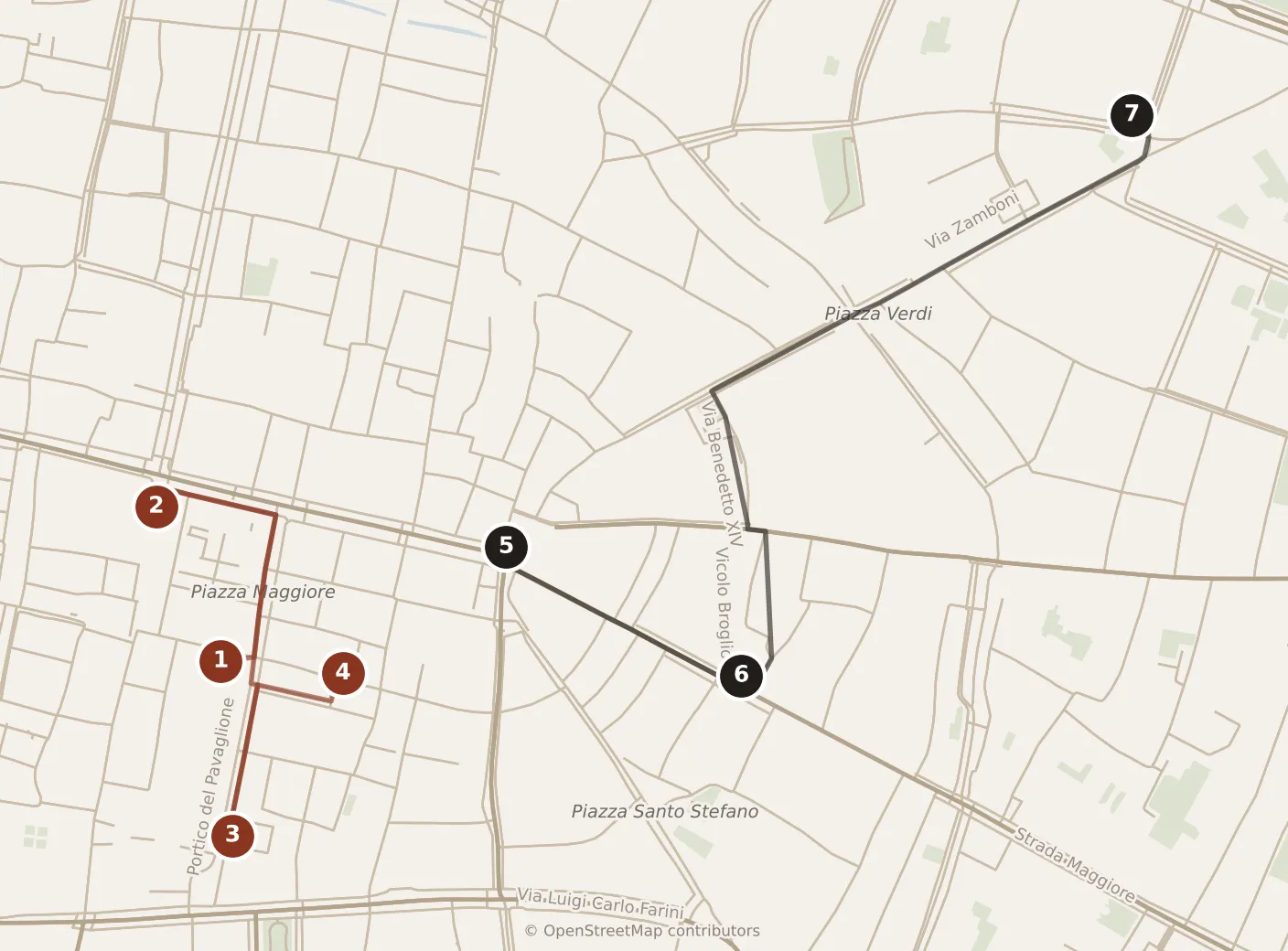
One thing decides which day is which before you read them: day two is the museum day, and most of what it contains closes on Mondays. If your second day would land on one, swap it with the first — day one is mostly churches, streets and a market, which do not care, and the one thing on it that keeps hours of its own is the Teatro Anatomico. The swap is not quite free: day one is arranged to teach you the shape of the center before you walk out of it, and it cannot do that second. On a Monday it is still the trade worth making.
- Day one
- 1San Petronio
- 2Biblioteca Salaborsa
- 3Archiginnasio
- 4Santa Maria della Vita
- Quadrilatero — in the prose, not on the map
- Day two
- 5Due Torri
- Santo Stefano — in the prose, not on the map
- 6Palazzo Poggi
- 7Pinacoteca Nazionale
Via del Pratello — not on the walking map.
- Day one · Evening
- Via del Pratello — in the prose, not on the map
Day one

Everything today until the evening is within four hundred meters of the same square, which is why it goes first: it teaches you the shape of the center before you start walking out of it.
Morning
Start in Piazza Maggiore, with the unfinished front of San Petronio on your right. The lower third is marble and the rest is bare brick, and that is not damage — the money ran out in the sixteenth century and it was simply left. Go inside for the meridian line laid into the floor: a brass strip running the length of the left aisle, with a hole in the vault above it, built so that the sun’s image crosses the line at solar noon.
Local tip. The meridian marks solar noon, not the one on your phone: in Bologna that falls around a quarter past twelve in winter and nearer half past one when the clocks go forward. Be inside a little before that. It is a slow, unannounced thing, and most people walk past it.
Two minutes north, the Biblioteca Salaborsa has a glass floor over the Roman excavations underneath it. It is free, it takes ten minutes, and it is the only place in the center where you stand on the older city.
Then the Archiginnasio, on the south flank of San Petronio: the university’s first single home, its walls layered with the painted coats of arms of centuries of students, and upstairs the Teatro Anatomico, a lecture room of carved wood built around a dissection table.
Afternoon
Cut into Via Clavature for Santa Maria della Vita, which looks like nothing from the street and holds the Compianto sul Cristo Morto: seven life-sized terracotta figures by Niccolò dell’Arca, caught mid-cry. It is three minutes from the Archiginnasio and the most disconcerting thing in the city.
You are now inside the Quadrilatero, the lattice of market lanes east of the square, which is where lunch is. This is where to eat tagliatelle al ragù sitting down rather than standing up.
Evening
Walk west, fifteen minutes across the center, to Via del Pratello. The center empties of visitors after dinner and Pratello is where the city keeps eating and drinking without ceremony — the right end to a day that started in a basilica.
Day two

Today hinges on the two towers: everything runs east and then north-east from them, so you pass the same corner twice and never cross the city twice.
Morning
Walk up Via Rizzoli to the Due Torri. They lean, both of them, and the shorter and more alarming one is the Garisenda; Dante saw it leaning and put it in the Inferno. Do not build a morning around them: the Garisenda has been fenced and scaffolded for structural work since 2023, the square at their feet is a working site, and the climb up the Asinelli has been suspended alongside it. Check what has reopened before you come, and plan the day so that the answer does not matter.
From there go south-east down Via Santo Stefano, four hundred meters to the piazza that opens in front of the basilica complex the city calls the Sette Chiese — a knot of churches, courtyards and a cloister built into and out of each other over eight hundred years. It is one ticketless building you can lose an hour in.
Afternoon
Back past the towers and north-east up Via Zamboni into the university quarter. Palazzo Poggi holds the old teaching collections of a university that taught by making things: rooms of eighteenth-century anatomical waxes modeled for students who had no cadaver that week, obstetric models in clay showing every way a birth can go wrong, ship models, maps of a world still half-guessed. It is stranger than any of that sounds and it takes an hour and a half. Nothing in it is behind glass in the modern sense; you are walking through a teaching collection rather than an exhibition. Go if you like museums that were not designed to be enjoyed; skip it without regret if you would rather spend the hour and a half on the Pinacoteca below, which is the more conventional pleasure and the better one if you are only doing a single museum today.
At the top of the street, on Via delle Belle Arti, the Pinacoteca Nazionale is the one large museum in Bologna you should not skip. It is the city’s own painting, four centuries of it, and the two rooms that justify the ticket are the early Bolognese panels and the Carracci generation that turned this into a school other cities copied. Two hours sees it properly; one hour, taking only those two rooms, is a fair trade if the day is running short. It closes earlier than you expect and it is not a building to hurry through, and in this afternoon it comes last: check its closing time before you start, and let it decide whether Palazzo Poggi happens at all.
In winter this is tortellini in brodo weather, and the university quarter is where it costs least.
Evening
Stay where you are. Piazza Verdi and the streets off it are loud, young and cheap, and the contrast with the Pratello evening is most of what there is to learn about how this city eats.
With a third day

- With a third day
- 8Porta Saragozza
- 9San Luca
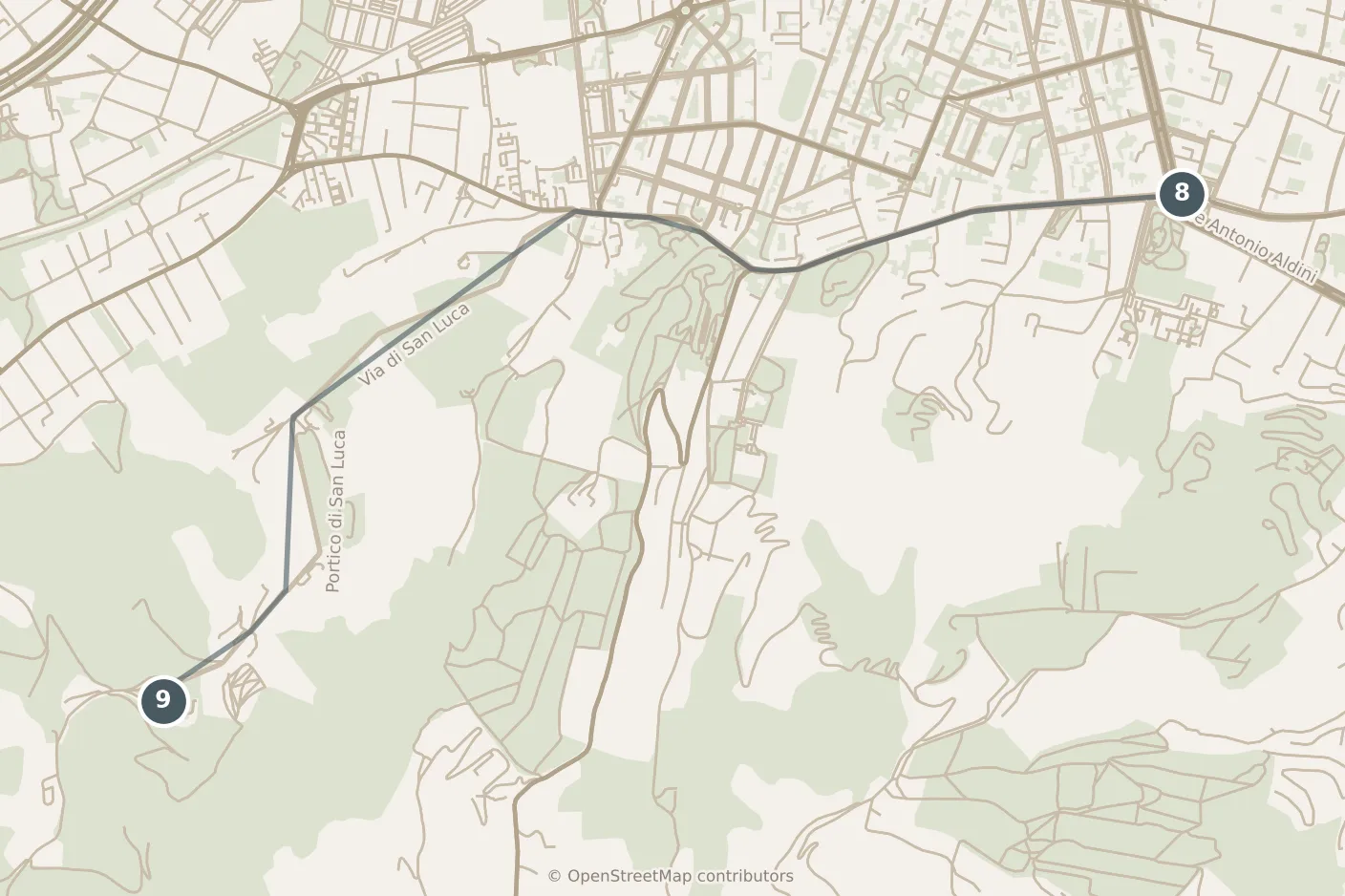
Give the third day to San Luca, and give it the morning.
The portico starts at Porta Saragozza, on the western edge of the old walls, and runs 3.8 kilometers and 666 arches up the Colle della Guardia to the sanctuary at the top. It is the longest covered walkway of its kind anywhere, it is free, it has no opening hours, and it climbs steadily for the last third. Allow an hour and a half up if you are not hurrying.
What you get at the top is the reason the third day exists: the whole city laid out flat below, the hills behind it, and the entire Po plain going north until it stops being visible. Go inside the sanctuary as well as standing outside it — it is free, it takes ten minutes, and the interior is a single domed room quite unlike the long climb that earned it.
Coming down is faster than going up, about an hour, and there is a city bus from the sanctuary if your legs have finished. Either way you are back in the center by early afternoon, and the right lunch after that walk is lasagne verdi.
That leaves an afternoon, and the honest advice is not to fill it with a fourth church. Two things suit a body that has just walked four kilometers uphill. One is the weekend market sprawl of Via del Pratello and the streets around it, which is flat, slow and entirely local. The other is the one thing days one and two deliberately left out: the covered walk from Piazza Maggiore out under thirty-eight kilometers of portico in whatever direction you have not yet been, with no destination at all. Bologna is the only city where that is a plan rather than an absence of one.
Practicalities
Book, or at least check, two things before you arrive: the Teatro Anatomico inside the Archiginnasio, which has its own ticket and shorter hours than the building around it, and the Pinacoteca Nazionale. Everything else on these days is either free or walk-up.
If your second day lands on a Monday, swap the two. Day two is the museum day and most of it will be closed; day one is mostly churches, streets and a market, which are not — check the Teatro Anatomico’s hours before you rely on it.
Everything on days one and two is walkable, and the distances above are real — the longest single stretch is the fifteen minutes from the Quadrilatero to Pratello. The third day is walkable end to end as well, and it is the only one with an alternative: if you would rather not climb the whole portico, city buses run to the foot of the hill and part of the way up it.


.jpg)