Bologna in one day: what to see, and what to leave out

Last updated 3 August 2026
Overview
One day is not a tragedy in Bologna, and that is a fact about the city rather than a consolation. The old town is twenty minutes across on foot, so nothing on this route is more than a ten-minute walk from the last thing, and the only ground it covers twice is the four hundred meters of Via Santo Stefano, walked back up in the evening.
What a single day costs you is the museums. Bologna has good ones and they are the first thing to give up: an hour indoors is the hour that would have bought you the towers, the market lanes and a sit-down lunch, and those are what the city is actually made of. Naming a fourth church is easy and useless.
It also suits people who are not staying. Bologna is the country’s rail crossroads, so a great many readers arrive here with a few hours between trains rather than a hotel booking, and the whole of this day sits within a fifteen-minute walk of Bologna Centrale. Leave the bag at the station’s left-luggage office before you start: everything below assumes your hands are empty, and the day ends back within a quarter of an hour of where you left it.
The day
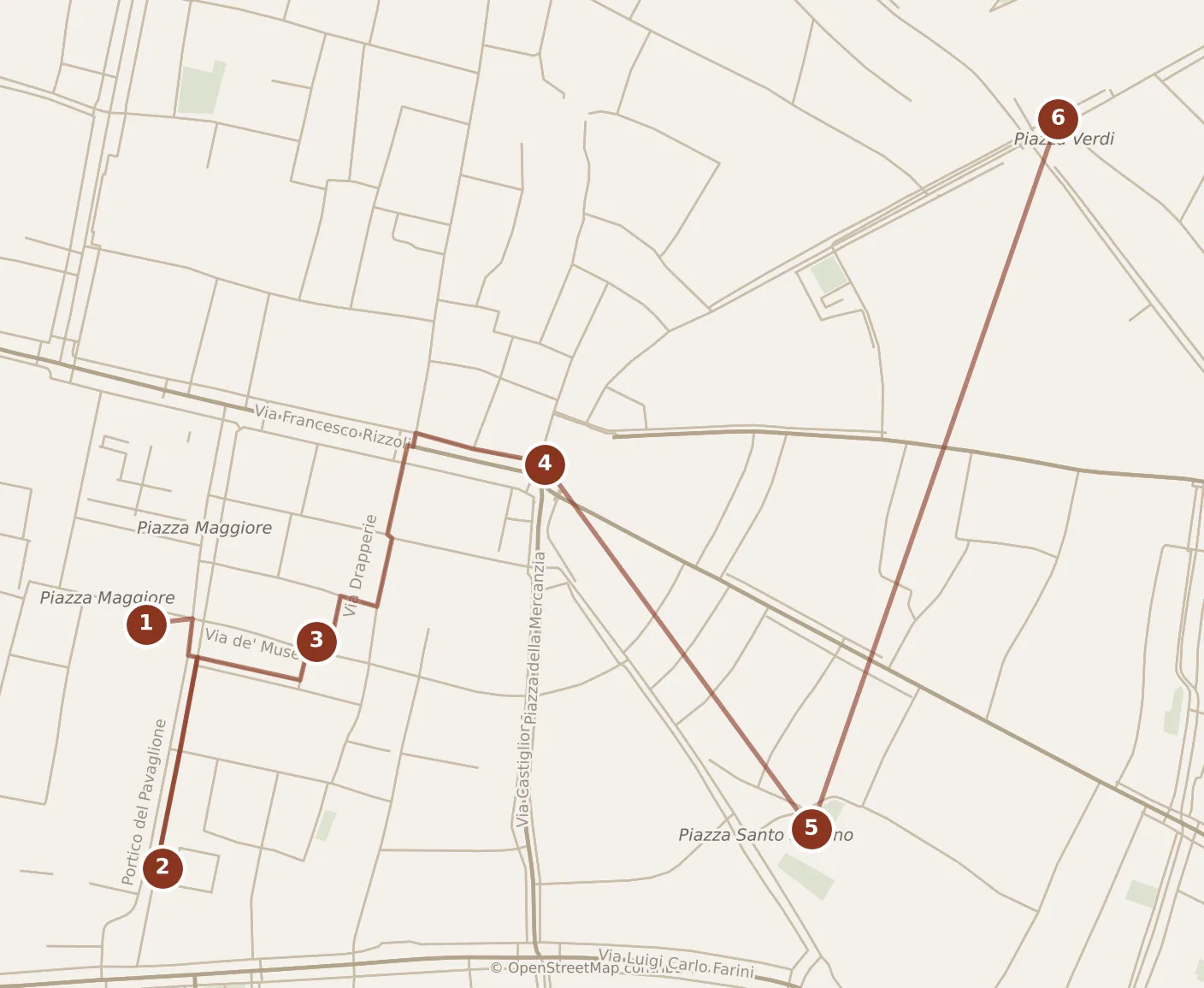
- The day
- 1San Petronio
- 2Archiginnasio
- 3Santa Maria della Vita
- 4Due Torri
- 5Santo Stefano
- 6Piazza Verdi
Morning
Start in Piazza Maggiore with the front of San Petronio on your right. The lower third is marble and the rest is bare brick — not damage, but the money running out in the sixteenth century and nobody ever finishing it. Inside, the meridian line runs the length of the left aisle in brass, with a hole in the vault above it that puts the sun on the line at solar noon.
Round the south flank of the basilica to the Archiginnasio, the university’s first single home: a courtyard and staircases carpeted in the painted coats of arms of centuries of students, and upstairs the Teatro Anatomico, a lecture room of carved wood built around a dissection table.
Local tip. The courtyard and the walls of coats of arms are free and open to walk into; it is the Teatro Anatomico upstairs that has a ticket and shorter hours. If time is tight, the free half is the one that photographs and the paid half is the one worth the ticket.
Then three minutes east into Via Clavature for Santa Maria della Vita, which looks like nothing from the street. It holds the Compianto sul Cristo Morto: seven life-sized terracotta figures by Niccolò dell’Arca caught mid-cry, and it takes fifteen minutes to see properly.
Afternoon
You are already standing in the Quadrilatero, the lattice of market lanes east of the square, and this is where lunch goes. Eat it sitting down. The temptation with one day is to buy something to carry and keep walking, and in this particular city that is the wrong economy — tagliatelle al ragù at a table is a sight here in the way a facade is elsewhere.
Five minutes further east, at the end of Via Rizzoli, the Due Torri. Both lean; the shorter and far more alarming one is the Garisenda, and the taller is the Asinelli. Plan to look at them and nothing more: the Garisenda has been fenced for structural work since 2023, their square is a working site, and the climb up the Asinelli is suspended with it. A single day is exactly the wrong trip to spend on hoping something has reopened.
From the towers go south-east down Via Santo Stefano, four hundred meters to the piazza that opens in front of the basilica complex the city calls the Sette Chiese: churches, courtyards and a cloister built into and out of each other over eight hundred years. It is free, it is one building you can lose an hour in, and it is the right last thing to go inside because it is the quietest.
Evening
Walk back past the towers and up into the university quarter, ten minutes, for Piazza Verdi and the streets around it. This is the cheap, loud, young end of Bologna and it is the correct ending: the day started in a basilica and finishes among students eating standing up. If you are catching a train, Bologna Centrale is fifteen minutes north-west from here on foot — the same quarter of an hour you walked in, with the left-luggage office at the end of it.
Practicalities
The only thing on this day that has to be booked is the Teatro Anatomico inside the Archiginnasio: since 2025 it is seen on a timed visit with an audioguide or on a guided tour, not simply walked into, and the full ticket was in the ten-to-twelve-euro range in 2026. It also keeps shorter hours than the building around it and is shut on Sundays, along with the rest of the palace — the courtyard included — so a Sunday is the one day this route loses its single paid stop. Everything else here is free or walk-up — but free is not the same as open. The churches on this route, San Petronio and Santa Maria della Vita among them, shut for a couple of hours around the middle of the day and during services, which on a Sunday morning means most of the morning. With one day that is the single thing most likely to break the plan, so check the two churches before you fix the order.
This route survives a Monday, which is worth knowing if your one day falls on one: it is churches, streets and a market, and the museums that close are the ones this day already gives up. That is not true of a longer stay in Bologna, and it is a reason to take the single day as written rather than swapping things into it.
If you are between trains, the left-luggage office at the station means you do this day without a bag, and the walk in from it is fifteen minutes to Piazza Maggiore. Everything after that is within seven hundred meters: the longest single stretch on this itinerary is the ten minutes from Santo Stefano back up to Piazza Verdi in the evening.


