Bogotá in two or three days: the colonial center, Monserrate and the museums, with a salt mine on a third day

Last updated 8 August 2026
Overview
One day in Bogotá is the old town with the mountain on the end of it, and that is the right shape for one day. Two days buy something more specific than more sights. They buy the altitude, and then they buy the doors.
The altitude decides the order, and it is the only structural argument on this page. The plateau is at 2,640 meters and the ridge above it at 3,152, and a visitor’s first day here is the day on which a flight of stairs is a surprise. So day one below stays low and walks about a kilometer and a third in total, all of it inside six blocks of the colonial center and only the last stretch of it uphill. Day two goes up the ridge first thing and then comes back down and walks four and a half kilometers north. Run those the other way round and you have put the hardest thing in the trip on the morning your body understands it least, for no gain at all.
The doors are the second thing. A single day in this city walks past the interiors because it has to: it can afford the Gold Museum and one gallery and no more. Two days can go inside a seventeenth-century church whose vault is covered from end to end in gilded wooden flowers, spend a morning in three free museums on the same block, read the Gold Museum in the order it was built to be read rather than raiding it for its two famous objects, and give an afternoon to the national collection in the radial prison it occupies. None of those can be looked at from the street.
The one planning rule, and it is unusually clean. Museums in Bogotá close on a Monday. The exception is a whole city block: the Banco de la República runs four buildings on Calle 11 in the old town — the Botero collection, the colonial mint, its own art museum and its library — and those shut on a Tuesday instead. In 2026 the national collection published Tuesday to Sunday, the Gold Museum kept the same week, and the block on Calle 11 opened every day but Tuesday. So day one below is built around the Calle 11 block, and day two around everything that shuts on a Monday. No day of the week shuts both. If one of your two days is a Monday, make it day one; if one is a Tuesday, make it day two; if neither is, run day one first, for the altitude reason above. Where the calendar forces day two to come first, the closures win — three shut doors cost more than one hard morning — but the reversal is not free. The full rules, including what it costs and what a third day does to them, are in Practicalities.
Getting to the first morning. From El Dorado the journey in is as long as the traffic makes it, and for a first arrival with luggage the honest answer is a ride-hailing car or the airport’s own taxi desk rather than the TransMilenio link, which runs on the Calle 26 trunk and needs a change. Day one begins at the Museo Santa Clara, Carrera 8 # 8-91, three blocks south of Plaza de Bolívar. If you are coming from a room in the north rather than from the airport, the Avenida Jiménez trunk carries a station named Museo del Oro, and that stop is the front door of the old town: from it the church is a quarter of an hour on foot, southward. Nothing about how you pay for any of that belongs here; it is in the parent city guide.
The one thing to buy in advance is the ride up the mountain — two things if you add the third day below, which wants a train seat. The round trip on the funicular or the cable car was in the thirty-to-thirty-five-thousand-peso range in 2026 from Monday to Saturday and on public holidays, and lower on a Sunday. It is sold on the operator’s own ticketing site and at the taquilla at the lower station on Carrera 2 Este, and the reason to do it online is the line at the door. How long that line can be is best judged from the operator’s own price list, which offers a way past it for close to triple the standard round-trip fare — nobody prices a convenience like that for a line that moves. Everything else on these two days is free, walk-up, or a bus ticket.
The light is not what these days are built around, and it is worth saying why. Bogotá is four degrees north of the equator and its sunset barely moves: the earliest is a little before twenty to six at the end of October, the latest a quarter past six in the middle of July, thirty-five minutes of drift across an entire year. There is no season to plan around and no month in which the evening arrives early enough to threaten anything. What decides these two days instead is a closing time and a cloud, and both are dealt with where they fall.
The bag. With two or three days you have a room, and the room is the answer, including on the morning you check out — nothing on either of these routes will hold a case, and there is no railway terminus in the center with a left-luggage office to fall back on. Two route-specific consequences follow. The cable car charges for an extra piece of luggage beyond what you can carry, which makes the mountain the one stop on these days where a bag has an actual price on it. And day two ends in La Macarena, which sits on Calle 26 — the avenue that runs west to the airport — so if you are flying out on your last evening, make day two the last day rather than the first. The old town is a kilometer and a half further east on the same road, so the difference is a direction rather than a delay. And where the closures have already fixed the order, they win: a shut museum cannot be bought back, and a longer ride to the airport is only a longer ride.
La Macarena — not on the walking map.
- Day two · Evening
- La Macarena — in the prose, not on the map
Estación de Usaquén, Salt Cathedral of Zipaquirá — not on the walking map; you get there by taxi.
- With a third day
- 12Estación de Usaquén
Day one

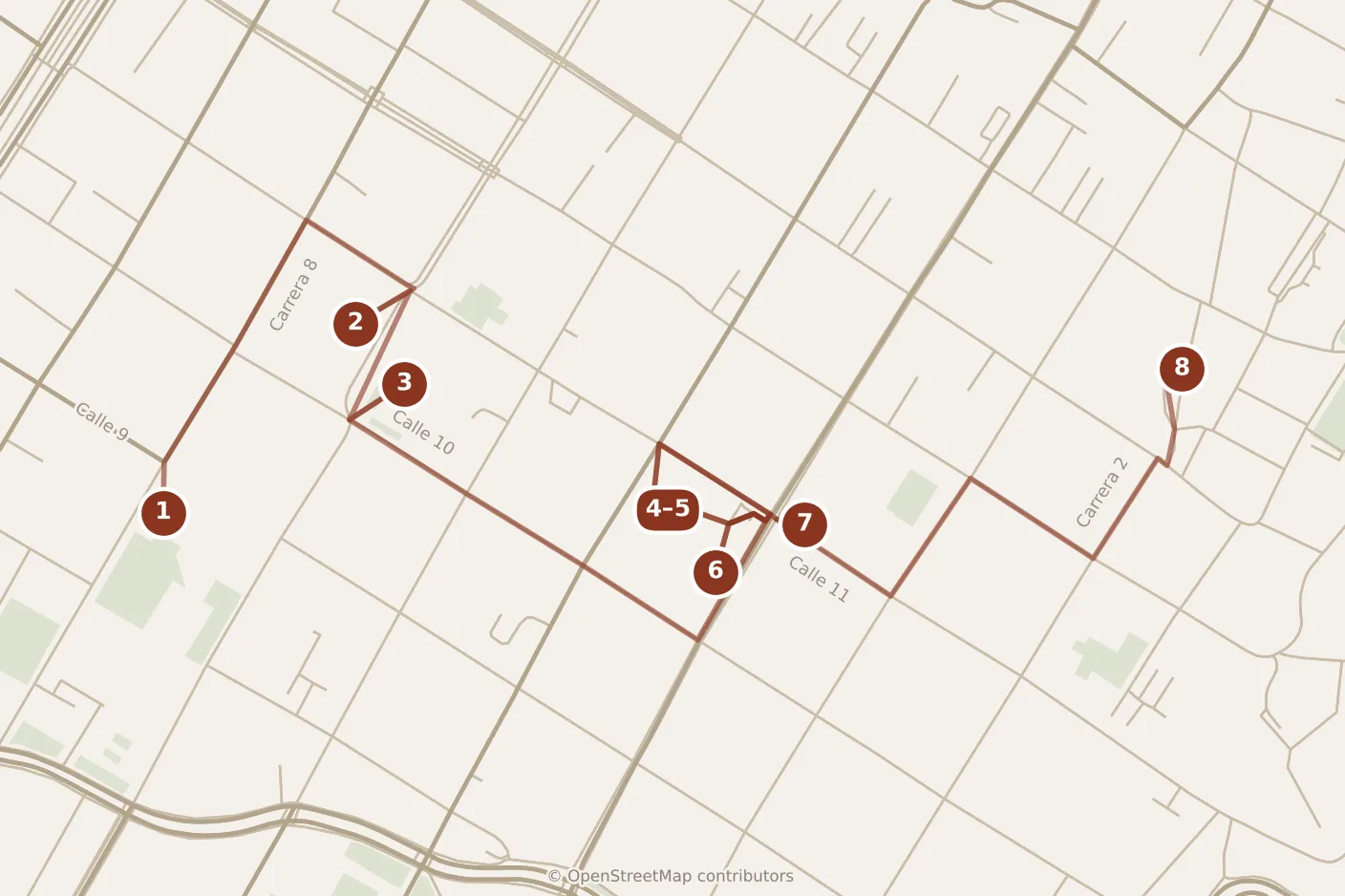
- Day one
- 1Museo Santa Clara
- 2Plaza de Bolívar
- 3Capilla del Sagrario
- 4Museo Botero
- 5Museo Casa de Moneda
- 6Museo de Arte Miguel Urrutia
- 7Iglesia de Nuestra Señora de la Candelaria
- 8Chorro de Quevedo
Six blocks and deliberately short. Everything today is within seven hundred meters of Plaza de Bolívar, and the whole day is a kilometer and a third of walking in seven pieces, none of them longer than eight minutes and only the last of them uphill.
This is the day with no hinge in it, which is a real kind of day and worth naming rather than inventing a deadline for. Nothing today has to happen before anything else closes: the block on Calle 11 stayed open until seven in the evening in 2026, later than the day needs, and the two churches keep parish hours rather than museum ones. So there is no count to make backwards — count forwards from the start instead. The stops below come to about seven and a half hours with the walking in, which means a nine o’clock start is out of the last museum by a quarter to three and at the top of the old town with two and a half hours of light in hand. That is not slack. It is what an acclimatisation day is for.
Morning
Start at the Museo Santa Clara, on Carrera 8, and start here because it is the most disorientating room in the city and almost nobody with a single day ever sees it. From the street it is a plain brick box: an unornamented baroque shell built between 1619 and 1647 by the Spanish architect Matías de Santiago for the convent of the Poor Clares, whose nuns arrived in 1630. Inside is a single nave thirteen meters to the crown of the vault, and every surface of that vault is covered in gilded wooden flowers on blue. Around a hundred paintings hang on the walls — several by Gregorio Vásquez de Arce y Ceballos, the one colonial painter this country produced who is studied anywhere else, and by the Figueroa workshop — with two dozen carved wooden figures among them. The thing to find is not a painting but the celosías: the latticed screens and grilles through which the enclosed community heard Mass without being seen or seeing. They are what tells you this was not a parish church but the inside wall of a life. The state bought the building from the nuns in 1973, deconsecrated it, restored it from 1975 and opened it as a museum in 1983, which is the only reason you can walk about in it at all. Give it three quarters of an hour.
Four minutes north-east is Plaza de Bolívar, and twenty minutes standing in it is enough. This is where Colombian politics physically happens, and the thing worth noticing is that almost nothing on it is old: the cathedral you are looking at is the fourth church on the site and was finished in the 1820s, the congress building took the better part of a century to put up, the city government’s palace is barely a hundred years old, and the flat modern block of the law courts went up in the 1990s.
The exception is easy to miss and it is fifteen minutes well spent: the Capilla del Sagrario, the small chapel wedged tight against the cathedral’s flank. It is genuinely of the colony, and it hangs the same seventeenth-century painting you have just been looking at in Santa Clara. After that vault, its plainness is the point.
Five minutes east, on Calle 11, is the block the rest of the day lives on, and the Museo Botero is the door to go in by. Give it an hour and a quarter. There are around a hundred and twenty works by Fernando Botero here, and the swollen figures are what people come for and are not the reason to stay. The reason is the eighty-seven pieces he gave away with them out of his own collection — painting and sculpture from Europe and from across this continent that a Colombian audience had no other way of seeing, hung in the rooms of a colonial house around a courtyard. Look at what he chose to own. It is a more revealing portrait of the painter than the paintings are.
Afternoon
Lunch first, in the lanes off Calle 11, and sitting down. The dish to ask for is ajiaco, which arrives as a bowl of pale soup with three kinds of potato dissolving into it at different speeds and enough put on the table beside it to be the whole meal. It is what this city’s own kitchen puts in front of you at this hour, in any month of the year. An hour, and it will run over.
Then back into the block, because the Botero is one third of it and the rest is behind the same courtyards. The Museo Casa de Moneda is the mint, and the building is the fact: a mint established on this spot by Spanish royal decree in 1621, which struck coin here until 1987, when the presses moved to Ibagué. That is three hundred and sixty-six years of a single industrial function in one colonial house, and the collection inside — coins, notes, medals, the machinery itself — is the history of a republic that has changed its name more than once, told through the one object that had to be reissued every time it did. Forty-five minutes.
The Museo de Arte Miguel Urrutia is the modern building on the same block, opened in 2004 on three floors behind the library, and it holds the Banco de la República’s own art collection: twentieth-century Latin American work on one floor, temporary shows on the next. An hour and a quarter. It is the least famous of the three and the one most likely to contain something you have never seen, which is the usual arrangement.
Local tip. All three of these are free, which makes it very easy to do all three badly. If the day is running short, the mint is the one to drop and not the art museum: the coin cabinet is the half you will remember least, and dropping it buys you forty-five unhurried minutes upstairs instead of two rushed hours downstairs.
Two minutes on, the Iglesia de Nuestra Señora de la Candelaria is the church the whole neighborhood is named after, and ten minutes inside it is the correct amount. It is a working parish with services through the day. Walk in on one and the rule is simple: keep to the rear benches, stay quiet, and do not cut across the front of the altar to see something. The Sagrario asks the same, for the same reason.
From there it is seven or eight minutes up to the Chorro de Quevedo, and every one of them is uphill. La Candelaria climbs towards the mountains and this is the stretch where the altitude introduces itself; take it slowly and look at the walls, which from Calle 12 upwards are painted end to end. The plazoleta at the top is small, sloping and cobbled, and it is where the city says it was founded in 1538. Twenty minutes covers the square itself.
Then stop. There are close to three hours between the last museum and the dark, which is the thing two days have that one day does not, and the local use for the middle of them is onces: coffee or thick hot chocolate in the late afternoon with an almojábana, the warm cheese bread that exists for exactly this. Give it an hour. Sit in one of the places on the lanes off the plazoleta and let the students arrive.
Evening
Stay where you are. A narrow lane runs off the Chorro de Quevedo and it is where the old town does its drinking: chicha, the fermented maize drink, sold by the jug from doorways barely wider than a person, with students and storytellers filling the steps between them. This is what the plazoleta is for once the light goes.
One thing about this lane a first-time visitor cannot guess, and it is not a reason to skip it. The lane is busy and watched; the streets running downhill from it are neither, and they empty completely. So leave from the top rather than walking down through them: order a car from the plazoleta, which is a named place a driver will find, and do not do the ten minutes downhill on foot at eleven at night on the grounds that you did it uphill at four in the afternoon.
Day two

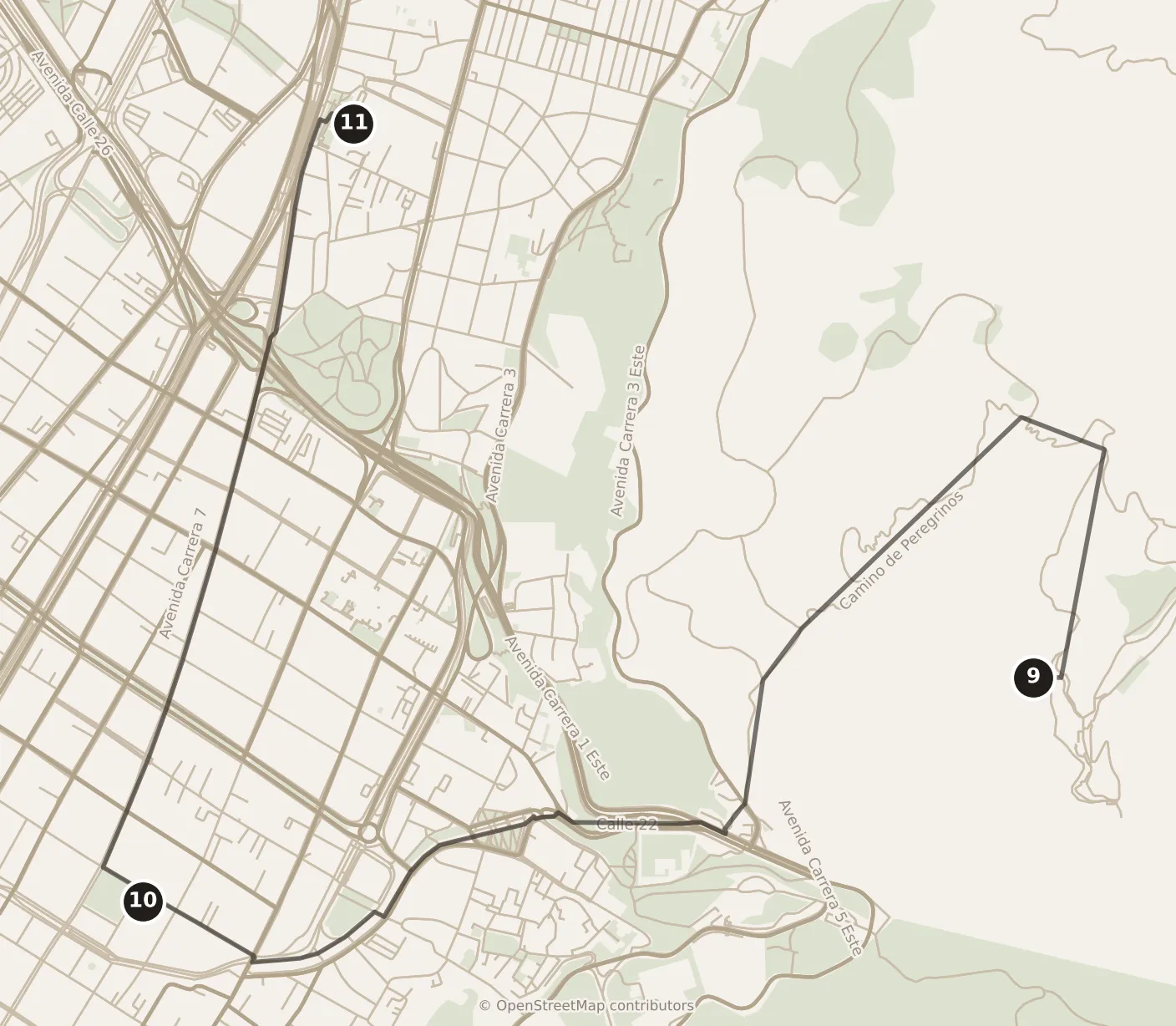
- Morning and afternoon
- 9Monserrate
- Quinta de Bolívar — in the prose, not on the map
- 10Gold Museum
- 11Museo Nacional de Colombia
Today runs east to west and then north, in one line, and it never doubles back. The mountain first, then the little house at its foot, then downhill into the center for the Gold Museum, then half an hour north on foot to the national collection. It ends in a neighborhood you have not been to, on the road to the airport.
The hour this day rests on is at the far end of it, not at the near one. The Museo Nacional published nine to five, Tuesday to Sunday, in 2026, and five o’clock is the only immovable thing on the page. Everything above it is a chain: two hours on the mountain, five minutes down to the Quinta de Bolívar and three quarters of an hour inside it, twenty minutes downhill into the center, two and a quarter hours in the Gold Museum, three quarters of an hour over lunch, half an hour north up Carrera Séptima, and an hour and three quarters in the national collection. That is eight and a half hours, so a half-past-eight start at the lower station puts you out of the last door at about five, which is when it shuts. A ten o’clock start does not work, and no amount of hurrying the Gold Museum makes it work. If the closing time has moved since, build the same chain back from the new one: the shape of this day is a chain and not a schedule.
What that count does not include is the ticket line at the lower station, which is why the ticket is bought before you leave, and the fact that the summit is a site rather than a building — the two hours hold the ride up, the church, the terraces and the ride down only if you are not also eating up there.
Morning
Eat before you go. Changua, the milk-and-egg soup with bread in it that this city has for breakfast, is what half past seven in this climate is asking for, and the mountain is a poor place to arrive hungry.
Take a car to Carrera 2 Este # 21-48, on the Paseo Bolívar, which is the lower station for both the funicular and the cable car. Know which way that is before you set off. The station sits uphill and well north of La Candelaria, on a road that runs along the base of the ridge at the level of Calle 21 — so it is nowhere near the bottom of the old town, and the address, not the mountain, is what you give the driver. In 2026 the cars ran on every day of the year: a half-past-six start and a ten o’clock finish on weekdays and Saturdays, a half-past-five start on Sundays, and a five o’clock finish on Sundays and on public holidays. Whichever of those your date falls under, the early morning this day is built on is available. There is also a stepped public path up the hill, free and much used on weekends by people who run it; it climbs five hundred meters, and this is not the morning of your trip to try it.
The summit stands at 3,152 meters, roughly half a kilometer of vertical above the sidewalk you started on, and the reason to be up there early is not light but cloud. The ridge is clearest in the morning and the plain below it goes under weather as the day wears on, which in April and May and again in October and November it does close to daily. From the terrace the city runs west until it stops being a city and becomes flat green nothing, and the whole grid of the old town is a thumbprint below you. The church at the top is a pilgrimage shrine and a working one, so behave in it as you would in any church in use, and dress for a summit rather than for a street: it is colder and far windier than anything the city has shown you, and you will be standing still in it. One thing to know before you plan the week around it: in 2026 that church opened only from midday on a Tuesday, while the funicular and the cable car ran from half past six as usual, so a Tuesday gives you the mountain and the view and not the interior. Two hours, including both rides.
Local tip. Look at the ridge from the street while you are still standing in it. If the summit is in cloud you are paying to stand inside a white wall. From Monday to Saturday the cars run until ten at night, so the one relocation that actually exists is that same evening; on a Sunday or a public holiday they stop at five in the afternoon, and a clouded-out summit is lost rather than moved. The morning is not lost either way: skip the summit, take the Quinta slowly, and give the Gold Museum the extra hour and a half, which is the one museum in this city that repays it. Everything below the mountain is two hours better for being started early.
Five minutes west of the lower station, and downhill, is the Quinta de Bolívar: a country house begun in 1800 by the merchant José Antonio Portocarrero, given to Simón Bolívar by the new republic, and lived in by him on and off from 1821. Manuela Sáenz made it habitable in 1827 and turned it into the meeting house of his faction, which is most of what happened there. It is small — the bedroom, the dining room, the hall, her rooms, and terraced gardens climbing back towards the hill you have just come down — and it became a museum in 1922. Three quarters of an hour, and this is the stop on this day that goes if the day is short.
Then twenty minutes downhill and west to the Gold Museum, and give it two and a quarter hours rather than the ninety minutes a single day can spare. The collection runs to some fifty-five thousand objects with roughly six thousand of them out, and what the extra time buys is the order. The second floor is arranged by the people who made the work — Calima, Quimbaya, Muisca, Zenú, Tairona — so that by the time you go up a floor you can tell one goldsmithing tradition from another by looking, which is the museum’s whole argument and is entirely lost if you skip to the end. The third floor is where it pays: a room on shamanic flight, then the Offering rooms, and in them the Muisca raft: a gold casting no bigger than a hand, showing a ruler upright on a reed vessel with his chiefs ranged around him, found in 1969. This single object is what Europe turned into the El Dorado legend. The last of those rooms is dark and is a reconstruction of an offering lake, and it is the only part of the building trying to do something to you rather than show you something. The interactive fourth floor can go.
Afternoon
Lunch in the streets around Parque Santander before you start walking. Three quarters of an hour.
Then walk north up Carrera Séptima. It is half an hour to the Museo Nacional and it is the longest single stretch of these two days, on a street given over to pedestrians for most of the way and functioning as the city’s own promenade: buskers, evangelists, chess tables, men selling single cigarettes and tinto, black coffee poured from a flask into a cup the size of a shot. On a Sunday it is closed to cars altogether until the early afternoon and full of cyclists, which is the Ciclovía, and which makes the walk better rather than worse.
The Museo Nacional de Colombia is at Carrera 7 # 28-66 and the building is half the reason to go. It is a radial prison of the 1870s: a cross in plan, in stone, with cell blocks running out from a central rotunda, and the galleries are the cells, opened into one another along the arms. You climb from archaeology on the first floor to the country’s own painting at the top, and the pleasure and the discomfort of it are the same thing, because the vaulted brick corridors are prison corridors and nothing has been done to disguise it. An hour and three quarters sees it properly. If you have only an hour, take the top floor and the rotunda and leave the archaeology, which the Gold Museum has already answered better this morning.
Evening
Ten minutes south-east from the museum door is La Macarena, a small steep pocket of streets between Carrera 4 and Carrera 5 where the center goes out to eat. It is residential and quiet rather than a scene — galleries, a dozen small restaurants, university buildings on its edge — and the change of register from the colonial center is the point of ending here.
If you want the larger eating districts instead, order a car north to Chapinero, whose restaurant streets are the obvious alternative to this one. Do it by car rather than by TransMilenio: the station outside the museum door is on the Carrera Séptima corridor, not on the Avenida Caracas trunk the northern stops sit on, so the ride costs a change and then a walk in the dark at the far end. After eight and a half hours a car is a fair thing to want anyway.
With a third day

The third day goes to Zipaquirá, about fifty kilometers north, and to the church cut inside a working salt mountain there. It is the only thing near this city that is a genuinely different kind of day, and unlike a fourth museum it takes nothing away from the two days above.
Where it goes is decided by the calendar, not by the sequence. The Tren Turístico de la Sabana runs on Saturdays, Sundays and Colombian public holidays and on no other day. So if any of your three days is a Saturday or a Sunday, this is that day, wherever it falls in the sequence — first, middle or last. If none of them is, the day goes on the end and you take a bus instead. One thing overrides all of that: this cannot be the day you fly out in the evening. The train is not back in the city until the late afternoon, at a station in the far north or in the west, and the bus is two hours door to door — both with your room already given up. If the calendar leaves no other slot, take the bus rather than the train and start back from Zipaquirá after lunch. What moves when it is inserted is nothing on the ground: days one and two do not depend on each other’s order, only on which weekday each lands on, and the Monday and Tuesday rule above still decides that. The one sequence it does break is set out in Practicalities.
By train, it leaves the Estación de Usaquén at Avenida Carrera 9 # 110-08 at a quarter past nine, having started at Gran Estación on Carrera 66 with Calle 25 half an hour earlier, and it reaches Zipaquirá at a quarter to eleven. It starts back at a quarter past three and is in Bogotá by a quarter past five, calling at Usaquén first and ending at Gran Estación. That is four and a half hours in Zipaquirá, which is exactly right, and the return seat was in the ninety-to-a-hundred-thousand-peso range in 2026 — several times what the bus costs, and bought for the journey rather than for the transport, because it is an old train with a band on it and it is half of what the day is. Tickets are sold on the operator’s own site, at both departure stations, and at the Estación de la Sabana in the center, which sells for this train without being a stop on it. The Usaquén departure is the one to take if you are sleeping in the north, the Gran Estación one if you are in the center or the west.
Without a weekend, take the TransMilenio north to Portal del Norte, which is the northern terminal of the system, and the intermunicipal buses to Zipaquirá leave from the bay beside it. Reckon on two hours door to door and go early; the buses run all day and there is nothing to book.
The Salt Cathedral is at Carrera 6 with Calle 1 in Zipaquirá, about twenty minutes uphill on foot from the town center, and it opened every day of the week in 2026. What you walk into is not one church but two histories. The first cathedral was consecrated in 1954 inside the workings of a salt mine that had been cut since long before the Spanish arrived, and it was closed in 1992 because the mining around it had made it unsafe. The one you visit was begun in 1991, a couple of hundred meters down inside the mountain, and opened in December 1995. The route in runs past fourteen chapels of the stations of the cross, each carved out of the halite itself and each dimmer than the last, and then opens into a nave with a cross cut into the rock behind the altar. It is a consecrated church with services on Sundays, and it is not a novelty.
Give the cathedral itself an hour and a half. The site sells its ticket in tiers and the add-ons are the usual invitation to spend an hour on things that are not why you came — a mine-workings walk, a climbing wall, a museum of Tutankhamun that has no business being there. The plain ticket is the one to buy. Underground it is cold and damp whatever the plateau is doing, so bring a warm layer whether or not the city has needed one; and carry as little as you can, because the visit is long, downhill on the way in and uphill on the way out.
That leaves the afternoon before the train. The town’s own square is fifteen minutes back down the hill, a whitewashed colonial plaza with the ordinary cathedral of an ordinary diocese on it, and lunch there is better than lunch at the mine, where the restaurants exist because you are trapped.
Practicalities
The bookings. One thing needs buying before you set out and it is the round-trip ride up Monserrate, for the line rather than for availability; it is sold online by the operator and at the taquilla at the lower station on Carrera 2 Este. On a third day the train seat to Zipaquirá is the second, sold on the operator’s site, at both departure stations, and at the Estación de la Sabana in the center, which is not one of them. The Salt Cathedral sells at the door and online. Nothing else on these three days needs arranging in advance: the block on Calle 11 is free and walk-up, and the Gold Museum, the national collection, the Quinta and the painted church all sell a ticket at their own doors.
Which days break what, and who publishes the answer. Seven stops keep a weekly closing day — three on Calle 11, the painted church, the Gold Museum, the national collection and the Quinta — and they fall into two groups that never overlap.
Day one’s group is the Banco de la República block on Calle 11. The Botero, the mint and the art museum are one administration keeping one week, and in 2026 that week was every day but Tuesday. So day one must not be a Tuesday: a Tuesday loses three of its stops at once and there is no repair worth making. The rest of day one, with the one exception below, is a square, a street or a church in use, and has no closing day at all.
Day one does carry one stop from the other group, and it is the painted church museum at the start. It is a state museum, and the state museums here run Tuesday to Sunday, so assume it is shut on a Monday, read its own page the week before, and if it is closed on your date give its three quarters of an hour to the block on Calle 11, which will absorb them without noticing. That is the whole cost of a Monday on day one, and it is the smallest closure on this page.
Day two’s group is everything else on it. The national collection published Tuesday to Sunday in 2026 — that one is taken from the museum’s own page rather than inferred — and the Gold Museum and the Quinta de Bolívar keep the same week. So day two must not be a Monday: a Monday loses three of its four stops and is not worth attempting. The mountain is the exception, and it is what makes a Monday survivable at all if you have three days: in 2026 it ran on all three hundred and sixty-five of them, though it stopped at five in the afternoon on Sundays and on public holidays. That last rule is the one that rewrites the single-day route on this site, which ends on the summit at dusk. It leaves the ordinary running of this one alone, where the mountain is a morning — but it is what shuts the escape route in the box on day two: on a Sunday or a public holiday there is no evening to move a clouded-out summit into.
Any Tuesday day two costs the summit chapel, whichever pair of days produced it. For the reason day two’s morning gives, a Tuesday on the mountain buys the ride, the terraces and the view and not the inside of the church. That is a ten-minute loss and it changes nothing about the day; it is here because arriving at a locked church door at nine in the morning, having just paid for a cable car, feels like a great deal more than ten minutes.
Which pairs cost what. A Monday with a Tuesday: day one on the Monday, day two on the Tuesday, and you lose the painted church and the summit chapel. A Tuesday with a Wednesday: day two on the Tuesday and day one on the Wednesday, which costs the summit chapel and runs the two days in reverse, for which see below. Any pair from Wednesday to Sunday: the closures cost nothing either way round, so run day one first. The pair that needs checking is a Sunday with a Monday. The Monday must be day one, so day two falls on the Sunday, which is both the reverse and the weekend; several of these places open later and shut earlier at the weekend — which pushes day two’s whole chain to the right rather than to the left, so an earlier start does not repair it. Read that Sunday’s hours off each institution’s own page before you fix the order, and if the chain will not close, cut the Quinta de Bolívar. That is the three quarters of an hour the day can afford to lose, and the mountain still opens before anything else does.
What the reverse costs, and why the closures still win. Two of those arrangements put day two first, and the Overview’s one structural argument says not to: 3,152 meters on the morning your body understands the altitude least. The closures win anyway — a Tuesday day one loses three museums in one block, and that is a larger loss than a hard morning — but it is not free, and it is worth knowing before you fix the dates. What softens it is day two’s own shape: the mountain is the first two hours of it and everything after is downhill and indoors, so the hard part is over before eleven. Take the summit slowly, and leave the stepped path alone.
Insert a third day and the same two rules still do all the work, because a third day is only ever a Saturday, a Sunday, or a day with no train, and none of those can be the Monday or the Tuesday that either city day needed. The sequence that catches people is a Sunday, a Monday and a Tuesday in a row: the train takes the Sunday, the Monday must then be day one and the Tuesday must then be day two, which is the arrangement that costs you the summit chapel above. Three consecutive days cannot be rearranged out of that, and it is not worth trying.
If it rains. Day one is mostly indoors — three museums, two churches, and about twenty minutes of walking between them, though the square, the plazoleta and the evening lane have no roof over them — so if a forecast puts weather on one of your days, make that day the first one. The swap is free only where the wet day is already the first of the two. Where it is the second, taking it first reverses the days, and the reverse costs the hard morning at 3,152 meters set out above. A shut door outranks that; a forecast does not, so this one is a judgment rather than a rule. And if one of your two days is a Monday or a Tuesday, the closures have already fixed the order and the weather does not get a vote. If it rains on day two, the decision is made in the street outside the lower station and is described in the box there: skip the summit, take the Quinta slowly, and give the Gold Museum the extra hour and a half.
If you are short. On day one the stop that goes first is the mint, for the reason in the box there; cutting it saves forty-five minutes and costs the day nothing structural. On day two it is the Quinta de Bolívar, which saves three quarters of an hour and a change of pace: it is the smallest door of that day and the only one that is not the best of its kind in the country. On a third day it is the mine-workings add-on, which is sold hard and is not the church you came for. Cutting all three saves about two hours across three days and removes nothing the rest of the trip depends on.
Getting between the stops. Day one needs no transport at all: a kilometer and a third on foot in seven pieces, the longest of them the eight minutes uphill to the Chorro de Quevedo, and a car home from the plazoleta at the end of the evening. Day two is four and a half kilometers in four pieces, and the long one is the half hour north up Carrera Séptima, which is worth walking rather than riding — the parallel TransMilenio trunks cost a change and save almost nothing once you have walked to and from the stations. The rides day two does need are named: a car out to Carrera 2 Este at the start, the funicular or the cable car up and down, and, if you want the northern eating districts in the evening, a car north to Chapinero. On a third day it is the Estación de Usaquén, or the TransMilenio to Portal del Norte and a bus from the bay beside it.
The altitude, once. Both days above are shaped by it and neither of them says so twice. If your first night here was a bad one, that is normal and it passes; take day one exactly as written, which is the flattest day this article could honestly build, and do not move the mountain forward to fill the time.


.jpg)


