Bogotá in one day: the historic center on foot, and Monserrate at dusk

Last updated 4 August 2026
Overview
One day in Bogotá is a day in about one square kilometer, plus a mountain, and that is the honest shape of the place rather than a compromise. The city is enormous and most of it is a long way from the rest of it, but the part the Spanish laid out in the sixteenth century is compact and holds nearly everything a first visit wants. The route below walks a kilometer and a half in total, all of it in the historic center, and then rides up the ridge on the eastern edge for the last of the light.
What you give up is the northern half of the city and every museum this route does not enter. That is the right trade: crossing Bogotá end to end is the most expensive thing you can do with a single day here, and doing it twice would cost you the mountain.
Answer one question before anything else: is your day a Sunday or a public holiday? In 2026 the way up Monserrate ran until ten at night from Monday to Saturday and stopped at five on Sundays and public holidays — which is before dark here in every month of the year. So on an ordinary weekday the mountain goes last, at dusk, and everything below is arranged to reach it in time. On a Sunday or a holiday the day inverts: the mountain first, soon after it opens, and the center takes the afternoon. If the hours have moved since, put the same question to the new ones — whether the mountain is open after dark is what decides which end of the day it goes on, and nothing else about this route changes.
Sunset barely moves here. Four degrees off the equator, the sun goes down between about twenty to six and a quarter past six, all year: thirty-five minutes of drift across twelve months, and no season to plan around. Count back from your own day’s hour. The stops below come to about five hours of standing still, half an hour of walking between them and a quarter of an hour riding out to the ridge, and you want to be at the lower station an hour and a half before sunset to absorb the ticket line and the ride up. That is a little over seven hours, which puts the first door somewhere between half past ten and eleven. Earlier is better, because the count models only the time you spend inside things: not the altitude, which makes every one of those walks longer than the map suggests, and not the line at the cable car on a busy afternoon, which the operator itself prices at nearly three times the ordinary fare to skip.
The one thing to buy before you set out is the round-trip ticket up Monserrate — the round trip was in the twenty-to-thirty-five-thousand-peso range in 2026, at the low end on a Sunday. Everything else here is paid at the door, and how you pay for transport in this city belongs to the parent guide rather than to this page.
Bogotá offers a day visitor nothing like the left-luggage office of a European railway terminus, because there is no rail station in the center to leave a bag at. So plan on carrying it, and let it set the order of the day rather than the mood of it. In the center it costs almost nothing: the stops are minutes apart on foot, and nothing between the Gold Museum and the Chorro de Quevedo is closed to you for having one on your shoulder. What it rules out is the mountain at the end of the day, so with a bag run this day the way a Sunday runs it — Monserrate first, soon after it opens, then the center in the order below, finishing on foot at the Chorro de Quevedo instead of on a ridge a car ride from it. What you give up is the dusk from the summit, which is the reason the day is written the other way round, and a bag you cannot put down is the one thing worth losing it to. Kept the ordinary way round, the mountain is the leg the bag spoils — a car out to the lower station, a ticket line and a cable car, at the end of a day already spent carrying it.
The day

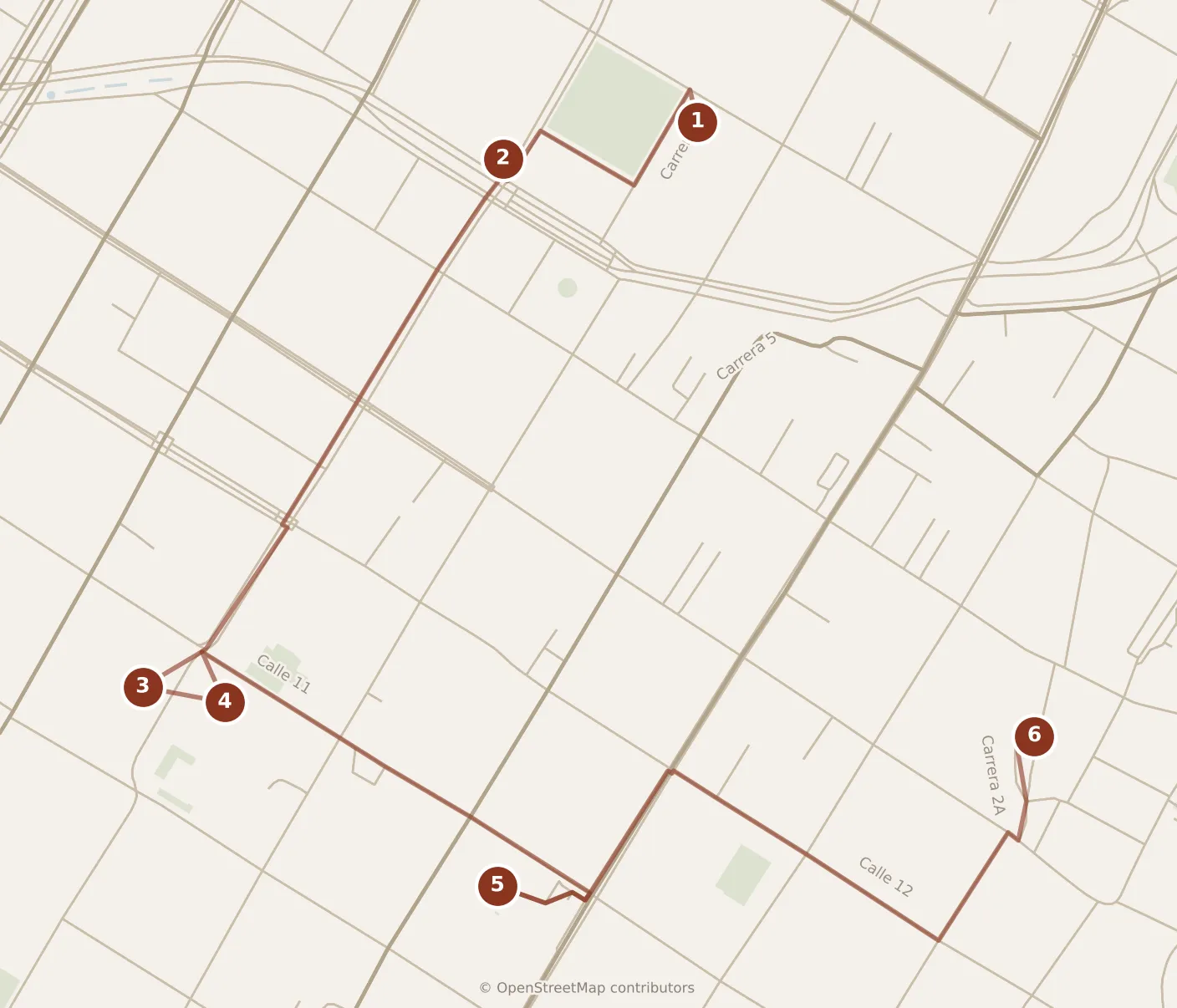
- Morning and afternoon
- 1Gold Museum
- 2Church of San Francisco
- 3Plaza de Bolívar
- 4Primary Cathedral of Bogotá
- 5Botero Museum
- 6Chorro de Quevedo
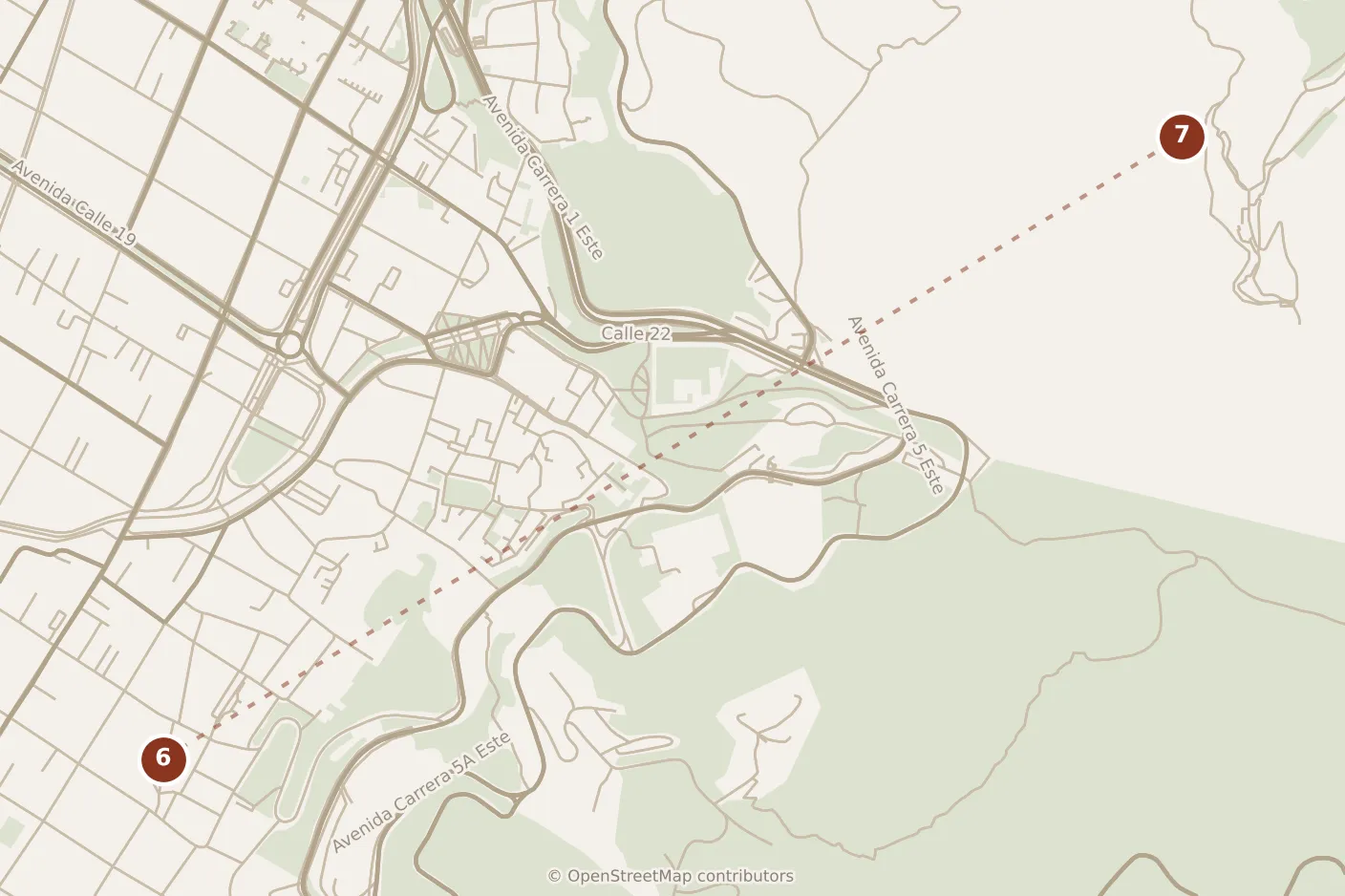
The leg out of the center: from stop 6 by taxi, not on foot.
- Evening
- 7Monserrate
Morning
Start at the Gold Museum, at the top of the historic center on Parque Santander. The TransMilenio station a couple of minutes away is called Museo del Oro, which makes it the one address on this day you cannot get wrong. Give the museum two hours. It holds the largest collection of pre-Hispanic goldwork anywhere — tens of thousands of pieces, a fraction of them on show — and two objects are why people come. The Muisca raft is a palm-sized gold model of a chieftain and his oarsmen on a reed craft, the offering ceremony out of which the El Dorado legend was built. The Poporo Quimbaya, a small lime flask with a body like a gourd, was the first object the collection ever acquired, in 1939, and has been on show for most of the time since. Follow the signs to those two first and let the rest of the museum happen on the way back: the display is an argument about metal, cosmology and offering, and it repays being taken in order only if you have the whole morning for it.
Three minutes away is the Church of San Francisco, on the corner where Avenida Jiménez meets Carrera Séptima, diagonally across from the TransMilenio station named after the museum you have just left. Built between 1557 and 1566, it is the oldest church still standing in the city, and two things in it are worth the stop: the timber ceiling, a mudéjar frame of the kind Spanish carpenters brought with them, and the gilded Renaissance altarpiece behind the altar. Ten or fifteen minutes. It is a working parish in the middle of the business district and there is very often a service on, so if you arrive in the middle of one, stand at the back and look up — the ceiling is the half that does not ask you to walk about.
Then ten minutes south down Carrera Séptima to Plaza de Bolívar, which is enormous, hard-surfaced and deliberately empty, and is where the country holds its protests and its ceremonies. The long ochre front on one side of it is the Primary Cathedral of Bogotá; the columned National Capitol and the blunt modern Palace of Justice, rebuilt after it burned in 1985, take two of the others. Twenty minutes on the square, and step into the cathedral if it is open. Of every interior on this route it is the one you can lose without losing the day, so a closed door here is twenty minutes given back rather than a problem.
Afternoon
Five minutes south-east of the square, on Calle 11, the Botero Museum. Give it an hour. Rather more than a hundred works by Fernando Botero, whose swollen figures are what most people come for, and nearly ninety more that he donated from his own collection — a Picasso, a Giacometti, a run of European painting from either side of 1900. The donated half is the one nobody expects and the reason the hour is worth spending.
Lunch goes here, sitting down, in one of the lanes off Calle 11 rather than carried. Order ajiaco: the thick chicken-and-potato soup that belongs to this city specifically, and which is exactly right at this altitude and this temperature. Give it an hour — it arrives with enough beside it to be the meal rather than a course.
Local tip. If the day runs late, cut the cathedral’s interior first and shorten the Botero second — never the mountain. Everything in the center is five minutes’ walk from everything else and can be picked up on another trip; the light on the ridge happens once, at one hour, and missing it means paying for a cable car in order to look at the dark.
Then eight or nine minutes east and uphill through the old lanes to the Chorro de Quevedo, the small sloping plazoleta at Calle 12B and Carrera 2 where Gonzalo Jiménez de Quesada is said to have set his garrison before founding the city on this spot in 1538. Twenty minutes: painted colonial fronts, a stone water spout, students, and the narrow lane running off it that is the reason the square is busy after dark. It is the last thing on foot.
From here the lower cable-car station is a kilometer and a bit north-east and uphill — twenty minutes’ walk if you want them, but this is the leg to hand to a ride-hailing app, because it is uphill the whole way and uphill at this altitude costs a good deal more than the distance suggests. Ten to fifteen minutes by car. The station is at Carrera 2 Este with Calle 21, on the Paseo Bolívar, and it is worth being clear about where that is: above and to the north of the old town, not below it. Walking south out of Plaza de Bolívar to look for it takes you away from it.
Evening
Monserrate is the ridge behind the city, 3,152 meters at the top and some five hundred above the streets you left. A funicular and a cable car both climb it, from two stations a few steps apart at the bottom. At the top there is a white pilgrimage church, a terrace along the front of it, and the whole plateau laid out below — a grid running west until it stops. Give it an hour and a half, arriving with the light still on the mountains and staying while the city switches on beneath you. That transition is the reason the entire day above was ordered the way it was, and on an ordinary weekday it is the one thing on this route that cannot be moved.
Coming down puts you back at Carrera 2 Este in the dark, on the eastern edge of everything. Allow far more time than the distance suggests for whatever comes next: the airport is the full width of the city from here, and this is the one leg of the day that no amount of walking will solve.
Practicalities
Book only one thing before you travel: the round-trip ticket up Monserrate. Everything else on this route is walk-up.
Two stops here close a day a week, and they are the two museums. Check both before you set out rather than assuming — and if one of them is shut on your day, this route survives it: the other absorbs the time, and the churches, the square, the plazoleta and the mountain have no weekly closing day at all. What the churches have instead are services, which is a different problem and only ever costs you a quarter of an hour.
The Sunday and holiday inversion is the one thing that genuinely rewrites the day, so it is worth restating as a method rather than an hour: find out when the last car down runs on your date, and if that is before dark, the mountain goes first and the museums take the afternoon. The return fare was also cheaper on a Sunday in 2026, which is a small consolation for losing the dusk.
Getting between the stops needs almost nothing. The whole of the day in the center is on foot, and the longest stretch the route asks you to walk is the ten minutes down Carrera Séptima from the Church of San Francisco to Plaza de Bolívar. The TransMilenio station called Museo del Oro, on Avenida Jiménez, leaves you a couple of minutes from the first stop; the only ride the day requires is the one out to the cable-car station, and the only one it requires afterwards is whatever takes you home.
Dress for the summit rather than the streets. It is five hundred meters above the city and colder and windier than anything you will have felt all day, and you will be standing still on it while the light goes.


