Bergen in two or three days: the wharf, a fjord, and the mountain above the town

Last updated 15 August 2026
Overview
Bergen is a small city with a very large thing beside it, and that is the whole argument for a second day. The old town is not much more than a kilometer across, and one day sees it; the one-day itinerary on this site does exactly that and says plainly what it gives up. The second day is not more city. It is the water — three and a half hours up a fjord and back — and it is the right to look at the forecast the night before and choose which of your two days gets the sky.
So the two days below are written to be swapped. Day one wants nothing from the weather: a row of timber houses you can shelter under, four ticketed interiors, a covered market hall and an art museum, none of them a kilometer apart. Day two is a boat deck and a mountain top, and cloud takes both. Read the forecast the evening before, give day two to the better of your two dates, and let day one have the horizontal rain. It will not notice.
The light is the other variable and here it is a large one. The sun sets in Bergen from just before half past three in the middle of December to a little after eleven at night around midsummer — nearly eight hours of swing between the ends of the year. But do not plan this trip around the sunset hour, because in this city the rain decides more than the darkness does: the band tells you when the light goes, not whether there is any, and a bright afternoon in January beats a gray one in July. Day two is the day that needs it, and its count is short. From the boat’s ten o’clock departure, three and a half hours on the water, an hour at the table, six minutes on foot and eight on the funicular put you on top of Fløyen four and three quarter hours later — a quarter to three. Take your month’s sunset hour and compare. From March to September the comparison decides nothing at all; the months that need looking up are October, November, December, January and February. December is the tightest of them: it leaves three quarters of an hour of daylight on the summit, enough only if nothing slips; skip the sit-down lunch and go straight up and you are there a little before two with an hour and three quarters. That is the whole of the winter adjustment, and it is a meal rather than a rebuild.
Those counts are time inside places and on sidewalks between them, and nothing else. They do not hold an hour under an awning waiting out a squall — in Bergen that is a line item rather than a caveat — nor the wait for the funicular, which loads a carriage on a schedule rather than standing there like an elevator, nor a Bryggen row with three cruise ships’ worth of people on it in August.
Two days here contain two paid rides. One is the fjord boat and one is the funicular, and once you are in town there is no bus, tram or light rail in either day; a third day adds a cable car or a ride south on the light rail, and the bus to reach the first of those. If you have arrived on this page holding nothing, the two names worth having are Skyss, the app the buses and both Bybanen lines are paid through, and the Bergen Card, sold in twenty-four-, forty-eight-, seventy-two- and ninety-six-hour lengths. It covers the transport outright and either covers or discounts the funicular, the cable car, the art museums and the aquarium — which of the two applies differs by attraction and is published on the card’s own page. The two- and three-day cards were in the five- to six-hundred-krone range in 2026, a figure worth re-checking on the card’s own page before you rely on it, and it is bought online before you travel or in person at the tourist information office at Strandkaien 3, at the head of Vågen beside the fish market. Everything else about fares, arrival and the state of Norwegian prices is the city guide’s, and this article assumes nothing from it.
One thing on these two days must be booked, and it is the boat. The Mostraumen fjord cruise is run by Rødne and leaves from Zachariasbryggen at Torget 2, two minutes from the fish market; an adult return was around nine hundred krone in 2026, with selected departures sold below that. Book it on the operator’s own site, or buy it at the pier, or at that same office on Strandkaien. Here two of this article’s rules collide, so take the trade knowingly: you are told above to choose your boat day off the forecast, and told here to book ahead, and in July and August you cannot do both. High summer runs three departures a day, at ten, at noon and at two, so a morning that comes up wrong can sometimes be moved a few hours. From November to June there is a single ten o’clock sailing and no flexibility at all, and there the boat fixes the day and the mountain takes what is left of it. September and October belong to neither rule and the operator publishes them on their own: look your month up rather than assuming either half of the split.
You will have a bag on one of these days, because two days means arriving and leaving. The shape that matters is that day one starts nineteen minutes’ walk from Bergen station and ends, at dinner, eleven minutes from it, and that day two starts two minutes from that same tourist information office. Left luggage here is worth confirming rather than assuming — both whether that office still takes a case and what time it opens, since day one starts at nine and a winter opening hour may not. Bergen station is the fallback, and day one begins nineteen minutes from it anyway. Two things on this route are genuinely bad with one: the Bryggen passages, which are narrow, sloping and uneven underfoot, and the funicular and the paths above it, where there is nowhere at the top to set anything down.
Zachariasbryggen, Mostraumen — not on the walking map.
- Day two · Morning
- Zachariasbryggen — in the prose, not on the map
- Mostraumen — in the prose, not on the map
Day one

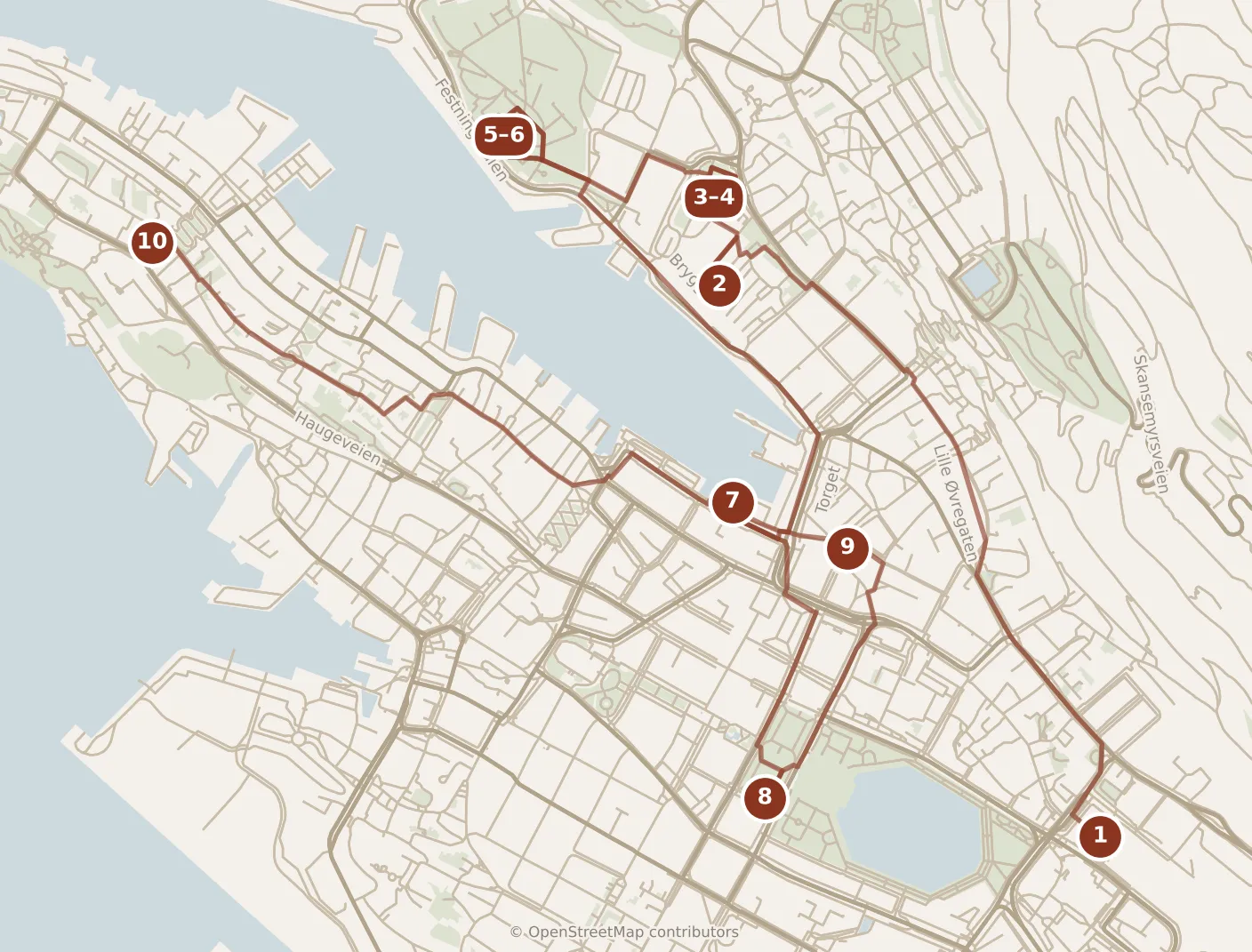
- Day one
- 1Bergen station
- 2Bryggen
- 3Bryggens Museum
- 4Mariakirken
- 5Rosenkrantztårnet
- 6Håkonshallen
- 7Fisketorget
- 8KODE
- 9Vågsbunnen
- 10Nordnes
Everything today is within a kilometer of the harbor and none of it needs the sun. That is what makes it the day to put on the worse of your two dates.
Morning
Start on the wharf, and start before the city does. From Bergen station the Bryggen front is a little under twenty minutes on foot, north-west past the head of the harbor and then up the quay with the water on your left. If you came in on the Bybanen from Flesland, get off at Byparken, the inland terminus of line 1, and it is twelve minutes from there. On the Oslo train you are standing at Bergen station already.
Nine in the morning is the hour to be there, and the reason is the one thing a second day genuinely buys: an empty row. Bryggen is a street rather than a museum — free, always open, and a completely different place at nine from what it is at eleven, when the tour groups and, in summer, the cruise passengers arrive on it. The port publishes its calls in advance, so look up your own date: three hundred-odd calls a year land very unevenly, and on a day with no ship in the nine o’clock rule buys you much less than it does on a day with three. What stands is a row of narrow timber trading houses, gable-end to the water, the surviving fragment of a much longer wharf. It has been a UNESCO World Heritage Site since 1979 and what earned that is not the woodwork but the ground plan, which is the medieval one, put back after the fire of 1702 on the same foundations and in the same lines. Behind each gable a passage runs inland at a right angle, and the passages are where the hour goes: give the row a full hour and walk the whole sequence of them, one after another, rather than dipping into two. They differ, and the difference is the point — some are galleried, some are barely shoulder-width, some open into small yards at the back. This was the German merchants’ wharf, run for four centuries from the Kontor, and it is the only place in Bergen where the fourteenth century is a shape you walk through rather than an object in a case.
Two minutes on, where the timber ends, is Bryggens Museum. In 1955 fire took a section of the wharf; the clearance turned into a thirteen-year excavation, and the museum was built over the hole in 1976 with the medieval foundations left standing in its floor. Give it three quarters of an hour and give most of that to the small objects rather than the reconstructions — leather, combs, wharf timbers, and the scratched runic messages that came up in their hundreds and turn out to be shopping lists and squabbles.
A minute further, standing free of everything around it, is Mariakirken, begun in the 1130s and the oldest building in the city by more than a century. Fifteen minutes covers it, and it comes with a closing rule worth checking before you set out: from 2026 it opened to visitors Monday to Friday only, and from September it closed on Wednesdays as well. It is not shut on the weekend — it is a working parish church, and it is closed to sightseeing precisely because it is busiest then. Services are held, an English-language Anglican one among them, and you are welcome at those as a worshipper rather than as a spectator. If your day one is a weekend and a service is not what you want, look at the two squat stone towers from the outside and walk on. You lose a quarter of an hour and nothing of the day’s shape, which is exactly why it sits here rather than anywhere the loss would matter.
Six minutes west, past the turn of the quay, is Bergenhus. Two buildings are open and they are opposite kinds of visit. Håkonshallen is one vast thirteenth-century room over a vaulted undercroft, and Rosenkrantztårnet beside it is a tower you climb through floor by floor, on stairs cut inside the thickness of the wall, ending on a roof above the harbor mouth. Both were blown apart in 1944 when a munitions ship went up in the water below, and both were rebuilt over the twenty years that followed, which is why the masonry reads older than the carpentry inside it. An hour and a quarter covers the pair. This is the one hour today rests on: in 2026 both shut at four in the afternoon, and that is why they come in the morning and the art museums, which stay open later, come after lunch. Håkonshallen is also a working events venue and shuts for perhaps two dozen scattered dates a year, December in solid blocks among them; Bymuseet publishes the list, so check your own date against it rather than against a season. When the hall is closed the tower beside it usually is not, except on public holidays — which turns the hour and a quarter into half of it rather than into nothing. If the hour has moved by the time you read this, keep the rule and throw the number away — the fortress is the stop with the earliest door on this day, so it goes before the ones that stay open, and the afternoon arranges itself behind it.
Afternoon
Thirteen minutes back along the quay the way you came is Fisketorget, at the head of Vågen. Lunch goes in the covered hall rather than at the outdoor stalls beside it, which are seasonal, pitched at whoever came off a ship that morning and priced accordingly. Sit down for an hour. The fish soup is tomorrow’s, when you will be cold and want it; today take a plate of shellfish, which is unambiguously what this hall sells, and eat slowly, because you have a museum to stand up in afterwards. The klippfisk whose name you will see about the harbor is the salt cod dried here and shipped south for three hundred years — the thing this port sent out rather than the thing it sits down to, which is not the same claim at all.
Twelve minutes south, on the west shore of the small city lake, is KODE, which is four buildings in a row and one institution. The numbers you may see attached to them are out of date; they go by their own names now — Rasmus Meyer, Lysverket, Stenersen and Permanenten. Two hours is the right allowance and it covers one and a half of them. Rasmus Meyer is the one to take: the collection of an industrialist who died in 1916 and whose heirs gave it to the city, in a purpose-built gallery of 1924, and it is Norwegian painting of the century and a half up to about 1950 — a substantial holding of Edvard Munch, and the landscape painters including Nikolai Astrup, whose western Norway is the country you sail into tomorrow. Permanenten is decorative art and silver, a real museum but not the reason you came; Stenersen is where the changing shows are, which means it is either the best thing here or irrelevant, and you can tell which from the door.
Local tip. If the afternoon is running short, halve KODE rather than dropping a whole stop: an hour and a quarter in Rasmus Meyer alone is a complete visit, and the three quarters of an hour it gives back is slack against KODE’s own closing hour rather than extra sightseeing. At a weekend take the halved version as the default and not as the fallback: the art museums closed at four on Saturdays and Sundays in 2026 against six on weekdays, and the full two hours runs the afternoon right up against that earlier close.
Evening
Ten minutes north-east brings you into Vågsbunnen, the quarter behind the fish market where the medieval street plan survives as short crooked lanes of timber and stucco. This is where the small kitchens are and where dinner goes — though four o’clock is when you reach the quarter, not when you sit down in it. Lunch ended barely two hours earlier and a small kitchen may not be serving dinner yet, so treat the arrival and the meal as two separate things with the walk below in between. On a Thursday ask for raspeballer, the west-coast potato dumplings eaten on that day of the week here and rarely on any other — but ask in a place that cooks traditionally, where it goes up as the Thursday dish of the day, rather than in any small kitchen that happens to be open. It is the kind of local rule you otherwise discover by turning up on the wrong day.
From the middle of May to the middle of August there is a great deal of day left at four o’clock, which is an artifact of an early finish rather than a design, and a useful one. Spend it walking eighteen minutes west out along Nordnes, the low peninsula that closes the harbor — narrow lanes of painted wooden houses, quiet in a way the wharf never is, and a park at the point where the city looks straight out west down the fjord towards the sea. Nordnes Sjøbad, the open-air heated seawater pool on its northern shore, opens from the middle of May to the start of September; it is a ticketed municipal pool with a closing hour of its own, so look that up before you count on a swim at the end of a walk that gets you there around half past five. In the dark half none of this exists, and dinner is simply the end of the day. That is a complete answer rather than a shortened one.
Day two

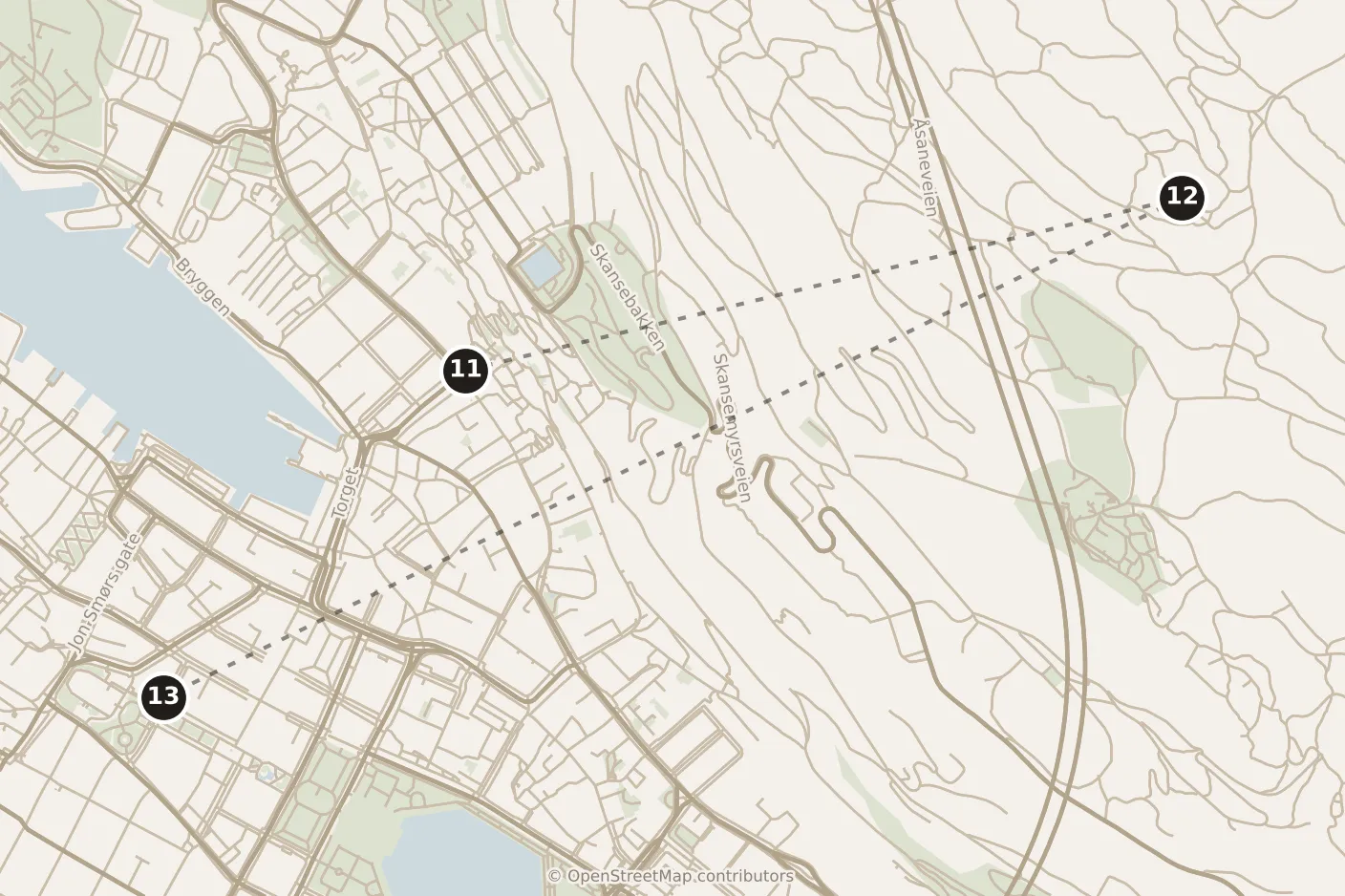
- Afternoon and evening
- 11Fløibanen
- 12Fløyen
- 13Ole Bulls plass
Today is the reason the second day exists. It is also the one that wants the better forecast, so if your two dates are not equal, this is the one to move.
Morning
Eat early — a skillingsbolle and a black coffee from a bakery counter is the local answer and takes ten minutes — and be at Zachariasbryggen, the quay at Torget 2 immediately beside the fish market, for the ten o’clock boat. That hour is the architecture of the whole day: it is the only fixed thing in these two days, it runs year-round, and from November to June it is the only departure there is. In July and August there are two more, at noon and at two. September and October follow neither pattern — check the operator’s schedule for those two months specifically.
The crossing is published as three to three and a half hours out and back, and you do not get off; every count in this article takes the longer end, so you may well be back sooner rather than later. The boat runs north out of the harbor into Osterfjorden, between mountainsides that come straight down into the water, past waterfalls it noses in close enough to feel, and through Mostraumen, a strait narrow and shallow enough that the tide runs through it as a visible current. The water beyond runs on towards Modalen, one of the smallest municipalities in the country. What this buys, and what no amount of city walking does, is the scale: the fjord is the thing western Norway actually is, and Bergen is the place you leave from.
Dress for the deck rather than for the saloon. The saloon is warm and glazed and you will not sit in it, and open water on a moving boat is cold in July and serious in February — a windproof layer and a hat, and gloves in the winter half. The spray at the waterfalls is not a figure of speech.
Afternoon
The boat is back at the quay by half past one. Two minutes away is the covered hall you ate in yesterday, and this is the moment fiskesuppe makes sense: you have been on the water for three and a half hours, and the local fish soup, thick and faintly sweet-sour, is what this city does about exactly that. An hour.
Six minutes east, at the foot of the slope behind the harbor, is the lower station of the Fløibanen, and eight minutes of track later — four if the carriage runs through without stopping at the halts between — you are 320 meters up on the shoulder of Fløyen, directly above the town. The view is the reason: the harbor read as a plan rather than a profile, the ring of mountains, the islands and the open sea behind them. Give it an hour and a half and spend most of that away from the terrace at the top station, which is where everyone stops and is the least interesting part of the mountain. Twenty minutes along the marked gravel paths behind it and you are in ordinary Norwegian upland — spruce, bog, a small lake, goats in the summer half — with the crowd gone.
This is the stop the day is counted to, and the Overview has already done the arithmetic: a quarter to three at the top. If your month’s sunset makes that tight — look it up for the five dark months the Overview names, and in December and January take it as given — eat after the mountain instead of before it and you gain a clear hour. And if the summit is in cloud when you look up at it from the quay, it is a white room with a railing in it and no plan improves that: go instead to KODE, twelve minutes south of where you are standing. Yesterday’s two hours covered Rasmus Meyer and part of one more, so there are two buildings you have not been inside, and the mountain moves to a third day if you have one, or to tomorrow morning before your train if you do not.
Evening
Take the funicular back down rather than the path, and walk eleven minutes south-west to Ole Bulls plass, the square between the shopping streets and the theater, with its small pond and the statue of the violinist it is named for. This is the other evening quarter — larger, later and less domestic than Vågsbunnen, with the streets running west off it where, on most nights, the drinking happens. Dinner goes here too: you have eaten nothing since the soup at half past one, and the choice around this square is wider and later than last night’s lanes. Sunday is the quiet exception at both ends of this city, and it is the one evening worth having a table in mind before you set out. It is deliberately a different end to a day than yesterday’s, and the two together are most of what there is to learn about how this town spends an evening.
In the light half of the year you can invert this entirely and stay up the mountain instead. The funicular runs late into the night, the paths are still walkable at nine, and coming down at half past ten in June to eat is an ordinary thing to do here rather than an eccentric one.
With a third day

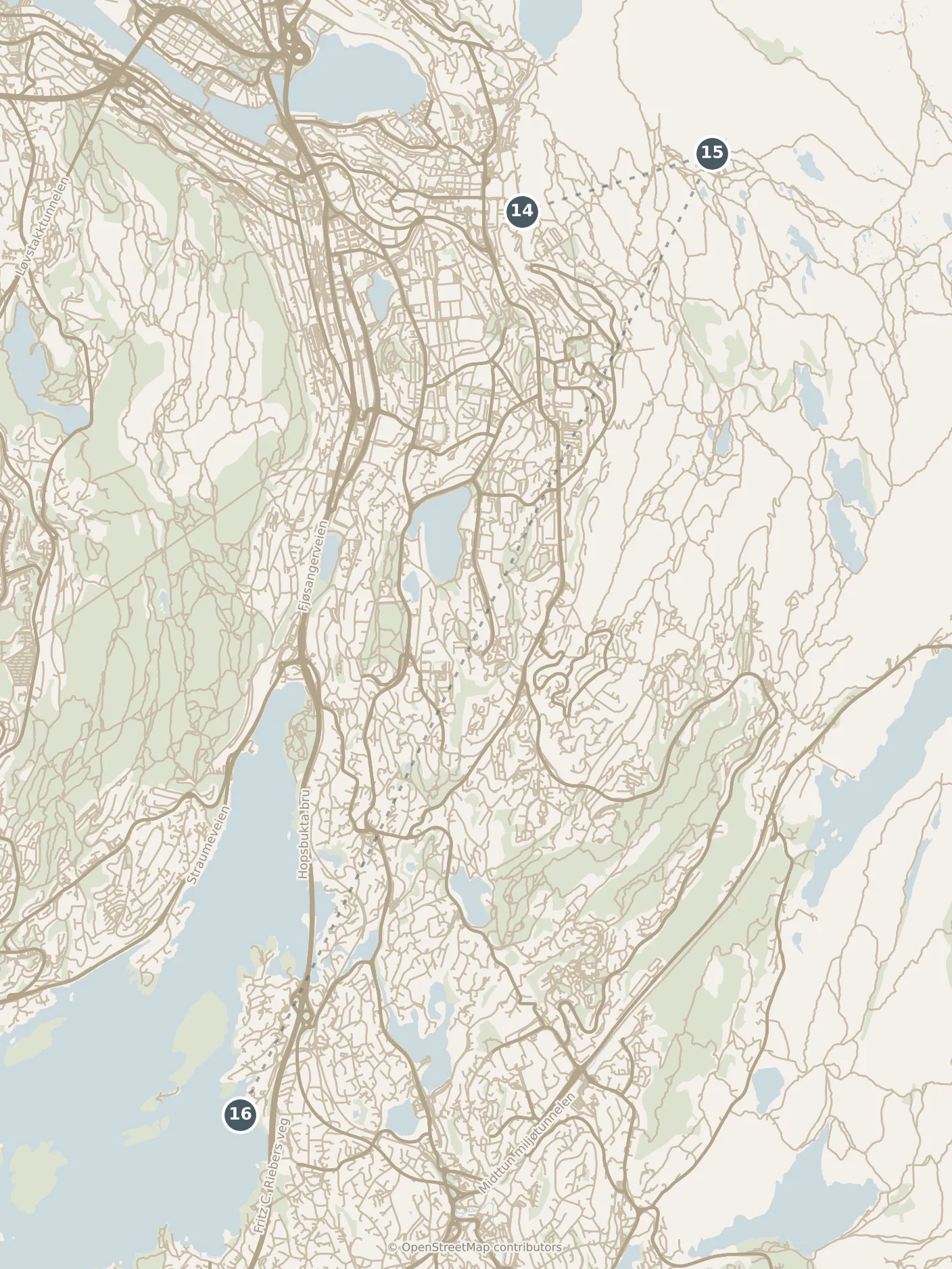
- With a third day
- 14Ulriksbanen
- 15Ulriken
- 16Troldhaugen
A third day in Bergen does one thing above all others: it means you no longer have to gamble. With two days you must decide in advance which one gets the boat; with three you can hold the outdoor day back and take the best of them. So the third day is appended, not inserted — it is the spare, and it goes on whichever of your three mornings looks best from the window.
The main plan for it is the other mountain. Ulriken is 643 meters, three hundred higher than Fløyen and further out of town, and the Ulriksbanen cable car goes up it in about five minutes. Reaching the lower station is the only part that needs thought. From the first of April to the middle of October the Ulriksbussen shuttle leaves from a stop on Torgallmenningen every half hour and takes ten to fifteen minutes; outside that window the year-round answer is Bybanen line 2 from Kaigaten to Haukeland sykehus, and then about ten minutes uphill on foot. The cable car is the dearest ride in this article — its return fare ran to several times the funicular’s in 2026, depending on the season — so this is a deliberate second purchase rather than a free extra. Both operators publish their current fares and the two are worth putting side by side before you commit, because if you are only ever going to ride one mountain in this city it should be Fløyen, which is why that one sits on day two.
What justifies the fare is not the top station but the walk from it. Vidden is the open plateau between the two summits, and crossing it from Ulriken to Fløyen takes about five hours and finishes at the funicular you already know. It is the finest thing in this article and the only thing in it that can go seriously wrong, so read the next four sentences before you commit to it. The route is bare plateau with no shelter, no shop and no road for its whole length; it is waymarked with cairns, and in cloud those disappear at a distance where you can still walk confidently in the wrong direction. The official visitor information calls it a late-spring-to-early-autumn walk and means it — in winter this is a snow crossing rather than a path. The cable car itself does not run in high wind, which on this coast is not a rare event, and if it stops while you are at the top the way down is on foot. So: boots rather than sneakers, because long stretches of the plateau are bog; food and water, because there is nowhere to buy either; a windproof layer whatever the sky looked like in town; tell somebody where you have gone; and turn back if the cloud comes down, which here is the ordinary rule rather than an excess of caution.
If five hours on a moor is not what you came for, or if the third day turns out to be the wet one, the alternative is a real day rather than a consolation, and it is the composer. Take Bybanen line 1 south from Byparken — the same line that runs to the airport, and Hop is well short of it — and walk about twenty-five minutes from Hop, signposted, to Troldhaugen. Edvard Grieg built the villa in 1885 and lived in it for the last twenty-two years of his life, and what makes the journey worth it is not the house but the composing hut down at the water’s edge on Nordåsvannet, one room and a piano, and the grave cut into the rock face above the lake. In summer and autumn there are recitals in Troldsalen, the small hall built into the slope in 1985, and going to one turns the visit into an evening as well as an afternoon. Coming back, Fantoft station is on the same line, and the stave church above it is the one thing in this article to skip outright: what stands is a 1997 reconstruction of a building burned down in 1992, and that building had itself been carried here from Fortun in Sogn in 1883. It is behind a security fence and it is a modern copy on a borrowed site.
What the third day changes about the first two. If you take Vidden, it ends on Fløyen — so the mountain comes off day two, day two’s afternoon goes to KODE instead, and that in turn leaves day one’s afternoon empty: two hours to give back to the wharf in the morning, or to reaching Vågsbunnen and the walk out to Nordnes earlier than four. Two things above stop applying under that arrangement, and it is worth saying so rather than leaving you to find out: the tip about halving KODE on day one has nothing left to halve, and KODE’s closed days in the next section have already been answered, because it has moved to day two of its own accord. If you take Troldhaugen instead, nothing moves at all — the two days stand exactly as written and the third is simply added to the end.
Practicalities
Book one thing before you arrive and calculate a second. The thing to book is the Mostraumen boat, from Rødne, on the operator’s own site or at the pier at Zachariasbryggen or at the tourist information office on Strandkaien; a few days ahead is enough in July and August, and in the winter half there is one sailing a day and it is the one you cannot afford to find full, so book it the moment you have chosen the date. The thing to calculate is the Bergen Card, which is a sum rather than a purchase: it pays for itself if you ride both the funicular and the cable car and go into the art museums, and it does not if you are walking everything and taking the boat, which is not on it beyond a discount. This article deliberately does not carry the three numbers that settle it, because they move every season — take the card’s price from its own page and the funicular, cable car and museum fares from theirs, add only the ones you will really buy, and compare. The transport it covers is worth nothing to the two days above, which contain no bus, tram or light rail at all, so the sum turns entirely on the rides and the museums. Nothing else on these days needs booking at all, outside the two-week festival below.
The calendar here is not a week, and writing “start on a Tuesday” would answer a question Bergen does not ask. Three things govern it instead, and none of them is a weekday.
The first is the season, and it is a switch rather than a gradient. The fjord boat runs one departure a day from November to June and three in July and August, with September and October published separately; the shuttle to the cable car runs from the first of April to the middle of October and not otherwise; the ridge walk is a late-spring-to-early-autumn proposition; the outdoor half of the fish market and the sea pool on Nordnes exist only in the summer months; and the light swings by nearly eight hours across the year. A February trip and a July trip here are not the same trip in different weather. They have different contents, and everything above is written so that the February version still works.
The second is the national holidays, which is where the calendar does bite and where it does not behave as visitors expect. The museums take their closed days from the calendar rather than from the week: the art museums publish their own as the first of January, the first and seventeenth of May, and the twenty-fourth, twenty-fifth and thirty-first of December. The seventeenth is Constitution Day and it inverts this article completely — the indoor half is shut and the streets are the best they are all year, full of processions and people in national dress, so a reader who lands on it should take the day outdoors and begin day one the morning after. And check two schedules against the seventeenth before you book anything on it: the fjord boat, which in the single-sailing half of the year is the one item here that cannot be moved, and the funicular. You are told elsewhere to book the boat the moment you have chosen your date, and this is the date on which that instruction can put you on a sailing that may not run. Easter is the other cluster: four public holidays inside five days, from the Thursday to the Monday, with holiday schedules either side of them. The days between Christmas and the New Year behave the same way.
The third is the Bergen International Festival, two weeks at the turn of May and June, and it touches this article at both ends: Håkonshallen is one of its venues, so day one’s anchor can be closed for a performance, and the Troldhaugen recitals of the third day are part of it. It also fills the rooms and the tables, and those two weeks are the one exception to the rule above that the boat is the only booking these days need: inside it, book a room and a table further ahead than you otherwise would.
Which leaves three weekday rules worth carrying, and two of them are Monday. Mariakirken, a quarter of an hour of day one’s morning, was closed to sightseeing every Saturday and Sunday of 2026 and on Wednesdays from September — a church that shuts its door to visitors at the weekend precisely because that is when it is busiest, the reverse of what anyone assumes, and the reason it is placed where losing it costs nothing. The art museums are the one stop on day one with an ordinary weekly closing day, and in the winter half there are two of them: KODE closed on Mondays all year in 2026 and on Tuesdays as well from the middle of September to the middle of May. Check both against your dates, and if either falls on your day one, swap day one’s afternoon with day two’s, because the boat does not care which date it sails on and KODE after the fjord works exactly as well. And the cable car was closed on Mondays through the winter half of 2026, which matters only if you have a third day and it lands there; if it does, take the Troldhaugen version of the third day, which is on a light-rail line that runs every day of the year.
One thing to pack, and it is not an umbrella. A hooded waterproof and shoes that do not mind being soaked through, because the rain here arrives sideways on the wind and an umbrella in it is a liability rather than a defense. That is the whole of the clothing advice for the city, and it does not change with the season — only the number of days it is needed on does.
If the two days become one and a half, the order of subtraction is fixed and it is worth having in advance. First the part of KODE beyond Rasmus Meyer, which is three quarters of an hour and costs nothing structural. Then Mariakirken, a further quarter of an hour, which a weekend may have taken from you anyway. Then Bryggens Museum, and that one hurts, because it is the only place on either day where the medieval city is physically present. Do not cut the boat: it is the whole crossing or it is nothing, there is no short version of it, and a second day in Bergen without the fjord is a first day with more museums in it.
Everything on day one is walked and the distances are real. The longest stretch inside the day is the thirteen minutes from the fortress back to the fish market; the evening walk out to Nordnes is eighteen, and the arrival from Bergen station is nineteen. The whole of it — six and a quarter hours in the places, three quarters of an hour between them — comes to seven hours from the wharf at nine to Vågsbunnen at four; that four o’clock is when you reach the dinner quarter, not when you sit down in it. Day two contains almost no walking at all, which is worth knowing if you are sore: two minutes to the quay, six to the funicular, and whatever you choose to do on the mountain. If you are leaving by train, Bergen station is eleven minutes on foot from Vågsbunnen and fourteen from Ole Bulls plass. If you are flying, Bybanen line 1 boards at Nonneseter beside the station and takes about three quarters of an hour to Flesland.


_(36439502936).jpg)


