Bergen in one day: the wharf, the fortress and the mountain above them

Last updated 4 August 2026
Overview
Bergen holds a one-day visit better than most cities its size, because the whole of it is within a kilometer of the water. The two ends of the route are the railway station and the far side of the fortress, and even those are under half an hour apart on foot — the route never does that walk in one go. The longest single stretch below is the thirteen minutes back from the fortress to the fish market, and there is no bus, tram or metro in the day itself. The only thing on the route that is not walked is the funicular, and that is the point of it; the light rail appears only at the very end, and only if you are leaving from the airport.
What one day here costs you is the fjords, and there is no arranging round it. Bergen is where people come to leave from: the express boats and the rail-and-boat routes out to the Hardangerfjord and the Sognefjord are full days, out and back, and any one of them consumes the whole of the time you have. So the choice is stark and worth making on purpose rather than by drift — spend the day on the water and see the country, or spend it here and see the city. This article is the second answer. If you get a second day, that is the one the fjord goes on.
The day also gives up Ulriken, the higher of the two mountains with a cable car up it. Fløyen is the one this route takes, for the dull and correct reason that its funicular starts three streets from the fish market and the cable car up Ulriken does not.
The shape is a loop. It begins at Bergen station, works anticlockwise round the head of the harbor to the fortress at its mouth, comes back for lunch, goes up the mountain, and finishes ten minutes from where it started. That shape is deliberate, because the reader of a one-day itinerary is usually between trains and carrying something. Two places on this route will take a bag. The station is one, though neither the railway nor the station publishes what its lockers hold, so treat a full-size case there as unconfirmed rather than assured. The other is the tourist information office at Strandkaien 3, at the head of Vågen beside the fish market, which took luggage at a hundred kroner per item per day in 2026, inside its own opening hours and for one day only; the route reaches its door a few minutes after Torgallmenningen, before Bryggen. The loop brings you back past the station at the end, which is the whole reason it is a loop rather than a line; the office keeps its own hours and shuts in the evening, so a bag left there is collected on the way to dinner rather than after it.
If you end up carrying the bag anyway — the office shut, the hours wrong, the case too big — then the day to walk is the sea-level one, and it is a real day rather than a consolation. Take this route unchanged as far as the fortress: Torgallmenningen, the Bryggen front and two or three of its passages, the excavation museum, the church if its hours allow it, then Håkonshallen and Rosenkrantztårnet. Come back along the quay for a sat-down lunch in the market hall, an hour of it — that is the five hours counted below — and give the afternoon that is left to Vågsbunnen’s lanes and the cannonball in the cathedral wall — the evening of this route, walked earlier, which the section below times at about twenty minutes of walking and five standing at the wall. All of that is at sea level and none of it has a staircase you cannot set a case down on. What you lose is Fløyen, and only Fløyen: a funicular carriage and a mountain path are the two worst places on this day to be holding a case, and there is nowhere at the top to put it down.
The stop whose value depends on the hour is that mountain, and Bergen is far enough north that the hour is not a small matter. The sun goes down here at half past three in the middle of December and not until a quarter past eleven at night around midsummer — a swing of nearly eight hours between the two ends of the year, and much the largest variable in planning a day in this city. Take your own month’s sunset hour and count back from it. Everything above the funicular in the route below comes to about five hours from the station: the wharf and its passages, the excavation museum, the church, the two fortress buildings and a sat-down lunch. From April to August that count decides nothing, because the light outlasts you and you could go up after dinner. From November to February it decides everything, and starting earlier is not the way out: nothing indoors on this route opened its doors before ten in the morning in 2026, so the five hours cannot begin before the doors do, and in December they end within half an hour of the sunset, which leaves nothing of the light for the mountain. The winter answer is a different order rather than an earlier alarm — go up the mountain first, on whatever light there is, and take the wharf, the museum and the fortress after it, because those lose nothing to the dark and the mountain loses everything. Keep the route as written and you go up in the dark instead — which is not a wasted trip, because the compensation of a Bergen winter is that the thing below you has switched itself on.
That five hours is time spent inside the places and on the sidewalks between them, and it models nothing else. In particular it does not model the weather. It rains here more often than almost anywhere in Europe, and an hour spent under an awning waiting for it to pass is an hour the count has not got; nor does the count include the wait for the funicular carriage, which leaves on a schedule rather than standing there like an elevator — every ten to fifteen minutes through the middle of the day in 2026, half-hourly at either end of it.
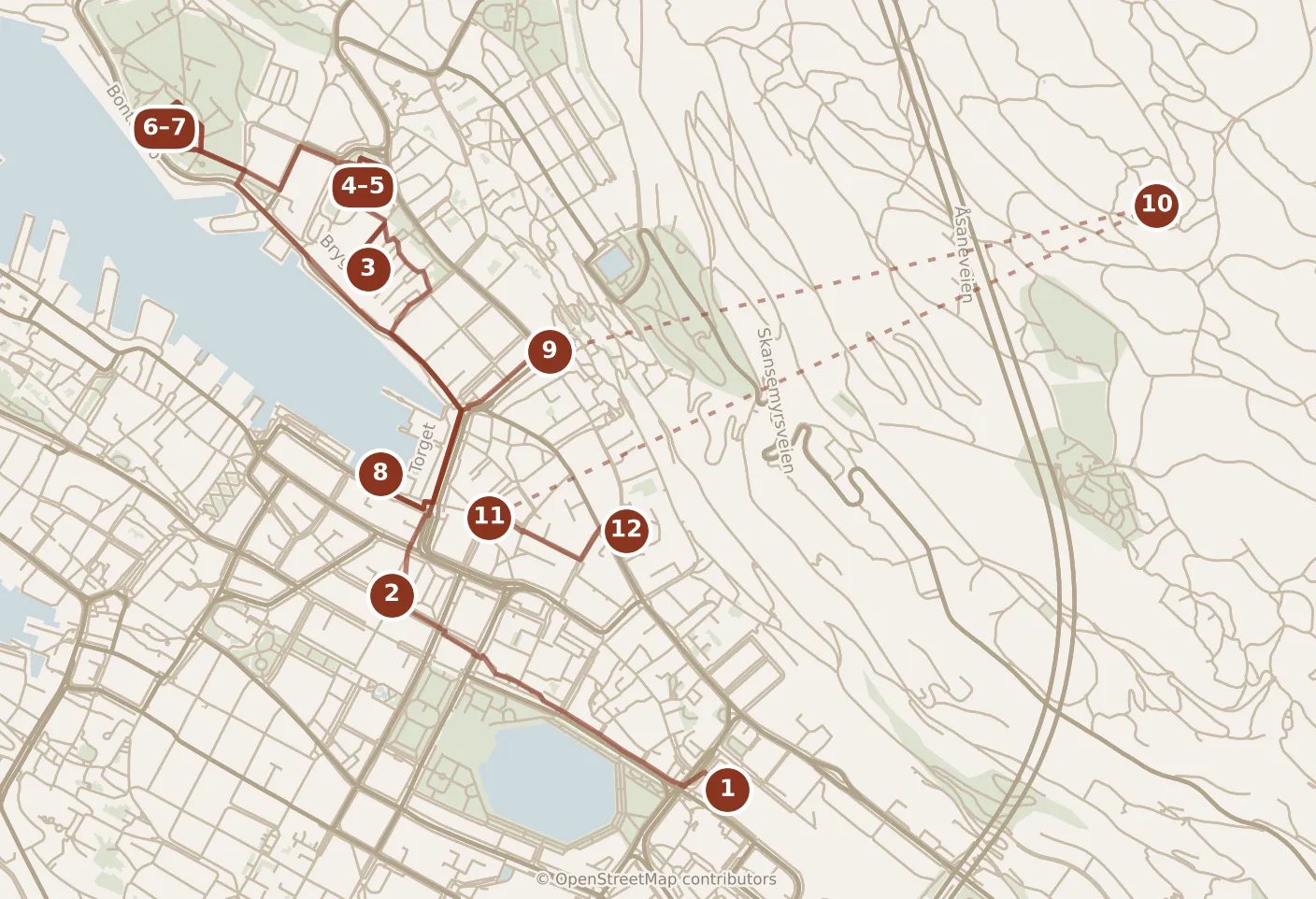
The day

- The day
- 1Bergen station
- 2Torgallmenningen
- 3Bryggen
- 4Bryggens Museum
- 5Mariakirken
- 6Rosenkrantztårnet
- 7Håkonshallen
- 8Fisketorget
- 9Fløibanen
- 10Fløyen
- 11Vågsbunnen
- 12Bergen Cathedral
Morning
From Bergen station it is twelve minutes north-west on foot to Torgallmenningen, and that walk is the whole of this itinerary’s first transport problem. Torgallmenningen is less a stop than an orientation: a broad paved square running downhill from the shopping streets to the water, with the Bybanen’s line 1 from the airport terminating at Byparken, a couple of minutes off its inland end. Give it the three minutes it takes to cross and keep going down to the harbor.
Turn right along the quay. You will pass the fish market at the head of Vågen — a covered hall, open year-round, with stalls under awnings on the landward side of it from the beginning of May to the end of September and nothing outdoors at all the rest of the year. The tourist information office that takes luggage is here too, at Strandkaien 3. Walk past the market. You are coming back here for lunch, because the loop brings you back this way and because you have a mountain in front of you.
Six minutes north along the quay is Bryggen. What stands is a row of narrow wooden trading houses, gable-end to the water, and the thing to understand before you look at it is that the row you photograph from across the harbor is the smallest part of it. Behind each gable a passage runs back at right angles — dark, plank-lined, sloping, leaning, with galleries and outside stairs and doors off it. The front is the picture and the passages are the place, so go down two or three of them, as far as they go. It has been a UNESCO World Heritage Site since 1979, and not for the facades: what is old here is the plan. A fire in 1702 took the buildings and they were put back on the same foundations in the same medieval arrangement, which is why a row of eighteenth-century timber is a document of the fourteenth. Give the row and the passages three quarters of an hour, and take the passages slowly — the boards are uneven and, in rain, slick.
Two minutes on, where the wooden row ends, is Bryggens Museum, which exists because of another fire. Part of Bryggen burned in 1955, the clearance turned into a thirteen-year excavation of what lay underneath, and the museum is built over the dig with the medieval foundations left exposed in its floor. The finds are the reason to go in: wharf timbers, leather, shoes, combs, and above all the runic inscriptions that came up by the hundred — shopping notes, business letters, insults and propositions, scratched on scraps of wood by people who had no idea anyone would ever read them. It is the one indoor stop on this route that repays every minute you give it, and three quarters of an hour is the minute count.
A minute further, standing on its own, is Mariakirken. It was begun in the 1130s and finished around 1180, which makes it the oldest building left in the city — it is stone, and everything around it was wood, and those two facts are the whole of Bergen’s building history in a sentence. It was the German merchants’ parish church for most of the time the Kontor ran the wharf, and the inside is stranger than the plain Romanesque box with two square towers leads you to expect: a pulpit of 1677, given by the Hanseatic merchants and inlaid with tortoiseshell and other imported oddities, with a gold globe and a painted sky of zodiac signs under its canopy, and a late-fifteenth-century altarpiece probably shipped in from Lübeck. Fifteen minutes, and a hundred kroner in 2026 to go in: it charges, and it keeps published visiting hours rather than opening by chance — the narrowest hours on this route. Photography inside is not allowed. Through 2026 it opened Monday to Friday only: across the middle of the day from the middle of May to the end of August, and in the afternoon alone from September, with Wednesdays shut from then as well. It was closed every Saturday and every Sunday of the year. The city’s official visitor-information site is where those hours are published, and they are worth checking before you leave home. On a weekend, or on an autumn Wednesday, the two towers from the outside are the stop, and the day loses a quarter of an hour and nothing at all of its shape. From September the door does not open until midday, and that does change the shape: take the fortress first and the church on the way back from it. The church stands between the museum and the fortress, so the doubling back costs a couple of minutes and the walk is the same line.
Six minutes west, past the point where the quay turns, is Bergenhus, which has held the mouth of the harbor since the thirteenth century. Two buildings are open and they are opposite kinds of visit. Håkonshallen is the ceremonial hall Håkon Håkonsson raised in the 1250s for his son’s wedding — one enormous room over a vaulted basement, and the largest secular medieval building in Norway. Rosenkrantztårnet beside it is the one you move through: a keep of the 1270s wrapped inside a governor’s residence of the 1560s, room stacked on room, staircases cut into the thickness of the wall, and a roof you come out onto over the harbor. Both were wrecked in 1944 when a ship full of explosives went up in the water below, and both were rebuilt over the twenty years after, which is why the stone reads older than the joinery. An hour and a quarter covers the pair.
This is the one hour the whole day rests on, and it is a closing rather than an opening. In 2026 the hall and the tower both shut at four in the afternoon — the tower alone stayed open into the evening on high-summer weekdays — the church shut at the same hour through high summer and the excavation museum an hour later, and nothing else on this route shuts before the funicular stops running. That fixes the order: the fortress goes before the funicular and never after it, which is why the mountain sits in the afternoon of an itinerary that would otherwise have put the view first. Two things move the order around. The first moves the church rather than the pair: from September it has the narrowest window on the route and that window opens at midday, so building the day round it means keeping the morning clear of it — the fortress takes the hours the church cannot use, and the church follows it. The second is the dark half of the year, when the sunset shuts the mountain before the fortress shuts, which is the inversion described above. If the hours have moved by the time you read this, keep the rule and throw the numbers away: the stop with the narrowest window is the one the day is built round, everything else arranges itself behind it, and the mountain, which runs late into the night, is last of all except when the light takes it first.
Local tip. If the fortress has to be one ticket rather than two — they are sold separately — take the tower. It is the one you walk up through and come out on top of, and the hall, magnificent as it is, is a single room you will have seen in ten minutes.
Afternoon
Thirteen minutes back along the quay the way you came is Fisketorget, the fish market at the head of the harbor. It is the longest single walk of the day and it is no hardship: you are doing the Bryggen front in the other direction with the water on your right, and it reads as a different row.
Lunch goes here, and it should be fiskesuppe — the local fish soup, thick and creamy, which this city settles arguments with. From May to September there are two markets on this spot and they are not the same thing. The outdoor stalls are the postcard version, pitched at whoever came off the ships that morning and priced accordingly; the covered hall beside them is where you sit down and eat. From October the hall is the whole of it, which for half the year settles the question for you. The hall is where you sit down, and an hour there is the easy answer. The temptation with one day in an expensive country is to buy something to carry and keep moving, and this is the wrong day for it, because you are about to spend as much as two hours on a mountain in whatever the weather has decided.
Six minutes east, at the foot of the slope behind the harbor, is the lower station of the Fløibanen. It has climbed the same 302 meters on the same 848 meters of track since 1918, and the ride takes about four minutes on a direct run and about eight when it stops at the stations in between. Buy from the machine at the lower station or on your phone rather than at the window, which costs more in summer. If you would rather not ride it at all, the operator puts the walk between the lower station and the top at about three kilometers and three quarters of an hour.
The top station stands 320 meters up on the side of Fløyen, directly above the town, so the harbor lies below you in plan rather than in profile: the wooden city, the seven mountains ringing it, the islands and the open sea behind them. The terrace at the top station is where everyone stops and it is not the best of it. Walk on. Behind the terrace the mountain turns into ordinary Norwegian outdoors — gravel paths, spruce, a small lake, goats grazing in the summer half of the year — and twenty minutes on the marked paths puts the crowd behind you. Give the top an hour and a half if the weather is with you and twenty minutes if it is not. On a mountain in this city both are correct answers, and which one you are giving is decided for you on arrival.
Evening
Ride back down and walk five minutes south into Vågsbunnen, the quarter immediately behind the fish market where the medieval street plan is still legible — short lanes, timber houses, and a scale that comes as a relief after the wharf. This is where the smaller kitchens and the bars are, a couple of streets inland from the harbor, and it is where dinner goes.
Four minutes on, at the landward edge of the quarter, is Bergen Cathedral, and it is worth the detour for one thing. A cannonball is still lodged in its outside wall, fired in 1665 when an English squadron came into this harbor after a Dutch treasure fleet sheltering in it and the guns of Bergenhus opened up on the English instead. Nothing marks it from a distance; you find it by walking round and looking, which is the whole of the pleasure. It is an outside wall, so this is the one stop on the route that keeps no hours and is still there after everything else has shut — though in the dark half of the year you will want the flashlight on your phone for it. Five minutes.
From the cathedral it is eight or nine minutes south-east back to Bergen station, where the day started and where the bag is, if the station is where you left it rather than the office. If you are flying out, line 1 of the Bybanen is the way, boarded at Nonneseter beside the station and about three quarters of an hour to Flesland. If you are on the Oslo train, you are already standing on the right side of the building.
Practicalities
This route needs no transport ticket of any kind, which is worth saying plainly to a reader who has arrived on this page holding nothing and does not know what they were supposed to have bought. The whole day is walked; there is no bus, tram or light rail in it until the ride out to the airport at the end. Nothing on it is booked ahead, either — there is no timed slot to secure and no advance fare to miss. For the airport, the fare system and the fjord boats, the city guide is the place, and this article assumes nothing from it.
The one fare on the day is the funicular. A Fløibanen return was in the 145-to-220-krone range for an adult in 2026, cheaper in the winter half of the year than in the summer and cheaper again from the machine or the app than from the window. In the summer half that is the largest single cost of this day and the number that settles whether the mountain is worth it to you; in the winter half, at 145, the fare drops below the price of a museum ticket and stops being the question. There are four admissions on this route, not two, and they are sold separately with no day ticket combining them: the excavation museum and Rosenkrantztårnet at 170 kroner each in 2026, Håkonshallen at 120, Mariakirken at 100. Everything else — Bryggen and its passages, the market, the harbor front and the walk itself — costs nothing.
One stop on this route keeps a weekly closing day and the rest do not, which is worth stating in that order. Mariakirken was shut every Saturday and Sunday of 2026, and on Wednesdays from September; the fortress buildings, the excavation museum and the funicular kept no weekly closing day at all, only a scattering of public-holiday dates and a few more at the end of December. So a Monday costs this particular day nothing it was going to give you, and a weekend costs it the church. What the fortress does do is close for private events — a scattering of afternoons and evenings across the year, listed on the city museum’s own page for each of the two buildings and often only a few weeks ahead. That is the other thing worth checking the night before you set out, and if it lands on your date the answer is not to rebuild the morning: give the hour to the passages and the excavation museum instead, and go up the mountain earlier, when the light is better anyway.
The weather is the other thing that reorders this day, and here it is a genuine variable rather than a caution. Fløyen in cloud is a white room with a railing in it, and no amount of planning improves that. So if you wake to a clear morning and a forecast that is not, invert the order: eat early, go up while it is dry, come down for the fortress in time for its four o’clock, and finish on the wharf and in the excavation museum, which stays open an hour later than the fortress does and is the right place to be when it is raining. Bring the footwear for it. The paths behind the top station are gravel and mud rather than sidewalk, the Bryggen passages are slick boards, and an umbrella is close to useless in the wind that comes up the harbor.


.jpg)