Belo Horizonte in two or three days: the center, Niemeyer's lake, and a day out at Inhotim

Last updated 14 August 2026
Overview
Belo Horizonte has no old town and two days will not conjure one. The place was designed on a drawing board in the 1890s, built to the design, and has been spreading outwards ever since, so what a visitor wants sits in three separate districts several kilometers apart. One day here takes a single thing from each and has to leave the doors shut: you look at buildings from outside, you eat once, and you watch the light come off the city from a lawn on the ridge. That is a good day. It is not this one.
What the second day buys is the inside of things, and it buys a pace. Two days is enough to give a market a morning rather than an hour, to go into both museums on the same square instead of picking one, to walk up a hill you would otherwise pay a driver to climb, and to spend an evening in a bairro that is nobody’s sightseeing. What the third day buys is not more city at all. It is Minas Gerais, and it goes to a contemporary art park sixty kilometers west.
The two city days split the map and neither crosses the other’s ground. Day one is the center and everything south of it: the market as it opens, the crossroads that explains the street plan, the square the state governed itself from, and the ridge at dusk. Day two is the north and the east: Oscar Niemeyer’s lake in the morning, then back down for the old railway terminus, the park, the viaduct and the bairro on the far side of it. Day one has two rides inside it, both short; day two has two, the ride out to the lake and the ride back. Everything else is walked, or two stops on the metro if you would rather not walk them. Getting yourself to the first stop on day one can be either.
One moment across the two days depends on the hour, and it is the end of day one. The sun sets here no earlier than about twenty-five past five, in the first days of June, and no later than about twenty to seven, which falls in mid-January: an hour and a quarter of variation across a whole year, which is almost nothing, and it runs the way round that catches out anyone from the northern half of the world — the long evenings are the January ones and the short ones fall in midwinter June. The lawn that ends day one wants the last hour of that light. Everything above it comes to a little over eight hours of looking, eating and moving, so in June you set off when the market opens and arrive with the hour in hand; in January you set off about an hour and a quarter later, which is the width of that band and nothing else. Better than starting late: start at the market anyway and give the spare hour to the park on the ridge, which is a far better place to spend one than the lawn below it.
That eight hours counts time in the places and on the sidewalk. It does not count the two rides honestly, and the one to watch is the first, up to the ridge in the late afternoon. Traffic at that hour is the single thing on day one that can put you on the lawn after the light rather than before it.
Nothing on either city day has to be booked. The third day carries the only two things that have to be — the ticket, and the seat on the coach out — and they are the only money this article asks you to commit before you travel.
Santa Tereza — not on the walking map.
- Day two · Evening
- Santa Tereza — in the prose, not on the map
Inhotim — not on the walking map.
Day one

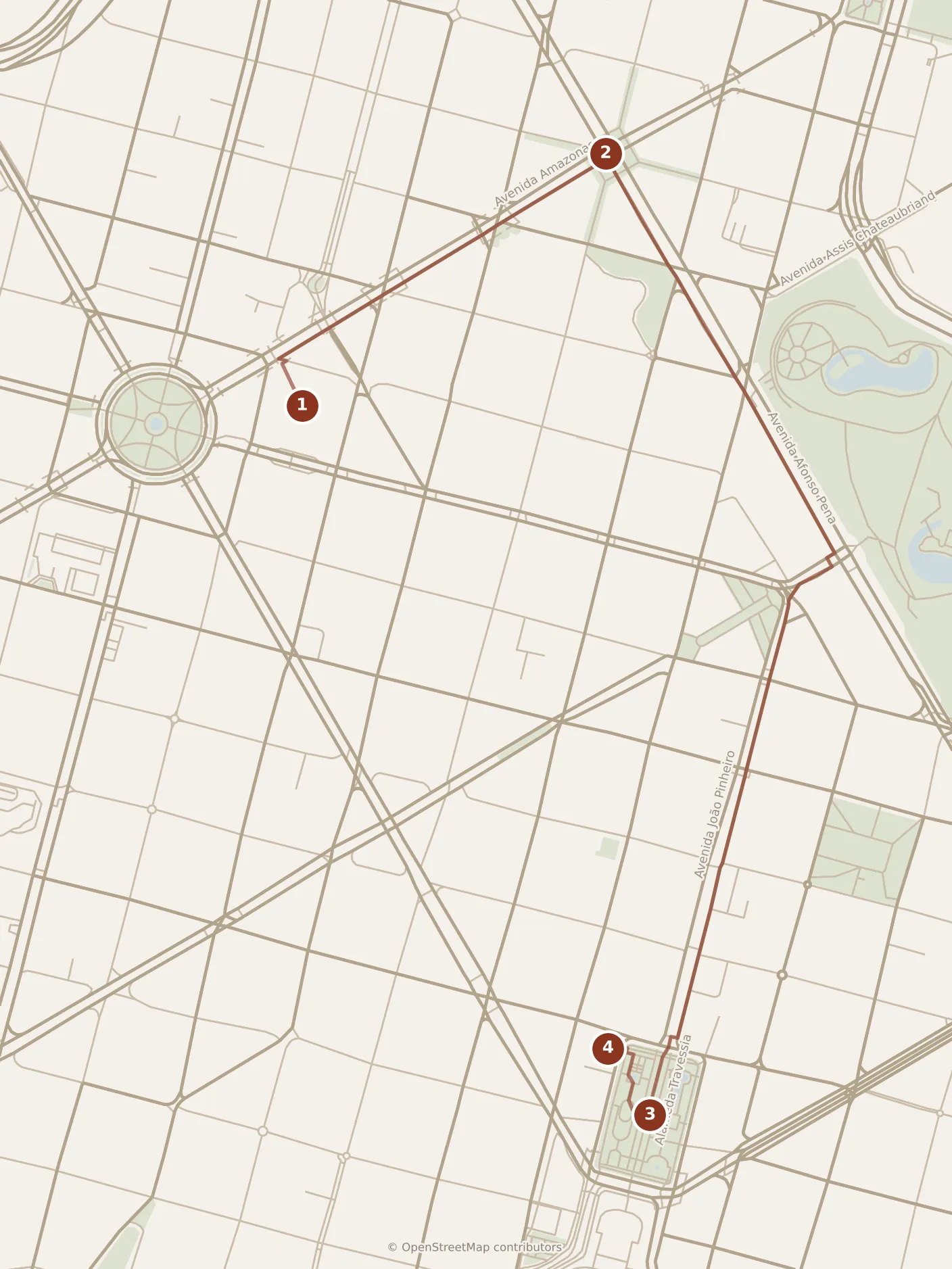
- Morning
- 1Mercado Central
- 2Praça Sete de Setembro
- 3Praça da Liberdade
- 4Memorial Minas Gerais Vale
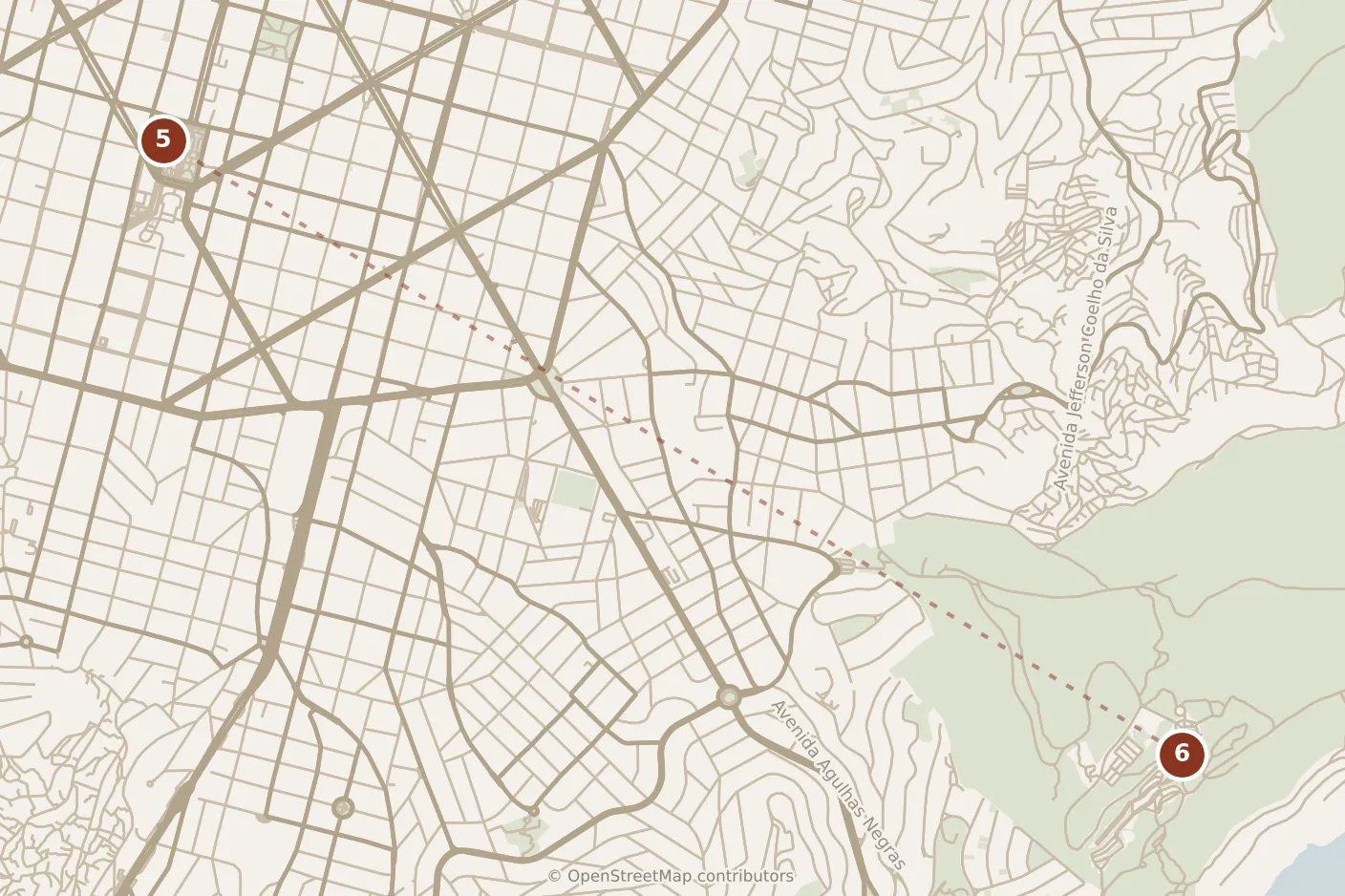
- Afternoon
- 5MM Gerdau
- 6Parque das Mangabeiras
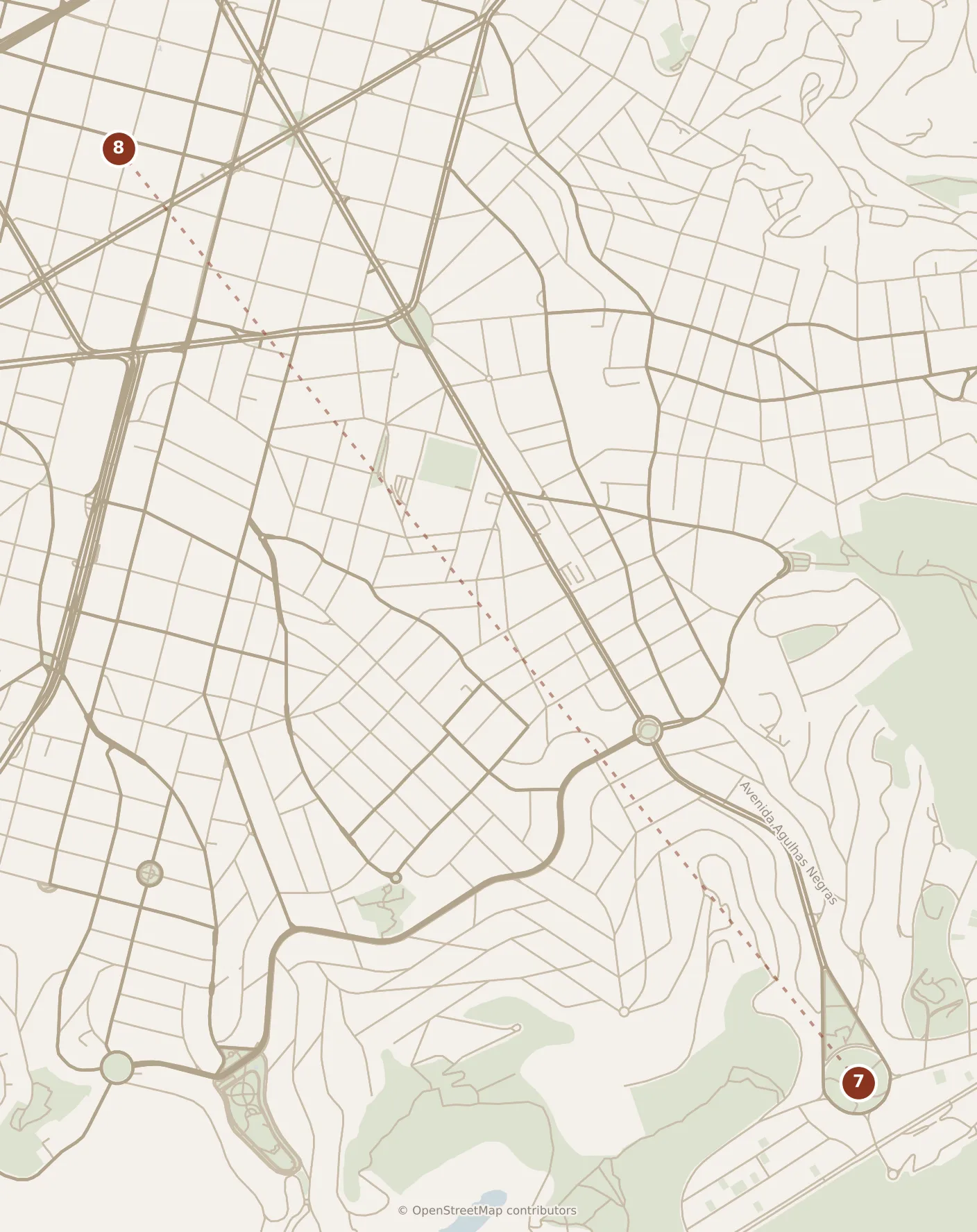
- Evening
- 7Praça do Papa
- 8Savassi
The day runs north-east for twelve minutes and then south and steadily uphill, out of the flattest and busiest part of the grid and onto the ridge the city is named after. You never walk back down a street you have already walked. Only one hour is load-bearing and it belongs to the first stop; only one stop has a gate, and it is arranged so that the gate does not matter.
Morning
The Mercado Central opened at eight in 2026, seven days a week, and the whole day counts forward from that. If the hour has moved, build the morning from the new one and nothing below changes. Be there for it. Several hundred stalls under one roof are a different building in the first hour: pallets are still coming through the doors, the counters are feeding people on their way to work rather than visitors on their way to lunch, and you can hear yourself think. Breakfast is pão de queijo and coffee taken standing at a counter, and it costs almost nothing.
Then walk the aisles, which is what an hour and a quarter buys and forty minutes does not. The stock is sorted by no principle anybody has explained: cheese and doce de leite, then a corridor of cachaça, then knives, then seed and songbirds, then religious articles, then a row of herbs and roots where the stallholder will ask you what is wrong before selling you anything. Buying cheese to carry home is a real reason to be here rather than a souvenir gesture. This is also why the day runs in this direction rather than the one a single day forces on you: a market seen at opening does not care that it shuts at one o’clock on a Sunday or a public holiday, and a market seen at lunchtime cares a great deal.
A dozen minutes’ walk north-east along Avenida Amazonas puts you in Praça Sete de Setembro, under the obelisk that gives the place its nickname — the Pirulito, the lollipop. Give it fifteen minutes, and give them for a reason that is not the obelisk: this is where Avenida Amazonas meets Avenida Afonso Pena, two of the great diagonals driven across a grid of numbered streets set at an angle beneath them, and standing in the middle of it is the quickest way to understand a city that otherwise makes no sense underfoot. It is a crossroads and not a monument, and knowing that is exactly its use.
Now the walk a single day cannot afford. Go south-east down Avenida Afonso Pena as far as the corner of the Parque Municipal — day two’s ground, so keep going — and then up Avenida João Pinheiro, which climbs straight into Praça da Liberdade. A little under half an hour, uphill throughout, and worth doing on legs that have had one market and nothing else.
Give the square half an hour before going into anything. This was the seat of the state government for a century, and it still looks it: the palace closing the top of it, the old ministries facing each other down the flanks, ranks of palms between them, and on one side the long white curve of the Edifício Niemeyer, from the 1950s, which is apartments and always has been, so the sidewalk is as close as anyone gets. The state left in 2010 for a purpose-built complex out on the northern edge of the city, and the ministries were handed over to museums — a dozen or so of them, collected under the name Circuito Liberdade, which is several more than one afternoon holds. Two of them are today’s work. Take the Memorial Minas Gerais Vale first: it is the state’s account of itself, it fills one of the old palaces, and an hour and a half is the right amount to give it.
Afternoon
Next door is MM Gerdau, the mines and metal museum, and this is the one that explains why any of the rest is here. The state’s name means the general mines; the ore under these hills is why a capital had to be invented for it in the first place, and it is still what pays. An hour and a quarter. Taking both museums is the whole argument for a second day: one tells you what this state says about itself and the other tells you what it was built on, and they do not agree nearly as neatly as you would expect. Neither charges: both are free to walk into, as most of the Circuito Liberdade is, so two museums in one afternoon costs nothing but the afternoon.
Local tip. If the day is running short, the second museum on this square is what goes, not the park on the ridge. Both museums are indoors, both keep the same sort of hours, and either can be taken on your other day. The light off the ridge happens once, at an hour you cannot move, and it is the one thing on these two days you cannot get anywhere else in the city.
Lunch takes an hour and belongs in the streets running west off the square into Lourdes. Make it a proper mineiro one: feijão tropeiro is the thing to look for on the board, beans cooked down with cassava flour and pork, and portions here are built for sharing whether or not you meant to share.
Then the first ride — and every ride on these two days is a ride-hail car, not a rental car: four kilometers south-east and up, a quarter of an hour in ordinary traffic, to Parque das Mangabeiras on the flank of the Serra do Curral. This is the ridge itself — woodland, running water, and paths out to viewpoints over the basin the city fills. Give it an hour and a quarter and spend it walking rather than sitting. It is also the only stop on these two days with a gate, and a park gate is exactly the kind of hour that moves and takes a day off in the week besides, so check it before you set out. The order is built so that the answer barely matters: the park comes first, and what follows it has no gate at all.
Evening
Walk down out of the park to Praça do Papa while the light is still on the hill: twenty-five minutes, downhill, which is the right direction to be going on foot at that hour. The lawn is wide, unfenced and tilted, it takes its name from the open-air mass a pope said on it, and the grid is spread out beneath you and away to the north-west, with the ridge running off on either side. A single day arrives here with forty minutes and a camera. Two days means you can sit on the grass and watch the light change across the towers, which is the entire difference between the two visits.
It is open ground on a slope and it is known for bag-snatching, which is a fact about this particular hillside rather than a general caution about Brazilian cities: take the photograph, put the phone away, and leave by car rather than strolling off down the hill in the dark. That is the same hillside you walked down an hour earlier, and what changed is the light and not the place — which is why the descent from the park is timed before the sun goes, and the departure afterwards is not on foot at all.
Dinner is a little over three kilometers north-west, a short ride, in Savassi. The going-out quarter works by sidewalk — chairs and tables put out on the street, botecos rather than dining rooms, cold beer, and small plates arriving one at a time for as long as you stay. It is loud from Thursday onwards, and that is the point of it rather than a drawback.
Day two

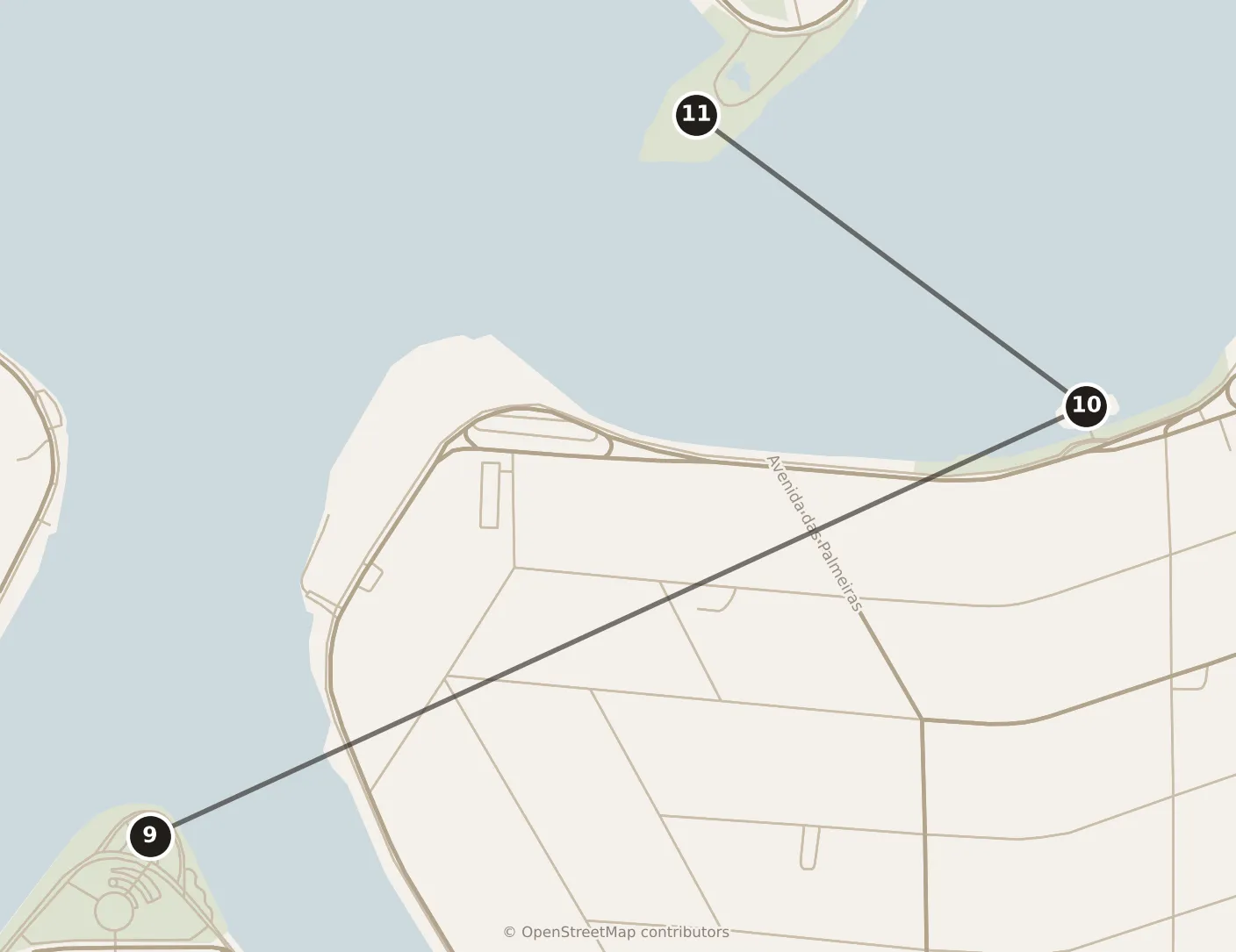
- Morning
- 9Igreja de São Francisco de Assis
- 10Casa do Baile
- 11Museu de Arte da Pampulha
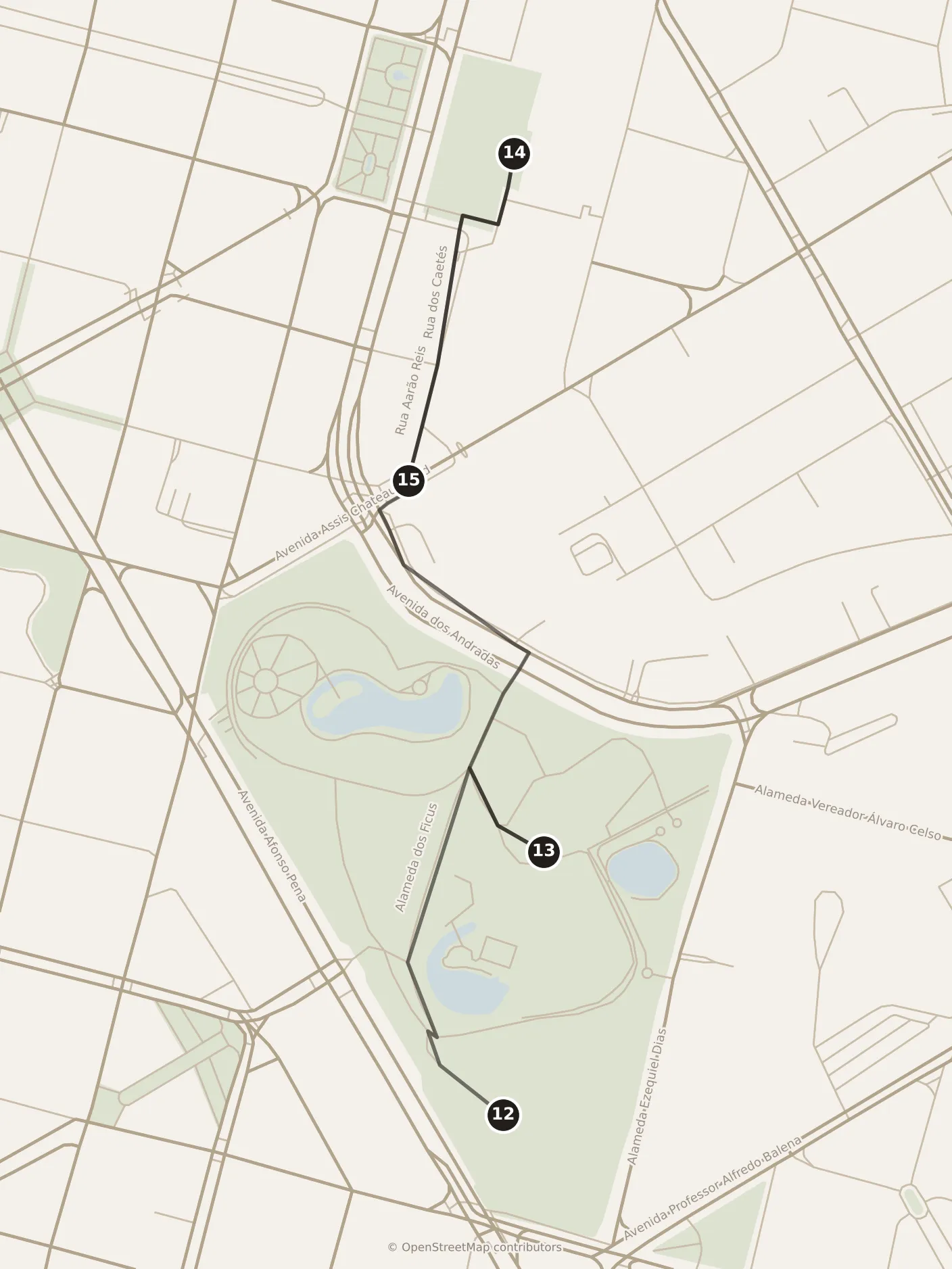
- Afternoon
- 12Palácio das Artes
- 13Parque Municipal Américo Renné Giannetti
- 14Museu de Artes e Ofícios
- 15Viaduto Santa Tereza
Today is the other half of the city and the one with road in it. It goes north first, comes back down through the middle, and ends east of the center in a bairro it never has to leave again. Nothing today rests on an hour, so the reason to start early is traffic rather than light: be moving before nine and Pampulha ends at lunch rather than in the afternoon. From the ride out to the far end of the viaduct it comes to about eight hours, the same as yesterday, and an hour of that is road — half of it going up, half of it coming back.
Morning
The lake is eight kilometers north, about half an hour by car along Avenida Antônio Carlos. The MOVE bus corridor runs the length of that same avenue and is the cheap way to do it; a car is the simple way, and either way this is the leg on the whole trip most likely to run over.
Start at the Igreja de São Francisco de Assis and give it an hour. Juscelino Kubitschek ordered it as mayor from a young Oscar Niemeyer, along with three more buildings set around the same piece of made water, and the same man later handed him Brasília to build. The archdiocese thought the result indecent, refused to consecrate it, and left it finished and unusable until 1959. Spend at least half your hour outside. Cândido Portinari’s tiles are on the exterior, more tilework by Paulo Werneck is on the buildings around the water, Roberto Burle Marx laid out the planting, and the four concrete vaults only read as a single gesture from some way back — so walk the whole way round it, ten minutes, which is precisely the ten minutes a one-day visit sacrifices. The Stations of the Cross inside are Portinari’s too, all fourteen of them. And this is a parish church before it is a monument: mass times decide what you can see and when, walking about during a service is not on, and like everything else here it takes one day off a week.
Half an hour along the shore of the Lagoa da Pampulha — it looks near enough to wave at across the water, and the path goes round the bay, which is the whole reason it takes that long — stands Casa do Baile, a low round pavilion on a small made island joined to the bank by a short bridge, its flat canopy wandering out over the terrace on a line borrowed from the water’s edge rather than from the building underneath. Since 2002 it has been the city’s reference center for architecture, urbanism and design, which in practice is one hall of changing exhibitions and a small auditorium. Half an hour, and the walk to it is half the reason to come.
A little over half an hour further round — the longest walk on these two days, and the ride back to the center starts from it — is the Museu de Arte da Pampulha, the first of the four to be built and, until 1946, the casino: travertine and glass, and the flattest and most rectilinear of the group — the one that shows what Niemeyer was starting from before the curves. Gambling was banned across Brazil in 1946 and the casino closed with it; the building became the city’s art museum in 1957, and the collection runs to some sixteen hundred works with the Minas modernist Guignard at the center of it. Do not plan on going in. It has been shut since 2019, the restoration had still not begun work by 2026, and the city’s own schedule does not have it reopening before 2028 — so the door is closed rather than uncertain. Give the outside twenty minutes and let the hour a museum would have taken go back to the church and the shore. The four buildings went onto the UNESCO list as a single entry in 2016; the fourth of them is a private club, and looking at it from the path is all anybody does. The stadium on the same water, the Mineirão, is not one of the four and this morning does not go to it.
Afternoon
Back down to the center, another half hour, and lunch there — an hour, somewhere ordinary and cheap, because the afternoon is long.
Begin it at Palácio das Artes, on Avenida Afonso Pena at the southern edge of the Parque Municipal. Its ground-floor galleries are walk-in and the program turns over constantly, which makes this a forty-five-minute stop that is either very good or nothing at all, and you find that out at the door rather than in advance. Five minutes north takes you into the Parque Municipal Américo Renné Giannetti, planned at the same time as the streets around it and never built over: water, big trees, and the only stretch of the grid where the temperature drops. Half an hour, walked end to end.
Fourteen minutes north again is the Museu de Artes e Ofícios, and of every interior on these two days this is the one to protect. It opened in 2005 inside the historic buildings of the old central railway terminus on Praça Rui Barbosa — the square everybody calls Praça da Estação — and it was built around a private donation of more than two thousand objects from the eighteenth century onwards: the tools of the trades, and the trades themselves, across nine thousand square meters. Every other museum on this trip is about who governed or what was dug out of the ground. This one is about how things were made, and it is the only one where the building and the collection are the same subject, because the trains and the metro still run out of it. An hour.
Then seven minutes to the Viaduto Santa Tereza, which lifts the street over the rail yards and is the city’s own emblem in a way that none of its monuments are. Cross it on foot rather than riding over it: twenty minutes end to end and into the bairro on the far side, and the view down into the cut is the whole reason the thing is famous.
Evening
Santa Tereza is low, old and in no hurry to be rebuilt — small houses, gardens, corner bars with plastic chairs on the sidewalk, and the neighborhood the Clube da Esquina musicians came out of. Savassi is one of several quarters this city goes out in; this one is a place people live in, though they also cross the city for these corner bars, so do not arrive thinking you have found something nobody else has. The gap between the two evenings is still most of what there is to learn about how this city drinks. Frango com quiabo — chicken stewed with okra — is the plate to have here, mineiro cooking at its plainest and best.
If the twenty-minute walk across the viaduct is not what you want at that hour, the metro does the same journey: two stops east on Linha 1 from Estação Central, through Estação Santa Efigênia, to Estação Santa Tereza. Going home afterwards is a car and not a walk. The center between here and the southern districts empties completely once dinner is over.
With a third day

The third day goes to Inhotim, and it does not go at the end. The calendar decides where it lands, which is the one genuinely awkward thing about it.
Inhotim is a contemporary art park at Brumadinho, sixty kilometers west: a hundred and forty hectares of botanical garden with something like two dozen pavilions dropped through it, most built for the single work they hold, open to the public since 2006. It is not a museum you see. You choose a route through it, you walk a long way, and you accept that you will miss things — which is a better day than that sounds, and unlike anything in the city.
In 2026 it admitted from half past nine, Wednesday to Sunday and on public holidays, and it shut at half past four midweek and half past five on weekends and on holidays. In January and July it opened on Tuesdays as well. On Mondays it does not open at all. That is why this day is inserted rather than appended: it takes whichever of your three days falls between Wednesday and Sunday, and the two city days take what is left. They are independent of each other and either can come first, but they are not quite interchangeable: two days of the week act on them, and the Practicalities below say what a Monday and a Sunday each do.
Tickets are sold through Sympla, the park’s own online box office, and at the window in the Recepção if you simply turn up. A full-day adult ticket was in the sixty-to-seventy-real band in 2026, roughly half that on the concession, and the park’s own app took ten per cent off. Admission is free every Wednesday and on the last Sunday of the month — and a free day is precisely the one to secure in advance rather than arrive hopefully for.
Settle one more thing when you buy. A hundred and forty hectares is more than you will walk in a day, and electric carts run fixed routes through the park; they were around forty-five reais a head in 2026, bought with the ticket through the same channel or through Belvitur, the park’s official agency. Decide before you go, because deciding at the gate means waiting in line at the gate.
Getting there is the part the park does not do for you, and it is the one paragraph here worth reading twice. Coaches leave from the Terminal Rodoviário Governador Israel Pinheiro. One operator, Saritur, runs the service that goes to the park’s own gate, and it is a single run out in the morning and a single run back, timed to the park’s own hours — so the coach decides the length of your day, and there is no later one if you misjudge it. Book that seat when you book the ticket, and write both times down while you are doing it. Other coaches to Brumadinho run more often and put you down in the town, which is a taxi at each end; if you take one of those, settle at the counter which it is, because it is a much easier question to settle in Belo Horizonte than in Brumadinho.
Local tip. Wednesday is free every week and shuts an hour earlier; a Saturday, or any Sunday except the last of the month, costs the ticket and hands that hour back. If the far pavilions are what you want, take the weekend. If you would rather keep the money, take the Wednesday and walk to the far end of the park first, working back — then the galleries you run out of time for are the ones beside the entrance, which are also the ones you can take in ten minutes on the way out.
The alternative, if baroque rather than contemporary is what brought you to Minas, is Ouro Preto: a colonial mining town a hundred kilometers south-east, coaches from the same terminal, a couple of hours of road in each direction. Take it instead of Inhotim, not as well — appending it makes a four-day trip. But be honest about what a day buys there. Four hours on the road leaves five or six on the ground in a town that is almost vertical, cobbled throughout, and at its best early and late, which are exactly the two ends of the day a return trip spends in a coach. Ouro Preto rewards a night. Inhotim does not need one, and that is the real reason it is the third day here.
Practicalities
Two bookings, and only if you take the third day: the Inhotim ticket, through Sympla or at the park, plus the cart if you want it, and the seat on the coach out. A few days ahead is enough in an ordinary week; go earlier for a free Wednesday or a last Sunday. Everything across the two city days is walk-up.
Two days of the week act on this trip, and they act differently. Sunday reshapes the ground: from early morning until about two, Avenida Afonso Pena between Praça Sete de Setembro and Avenida Carandaí is not a street but the Feira Hippie, a kilometer of open-air craft market with something like fifteen hundred stalls in it. That is exactly the stretch day one walks down, and day two’s afternoon starts on it too, at Palácio das Artes — though not until about two, which is when the fair ends. It blocks neither — the avenue is given over to it, so you walk through a market rather than along a sidewalk — and it is one of the larger things this city does, so a city day that falls on a Sunday should be day one, with more time given to the walk down Afonso Pena than day one otherwise allows it. If a Sunday and a Monday are both among your city days, that rule and the Monday one below cannot both hold — Monday has to be the day without doors, which leaves the Sunday carrying every interior on the trip. That is a real collision and not an oversight, and what gives way is the fair: an interiors day opens at Pampulha, eight kilometers north, and is not back in the center until about two, which is when the stalls come down. So the Sunday takes day two’s shape and not day one’s, and what you get of the Feira Hippie is the end of it rather than the morning of it — worth the ten minutes it costs on the way through, and not the thing the rule above sends you for.
Monday is the other, and Monday is closures. As a rule the interiors here take Monday off: the two museums on Praça da Liberdade, the galleries at Palácio das Artes, the museum in the old terminus, and the buildings at the lake — and at the lake, check the church and Casa do Baile as two separate questions, because they do not take the same day; the art museum’s door is shut whatever day you go. Check the park on the ridge while you are at it. If a Monday cannot be avoided, give it a day built only from things with no doors, in this order: the Mercado Central, which opens every day of the week, from opening; Praça Sete de Setembro; the walk up Avenida João Pinheiro; Praça da Liberdade from the sidewalk, for the palms, the palace front and the Edifício Niemeyer; then the ride up to Parque das Mangabeiras if its own gate is open, or straight to Praça do Papa if it is not, for the light; then Savassi. That is day one with its two museums removed, and it still works, because day one was never mostly indoors. It is also two and three-quarter hours shorter than day one, and the surplus is best spent where the list already puts it: longer in the aisles, and longer at the park on the ridge, which is a better place to have a spare hour than the lawn below it. Starting late instead is possible — the market keeps going until six from Monday to Saturday, so the building is still there at eleven — but the first hour is not, and that hour is why the market is the first stop on either day. Count forward to the light exactly as before.
What a Monday actually costs is on the other city day, and it is worth naming rather than discovering at four in the afternoon. That day then has to hold Pampulha in the morning, a nine-kilometer ride down to Praça da Liberdade, both museums on the square, the museum in the old terminus and Santa Tereza in the evening: close to nine hours before dinner, with three transfers inside it, which is more than most people will actually do. If something has to give, the second museum on the square goes first, exactly as on day one — that is an hour and a quarter back on the same day, and it protects the terminus museum, which is the one interior here you cannot get anything like anywhere else. A Monday among three days costs you a museum however you arrange it; it need not cost you that one.
The trap is a Monday-to-Wednesday trip. It leaves exactly one slot for the day out, the Wednesday, and exactly one day for every interior, the Tuesday, so the Monday has to be the doorless day whether or not you like it. If your dates are yours to choose, start on a Thursday and none of this arises.
Getting to the first stop: day one begins at the Mercado Central, and from Savassi, Lourdes or Funcionários, where most visitors sleep, that is a ten-minute ride or a little over half an hour on foot, downhill the whole way. The walk is worth doing once. Whatever brings you in from Confins, the international airport, arrive the night before — this day starts at eight and there is no version of it that starts at noon.
Paying for the rides: this route touches the public network exactly once, for those two stops on Linha 1, and since 2023 the metro has taken contactless bank cards, phones and QR codes directly, so nothing else is needed for it. The city’s rechargeable card is the Cartão BHBUS and it is for buses, MOVE included, and a two-day visitor has no need to go and get hold of one: the same operator’s BHBUS+ app sells a single fare as a QR code on the phone, and the readers on the buses and at the MOVE stations take it. That covers the only bus these two days offer you, the run out to the lake on day two. Everything else here is ride-hail, which in this city means Uber and the Brazilian app 99, both cheap and everywhere. Four rides across the two days, plus whatever takes you home at night, is the whole transport bill.
The bag is not the daily problem it is on a single day here, because you have a room. It decides one thing and it decides it firmly: the day out is not the last day. Inhotim is sixty kilometers west and the airport is thirty-odd kilometers north, with the whole width of the city between them, and the park is a hundred and forty hectares crossed on foot — there is no version of that day you do holding a case. If a flight forces it to be last, you are going back to the room for the bag and then out across the city again, and at that point the honest answer is to give the third day to the city and see Inhotim on a trip with room for it. If you are between coaches rather than between hotels, the Terminal Rodoviário Governador Israel Pinheiro has a left-luggage office inside it, on the third floor and again beside the arrivals area; the terminal stands at the top of the center, a twenty-minute walk from where day one starts.
On foot the numbers are modest. Day one comes to a little over an hour of walking in three stretches, the longest being the climb from Praça Sete de Setembro up to Praça da Liberdade, just under half an hour. Day two comes to a little under two hours in six, and the two long ones are both at the lake: half an hour of shore between the church and Casa do Baile, and a little over half an hour on from there to the art museum. The twenty across the viaduct into Santa Tereza is the third. Walking is not what varies here. The rides are, and the worst of them is the one up to the ridge on the afternoon of day one.


.jpg)

.jpg)