Belo Horizonte in one day: Niemeyer's lake, the market, and the city at dusk

Last updated 4 August 2026
Overview
Belo Horizonte does not reward a wanderer. It was drawn on paper in the 1890s, built to the drawing, and then grew a very long way past it, so the three things worth a single day are strung along a north–south line some eighteen kilometers end to end by road rather than gathered into an old town. There is no version of this day that walks between them. What there is, and what this page is for, is an order that keeps the rides short and puts each place at the hour it is best.
That order comes from the map rather than from taste. Pampulha, where Oscar Niemeyer’s first major works stand around an artificial lake, is eight kilometers north of the center — and it lies between the international airport and the city, so a reader who lands in the morning passes it on the way in. The center is in the middle. Praça do Papa, on the slope at the southern edge, is where the whole city lies below you. North, middle, south: take them in that order and you never turn round, and the day contains four rides instead of six.
What one day costs you here is the interiors and the excursions. This is the best base in Brazil for what surrounds it — Inhotim, the art park out to the west; Ouro Preto and the baroque mining towns south of it — and each of those is a whole day, not a morning. Spend your one day on any of them and you will not have seen this city at all. That is a defensible choice. It is simply not this article.
The day ends on a lawn watching the light come off the city, so it is built backwards from the sun. Sunset here runs from just before half past five at the start of June to about twenty to seven in the middle of January — a swing of a little over an hour, with the short evenings in June, which catches out anyone whose instincts were formed north of the equator. Everything below comes to roughly seven hours of looking, walking and riding, and the lawn at the end wants the last hour of the light rather than the last minute of it — so take your month’s sunset hour, take an hour off it for the lawn, and count the seven back from there. That total measures the time you spend inside the places and on the road at an ordinary hour; it does not measure Avenida Antônio Carlos at a bad one, which is the single thing on this route that can quietly cost you forty minutes.
The other thing the sun does not settle is the season. The rains here run from the end of October to the end of March, and December is the wettest of those months, with rain falling on about three weeks of its days. That changes nothing about the order — the market is covered and the Praça da Liberdade museums are indoors — but the hill at the end is the one stop with no roof and nothing to go into, so on a wet evening take a second museum on the square instead and let the view go.
The day

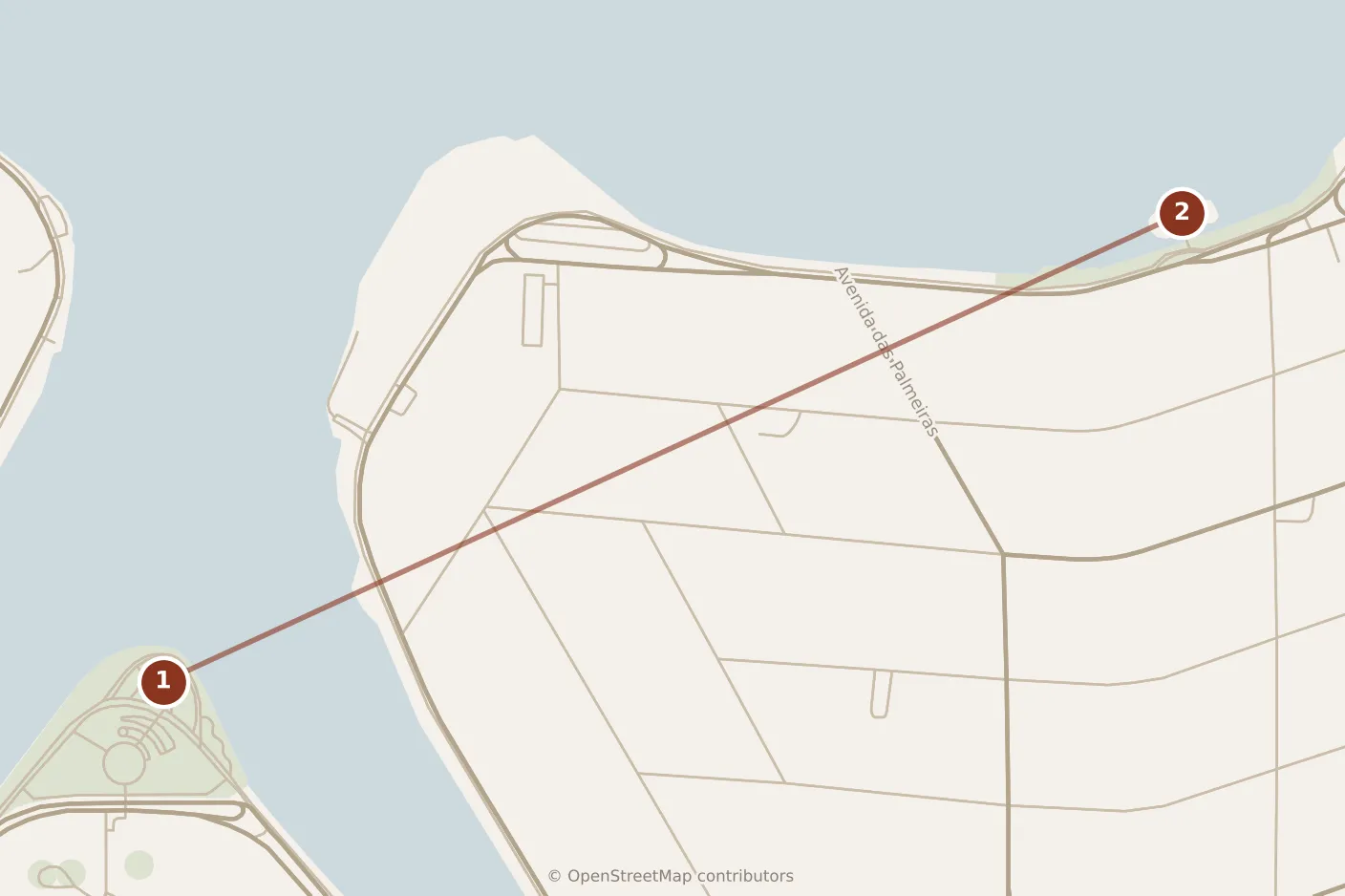
- Morning
- 1Igreja de São Francisco de Assis
- 2Casa do Baile
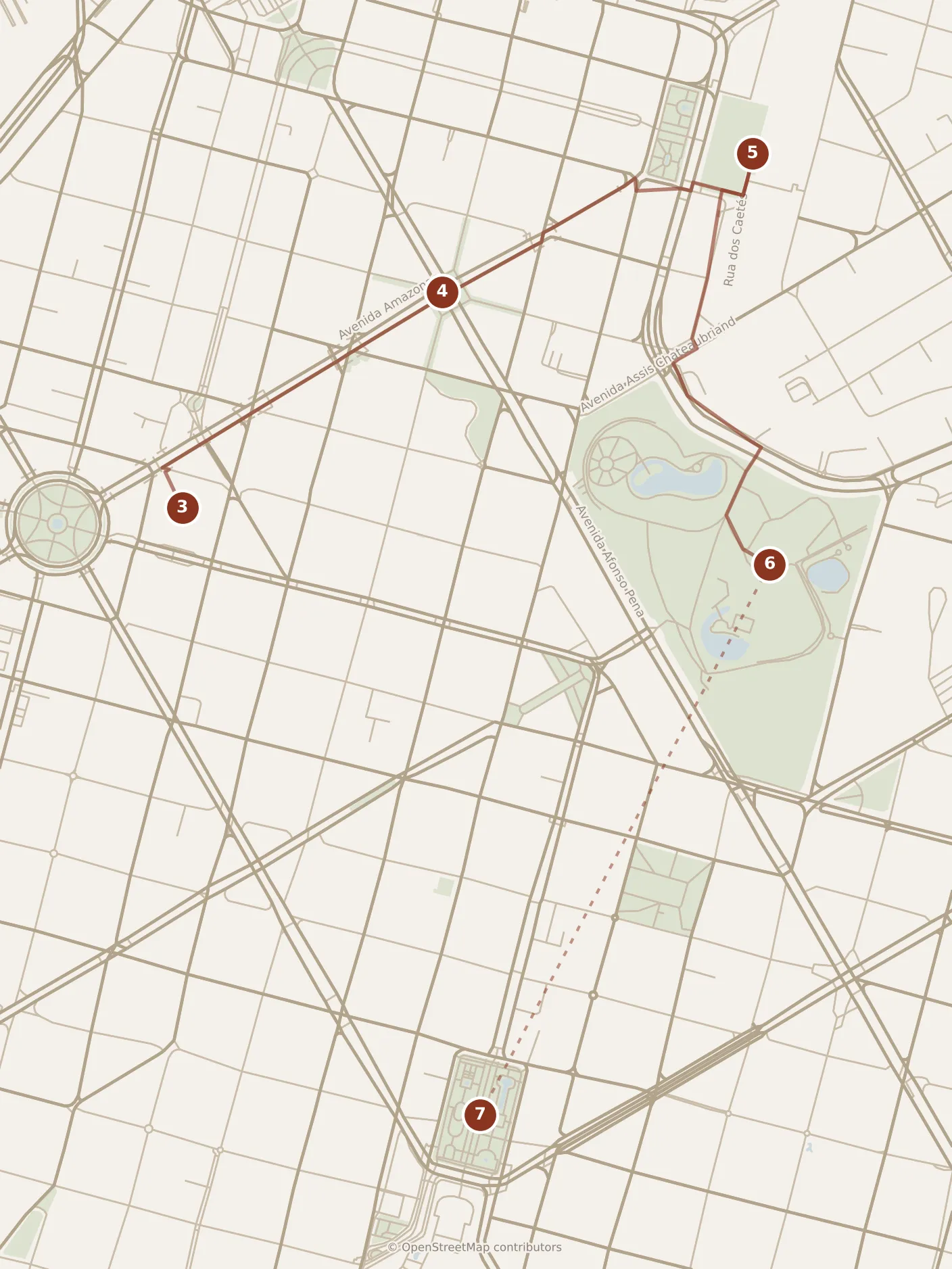
- Afternoon
- 3Mercado Central
- 4Praça Sete de Setembro
- 5Museu de Artes e Ofícios
- 6Parque Municipal Américo Renné Giannetti
- 7Praça da Liberdade
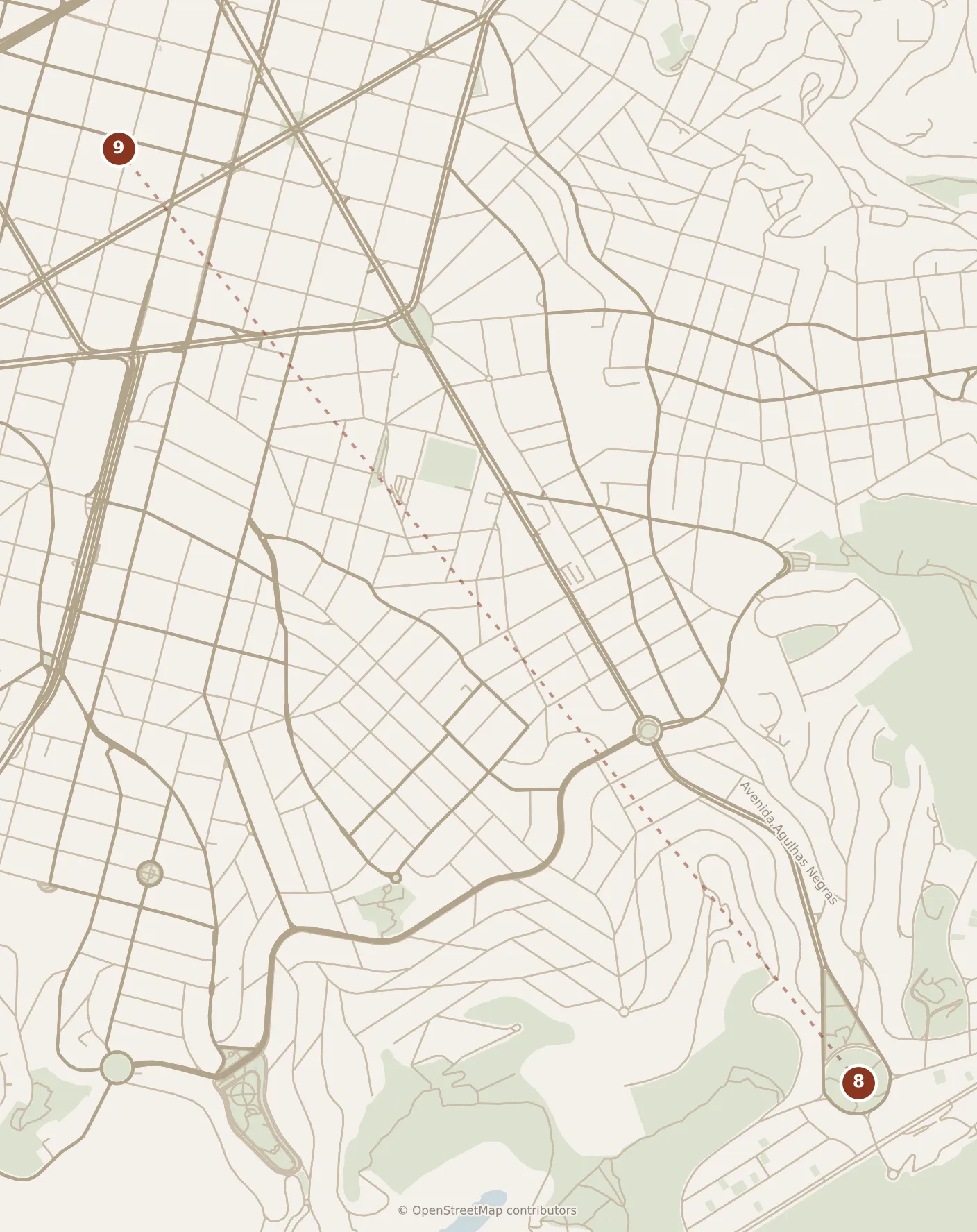
- Evening
- 8Praça do Papa
- 9Savassi
Morning
Start at the lake. The Igreja de São Francisco de Assis is four parabolic concrete vaults laid side by side, and in 1943 nothing of the kind had been built for a church anywhere: the archdiocese refused to consecrate it, and it stood finished and unusable for sixteen years. Oscar Niemeyer designed it, with three other buildings around the same water, for the mayor who went on to commission Brasília from him. There is tilework by Cândido Portinari and by Paulo Werneck on the outside walls and gardens by Roberto Burle Marx around it; inside are Portinari’s fourteen Stations of the Cross and a bronze by Alfredo Ceschiatti. It is a small building with no route through it — you stand still and look — so give it an hour and spend a good part of that hour walking round the outside, because the tiles are out there and the shape only reads whole from some distance back. It is a working church before it is a monument: it shuts one day a week, and the sanctuary publishes its own mass times, which are what a visit has to fit around. UNESCO listed the four buildings together in 2016.
Then twenty minutes north-east along the shore to Casa do Baile, a dance pavilion built on its own scrap of island, whose flat concrete canopy curves to follow the outline of the island rather than the outline of the building underneath it. It is the least famous of the four and the one that shows most plainly what Niemeyer was doing with a slab of concrete and no right angles. Twenty minutes is enough; it is small, and the walk to it along the water is half the point. The remaining two of the four — a private club and a municipal art museum — stand further round the same lake, and a single day is the wrong trip on which to discover whether a museum’s doors are open.
Local tip. If you are landing in the morning, take the lake before you reach the city rather than after. Pampulha sits between the airport and the center, so on the way in it is a detour of minutes; from the center later it is an hour of road and two fares. The order on this page is simply the cheap order, and it is worth arranging your arrival around it.
From Casa do Baile back into town is eight kilometers in a straight line and rather more by road, down Avenida Antônio Carlos. Reckon on half an hour, and treat it as the leg most likely to run over.
Afternoon
Lunch at the Mercado Central, and this is the stop to give real time to. It is a covered market of more than four hundred stalls, and the reason to eat there rather than merely shop there is the counters: you perch, and you eat feijão tropeiro or pão de queijo standing among people on their break. Then walk the aisles, which hold one of the odder inventories in the country — queijo minas and doce de leite in one row, several hundred labels of cachaça in the next, live birds and pet food after that. An hour and a half, lunch included.
The market is also the one hour this day rests on. In 2026 it shut at one o’clock on Sundays and public holidays, and at the end of the working day the rest of the week. That is what fixes the order above: on an ordinary day it is still open when this route arrives in the early afternoon, and on a Sunday it is not — so a Sunday reverses the day, market first from opening, lake afterwards. The market publishes its own hours on its website, and that is the page to trust: if you find a different one posted there, the method survives it — put the market on whichever side of the day it is open and the lake on the other.
A Sunday brings one more thing, and it is a reason to be downtown rather than an obstacle. The Feira Hippie, a street market of art and craft stalls, fills Avenida Afonso Pena south of Praça Sete de Setembro through the morning and into the early afternoon — exactly the stretch of sidewalk this route walks in the center. The avenue is shut to traffic for most of the day, so on a Sunday the walking is easier and a ride along it is not.
Twelve minutes east brings you to Praça Sete de Setembro, where Avenida Afonso Pena crosses Avenida Amazonas. The obelisk in the middle is universally called the Pirulito, the lollipop, and this crossroads is what people mean by downtown. Five minutes: it is a junction rather than a sight, and you are passing through it on the way to somewhere better.
Another twelve minutes on is Praça da Estação. The old railway station on it now holds the Museu de Artes e Ofícios, a museum of Brazilian trades and the tools they were done with, and if you take one interior in this whole day, take this one — it is about how things were made, where every other museum on the route is about who governed. Forty minutes for the museum, a quarter of an hour for the square, which is the city’s civic ground: the street carnival forms here and demonstrations end here, and the Viaduto Santa Tereza carries the road over the valley beside it. The metro’s Central station is on the square.
A quarter of an hour south is the Parque Municipal Américo Renné Giannetti, laid out with the city itself and still the main green space inside the grid: ponds, heavy old trees, and shade, which by mid-afternoon is the reason to be in it. It is a crossing rather than a destination — walk it end to end and you have had it.
A kilometer and a half south-west of the park, uphill the whole way, is Praça da Liberdade, from which the state governed itself for a century: the palace at the head of it, the old ministries down both sides, avenues of palms between them. Take that stretch as a ride: it is five minutes in a car and a twenty-minute climb on foot at the end of an afternoon already spent walking. In 2010 the government moved out to a new complex on the edge of the city, and the ministries became museums — a dozen of them, which is more than an afternoon holds. Take exactly one. The Memorial Minas Gerais Vale is the state telling its own story; MM Gerdau, the Museu das Minas e do Metal, is about mining and metal, which is what the state’s name means and the reason it exists at all. The curved white apartment block on one side of the square is the Edifício Niemeyer, from the 1950s, and you look at it from the sidewalk, because people live in it. An hour and a quarter for the square and one museum between them.
Evening
A ride of under four kilometers south-east takes you to Praça do Papa, and this is the stop the whole day was arranged around. It is a wide lawn on the slope below the Serra do Curral, named for the papal mass held on it, and the city lies below and to the north-west — the grid, the towers, the ridge running away on either side. Arrive with the last hour of light still in hand; the count at the top of this page is what puts you here in time to do that, and there is nothing to go into and nothing to wait in line for. It is an open lawn on a hillside and it has a record of street robbery — enough that the phone comes out for the photograph and goes back in the pocket after it.
Then dinner. Savassi is a little over three kilometers back north, a short ride, and it is where the city eats and drinks: sidewalk tables around Praça Diogo de Vasconcelos, bars rather than restaurants, beer and small plates rather than courses. Order frango com quiabo if you have never had it. If you are flying out that night this costs you nothing, because Savassi is north of the hill and therefore already on the way.
If you are catching a coach instead, the long-distance terminal is two and a half kilometers north of Savassi again — a few minutes by car, and not a walk to make after dark.
Practicalities
Nothing on this route has to be booked before you travel, which is unusual enough to be worth saying plainly. What it does need is a means of paying for four rides — the lake to the center, the park up to Praça da Liberdade, the square to the hill, the hill to dinner. Three of them are kilometers too long to walk; the fourth is short and uphill, and it is the one you will be tempted to walk and should not. How the city’s transport is paid for is in the city guide this page hangs off, and it is worth two minutes before you set out.
Closures are the thing to check, and they come in two kinds. The church and the museums keep museum hours and take a day or two off in the week; the market, the squares and the park do not. Check the church first, because it is the one stop here with no substitute — and if it is shut, the tilework is on the outside and the water is in front of it, so the morning survives at half strength rather than collapsing. If the Praça da Liberdade museums are shut, the square, the palms and the palace front cost nothing and are most of what you came for.
Two days rearrange the plan, and the worse of the two is not the one this page first named. Monday is the day to avoid outright: the church is shut, Casa do Baile is shut on Monday and Tuesday both, and the Museu de Artes e Ofícios — the interior this page recommends above the rest — is shut on a Monday as well, so the morning loses half its point and the afternoon loses its museum. Sunday reverses the day rather than ruining it: the market keeps half a day, so put it first and the lake after, as described above. What the reversal costs is exactly what the order at the top of this page was buying — you go north out of the center and south again for the hill, so the day crosses the whole eighteen kilometers instead of working down it, and two of its rides are the length of the city rather than one. It is still the better Sunday: there is no order that keeps both the market and the straight line. The Museu de Artes e Ofícios is shut on a Sunday too, so on that day the afternoon’s two museums come down to the one on Praça da Liberdade.
If you are between coaches, the terminal is the Terminal Rodoviário Governador Israel Pinheiro, at the northern edge of the center and about twenty minutes on foot from the Mercado Central. That is the only point at which this route goes near it, and the route does not reach it until the early afternoon. The terminal has a left-luggage office, in two places inside the building — the third floor and the arrivals area — and its own services page says both are staffed around the clock, so the case does not have to come with you. Leave it before you set off north: the Pampulha morning is a kilometer and a bit of open lakeshore with a long ride at each end, and the evening finishes several kilometers to the south-east, so those are the two halves you cannot do with a case in your hand. There is also a metro station across the road from the terminal, and the line it is on reaches Praça da Estação — the one leg of this whole day the metro covers.
If both counters are full, there is still a real day here, and it is the center on foot. Start at the Mercado Central and give it the hour and a half it is worth; twelve minutes east to Praça Sete de Setembro, five minutes there; twelve minutes more to Praça da Estação, where the museum and the square take the best part of an hour between them; then a quarter of an hour south into the park, and walk it end to end. All of it sits within half an hour’s walk of the terminal, it comes to something over three hours with lunch, and it leaves the lake and the hill as the reason to come back.
The longest single walk on this itinerary is the twenty minutes of lakeshore in Pampulha, and after it nothing on foot runs past a quarter of an hour. The whole afternoon in the center comes to a little under forty minutes of walking, over three legs of roughly equal length. It is the rides that are the variable here, not the legs.


.jpg)
