Barcelona in two or three days: the buried city under El Born, the Gaudí grid, and a third day on Montjuïc

Last updated 8 August 2026
Overview
Almost everything in Barcelona that repays real attention is behind a door with a ticket on it, and most of those doors want between an hour and three. That single fact is what a second day buys here. It does not buy more ground — the old city is twenty minutes across and the grid above it is a metro hop — it buys the inside of things: four thousand square meters of Roman street under a courtyard, a concert hall lit entirely by its own glass, the excavated lanes of a quarter the army pulled down in 1714, and a basilica you can stand still in rather than file through.
So these two days deliberately walk past the old-city spine that a single day here uses. There is no market, no Rambla and no cathedral below; those make a good line through the city on foot and they are not what an extra day is for. The basilica is the one thing the two routes share, and a second day changes what it is: not the last stop of a long walk but an hour and a quarter you arrive at down the avenue it was aimed along. What is here instead is one continuous argument on day one — the Roman city, the medieval port quarter, the streets destroyed after the siege, and the park built on the fortress that destroyed them — and on day two the four buildings the nineteenth and twentieth centuries put on the slope above, three of which you go inside.
Day one is walked from its first stop to its last. Day two is three metro legs and a downhill avenue. A third day adds the hill on the far side of the city, which the first two never touch, and it goes on the end rather than in the middle.
Three things want booking before you travel: the timed entry to the basilica on day two, the timed entry to the park above it, and the guided hour at the concert hall that opens day one, which wants a late-morning slot rather than an early one. In 2026 the basilica was in the twenty-five to thirty-euro range, the guided hour at the concert hall a little over twenty, and the park a little under twenty. Buy Casa Milà’s slot the night before as well, and the Picasso museum’s with it, because that museum’s closing hour is one of the two day one’s afternoon is built back from. Casa Milà at close to thirty euros in 2026 is the one ticket here you can decide against on the sidewalk without losing the building. The third day adds nothing at all to that list: everything on the hill is walk-up. How the metro is paid for, and everything else true of the city rather than of this route, is in the city guide.
Monday decides the order. Five stops here close one day a week and it is Monday for all five: the museum and the two archaeological sites on day one, and both collections on the third day. Day two closes nothing — the basilica, the park, the hospital and the house on the avenue open every day. So if any of your dates is a Monday, day two goes on it, and the other two days take the remaining dates in either order. Where the weekday leaves you free, day one goes first, because it is the day written from the station.
A Sunday breaks nothing here, which is worth saying because in most cities it breaks something. Day one’s one working church is an afternoon stop, so the morning services never collide with it; the national museum on the hill shut in the early afternoon on Sundays in 2026 rather than in the evening, and the third day already puts it first. The only real consequence is that a Sunday third day has no slack in it at all, so start it at opening rather than counting back from the light.
And the eleventh of September is the Catalan national day, which falls precisely on day one’s ground: the memorial beside the church and the market building over the excavation are where the city commemorates the fall of 1714, the whole quarter is given over to it, and the municipal museums keep holiday hours. If your dates include it, move day one and go quietly, on the day’s own terms rather than as a sight. Any public holiday overrides the Monday rule, and the institutions publish their own closing calendars — read them the week you buy the tickets, not as a separate errand later.
Only the third day makes you count backwards from the light yourself, and the band is worth having in advance. The sun goes down here between just after twenty past five in the first days of December and half past nine at the end of June. Take your month’s hour, and the third day’s own section says how far back to count from it.
On the bag: this article assumes you are sleeping in the city, so it is a problem on the first morning and the last evening only. Sants has a left-luggage office and day one begins a good four kilometers from it, so be rid of the case before the day starts rather than in the middle of it. At the other end, the third day begins two stops from Sants on line 3 and finishes four stops from it, which is why it belongs last if you are leaving by train. If a Monday pushes it out of last place, the day that lands there is day two, and its evening begins on top of Verdaguer station, four stops from Sants on line 5 without a change — but it ends twenty minutes’ walk south of that station, so on a departure evening walk the boulevard down and back, or skip it and take line 5 from where you came up.
Day one

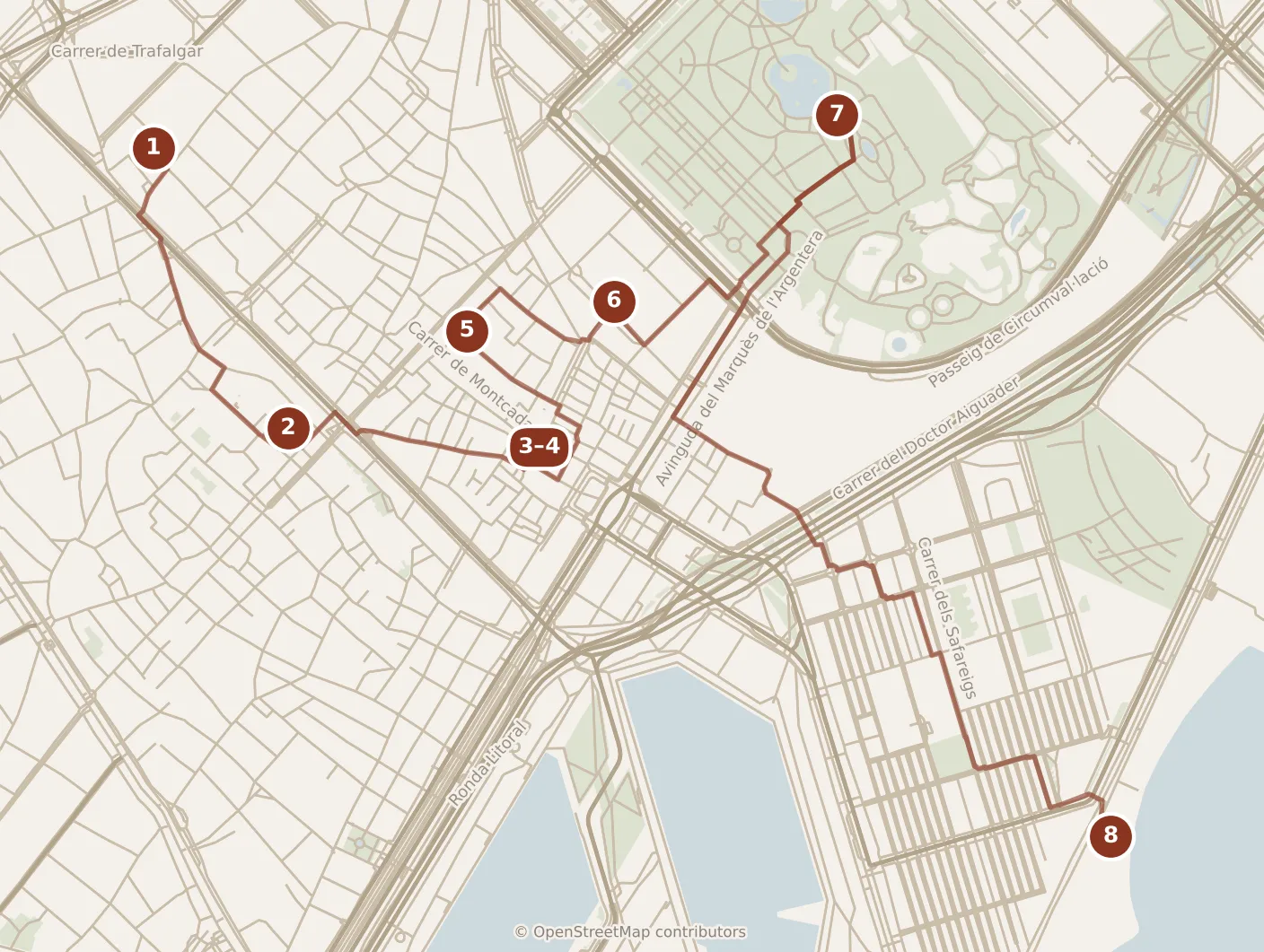
- Day one
- 1Palau de la Música Catalana
- 2Museu d'Història de Barcelona
- 3Santa Maria del Mar
- 4Fossar de les Moreres
- 5Museu Picasso
- 6El Born Centre de Cultura i Memòria
- 7Parc de la Ciutadella
- 8Platja de la Barceloneta
Everything today until the walk out to the sand happens within a few minutes of Via Laietana, in about half a square kilometer, and it goes one way: downhill and eastward, from the edge of the old city to the sand. After the concert hall that opens it, which is the day’s one anachronism, it also runs forwards in time — Roman, medieval, 1714, 1888. There is one booked slot in the morning and two things in the afternoon that shut; the rest is yours to move. Book the concert hall for eleven rather than at opening: an earlier slot finishes the morning two hours before the city will give you lunch, and the day never catches that up.
Morning
First, the leg nobody writes down. From Sants Estació take line 3 seven stops to Catalunya, then line 1 one stop to Urquinaona, and the Palau de la Música Catalana is under five minutes from that exit; walking from Catalunya instead takes about twelve. From the airport the Aerobús reaches Plaça de Catalunya in the region of thirty-five minutes and joins that same walk, or the Rodalies train from the far terminal puts you at Passeig de Gràcia, from where line 4 is one stop to Urquinaona. Half an hour from Sants; nearer an hour from the airport.
Give the Palau de la Música Catalana an hour, and take the guided visit rather than the cheaper self-guided one: the building is unreadable without its story, and nothing in the room tells it. The Orfeó Català, a choral society founded in 1891 to put Catalan singing back in public, built itself a concert hall between 1905 and 1908, and Lluís Domènech i Montaner gave it the only auditorium in Europe lit through the whole day by daylight alone. The ceiling is an inverted dome of stained glass by Antoni Rigalt, gold at the center and blue around it, hanging into the room. Behind the stage stand eighteen women, each with a different instrument: their upper halves were carved by Eusebi Arnau and their lower halves are flat mosaic by Lluís Bru, so they emerge out of the wall rather than stand in front of it. The proscenium is two arguments in stone by Dídac Masana and Pablo Gargallo — Catalan folk song at one end of the arch, Beethoven and a ride of Valkyries at the other — and the building is telling you which side it is on. If you would rather hear the room than tour it, a concert ticket puts you in the hall; only the visit gets you the staircase and the foyer, which are half the building.
Under ten minutes south on foot brings you to Plaça del Rei and the entrance to the Museu d’Història de Barcelona, which is the reason day one exists. Give it an hour and a half, and almost all of that underground. Below the square lie over four thousand square meters of Roman Barcino, excavated in the 1930s and walked through at street level on raised walkways: a laundry with its treading vats, a dyer’s, a factory that salted fish and made fish sauce, and a winery with the sunken jars still in the floor, with shopfronts and a stretch of the wall and its towers around them. It is not a room of objects. It is a quarter of a working town with the fourth century on top of the first, and you come up inside the medieval palace of the counts — the Saló del Tinell, one enormous hall on round arches, and the chapel of Santa Àgata with a fifteenth-century altarpiece by Jaume Huguet in it. Nothing else in the city puts eleven hundred years in one vertical line like this.
If this is your first morning in Barcelona and you have never been inside the cathedral, its cloister is two minutes from this square and costs ten more; the day as written does not go, and does not need to.
Afternoon
Lunch first, in the lanes between here and El Born, and give it an hour — the afternoon below is built on the assumption that you did. This is the right day for esqueixada — a summer salad that wants real tomatoes, so a warm-month order rather than a January one — since the salt cod that goes into it is the thing the Roman fish-salting floor you have just walked over was doing, on this ground, two thousand years earlier.
Six or seven minutes east stands Santa Maria del Mar, and even if you have already seen it, half an hour here is not wasted. It is a working parish church and it closes to visitors during services, which is the reason it sits in the afternoon of this day rather than in the morning: Sunday mornings are the hours it belongs to its parish, and the day as written is nowhere near it then. What day one wants from it is not the nave but the sunken square against its flank. The Fossar de les Moreres is a burial ground, the defenders of the city were put into it after the siege of 1714, and a flame stands over it permanently. It is a national memorial rather than a sight, and on the eleventh of September it is the center of the country’s commemoration. Read the ground and keep your voice down; nobody will stop you, and that is rather the point.
Three minutes north, on Carrer de Montcada, the Museu Picasso occupies five medieval merchants’ palaces knocked into one another, and two hours is the right length. What makes it unlike any other Picasso collection is that it is almost entirely the beginning: the boy who learned to paint in this city, in the academic manner, better than his teachers. Science and Charity and The First Communion are here, both painted before he was seventeen and both entirely conventional, which is the joke the rest of the museum then unwinds. The Blue Period rooms are deep because those years were Barcelona years. And at the far end, out of chronological nowhere, sits the complete set of fifty-eight canvases he made in 1957 taking Las Meninas apart over and over, which he gave to this museum and to no other. After 1917 there is very little here, and that is not a gap — it is the collection’s argument.
This is the one hour the day rests on. In 2026 the museum shut at seven from the end of September to the end of March, and an hour or two later through the summer. That is why it sits here and not later: it wants two hours, and it is not the only stop today that can lock you out — the market hall after it shuts at seven from November to February, with last entry half an hour before that, and the free look over the excavation goes when the doors do. So in those months it is the market hall’s last entry that bites first, not the museum’s closing time. Build the afternoon back from whichever of the two comes earlier, and if either hour has moved, build it back from the new one — the rule is the ticketed rooms before the park and the beach, not the clock.
Local tip. If the afternoon is short, do not drop this museum, shorten it: the early rooms and the fifty-eight canvases at the far end are the two halves that exist nowhere else, and everything between them is the part another large collection could show you. That is an hour instead of two, and it costs you nothing the museum is here for.
Four minutes on, the Mercat del Born is a cast-iron and glass market hall designed by Antoni Rovira i Trias in 1873 and finished in 1878, and it has no market in it. In 2002, digging for a library, they found the streets underneath, and what they found was the reason there is a hole in the middle of El Born: after the city fell in 1714, over a thousand houses of La Ribera were demolished to clear a field of fire for the fortress, and the rubble sealed the ground floors, the wells, the drains and the gutters exactly where they were. The library was canceled. The hall reopened on the eleventh of September 2013 as El Born Centre de Cultura i Memòria, with the whole excavation lying open under the ironwork and walkways over it. Three quarters of an hour, and the excavation itself can be looked at without a ticket while the hall is open, which is worth knowing on a tight day: it is the exhibitions around it that are sold.
Evening
The park gate is three minutes from the market’s door, and the Parc de la Ciutadella is the last third of the same story. This is the ground the fortress stood on: Philip V’s citadel, built after 1714 with the demolished houses at its feet, and so loathed for a century and a half that in 1869 General Prim handed what was left of it to the city to pull down. What went up instead was a park for the Universal Exposition of 1888, laid out by Josep Fontserè — and the exposition is still standing in it. The Cascada is a monumental waterfall staircase at the north end, with a lake below it, which a very young Antoni Gaudí is said to have worked on as a student assistant; the claim is repeated everywhere and is not firmly documented, so take it as folklore with a good address. On the north side stands the Castell dels Tres Dragons, a brick-and-iron pavilion by the same Domènech i Montaner whose concert hall opened this day — built as a restaurant for the exposition, never quite finished, and later the zoology museum. The Umbracle beside it is a shed of wooden slats built to grow plants in shade and is one of the coolest places in the city in August. The Parliament of Catalonia sits in the citadel’s old arsenal, the one building of the fortress that survived. Half an hour to cross it, longer if you sit down. The park keeps park hours and shuts earlier in winter than in summer; if you arrive to locked gates, Passeig de Picasso runs outside the railings for the same distance and loses you nothing but the trees.
Out of the far corner it is a little over ten minutes to the Platja de la Barceloneta, and this is where the day stops being about the past. The sand is made ground, laid out for 1992, and the point of coming now rather than at midday is that the heat has gone and it has stopped being a beach. Eat one street back from the front rather than at the terraces on the sand. Fideuà is what this stretch is for, it is made to order in a flat pan and takes as long as it takes, so order it before anything else. Finish with crema catalana and walk back along the front.
Two practical things about this last hour, both specific to arriving here at the end of a day rather than the beginning. Everything you have been carrying since the morning is still with you on a beach after dark, and the city guide is not exaggerating about the theft; keep it on you and not on the sand. And one thing to carry forward, whichever date day two lands on: the basilica publishes a dress code and enforces it at the door — no swimwear, no see-through clothes, and skirts and trousers to mid-thigh at least — so whatever you wear to the sea is not the question, but what you put on for the basilica is, and people are turned away.
The stops and the walking above come to about eight hours as written, half an hour less if lunch is a plate at a counter. That is the time spent inside things and moving between them and nothing else: it does not include the line at the ticket desk of the museum, it does not include the cathedral aside if you take it, and it does not include the meal at the end, which is an hour and a half from sitting down.
Day two

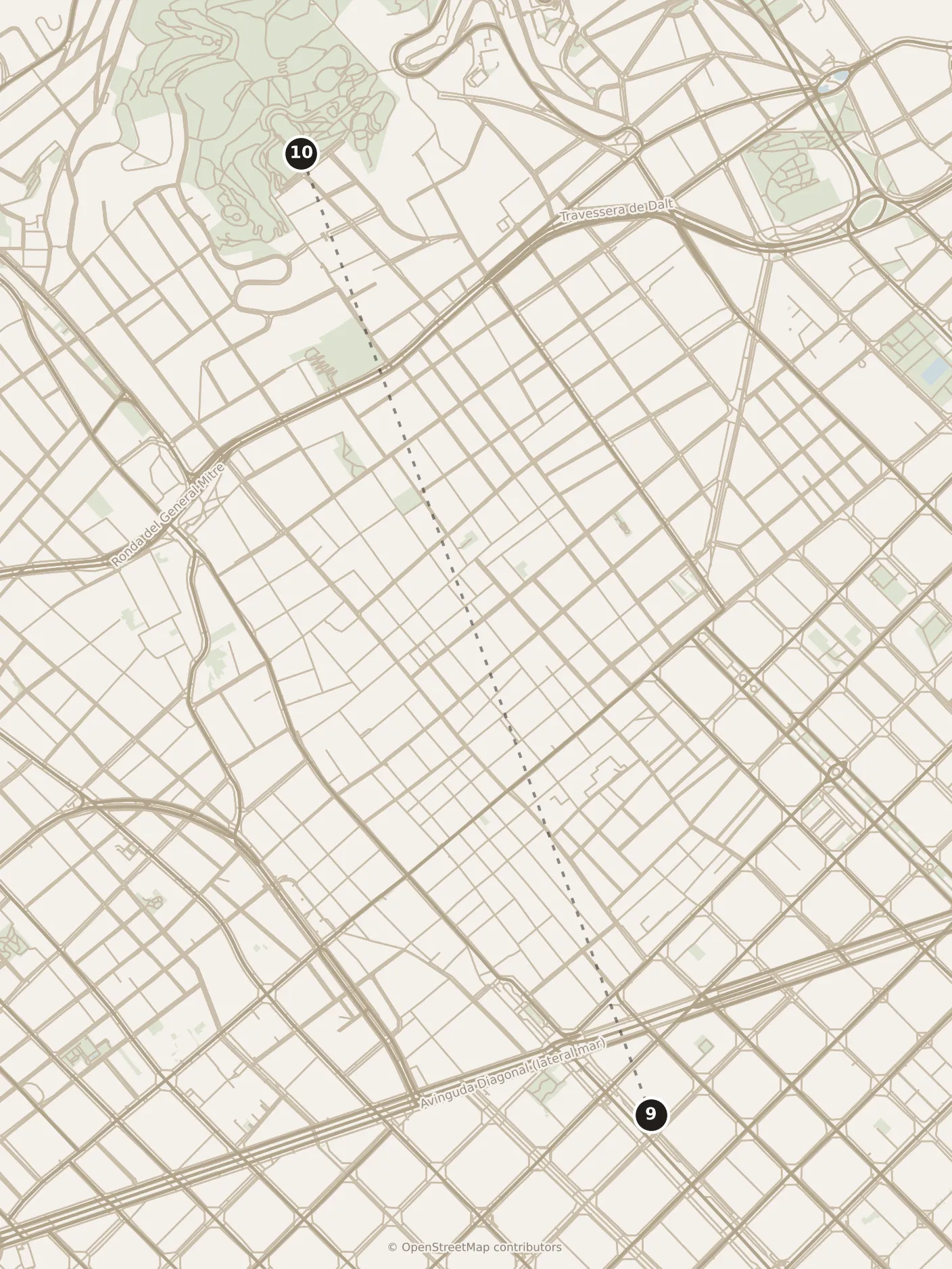
- Morning
- 9Casa Milà
- 10Park Güell
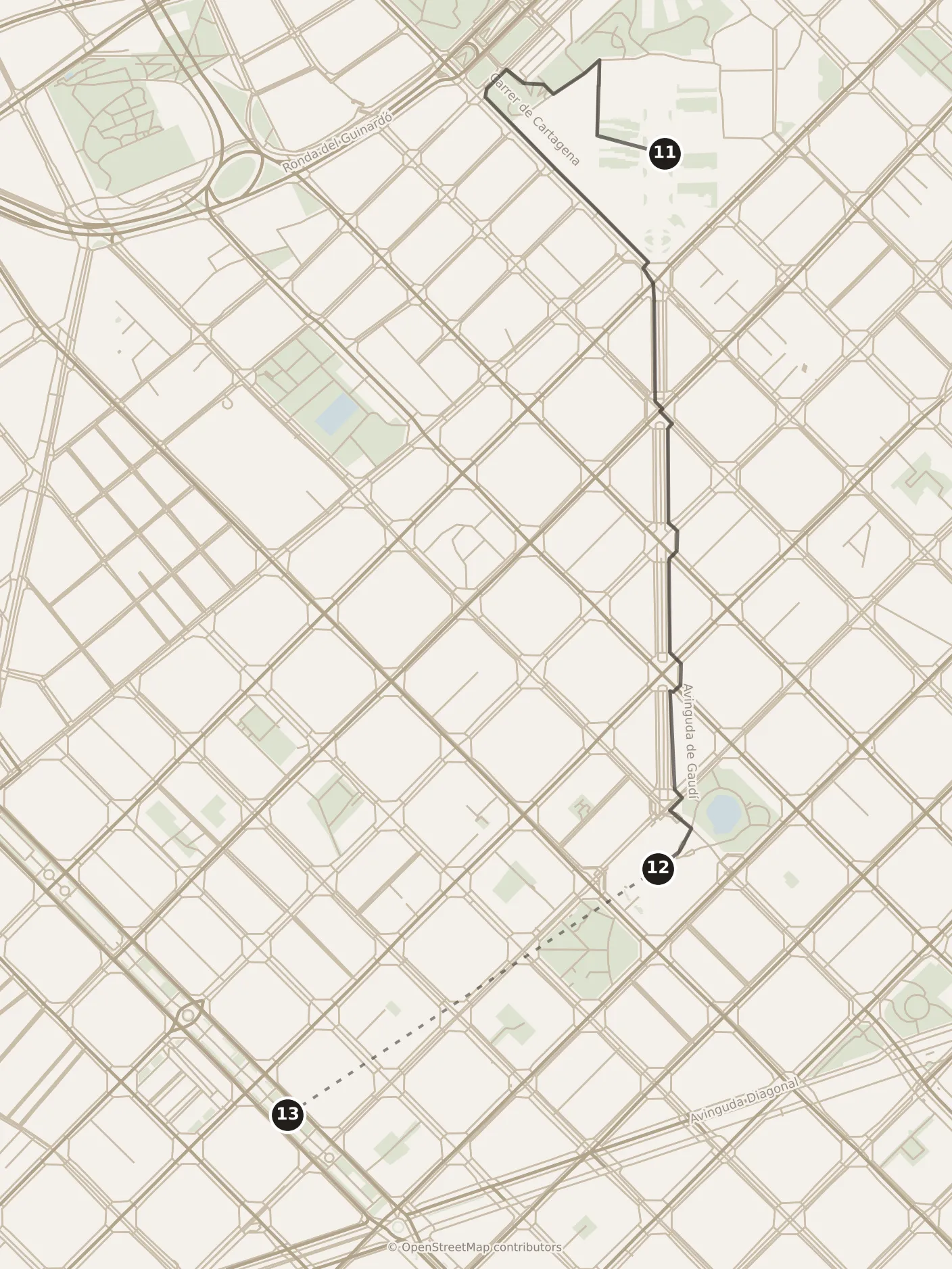
- Afternoon and evening
- 11Hospital de Sant Pau
- 12Sagrada Família
- 13Passeig de Sant Joan
Today is four buildings on the slope above the old city, three of them entered, and it climbs once and then descends: the avenue, then the hill, then the hospital at the top of the grid, then the basilica below it. Three of the four sell timed entry; the first is at opening, and only the other two pin the day: the park’s slot in the late morning and the basilica’s in the middle of the afternoon, with everything else fitted around those two pegs. Nothing today closes for a weekday, which is why this is the day a Monday goes on.
Morning
Start at Casa Milà on Passeig de Gràcia at opening, which in 2026 was nine, and give it an hour and a quarter. From the street it is a cliff of cut stone bending round a corner with wrought seaweed on the balconies, and the street is free; what the ticket buys is the two things nobody outside can see. One is the attic directly under the roof, a long low tunnel of nearly three hundred brick arches, each one the shape a chain makes when you hang it and turn it upside down, so the whole floor is held up by a form Gaudí worked out with string and weights rather than with arithmetic. The other is the roof itself, a landscape of chimneys and stair-heads modeled as helmeted figures standing about in the open. There is also a restored apartment on one of the middle floors, furnished as a family of 1912 would have had it, which is the only place on either of these days where you see what all this ambition was actually like to live in. If the day is short, this is the ticket to give up: the front of the building is the famous half and it costs nothing to stand opposite it for ten minutes, and the day then starts at the park with nothing lost but an hour and a quarter.
Now the first ride. Diagonal station is at the top of the block; take line 3 three stops to Vallcarca, and from there the outdoor escalators up the Baixada de la Glòria climb most of the slope for you, leaving about ten minutes on foot to the western gates of Park Güell. Lesseps, one stop earlier, works too and is a longer walk up. Reckon on forty minutes door to door either way.
Give Park Güell an hour and a half. It was not built as a park. Eusebi Güell bought a bare hill called Muntanya Pelada in 1900 and commissioned Gaudí to lay out sixty triangular plots for a gated estate on the English garden-city model; between then and 1914 the roads, the terrace, the gatehouses and the water system were all built and exactly two houses were sold, neither of them designed by Gaudí, and the project failed because it was too far out of town for the people it was aimed at. The city bought it and opened it as a park in 1926, so everything you walk on is infrastructure for a suburb that never happened. The Sala Hipòstila is the market hall of that suburb: eighty-six columns holding up the terrace above, with the ceiling between them tiled in broken crockery. The terrace on its roof is the serpentine bench, a single wave of seating that runs the whole way round, surfaced by Josep Maria Jujol in smashed tile and bottle glass — and the shape of it is social rather than decorative, because the curves make pockets that put people facing each other. Underneath the roads, the viaducts are carried on leaning stone piers that look like a colonnade collapsing in slow motion and are in fact doing exactly what they should. The ticketed zone is small and the free park around it is large; the ticket is for the terrace, the hall and the gatehouses, and that is what you have come for.
Afternoon
The second ride, and it is deliberately clumsy. Walk back down to Lesseps or Vallcarca, take line 3 to Diagonal, change to line 5 and ride to Sant Pau, the station named after the hospital — which means passing under the basilica’s own station and coming back to it on foot. That is the point. Forty minutes door to door.
Lunch goes here, on the avenue below the hospital gates, and it is an hour. Then give the Hospital de Sant Pau an hour and a quarter. This is the other half of the World Heritage listing the concert hall belongs to, by the same architect, and it is the larger and stranger half: Lluís Domènech i Montaner planned forty-eight buildings and twenty-seven went up between 1901 and 1930, twelve of them the great pavilions, each a separate brick-and-tile hall standing in its own garden. The idea was medical rather than ornamental — separate the diseases, give every ward its own air, light and trees — and the pavilions are joined underneath by a network of tunnels so that patients and supplies never crossed the gardens. It worked as a hospital until June 2009, when the new one opened behind it, and reopened restored in 2014. Walk the tunnels, then come up into one of the restored wards and look at the tiled vaulting over a room built for people who were ill. Nothing else in this city was this beautiful and this useful at once.
Then walk. Avinguda de Gaudí runs a kilometer diagonally downhill from the hospital’s gates to the basilica, cut on purpose so that one is in view from the other, and it is a quarter of an hour at a stroll with the towers growing in front of you the whole way. This is the single best approach to the Sagrada Família and it is the reason for the awkward ride above.
Take a mid-afternoon slot. Twenty minutes outside first, on the older front, the one begun in Gaudí’s own lifetime and finished a decade after it, between 1893 and 1936: three porches for hope, faith and charity, a stone cypress over the middle one crawling with doves, and at the foot of the columns two tortoises — one of the land and one of the sea — put there as time that does not move, with chameleons at the edges of the facade as the thing that does. Then an hour and a quarter inside. The columns branch as they rise, so the roof is carried the way a wood carries its canopy, and the windows were designed as one object across the whole building, cool at the end the sun rises over and warm at the end it sets over — which is why the afternoon is the slot to take, and why standing still in the middle for ten minutes is worth more than a second lap.
The building has also just changed. The central tower, the Tower of Jesus Christ, topped out structurally on 20 February 2026 at 172.5 meters, which makes this the tallest church in the world, and it was blessed on 10 June 2026, the centenary of Gaudí’s death; the interior of it is not expected before 2028. Gaudí’s own rule was that the tower should stop just short of the hill of Montjuïc, on the principle that nothing built should out-top what was not — the two figures usually quoted for the hill do not quite agree with each other, so take that as the intention rather than as arithmetic. If you are taking a third day, you will be standing on that hill on it. The basilica’s rules of entry are published and enforced at the door: no swimwear, nothing see-through, mid-thigh at least, no bare feet, and hats off in the nave. Since February 2026 the first hour of each day inside has been kept silent, which is worth knowing if you ever swap to a morning slot.
The day comes to a little over eight hours with that lunch and just over seven without it, counting the stops, the two rides inside it and the walking; the evening below sits on top of that. What it does not count is the security line at the basilica, which exists whatever your ticket says and is the largest thing left out of the figure, and it does not count the climb from the metro up to the park’s gates, which is ten minutes of real ascent.
Evening
One stop on line 5 from the basilica to Verdaguer, and you come up in the middle of Passeig de Sant Joan; walking the same distance west takes about a quarter of an hour. Turn downhill and walk south. The boulevard was rebuilt from 2011 as a linear park — the roadway narrowed, the sidewalks widened to something like a promenade — and the stretch between here and the Arc de Triomf at the bottom is where the Eixample actually eats and drinks, at a scale the avenue you started the day on has entirely lost. It is a twenty-minute walk end to end and there is nothing to see, which after four buildings is the correct amount.
With a third day

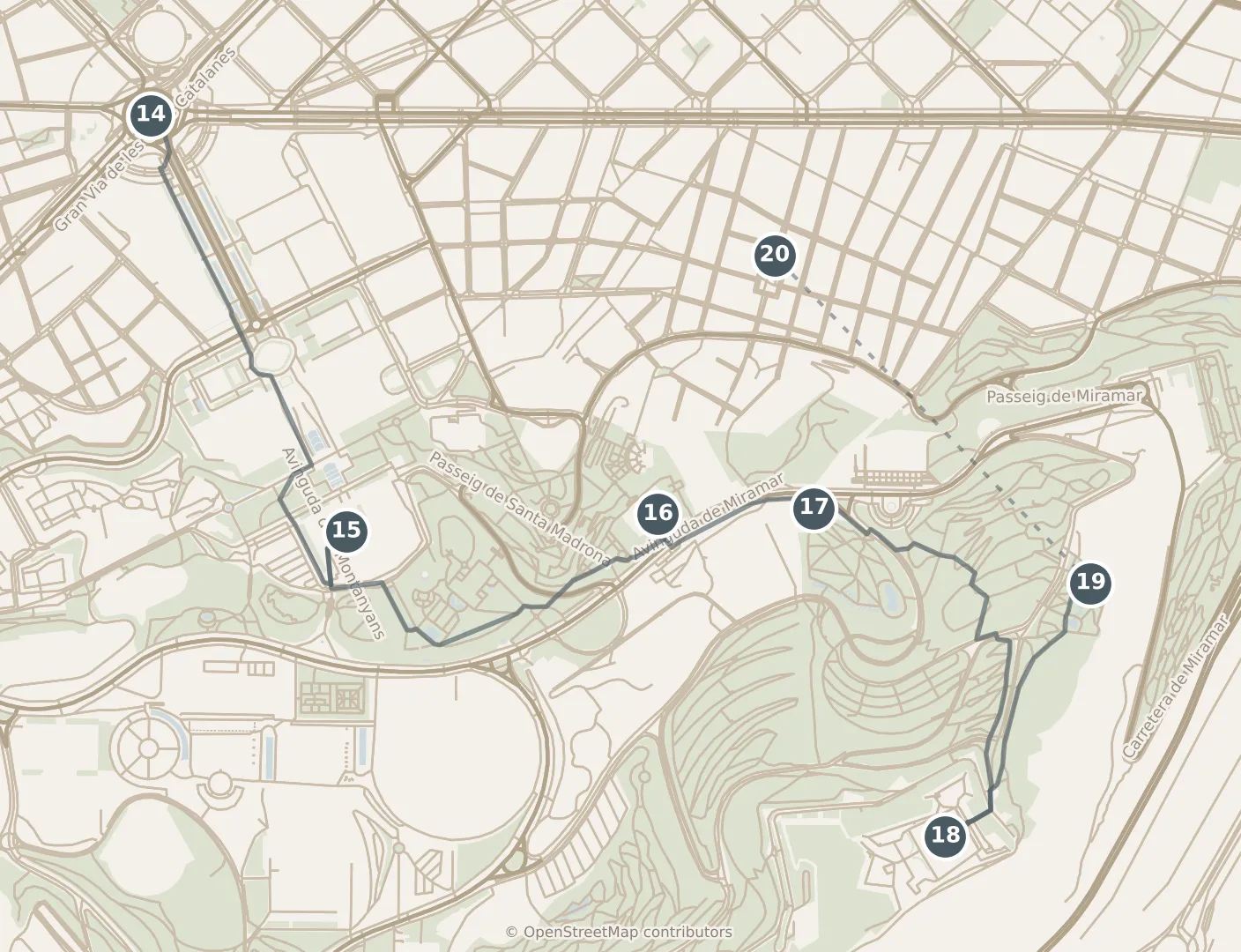
- With a third day
- 14Plaça d'Espanya
- 15Museu Nacional d'Art de Catalunya
- 16Fundació Joan Miró
- 17Telefèric de Montjuïc
- 18Castell de Montjuïc
- 19Jardins del Mirador de l'Alcalde
- 20El Poble-sec
The third day goes on the end and it goes across the city to Montjuïc, the hill on the far side of the port that days one and two never look at. It is a whole day and it cannot be made into half of one: it is two large collections, a fortress and a climb, and folding any of it into the first two days would spoil those instead. It adds nothing to the booking list — every ticket on it is sold at the door — so it is also the cheapest of the three to add late.
It is also the day that moves if a Monday forces it. Both collections below close that day, and so does day one — day two is the only one of the three that takes a Monday, so day two goes on it and these two swap around it freely. Sunday and Monday together is the case worth working out in advance, and it comes out in the natural order: day one on the Sunday, because Sunday is the one weekday that does not touch it; day two on the Monday; and this day on the third date, which is where you want it anyway if you are leaving from Sants. Where you do put it first — because the dates fall differently, or simply because you would rather climb on fresh legs — it starts from a station perfectly well: Plaça d’Espanya is two stops from Sants on line 3, and the airport bus stops on the square.
Come up out of Plaça d’Espanya between the two brick campaniles and walk up the avenue towards the hill. The fountain on the way runs only on a published handful of evenings a week and not at all in the coldest weeks of the year, and this day passes it in daylight and does not wait for it — do not build an evening on it without checking first. Twenty minutes from the metro to the museum door, most of it a straight avenue and the last of it a flight of outdoor escalators.
Give the Museu Nacional d’Art de Catalunya two hours, and go for one thing above all. An American dealer began buying Romanesque wall paintings out of half-abandoned churches in the Pyrenees to ship to the United States, and the response was to send Italian specialists up the valleys between 1919 and 1923 to strip the frescoes off the walls first and bring them here. So the ground floor holds the painted apses of a dozen mountain churches, remounted on curved plaster that reproduces the shape of the apse each one came out of, and you walk from one to the next through what is effectively a street of eleventh- and twelfth-century interiors. The Pantocrator of Sant Climent de Taüll is the one everybody knows and it earns it. Above that, the Gothic rooms of the Crown of Aragon and, at the top, the modern floor, which is where the buildings of day two get explained: Ramon Casas and Santiago Rusiñol on the walls, and Gaudí’s own furniture in the cases. The building is the Palau Nacional, put up for the exposition of 1929 and given the museum in 1934, and it has a viewpoint of its own reached from inside.
Now a warning that is really about lunch. There is very little on this hill: the museums have their own cafés and outside them the gardens go on for a long way with nothing in them at all. Either eat at the museum, or carry something up, or eat properly in Poble-sec at the foot of the hill before you climb. Whichever you choose, three quarters of an hour is enough and there is nowhere up here to make it longer.
Ten minutes east along the ridge is the Fundació Joan Miró, and an hour and a half. Josep Lluís Sert built it for his friend and it opened in 1975: whitewashed concrete, courtyards, roof terraces and skylights shaped to throw daylight down the walls, which is the reverse of the usual museum and is why the pictures look the way they do in it. Miró gave the collection himself, so it runs from 1917 to the end of his life and includes the drawings and the failures alongside the finished work. In one room stands Alexander Calder’s Mercury Fountain, a pool of liquid mercury moving behind glass because the metal is poisonous; it was made for the Spanish republic’s pavilion at the Paris exposition of 1937, the same pavilion that showed Picasso’s response to the bombing of a Basque town, and it has been on this hill ever since. Go out onto the roof terrace before you leave.
Five minutes on is the lower station of the Telefèric de Montjuïc, which runs up to the castle in about ten minutes by way of a middle station. The road does the same climb in about a quarter of an hour on foot, and it is not unpleasant; the cable car is sold as an attraction rather than as transport, so this is a real choice and not a formality.
Give the Castell de Montjuïc an hour. Its first stone was laid in 1640 and the Catalans beat a Spanish army under its walls the following year; the British took it in 1705; the Spanish demolished it in 1751 and rebuilt it, and what is standing now took its shape in the last two decades of that century, with a hundred and twenty guns on it by the end. What it was for is the thing to hold on to as you walk the ramparts, because the guns were never only pointed out to sea. This was the fortress the city did not control, then a military prison, and in 1940 the place where Lluís Companys, the president of Catalonia, was taken out and shot. It was handed over to the city only in April 2007. There are information panels and there is a memorial; read them rather than walking straight to the view.
Ten minutes downhill from the castle gate, on the seaward side, the Jardins del Mirador de l’Alcalde are an open terrace with no gate, no ticket and no closing hour, looking down over the whole port and the city behind it. Half an hour. And here is the thing worth knowing before you plan around it: you are not looking at the sunset from here. The sun goes down behind the hill at your back. What you are looking at is what it lights — the cranes, the water, the grid running inland and the towers going orange one after another — and that happens in the half hour before the sun actually sets, not after.
So count. The stops and the walking above come to close to seven hours, with a short lunch and without the line at either museum’s desk. From the October clock change to the end of February, subtract that from your month’s sunset and you get a morning start and a day that ends exactly on the light. Either side of that band the subtraction still closes, but the answer is not a morning start at all: in early October and again in March it puts the start at midday, which is late enough that those weeks are better run like the summer ones. The rest of the year the arithmetic does not close: the sky stays up until nine or half past and both collections have shut long before that, so run those months forwards from opening instead, take the terrace in the late afternoon, and accept that the low light on the city is a different and shorter month’s pleasure. Do not force a two-thirty start in June to catch it. Say what that version costs, because two of this article’s own rules genuinely collide here and it is not an oversight: run forwards from opening in summer and you are off the hill in the late afternoon, a long way short of when Poble-sec sits down to dinner. Take the gap as a break rather than trying to fill it up here.
Local tip. If the day is running short, the stop that goes is the castle, not the terrace. The terrace is ten minutes below it, it is free, it has no closing hour, and it gives you the same port from slightly lower down. What you lose by skipping the castle is the history, which is the reason to go — so skip it only if the alternative is arriving at the terrace after the light has gone.
If it is raining, the hill loses most of what it is for, because the terrace is only a view and the castle’s ramparts are open to the sky. Do not stand about in it. Give the national museum three hours instead of two, take the Miró as written, then come back down to Plaça d’Espanya — the same square you started on, so it costs you no travel — and spend the rest of the afternoon in the old Casaramona textile factory at the foot of the hill, a Puig i Cadafalch building of 1911 with a brick roofscape of its own that now runs exhibitions. That is a whole indoor day and it is a real one, not a consolation.
The day ends in El Poble-sec, the narrow neighborhood on the city side of the hill. From the terrace, the funicular’s upper station is about ten minutes back along the road and it drops you at Paral·lel, which is where Poble-sec begins; the funicular is run as part of the metro and is inside the ordinary fare, unlike the two cable cars on this hill, which are each priced as an attraction. If it has stopped for the night, walking down to the same place takes about twenty minutes and is all downhill. Poble-sec is a few streets of small, cheap places to eat, and it is where the people who work on the hill live.
There is one other way off this hill and it is worth naming because it is spectacular and often misunderstood. The Transbordador Aeri crosses the harbor from Miramar, fifteen minutes from the terrace, to the Torre de Sant Sebastià on the Barceloneta side — 1,303 meters in two spans, built for the exposition of 1929 and finished in 1931, and about seven minutes in the air over the port. It costs several times what the funicular costs, it keeps daylight hours and stops well before dark in winter, and it lands you at the beach rather than in Poble-sec. Take it instead of the funicular if you want the crossing and are happy to eat by the water twice; do not plan the end of the day around it in December.
Practicalities
Three tickets want buying before you travel and they are all on day two or the morning of day one: the basilica’s timed slot, the park’s timed slot, and the guided visit at the concert hall. Buy the basilica’s first, because the mid-afternoon slots this day is built on go before the rest. Add Casa Milà and the Picasso museum online the night before — the museum’s closing hour is one of the two day one’s afternoon is built back from, so this is not only about the desk. The hospital, the two archaeological sites, both collections on the hill and the castle are all sold at their own doors, and the parks, the terrace and the beach cost nothing.
The Monday rule is set out at the top of this article and the whole of it is this: day two is the only one of the three days that survives a Monday, so a Monday date takes day two and the other two arrange themselves around it. Three things to add. A public holiday closes museums that a Tuesday would not, and the eleventh of September closes and crowds day one’s ground in particular. A Sunday costs this article nothing structural, but it shortens the museum on the hill, so a Sunday third day starts at opening rather than late. And the one other thing here that keeps a weekly calendar is not a closure at all: the fountain below the museum on the hill plays only on a published handful of evenings a week and stops entirely for the coldest weeks of the year. No day above depends on it, which is deliberate — it is the one thing on these three days that would be a nuisance to plan around. Each institution publishes its own calendar; check them at the moment you buy the tickets rather than as a separate errand later, because that is the only moment you are certain to remember.
The transport on these three days is small and easy to name. Day one has none inside it: once line 1 has put you at Urquinaona in the morning it is walked all the way to the beach. Day two has three metro legs — line 3 from Diagonal to Vallcarca for the park, line 3 back to Diagonal and line 5 out to Sant Pau, and line 5 one stop from the basilica to Verdaguer at the end. The third day has one at each end, line 3 to Espanya to start and the funicular down to Paral·lel to finish, plus the cable car up to the castle if you want it. The two cable cars on Montjuïc are sold as attractions and are not covered by an ordinary ticket; the funicular is, because it is run as part of the metro.
The walking is about three and a half kilometers on day one, spread across the whole day and entirely flat. Day two is about the same on the street but it is the day with the climbing in it, all of it in the ten minutes up to the park’s gates and on the paths inside the park. The third day is the one that looks easy and is not: about four kilometers, nearly all of it on a hill, with a stretch of open terrace at the end where there is no shade whatever. In July that ordering matters more than the distances do, and it is why the two collections go in the middle of the day and the outdoors goes at the end.
Two of these days end after dark a fair way from the center, and the routes back are short. From the beach at the end of day one, Barceloneta station on line 4 is about ten minutes’ walk in from the sand. From Poble-sec at the end of the third day, line 3 runs from Paral·lel and reaches Sants Estació in four stops. Neither walk is one to do with a phone in your hand; the city guide explains why at length and it is right.


