Barcelona in one day: the Gothic quarter, the water at lunch, and the Sagrada Família in late light

Last updated 3 August 2026
Overview
Barcelona does not fold into one day the way a compact old town does, and pretending it does is how a single day here goes wrong. The things people come for sit in three different parts of the city — the medieval tangle down by the sea, the nineteenth-century grid above it, and a hill on the far side — and the distance between them is real rather than a matter of minutes. So this day is a line and not a tour. It runs from the top of the old city down to the water, back up into the grid, and out to the basilica, and it never turns around on itself. There are exactly two rides on it, both short and both underground; the rest is walked, about six and a half kilometers in all.
What one day costs you is worth naming, because the subtraction is most of the service. Park Güell goes: it is an hour on foot from the center, uphill from the nearest station, the ticketed part wants a slot of its own, and the round trip is not an hour but an afternoon. Montjuïc goes with it — the hill on the far side holds the national art collection, a castle, a garden of sculpture and the fountain everybody photographs, and it is a half day with a climb at each end. The Picasso Museum goes too, and that one hurts, because it stands ten minutes off this route: but it is a place you wait in line for and then spend two hours in, and those two hours are the waterfront and the walk up the avenue. The beach is for swimming rather than looking, so you will see the sea on this day and you will not get into it.
What stays is the one building here that could not be anywhere else, and it is the only ticket on the route.
The day has a real hinge and, unusually, you set it yourself. The Sagrada Família is entered on a timed slot booked in advance, and which slot you take changes what you see. Its windows were made as a single object, cool colors down the side the sun rises over and warm ones down the side it sets over, so the inside of the building is blue and green in the morning and orange and red late in the day. Take a late-afternoon slot. Then count backwards through what is above it: with the long lunch this route recommends, everything before the basilica comes to close to seven hours, and with the quick version of that lunch, about six. Subtract from your slot and that is when to start.
Two things about that number, since a number is what readers act on. It is the time at the stops plus the walking between them and nothing else. It does not include the security line at the basilica, which exists whatever your ticket says and is the largest thing this count leaves out, and it does not include either of the two house interiors on the avenue, which are ticketed and are not in the day as written. Add both back before deciding the day is comfortable.
One thing to have in your hand before you arrive, since a reader of this page has not necessarily read anything else: that timed basilica ticket, bought from the basilica rather than from the resellers a search returns above it. Nothing else on this route has to be bought ahead. How the metro is paid for, and everything else that is true of the city rather than of this walk, is in the city guide.
The day

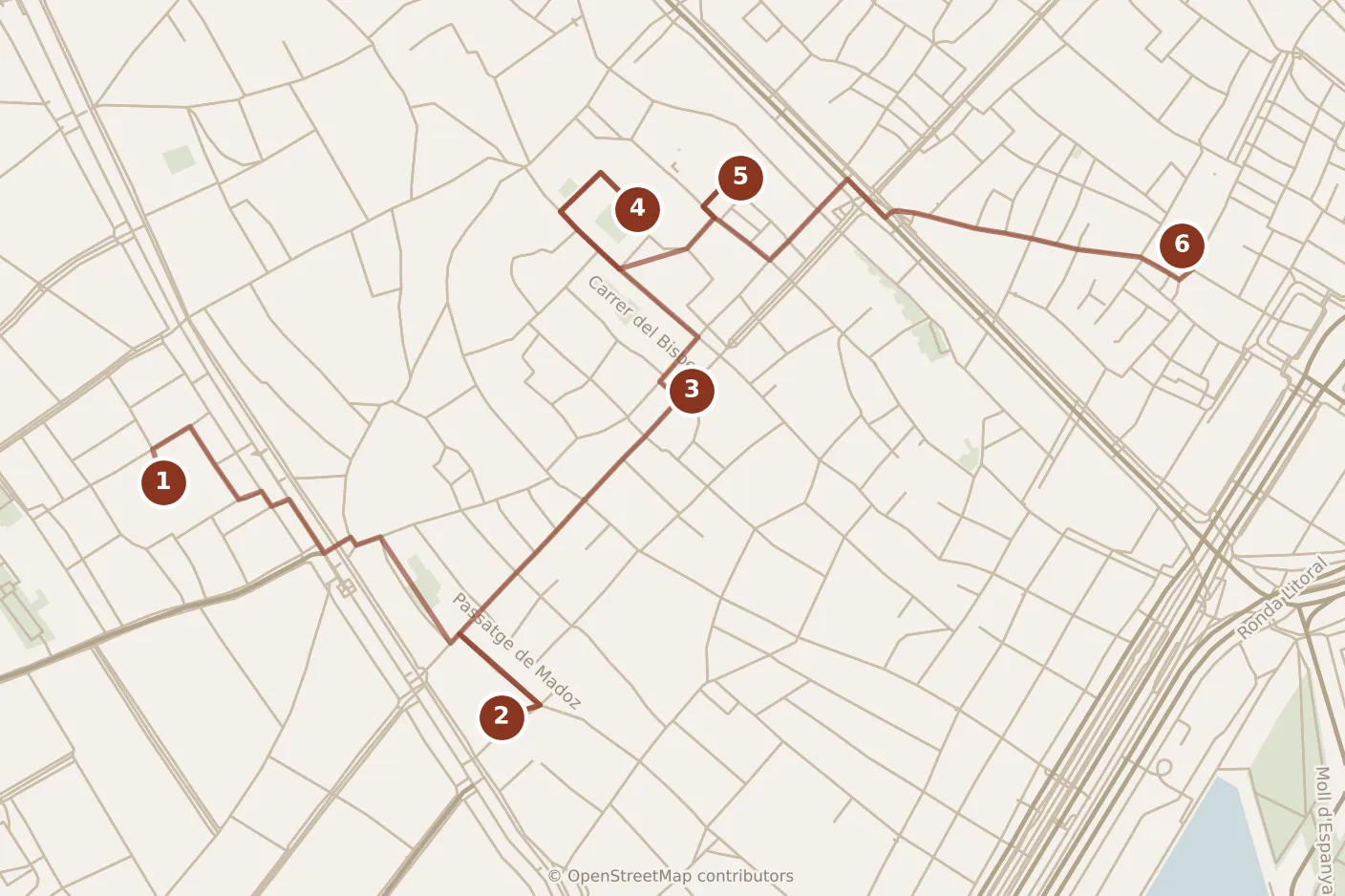
- Morning
- 1Mercat de la Boqueria
- 2Plaça Reial
- 3Plaça de Sant Jaume
- 4Catedral de Barcelona
- 5Plaça del Rei
- 6Santa Maria del Mar
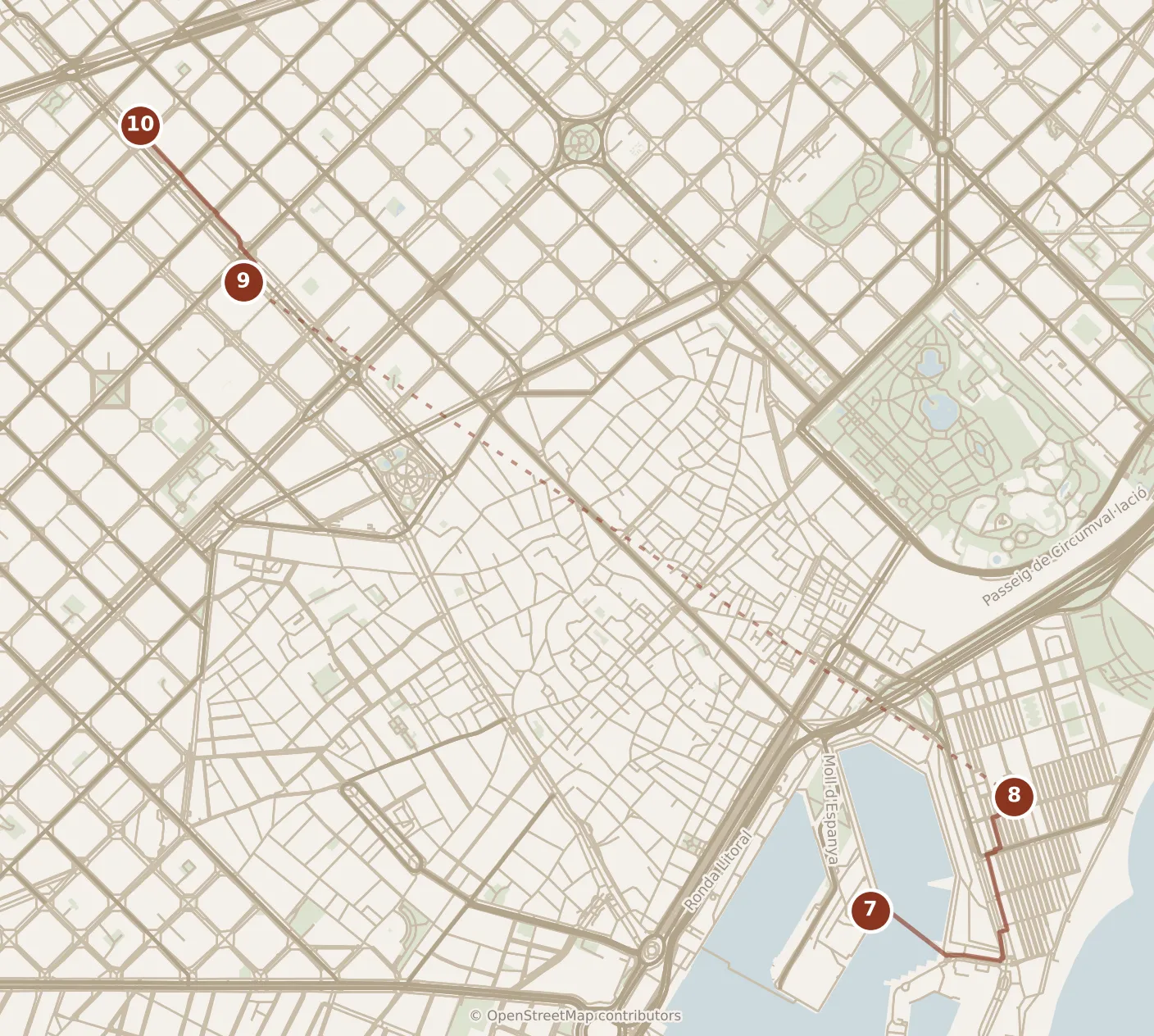
- Afternoon
- 7Port Vell
- 8La Barceloneta
- 9Casa Batlló
- 10Casa Milà
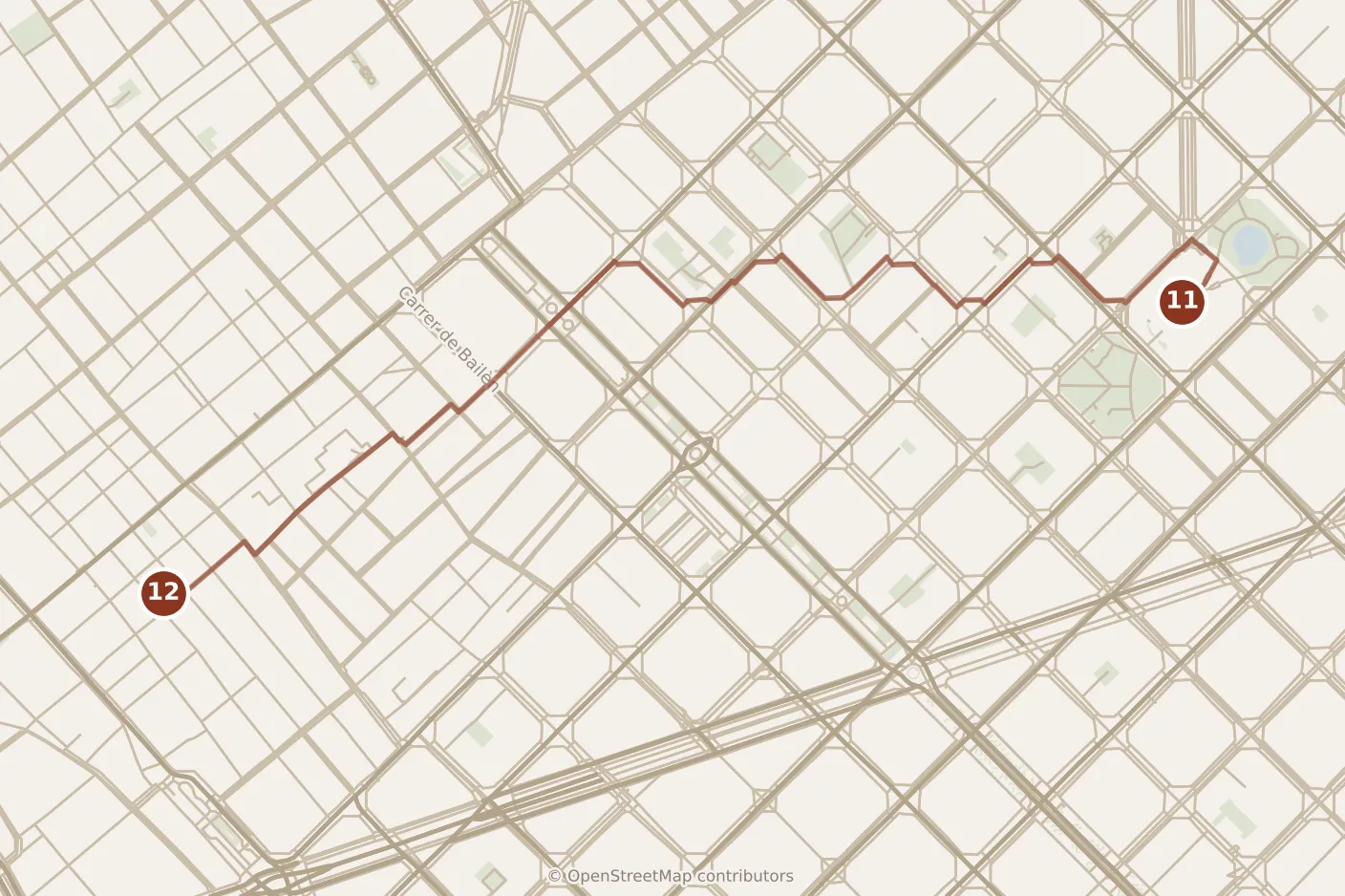
- Evening
- 11Sagrada Família
- 12Plaça de la Vila de Gràcia
Morning
Start at Plaça de Catalunya, the seam where the old city stops and the grid begins, and walk down La Rambla. A little over ten minutes, and take it as a corridor rather than a sight: the name means a watercourse, which is what this was before the wall came down and the trees went in, and for fifty years it has been the most walked and least loved street in the city. The market is on your right as you go down, about halfway along.
The Mercat de la Boqueria has traded on this spot since there were tables of meat set out by the city gate in the thirteenth century. It was only made official in 1826, the building began going up in 1840, and the iron roof over it is from 1914. Give it half an hour and give the first few meters of it nothing: the stalls at the entrance sell cut fruit in plastic cups at a price that says plainly who they are for. Go further in, to where the fish lies whole on ice, where the salt cod is stacked in slabs by grade — that is what esqueixada is made of, and seeing it raw explains the dish better than any menu — and where the counters sell offal, snails and mushrooms to people buying dinner. It is a working market and that is the reason to come; it is also emptiest early, which is the reason to come first.
Seven minutes on, a little further down and in under an arch, is Plaça Reial: a single closed rectangle of arcaded, uniform, faintly Italian facades round a courtyard of palms, which is a kind of square Barcelona has almost nowhere else. The state seized a Capuchin convent that stood on this ground in the 1830s, and between 1848 and 1859 the city filled the hole with this. It was meant to be the grandest address in town and it is now a drinking square, which is exactly why the morning is when to look at it. Two of the lampposts in the middle are by Antoni Gaudí — cast iron, six arms, the winged helmet of the god of commerce on top — and they were the first work the city ever paid him for, in 1879. Everything else on this day with his name on it comes at the end of it. Ten minutes.
Six minutes east along Carrer de Ferran brings you into Plaça de Sant Jaume, which is the political middle of Catalonia and has been the middle of the city for two thousand years: the two main streets of Roman Barcino crossed here, and the forum stood on this ground. The seat of the Catalan government faces the city hall across it, and the two have been arguing over a short stretch of paving for a very long time. Ten minutes — it is a square to understand rather than to look at.
Three minutes north the lanes open in front of the Catedral de Barcelona. The building behind the front was begun in 1298 and took a century and a half; the front itself is a Victorian afterthought, built from the 1880s to a drawing that had been left unused since 1408 and paid for by a banker, with the lantern over the crossing finished in 1913 — so the most medieval thing in the old city is younger than the grid above it. Forty minutes. Inside, the choir carries the arms of an order of knights that held its chapter here in 1519, and the crypt under the raised high altar holds Santa Eulàlia, whom the Romans are said to have martyred at thirteen. Then go out into the cloister, which is what to keep the time for: a square of green behind an iron screen, with a pond, and thirteen white geese living on it — one for each year of her life, and there have been geese in there for centuries.
Two minutes away, through a gate, is Plaça del Rei: a courtyard of bare stone with not a shop in it, which in this quarter is startling. It was the yard of the royal palace of the counts of Barcelona. The tall hall along one side, the Saló del Tinell, was built between 1359 and 1370 for a king who wanted a room the whole court would fit in; beside it stand a royal chapel and a tower of stacked arcaded galleries. The story the city tells is that Columbus was received in that hall on his return from the first voyage, and historians have doubted it for about as long as it has been told. Under your feet is the other thing, and it is the one indoor ticket in the old city that would repay an hour: in 1931 a fifteenth-century merchant’s house was moved here stone by stone to clear the way for Via Laietana, and digging its foundations opened the streets of Roman Barcino — a laundry, a dyer’s, a fish-salting works, a winery — which run under the whole square and are walked through from a door on it. This day does not go down there. Fifteen minutes above ground, knowing what you are standing on.
Seven minutes south-east through the lanes and you come out in front of Santa Maria del Mar, which is the best building on this day that is not the last one. It went up between 1329 and 1383 — fifty-four years, which for a church this size is a blink — so it is all one thing in one style, with nothing added later by a century that had changed its mind. The stone came from the quarry on Montjuïc and was carried across the city on the backs of the port’s dockers, whose guild paid for the work along with the rest of the Ribera; they are the small figures worked into the doors. Inside, the columns stand unusually far apart and the side aisles rise almost to the height of the middle one, so it reads as a single room rather than a nave with sides, and nothing stands between you and the light. The bareness is not a design decision: rioters set the interior alight in July 1936 and it burned for eleven days, taking the baroque altar and nearly everything in it. Half an hour, and five minutes more for the Fossar de les Moreres, the sunken square against the church’s flank, which is a burial ground from the siege of 1714 with a flame standing over it.
Afternoon
From the church it is fifteen minutes down to the water through the streets of the old merchant quarter, and the day changes character when you arrive. Port Vell is the oldest part of the harbor and it looked nothing like this before 1992: the waterfront was working docks, rail sidings and sheds, cut off from the city by all three, and the Olympics were the excuse to turn it round and hand it back. Twenty minutes is right — the length of the quay, the masts, the water, and the first sight on this day of the thing the whole city is arranged around.
Nine minutes further along the front is La Barceloneta, a grid inside a grid and a century older than the famous one. When the city fell in 1714 the crown leveled a piece of the Ribera to build a fortress, and the people it displaced were eventually given this triangle of made ground: a military engineer laid it out in 1753 as fifteen parallel streets crossed by nine, the blocks kept deliberately narrow, the houses one floor over a ground floor with windows on two streets so the air went straight through. Most have been built up and subdivided since, but the plan is unmistakable once you are inside it.
Lunch is here and it is the long kind. Fideuà — the flat pan of short noodles cooked in seafood stock, this coast’s answer to a paella — is made to order and made for two, so it takes what it takes; reckon on an hour and a half from sitting down, and order before you do anything else. Alone, or in a hurry, the quick version of this lunch is a plate of esqueixada — a summer salad that wants real tomatoes, so a warm-month order and not a January one — and something off the counter, and that is three quarters of an hour.
Then the first of the day’s two rides. The station at the top of the barri is on the line that runs under the old city, and it reaches Passeig de Gràcia in three stops; door to door it is about twenty minutes.
You come up on Passeig de Gràcia, which was the country road out to the village of Gràcia before there was anything in between. When the grid was laid over the fields in the second half of the nineteenth century this became the street the industrial families competed on, and the competition is still standing.
Casa Batlló is a few doors up. Gaudí did not build it: he was handed an ordinary block of 1877 and re-skinned it between 1904 and 1906, which is why the interesting thing about it is that it is a mask. The lower floors are bone — columns like femurs, openings like ribs — and above them the wall is a skin of broken tile in blues and greens that shifts color as the light moves over it, under a scaled roof with a ridge like an animal’s back. Twenty-five minutes from the sidewalk opposite, which is where a facade like this is meant to be read from. What the ticket buys is the part the street cannot show: a stairwell lined in tile that goes darker as it rises, so that the light coming down from the roof falls evenly on every floor. The block it stands on is called the Illa de la Discòrdia, because within a few doors there are two more houses of the same decade, one by Puig i Cadafalch and one by Domènech i Montaner, and the three of them disagree about everything except the money that paid for them.
Ten minutes up the avenue is Casa Milà, the last private house Gaudí built, put up between 1906 and 1912 and nicknamed La Pedrera — the quarry — from the day it appeared. The whole front is a cliff of cut stone undulating round a corner, and it carries only itself — the floors rest on columns and beams behind it, which is why the windows can be any shape they please — and the iron on the balconies was beaten into seaweed by the men who worked for him. Twenty-five minutes from the street. What the ticket buys here is the roof: a terrace of chimneys and stair heads modeled as helmeted figures, and none of it is visible from below.
Local tip. The two houses are the only place this day can be traded, and that trade is the one real decision in it. Each interior is worth an hour and a quarter if you go in, and neither is a trick — the stairwell of the first and the roof of the second genuinely cannot be seen from the sidewalk. But neither is in the count above, and an hour and a quarter has to come out of something, and this day has no spare hour in it: the twenty minutes at Port Vell are all the waterfront can give, because the walks either side of them are how you reach lunch. Take those twenty minutes and the quick lunch instead of the long one and you have an hour and five minutes, so an interior still starts your day ten minutes earlier than the count above. Decide it in the morning rather than at the door, because by the time you are standing at the door the waterfront has already been spent.
Then the second ride. The station six minutes from here is on the line that reaches the basilica in two stops; door to door it is about a quarter of an hour. Walking is possible and it is half an hour straight down one street, which is a decent walk with nothing whatever in it; with a timed slot ahead of you, take the train.
Evening
The Sagrada Família is the reason the rest of this day was walked in this direction.
Building started on 19 March 1882, under another architect and to an ordinary neo-gothic design. Gaudí took it over the following year, redrew it completely, worked on nothing else from 1915, was run over by a tram in 1926, and is buried in the crypt of a building that was less than a quarter finished when he died and is a construction site still.
Walk round the outside first, fifteen minutes, because two of the three fronts are up and they are the argument the building is having with itself. The one facing the sunrise was built in his lifetime and largely by him: dense carved stone, animals and plants and a whole nativity crowded into three porches, so busy it takes a while to resolve. The one facing the sunset was built to a drawing he made in 1917, begun in 1954 and carved from 1987, and it is the opposite — bare, angular, gaunt, and meant to be hard to like.
Then an hour inside. The columns branch as they rise and split again into smaller ones, so that the roof is carried the way a wood carries its canopy, and the vaults above are pierced so daylight comes down through them. And then the glass, which is why you chose the hour you chose: it was begun in 1999 by Joan Vila-Grau and designed as one object rather than window by window, warm colors down the sunset side and cool ones down the sunrise side. From the middle of the afternoon, once the sun has come round on that side, the warm half is lit from behind and the inside of the nave goes orange and red. It has to be the middle of the afternoon rather than the last of the light: the basilica closes well before sunset for most of the year, and earlier still on a Saturday, so the late slot to take is the last one it sells. Stand still somewhere in the middle for ten minutes instead of walking the perimeter twice: this is the one thing on the day that rewards not moving.
There is an elevator up one of the towers, sold as a supplement when the entry is booked, and you come down over three hundred steps of a narrow spiral on foot. It is a good view and it is not what you came for. If the choice is the towers or ten more minutes under the glass, take the glass.
Then the last walk, half an hour west across the grid, and the metro barely helps: no station serves the square, the line out of the basilica reaches the foot of Gràcia in two stops and still leaves you a walk up through it, and getting nearer than that costs a change. So walk it. The streets are long, straight and dull, and it is what the ending costs.
Plaça de la Vila de Gràcia is the ending. Gràcia was a town of its own until 1897, one of the largest in Catalonia by the time Barcelona swallowed it, and it still behaves like one: low buildings, small squares with people sitting out in them, and a scale that stops being Barcelona about two streets in. In the middle of this square stands a free-standing clock tower, thirty-three meters of it, put up in the early 1860s because none of the town’s churches had a belfry tall enough and the town wanted a bell of its own. It was rung to call people out during the conscription riots of 1870, the army shot it up in the reprisals, it was patched in 1882, and it has been the emblem of the district ever since. Sit down under it. The day began in a market at the bottom of the city and ends in a village square at the top of it, which is the right shape for it.
Practicalities
The one thing on this route that must be booked is the timed entry to the Sagrada Família, and it should be bought from the basilica rather than from a reseller. Buy it as early as you can: the late-afternoon slots this day is built around are the ones that go first — and on a Saturday the last of them is earlier than on other days, which moves the start of the whole day earlier with it. The two houses on the avenue sell timed tickets too, but the day as written does not use them.
Three stops here have hours you cannot see from the street, and they are the market and the two churches. The market keeps shop hours rather than church ones and does not trade on Sundays; the churches are working churches and close to visitors during services, which on a Sunday morning is most of the morning. Check all three before you fix the order. If your one day is a Sunday, the market goes and the Roman city under Plaça del Rei is the thing to put in its place — it is indoors, and it is the thing this day otherwise gives up. But it repairs only part of the morning: the cathedral’s forty minutes and the half hour inside Santa Maria del Mar are shut to visitors for most of a Sunday morning as well, so a Sunday is a shorter morning and a later start, not the same morning rearranged. A Monday costs less than a Sunday but not nothing: the collections that take Mondays off in this city are the ones this route leaves out anyway, and the market itself trades — but its fish counters do not, because nothing is landed on a Sunday, and the fish is half the reason the market is on this day at all.
The two rides are the only transport on the day and neither involves a change: three stops from the harbor up to the avenue, two stops from the avenue out to the basilica. What the fares are and how they are bought belongs to the city guide, not to this route.
The first hour of this route is the top of La Rambla and the market off it, and that is the most worked stretch in the city for the kind of theft the city guide describes at length. It is not being dramatic. Bag in front, phone away, and the rest of the day is ordinary.
If this day is happening between trains, the main rail station has a left-luggage office, so do it with your hands empty. Nothing on this route will solve a suitcase for you.
The walking comes to about six and a half kilometers and none of it climbs. The two long stretches are the fifteen minutes from Santa Maria del Mar down to the water and the half hour at the end from the basilica across to Gràcia; inside the old city, past the ten minutes down La Rambla at the start, nothing is more than eight minutes from the thing before it.


_edited.jpg)
_-_Entrance.jpg)