Bangkok in two or three days: the royal island, the west bank, and Ayutthaya on a third day

Last updated 8 August 2026
Overview
With one day here you have to pick one of two cities several kilometers apart, and the old royal one on the river is the right pick. Two days is the length at which picking stops being necessary. Day one below stays on the royal island and is walked from end to end; day two crosses the water to the west bank, then crosses the entire city eastward and comes back over the top of it on a canal. Those crossings are not the joins between the sights. They are half of what the second day is for, and they are the thing the extra day actually buys — not more temples, but the journey between the two halves of the place, which cannot be seen from either end of it.
Both days run on the same railways and the same water. The MRT Blue Line reaches the royal island at Sanam Chai, which opened in July 2019 and left Wat Pho three hundred meters from a platform; a great deal of advice about this city was written before that and still says the old quarter has no train under it. The cross-river ferries, the express boats down the Chao Phraya and the commuter boats along Khlong Saen Saep are ordinary public transport that happens to be the best seat in Bangkok, and this route uses all three.
Nothing on any of these days has to be booked before you arrive — not the palace, not either museum, not the trains on the third day. There is one thing the route needs that you may not be carrying, and it is small notes. Every boat leg on both days is paid to a conductor working a deck that is moving, the amulet market and the food stalls take cash and nothing else, and a contactless card earns its keep on the MRT and on the Airport Rail Link, and not at the Skytrain gates, which want coins or small notes exactly as the boats do. How the fares and passes work is the parent city guide’s subject; what matters here is having the notes on you before you set out.
Light is the other fixed quantity, and it barely moves. The sun goes down in Bangkok between about ten to six in the middle of November and ten to seven at the end of June — an hour of swing across an entire year, which is what the tropics give anyone who plans by it. Both days below finish outdoors inside that hour, and both count towards it forwards from a start rather than backwards from a closing door.
One thing sets the order before you read any further. Both days walk into working religious buildings during the day and end somewhere secular, so dress in the morning for the strictest of them and be done with it: shoulders and knees covered, everyone, and no negotiation at the door. The Grand Palace is where this is genuinely policed, by guards who turn people away rather than argue. There is a counter at the entrance that lends a wrap against a deposit, and pants are sold outside, so being turned back is not the end of the morning — but dressing for it at breakfast saves you the line, the deposit and the doubt. Inside the halls, shoes come off at the threshold, and you do not sit with the soles of your feet aimed at a Buddha image — which is less abstract than it sounds at Wat Pho, where the image is forty-six meters long and you will be sitting somewhere alongside it.
Tha Tien — not on the walking map.
- Day one · Evening
- Tha Tien — in the prose, not on the map
Krung Thep Aphiwat Central Terminal, Ayutthaya Historical Park — not on the walking map.
- With a third day
- 17Krung Thep Aphiwat Central Terminal
- Ayutthaya Historical Park — in the prose, not on the map
Day one

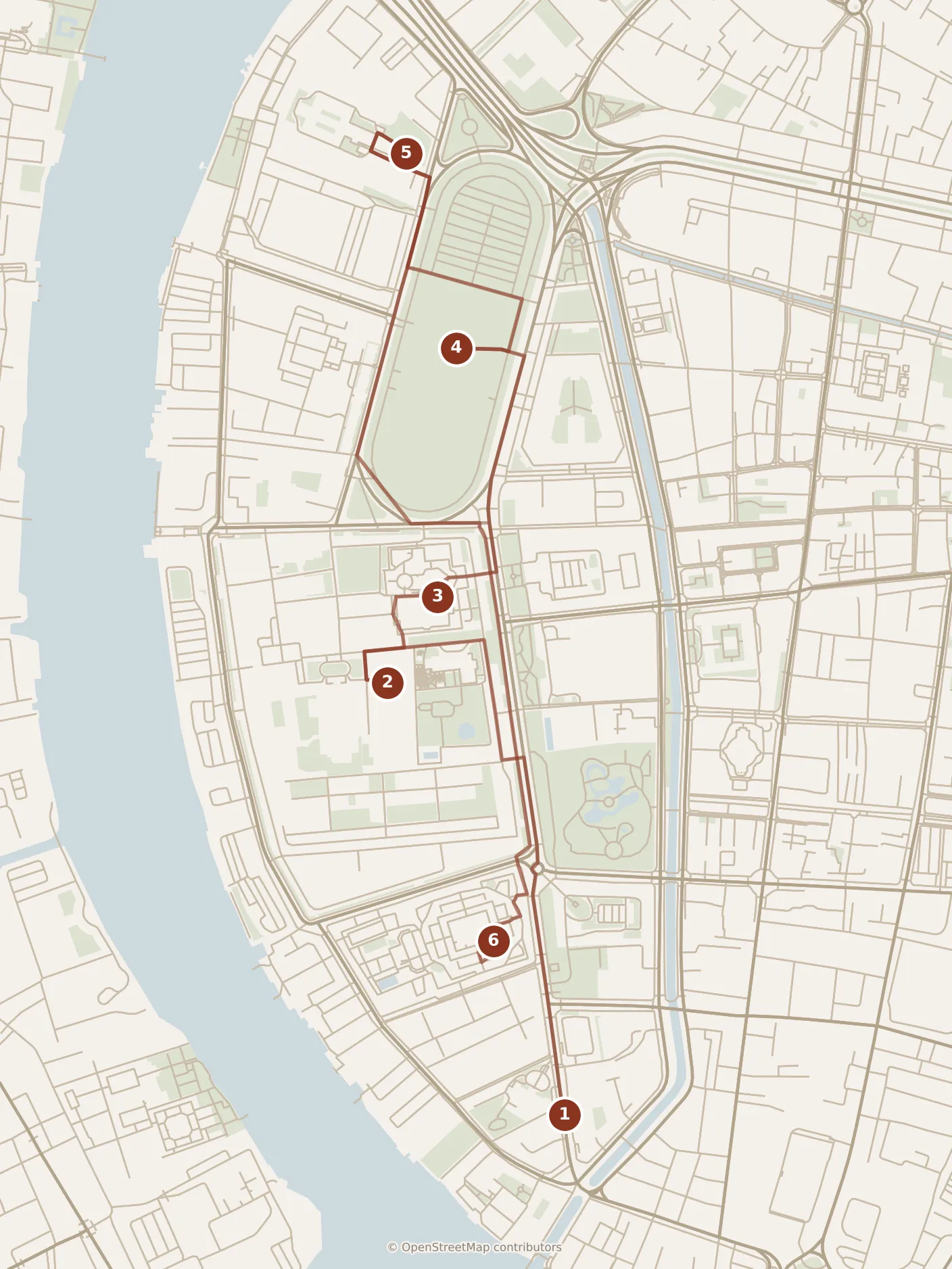
- Morning and afternoon
- 1Sanam Chai Station
- 2Grand Palace
- 3Wat Phra Kaew
- Tha Phra Chan amulet market — in the prose, not on the map
- 4Sanam Luang
- 5Bangkok National Museum
- 6Wat Pho
Everything today is on Rattanakosin, the island the city was laid out on under Rama I in 1782, and it is walked as one long arc: north along the river side of the palace walls, across the old royal field to the museum, then back south to the temple that closes the day. About five kilometers, and no ride at all except the one that brings you in.
Morning
The first leg is the one worth getting right, because you make it before you have any feel for how the city fits together. The old island has one station that helps and it is Sanam Chai on the MRT Blue Line. From the Sukhumvit hotels that means the BTS to Asok and the Blue Line from Sukhumvit station; from Silom, the BTS to Sala Daeng and the Blue Line from Si Lom. Both are direct once you are below ground. Coming straight in from Suvarnabhumi that morning, take the Airport Rail Link to Makkasan, walk over to Phetchaburi and ride the Blue Line the whole way, with no change at all and no expressway. From Don Mueang the equivalent is the commuter line south to Krung Thep Aphiwat and the Blue Line from Bang Sue — which is also the answer if you have arrived in the city on a long-distance train rather than a plane. Leave by exit 1, and give the station itself two minutes on the way out: it was built as a throne hall rather than as a concourse, and it is the one piece of new construction on either day that was put up to be looked at.
It is about fifteen minutes on foot north to the Grand Palace, and the hour to be at the gate is the opening one, which was half past eight in 2026. This is the single hard shape in the two days. That year the palace stopped selling tickets at half past three, earlier than anything else on either day, so it goes first — and if you find the hours have shifted, you build the morning back from the new opening in exactly the same way. The compound is also almost entirely unshaded, and an hour after the gate the courtyards are hot enough to shorten the visit whether or not you intended it. This gate is where the dress rule above is actually applied: covered shoulders and knees are checked before you reach the ticket window, and anyone who fails it is sent to the wrap counter rather than argued with. One thing to carry up to the gate with you: the palace is open every day, and anybody who stops you on the sidewalk to say it is shut this morning, with somewhere better to take you instead, is not from the palace. Keep walking and look for yourself.
Kings stopped living here under Chulalongkorn, and you are admitted to the outer court and to the royal chapel, and to nothing else. Two hours, chapel first. Wat Phra Kaew holds an image of dark green stone about the length of a forearm, raised on a gilded tower of a pedestal so far above eye level that the encounter is entirely a matter of craning; the monarch changes its robes at each turn of the three seasons, so whichever costume you are given is a third of the object. Slow down instead for the thing most people walk past — the painted gallery that runs the full circuit of the courtyard wall, telling the Ramakien over more than a hundred bays. It has been repainted so often that it is now a record of two centuries of Thai painting rather than one work. Walk a single long side of it properly and let the rest go.
Out through the north gate, then fifteen minutes up the river side of the walls to the Tha Phra Chan amulet market, which is not a sight and is the better for it. It runs along a lane under awnings, and the goods are small consecrated images laid out in trays and studied through jeweller’s loupes by men who came to buy. Half an hour. Do not pick things up: this is a trading floor and some of what is on it carries serious money. Lunch is in the lanes directly behind — an hour, at the noodle counters. Boat noodles have their own quarter elsewhere in this city and these lanes are not it, so order what is in front of you rather than going looking for a dish that is somewhere else.
Afternoon
Seven minutes east puts you on Sanam Luang, the bare oval field in front of the palace where royal cremations are staged and where kites go up in the hot months. Nothing to enter and no ticket; give it the five minutes it takes to walk into, which is long enough to see why the two buildings at either end of it face each other, and six more to reach the museum at its north end.
At the north end stands the Bangkok National Museum, occupying the Wang Na — the palace of the deputy king, an office Chulalongkorn abolished, so the building is itself the last of something. An hour and three-quarters, and do not try to take it whole. Three things carry it. The Buddhaisawan chapel is a separate ordination hall of 1787 raised to house the Phra Phuttha Sihing image, its walls painted with the life of the Buddha. The chariot hall holds the royal funeral vehicles, four stories of gilded teak still taken out and used. And the Ramkhamhaeng inscription is a stone roughly the size of a milestone on which a large part of the country’s account of its own beginnings rests. The remainder is a very large survey arranged by period, and it is the part to walk through rather than read.
Local tip. If the day has slipped — and the palace is where it slips — the museum is what goes, not the second hour at Wat Pho below. Dropping it puts you at the river with two hours in hand and the massage taken properly, and it is the one stop today whose absence costs you nothing of the city itself.
Then twenty-five minutes straight back south, down past the palace’s eastern wall, to Wat Pho, which wants two hours and divides them in half. The first hour is the temple. The reclining figure is forty-six meters of gilded plaster in a hall with barely a corridor’s width around it, so you get it in slices between columns and never entire; everyone stops at the mother-of-pearl soles, and then stays another ten minutes feeding coins into the row of bronze bowls down the flank. What hardly anyone looks at is better — the small walled courtyards of Chinese stone figures, scholars and guardians and top-hatted foreigners, carved as ballast and unloaded here when the ships were emptied.
The second hour is the massage. The temple has taught it in this compound since the 1950s, and the schools that teach it elsewhere largely trace themselves back here. There is no booking: pay at the pavilion, collect a numbered token, and sit until it is called, which around the middle of a day means a line on top of the hour. The end of a five-kilometer day is the right moment for it, and that is the entire argument for putting Wat Pho at the close of day one rather than at its opening, where a one-day visitor is obliged to put it.
Evening
Five minutes west the streets stop at the water at Tha Tien, and the day stops with them. The shophouse blocks behind the pier sell rice and noodles from counters on the ground floor; the pier itself has a wall to sit on. Across the river is Wat Arun, and it is where the other day begins: the same building from the two distances it was designed to be read from, and it is worth having them the long way round. Its floodlighting comes on long after you will have left this wall; what the stop is for is the late afternoon light going off the river, and then the train home.
Everything above, walks included, comes to about eight and a quarter hours from the gate, so half past eight at the palace puts you on that wall at around a quarter to five: an hour before the light goes in November, two in June. The count measures the time you spend inside the places and nothing else. It does not contain the security line and ticket line at the palace gate, which is the one wait today capable of eating half an hour on its own, and it does not contain waiting for a massage table.
Going home is six minutes back to Sanam Chai and the Blue Line, which runs directly to Si Lom and Sukhumvit.
Day two

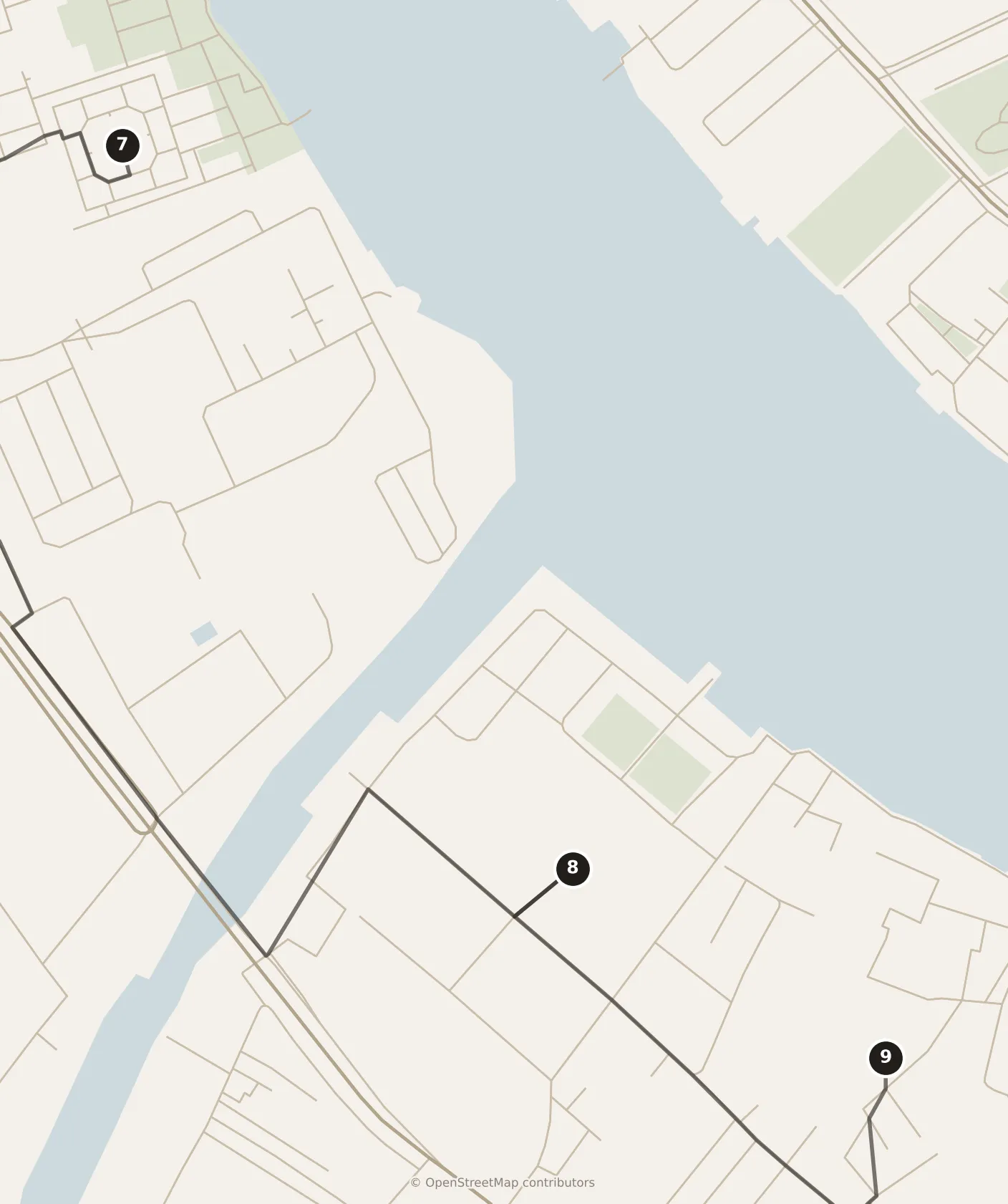
- Morning
- 7Wat Arun
- 8Wat Kalayanamitr
- 9Kudi Chin
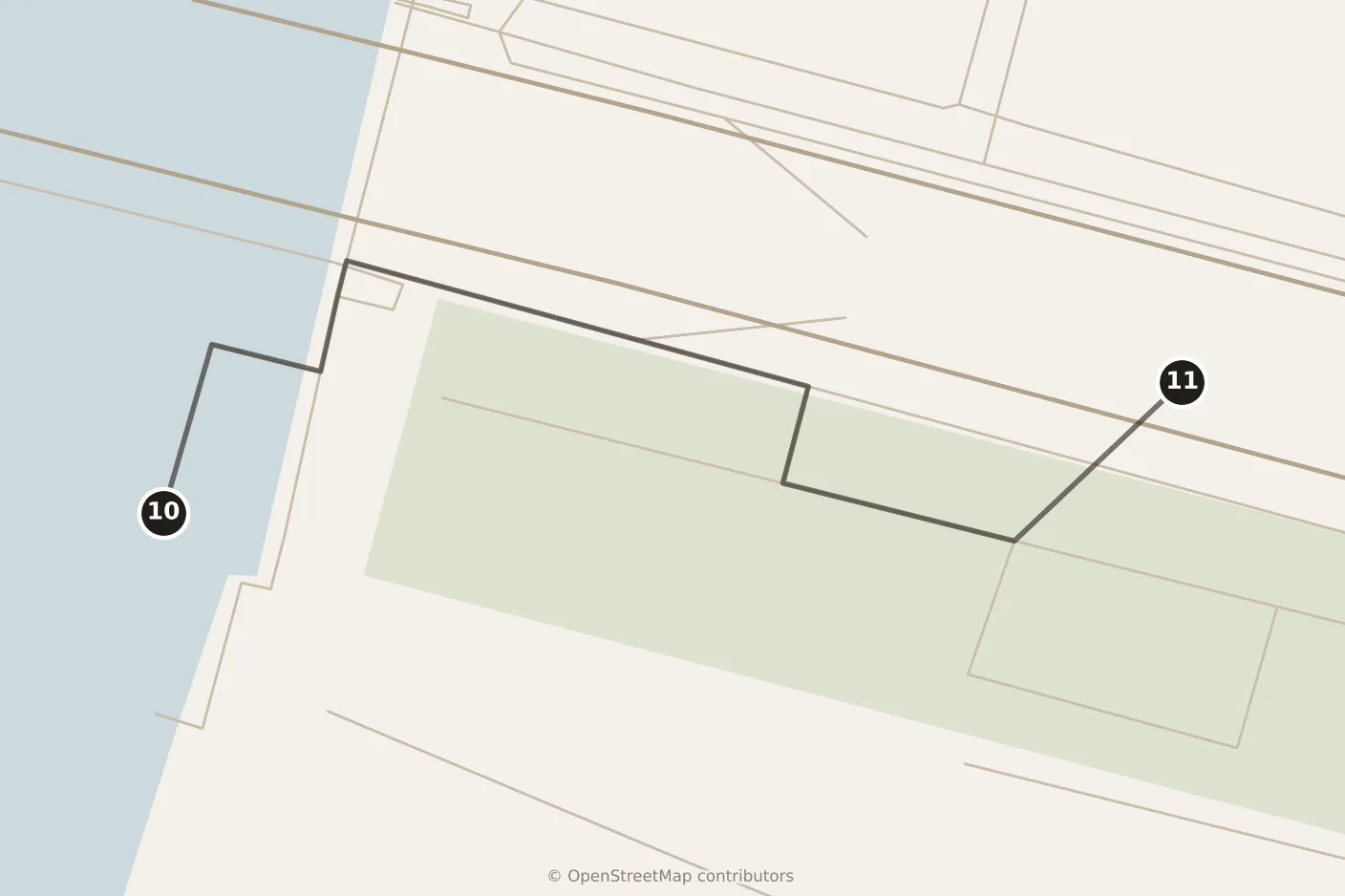
- Afternoon
- 10Sathorn Pier
- 11Saphan Taksin BTS Station
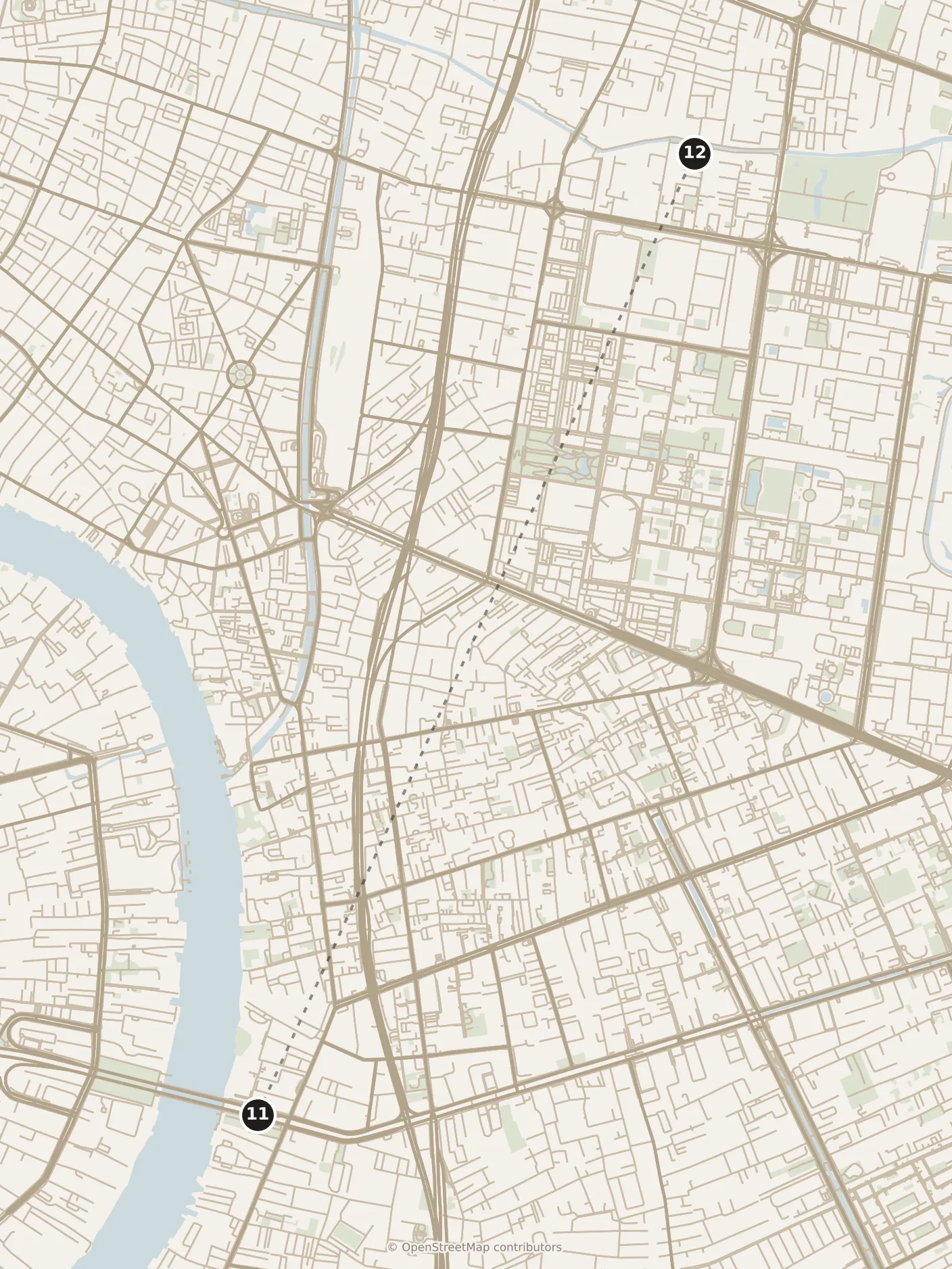
The leg out of the center: from stop 11 by metro, not on foot.
- Afternoon
- 12Jim Thompson House
- Evening
- Hua Chang pier — in the prose, not on the map
- 13Wat Saket
- 14Sam Yot MRT station
- 15Wat Mangkon MRT station
- 16Yaowarat Road
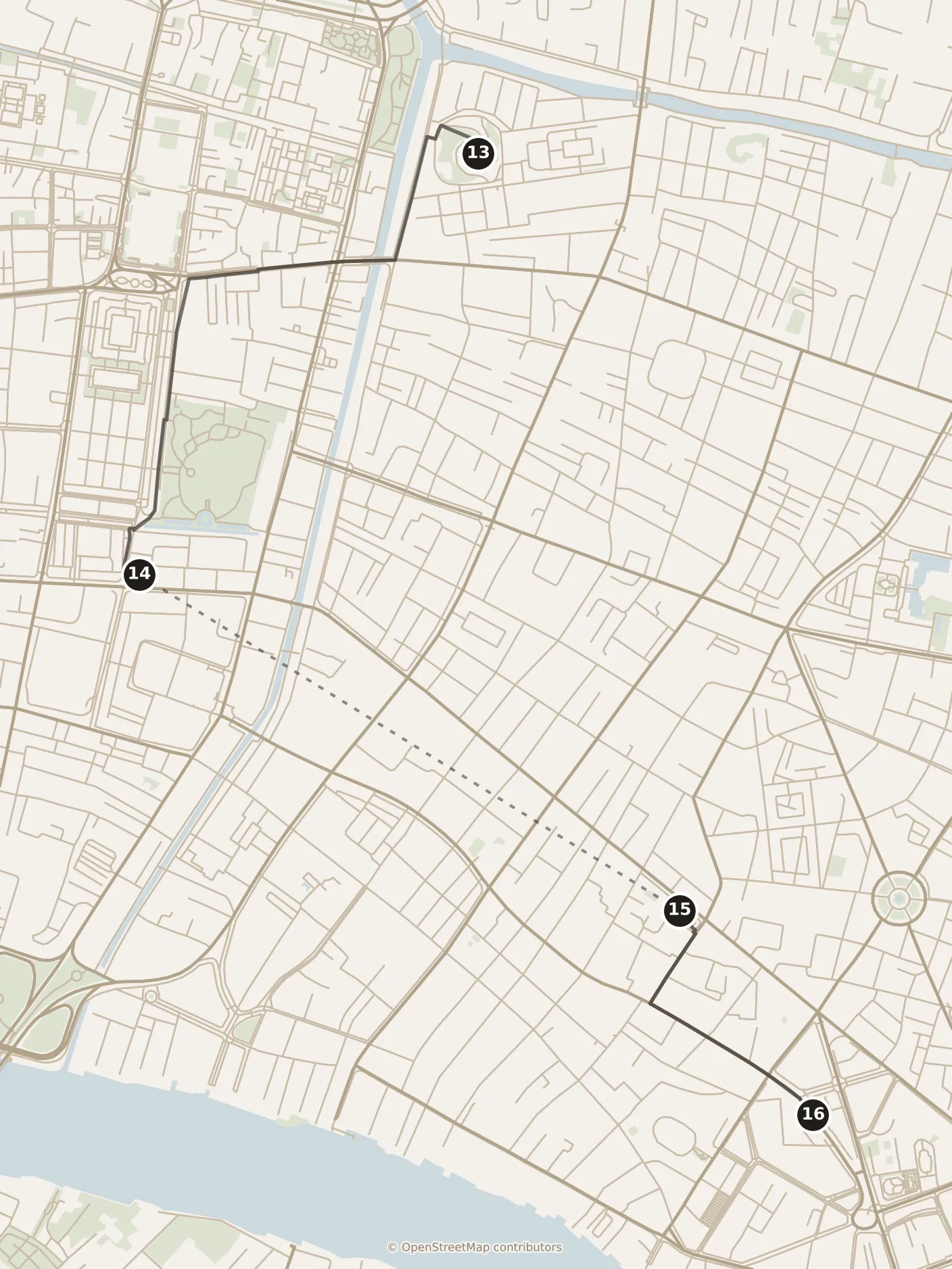
Today is the crossing, done twice. The morning is the west bank on foot — a bank most visitors touch for one temple and abandon. The afternoon is the river downstream and the Skytrain east into the modern city. The evening returns over the top of everything on a commuter canal boat and ends on the loudest street in the old quarter. Five services in one day, three of them boats, and none of them expensive. Only two walks run over a kilometer — the return north up the west bank and the descent off the Golden Mount — and everything else on foot is under ten minutes.
Morning
Sanam Chai again, exit 1, then six minutes west to Tha Tien pier. The cross-river ferry there is not one of the express boats and does not travel along the river at all: it goes over it, in about three minutes, and comes back. Two lines form near one another, and the one you want faces the far bank.
Wat Arun takes an hour and a half including both crossings, and it wants the morning. From the water it reads as a single silhouette, a corncob tower a little over seventy meters high. Close up it comes apart: every surface is set with fragments of Chinese porcelain, carried over as ship’s ballast and pressed into the render as flowers and rosettes, so the whole thing is other people’s smashed dinner services. The stairways are more ladder than stair and the treads are about a hand deep; how high visitors are permitted has been reduced for conservation, so take the highest level that is open, and bear in mind that going down is the difficult half. One door does shut in the afternoon and it is not this one: the Jim Thompson House runs its last guided tour at five and closes its ticket office with it, which a nine o’clock start clears easily. What sets today’s starting hour is not that door but the count at the end of this day.
Now walk south, which almost nobody does. Ten minutes along the lanes behind the bank brings you to Wat Kalayanamitr, a foundation of 1825 whose main hall is filled — the word is exact — by Luang Pho To, a gilded seated Buddha so large that the building looks to have been raised round it afterwards. There is a very large bronze bell in the courtyard that you may strike. The whole place is more Chinese in feeling than anything on the far bank, which is the point of coming: Thonburi, this side of the water, is where the Chinese and the Portuguese communities were settled when the new capital was set out opposite. Half an hour.
Ten minutes further south is Kudi Chin, and it is why the morning goes this way at all. The community here is Catholic and Portuguese-descended, settled after the fall of Ayutthaya in 1767, and it has held these four or five lanes for two and a half centuries. The domed church in the middle is early twentieth-century and is a working parish rather than a monument — on a Sunday morning there is a service on and you look from the lane. The lanes are narrow, residential and lived in, with front rooms opening straight onto them; walk quietly and do not photograph into doorways. What to eat is khanom farang kudi chin, a small round cake with a Portuguese ancestor and a Thai present, studded with dried fruit and sold out of the houses that still bake it. An hour and a quarter, which sounds generous for a handful of lanes and is not, because slowness is the whole content of the stop.
Come back the way you came — the riverside lane is the through route and it is fifteen minutes — and cross to Tha Tien for lunch, an hour and a quarter in the shophouse blocks behind the pier. It is the last cheap, unhurried meal of the day, and the afternoon is better for having had it.
Afternoon
From Tha Tien pier take an express boat downstream to Sathorn Pier, about twenty-five minutes away. Buy at the booth and say Sathorn out loud. The services are told apart by a flag at the stern and the quicker ones leave out piers; the one that calls at Tha Tien flies an orange flag, and Sathorn is not where it finishes — it carries on south past there, so watch for the pier rather than sit and wait for the end of the line. Sathorn is the one under the Skytrain bridge, which is what you are looking for from the water. What the ride gives you is the half of Bangkok that still faces the river: warehouses, the old legation compounds, and temples that finish in a landing stage rather than a gate.
Sathorn Pier sits directly beneath Saphan Taksin BTS Station, the one Skytrain station on the river. Seven stops on the Silom line, no change, and you are at National Stadium; allow half an hour with the walk at either end. This is the transition the whole article is about and it takes twenty minutes of it: you board beside a pier and step out above a six-lane road under a concrete viaduct, in a city of offices and malls that has almost nothing to do with the one the other day is spent in.
Seven minutes north of the station, up a lane that gives no warning of it, is the Jim Thompson House: six old teak houses brought in from Ayutthaya and from Bangkrua and put back together on the canal bank in the 1950s by an American who arrived with wartime intelligence work, stayed to rebuild the Thai silk trade, and walked out of a hill bungalow in the Cameron Highlands in 1967 and was never found. An hour and a quarter, which allows for waiting on a guided group rather than wandering in. The detail that makes the place is geographic rather than biographical: it faces across the water at Bangkrua, the Muslim weavers’ village whose looms the business was built on, so the house is sited to look at its own supply.
If the day has to lose something, lose this house. Without it the eastern half has no anchor at all, and what replaces it is a whole plan rather than a gap: take the morning on the west bank as written, come back over for lunch at Tha Tien, then ride the Blue Line two stops from Sanam Chai to Wat Mangkon and give the afternoon to Chinatown in daylight, which the day as written never does — the dried-goods lanes, the gold shops open, the shrines. Then one stop back to Sam Yot and eighteen minutes on foot north-east up to the Golden Mount. The mount takes visitors until nine in the evening, so do not climb it early merely because you have arrived early: time it to reach the terrace as the light goes, exactly as the written day does, then walk back down to Sam Yot and take the one stop to Wat Mangkon for the carts on Yaowarat. That version drops the express boat, the Skytrain and the canal boat together, which is a real loss, and it is still a better afternoon than a rushed one.
Evening
Six minutes east along the canal is Hua Chang pier, and this leg repays the whole day. The Khlong Saen Saep boats are commuter transport — a long low hull, a rope-hauled awning the crew drop at every low bridge, and a fare collected by a conductor walking the gunwale while it moves. There is a screen along the side by your seat, on a string, and raising it is your job rather than the crew’s: the canal water is filthy and the hull throws it, so put it up between piers and let it down again at each stop for people to climb aboard. Keep it out of your eyes. Heading west there is no change to make; the run to Phan Fa Lilat, the western terminus, is about twenty minutes and covers ground that would be an hour of traffic. These boats stop for the night, which is precisely why this leg sits before the climb and not after it.
Phan Fa Lilat lands you six minutes from Wat Saket and the Golden Mount — Phu Khao Thong, an artificial hill raised over a chedi that collapsed under Rama III and finished as a mound with a gilded one on top. Three hundred-odd steps spiral up the outside, past hanging bells and under trees, and they are not steep. The temple at the foot was the city’s charnel ground through the cholera years of the nineteenth century, which is worth carrying up with you. At the top you can walk the whole way round the terrace and read the old city off in every direction: the flat sprawl of it, the river, and the palace roofs taking the last of the light. There is nowhere else in the old quarter you can get above it, which is the whole reason the day finishes on this side. Every November there is a candlelit procession up these steps for the temple’s own fair, which falls with Loy Krathong.
Everything above comes to about eight hours to the foot of the steps, so a nine o’clock start at Tha Tien pier puts you there around five: the last of the light in November, the better part of two hours of it in June. Begin at eight instead and the surplus goes into a longer lunch, which on a second day is not a loss. What the count leaves out here is piers. The cross-river ferry runs continuously, but the express boat and the canal boat both work to schedules you cannot read in advance, and standing on a landing stage is not in the figure.
Local tip. The one leg today with no substitute is the ferry across to Wat Arun; the express boat and the canal boat both have a train that does the same journey worse, which is exactly what the cut above swaps them for. So when this day collapses it should collapse inland and eastward, never at the crossing — the morning is the half you cannot rebuild.
Down from the mount it is eighteen minutes south-west on foot to Sam Yot MRT station, then one stop on the Blue Line to Wat Mangkon MRT station, whose exits come up inside Chinatown instead of on its outskirts. Yaowarat Road is what you came up for. By early evening the carts have taken the sidewalks and the street stops being a road with food on it and becomes a kitchen with traffic in it: fire under woks at knee height, trays and tanks of shellfish, tables of four stools that appear and vanish, and above all of it a solid wall of gold-shop signage in three scripts. Do not sit down to one meal. Buy a thing, walk, buy the next; the length of the street is the menu. The longest line on it is usually for mango sticky rice, weighed into a box. Leave from Wat Mangkon, on the same Blue Line that reaches Si Lom, Sukhumvit and Phetchaburi for the Airport Rail Link.
With a third day

A third day goes on the end rather than in the middle, and it leaves the city. Days one and two are one argument in two halves — the island, then the crossing off it — and dropping an excursion between them means arriving back into the old quarter cold, twice. Appended, nothing above moves at all. Two things can move it anyway. One is the weekend alternative below: if a Saturday or a Sunday falls in the middle of the three days, the market version can go there and day two move to the end. Check what that lands day two on before you commit, because day two’s one hard weekday is Monday and its one soft one is a Sunday morning at Kudi Chin. Where both a Saturday and a Sunday fall inside the trip, either of them can take the market — the other two days trade places freely, so neither choice traps day two on a Sunday morning at Kudi Chin — unless the trip holds a Monday as well, in which case the market cannot be the third day at all, because the Monday has nowhere else to go. Which is the other thing: the weekday rules below leave Monday to Ayutthaya, so a Sunday arrival puts the excursion in the middle whether the shape likes it or not, and a Monday arrival puts it at the front of the trip.
The third day is Ayutthaya, the capital Bangkok replaced. It is about seventy kilometers north up the Northern Line, and the practical fact most older advice has not caught up with is that it no longer leaves from Hua Lamphong: the State Railway of Thailand moved its long-distance departures to Krung Thep Aphiwat Central Terminal on 19 January 2023. Reach it on the Blue Line to Bang Sue and walk through the underground passage into the terminal. Tickets are bought at the counter on the day and there is nothing to reserve. Every passenger train on that line calls at Ayutthaya and they leave roughly hourly, so the only choice is how fast: the ride is somewhere between an hour and twenty and two hours depending on the service. Read the return departures off the board before you go up to the platform, because the last convenient one back is what decides how much day you actually have.
The station is not on the ruins. The old capital is an island west across the Pa Sak river, so the first thing to do on arrival is get over it: walk across the main road and straight down the street opposite to the ferry, which runs every few minutes for a few baht, or use the bridge with a walkway a little to the south. The Ayutthaya Historical Park is spread over several kilometers of the island, so the other decision is wheels: bicycles are rented around the station forecourt and tuk-tuks there are taken by the hour rather than by the trip, which is what most people do and what makes a half-day possible at all. Sun and distance are the whole difficulty; there is very little shade between one temple and the next.
Take three in the center together and give them two and a half hours. Wat Mahathat, for the sandstone Buddha head held at ground level in the roots of a fig — the one image of this country that everybody has already seen. Wat Ratchaburana beside it, where a narrow stair takes you down into the crypt beneath the prang — one of very few interiors on the whole site. And Wat Phra Si Sanphet, the royal monastery, whose three restored bell-shaped chedis are the form the Grand Palace was later built to echo. Then, if the return train allows, ride out west to Wat Chaiwatthanaram on the river bank: a tall central prang ringed by chapels, and the site out here that late light does most for. Forty-five minutes, plus the ride each way. Those two facts pull against each other — the light that suits it best arrives after the trains you want to be on — so choose the return first and take this stop only if it fits inside it. The ticketed ruins have no dress check of the palace kind, and the day is spent in full sun with almost nothing over you, so dress for the heat and carry something to put over your shoulders for the working temples, where covering up is a courtesy rather than a gate. Climbing on the brickwork is prohibited and enforced.
If the third day falls on a Saturday or a Sunday there is a case for staying in the city, and it is a plan rather than a gesture. Go to the Chatuchak Weekend Market in the morning — MRT Kamphaeng Phet, exit 2, which puts you inside it rather than at a corner, or BTS Mo Chit for the northern end. The whole of it trades both weekend days and well past lunch, so the morning is a choice rather than a deadline: the roof turns the covered lanes into an oven long before it closes. Three hours; those lanes are numbered and the numbers are the only navigation there is. Eat som tam there at the Isan stalls, pounded to order and hotter than you will have asked for. Then ride the Blue Line straight south from Chatuchak Park to Si Lom and spend the last of the light in Lumphini Park: pedal boats, joggers doing circuits, water monitors the size of dogs coming up out of the lake, and the Silom towers switching on behind the trees. At six the national anthem comes over the loudspeakers and the whole park stops where it stands, joggers included; stand still with everyone else and pick up where you left off when it ends. Two stops and two fares, with the afternoon between them left open.
Cutting is the other case, and the commoner one. If the third day is really a half day — a late flight, a morning train — then Ayutthaya is the thing to drop whole rather than compress, because seventy kilometers each way does not fit round a check-out. Take the weekend market if the calendar allows it, and otherwise spend the morning in Chinatown, which day two only gave you after dark and which is a different quarter in daylight.
Practicalities
Nothing on any of these three days needs booking before you arrive. That is unusual enough to say plainly: the palace, both museums, every temple and the trains to Ayutthaya are all bought at a counter on the day. The one figure worth having in advance is that the Grand Palace is the expensive ticket of the trip — in the five-hundred-baht range in 2026, several times any other admission on this route, and sold at its own gate and nowhere else, which is also the only place that can tell you truthfully whether it is open today. Everything else is in the low hundreds or free, which is why the palace is the stop to be certain about and the others are not.
The weekday rules, in the order they bind. Day one must miss Monday and Tuesday: the Bangkok National Museum closes on both, in the way the country’s national museums generally do, and the Fine Arts Department publishes its own days — one look the week before settles it. If you cannot avoid it, the substitute keeps the same shape and the same afternoon: Wat Suthat and the Giant Swing, under twenty minutes south-east of Sanam Luang and open daily — a hall with murals among the most complete of their period and, outside it, the tall red teak frame that used to hold a genuinely dangerous ceremony. It costs the afternoon about seven extra minutes of walking on the way down to Wat Pho and gives it back an hour, since the temple wants three-quarters of an hour where the museum wanted nearly two: the massage lands earlier, and there is more light left on the river wall at the end.
Day two must miss Monday, the day the carts on Yaowarat thin out. The restaurants in the shophouses are unaffected and open as usual, so you can still eat well there seated; what disappears is the sidewalk kitchen, and that is the only reason to finish a day on that street at all. Day two also prefers not to reach Kudi Chin early on a Sunday, when the church is in use — go later in the morning and nothing else moves. The two days may trade places freely. Nothing else on either depends on a weekday, and day two takes a Tuesday without complaint, which is the fix for a Tuesday arrival: run day two first.
The third day takes any day if it is Ayutthaya, and only a Saturday or a Sunday if it is the market. The arrival that quietly breaks all of this is Monday, because it is the one day that lands on both rules at once. With three days the Monday has to be the Ayutthaya day, and where that leaves the excursion depends on which day you arrive. Arrive on the Saturday and the Monday is the last day, which is where the section above wants it. Arrive on the Sunday and it falls in the middle, which that section argues against — take it there anyway, because the alternative is running day one on a Monday, and coming back into the old quarter cold is the cheaper of the two. Arrive on the Monday itself and the excursion opens the trip: a second long train ride on your first morning, which is the real price of a Monday arrival and is worth knowing before you book it. With two days, run day one on the Monday using the Wat Suthat substitute above, and day two on the Tuesday, where the carts are out. One stop is not covered by any of this, and it is the one you would expect to be: the Jim Thompson House, the route’s other ticketed interior, opens every day of the week. What binds there is not a closing day but the last tour, which is day two’s business and is written into its morning above.
Getting between the stops needs little explanation on day one: it is walked, about five kilometers, and the longest single stretch is the twenty-five minutes back south from the museum to Wat Pho, which is deliberately the flattest, dullest part of the route rather than the most interesting. Day two contains five services and three of them are boats, so the useful rule is that the cross-river ferry runs constantly and the other two do not — the express boat and the canal boat both have last departures, and the canal boat’s is the one that shapes the evening.
Neither day is written for somebody holding luggage, and the old quarter has nowhere to put it: none of the stations at that end of the route has anywhere to leave a bag. The other end does — there are lockers at the MRT stations Sukhumvit and Phetchaburi and at the Skytrain stations Sala Daeng and National Stadium, which between them are the two hotel districts this article sends you out from and the station it drops you at for the Jim Thompson House. So on a check-out morning the bag goes in before the day starts rather than deciding it, and either day can still be taken whole. If you would rather keep it with you, take the front half of day two — cross to Wat Arun, stay at ground level instead of going up the prang, come back over, eat at Tha Tien — and then ride the Blue Line from Sanam Chai: east to Phetchaburi for the Airport Rail Link at Makkasan, or north to Bang Sue for a long-distance train. That is a real morning, it finishes at a station, and it asks nothing of you that a bag makes impossible, where day one opens with a search at the palace gate and runs five kilometers on foot.
Between June and October, expect an afternoon to be interrupted rather than ruined: the pattern is a burst of very heavy rain that has finished inside the hour, and it lands on the open parts of both days. In those months the National Museum turns from the hour to sacrifice on day one into the hour to keep back, since it is the only substantial indoor stop there — except on the Monday or Tuesday when it is shut, and that is a real collision rather than an oversight: the Wat Suthat substitute is a smaller stop, not a second shelter, so on a wet Monday day one has no indoor stop to sit a burst out in, and a long lunch under a roof is the only shelter it offers. On day two the equivalent shelter is the Jim Thompson House, which is one more reason that leg sits in the middle of the afternoon rather than at the end of it.


