Baku in 2-3 days: the Old City, the boulevard, and a day out to Gobustan

Last updated 15 August 2026
Overview
Baku sits on the Absheron Peninsula, the only major capital on the Caspian Sea, and the two forces that shape a visit here are the walled Old City at its center and the modern skyline that has grown up on the hills around it in the last two decades. Two days cover both properly: a day inside the Old City and along the seafront boulevard it opens onto, and a day on the hillside above the city among its newest landmarks. A third day leaves Baku altogether, for the rock art and mud volcanoes at Gobustan, down the coast.
The center is flat and entirely walkable, and the two days below assume you’re mostly on foot there, with a couple of short taxi hops to cover the ground the hillside and the newer districts put out of walking range. Spring and autumn are the easiest seasons to be outside for a full day; summers are hot and dry. The wind here is real and constant, on the boulevard and the hillside both, worth a layer even when the sun is out.
One thing decides the order below more than anything else: state museums in Azerbaijan often keep a weekly closure, and the Palace of the Shirvanshahs is one of them. Check which day before you fix your dates — if it falls on your Old City day, the tower, the mosque and the lanes around them still fill a morning without it.
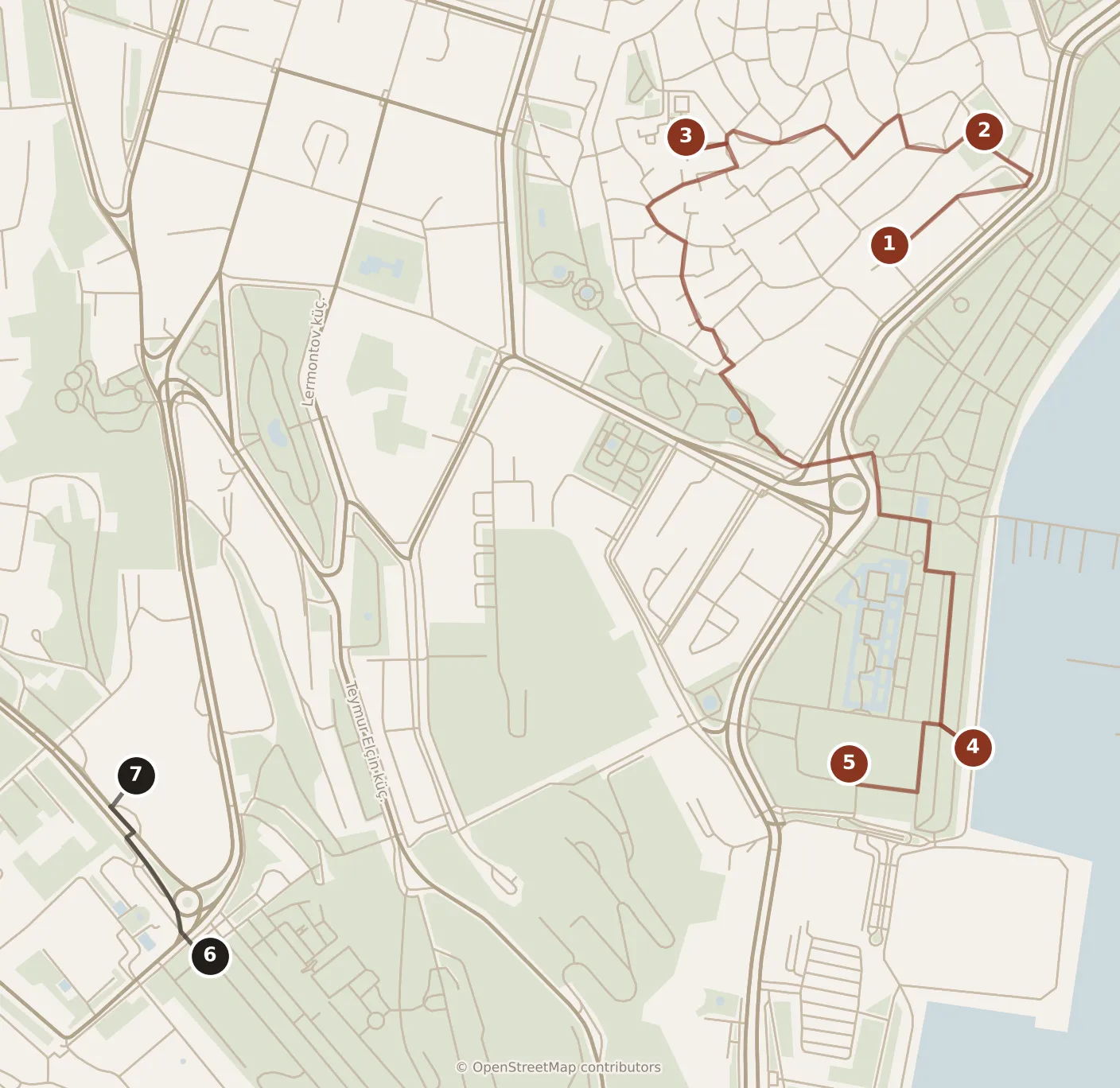
- Day one
- 1Old City
- 2Maiden Tower
- 3Palace of the Shirvanshahs
- 4Baku Boulevard
- 5Carpet Museum
- Day two
- Highland Park — in the prose, not on the map
- 6Martyrs' Lane
- 7Flame Towers
Gobustan — not on the walking map.
- With a third day
- Gobustan — in the prose, not on the map
Day one

Everything today is within the Old City walls or a few minutes past them on the boulevard, so it’s a day spent almost entirely inside one small, dense district before you step out onto the open seafront in the afternoon.
Morning
However you arrive in Baku, start at the Old City walls: this is where the day, and really the whole visit, begins. Go first to the Maiden Tower, the cylindrical stone tower that is the city’s oldest and most recognisable structure — nobody agrees what it was originally built for, which is part of what makes the climb up its narrow internal stair worth doing on its own terms. Give it half an hour, more if you take the view from the top slowly.
From there, a few minutes’ walk through the lanes brings you to the Palace of the Shirvanshahs, the residence of the dynasty that ruled Baku through its medieval centuries before the city passed to outside powers: a complex of courtyards, a mosque, a mausoleum and a bathhouse built up over more than a century, all in the same pale stone as the tower. Give it an hour — it rewards slow walking between the courtyards more than it rewards reading every panel.
Local tip. The lanes and squares of the Old City are free to wander; it’s only the Maiden Tower and the Palace that carry tickets. If your morning is short, the free half is what gives you the atmosphere and the ticketed half is what gives you the history — do both if you can, but know which one to drop first.
Between the two sights, or after them, let yourself get lost for a while in the surrounding lanes: the district is small enough that you can’t really go far wrong, and its old caravanserais and courtyards, now full of small workshops and stalls, are as much the point of the morning as the two ticketed buildings. If you pass a working neighborhood mosque with its door open, you’re welcome to look in from the threshold; dress modestly, and women should cover their hair to go further in, as at any active mosque.
Afternoon
Walk out of the Old City on its seaward side and you’re on Baku Boulevard within a few minutes — the long promenade that runs the length of the city’s Caspian shore. It’s a different register entirely from the morning: wide, open, full of families and joggers rather than visitors, the sea on one side and the newer skyline rising behind you on the other.
Follow it toward the Carpet Museum, the building shaped like a giant rolled carpet, which is about as literal as museum architecture gets. Inside is a chronological run of Azerbaijani carpets from villages and regions across the country, each with its own pattern and palette; give it an hour if carpets interest you at all, twenty minutes if you’re mainly there for the building itself.
Evening
Stay on the boulevard as the light goes. It’s the one part of Baku built entirely for walking without a destination, and early evening is when it fills with locals rather than visitors — cafés and ice-cream stands along the water, the sea usually rougher and greyer than you’d expect this far inland from an open ocean. There’s no fixed hour this depends on; just give the last part of the day here rather than spending it indoors, and let the walk be the whole plan.
Day two

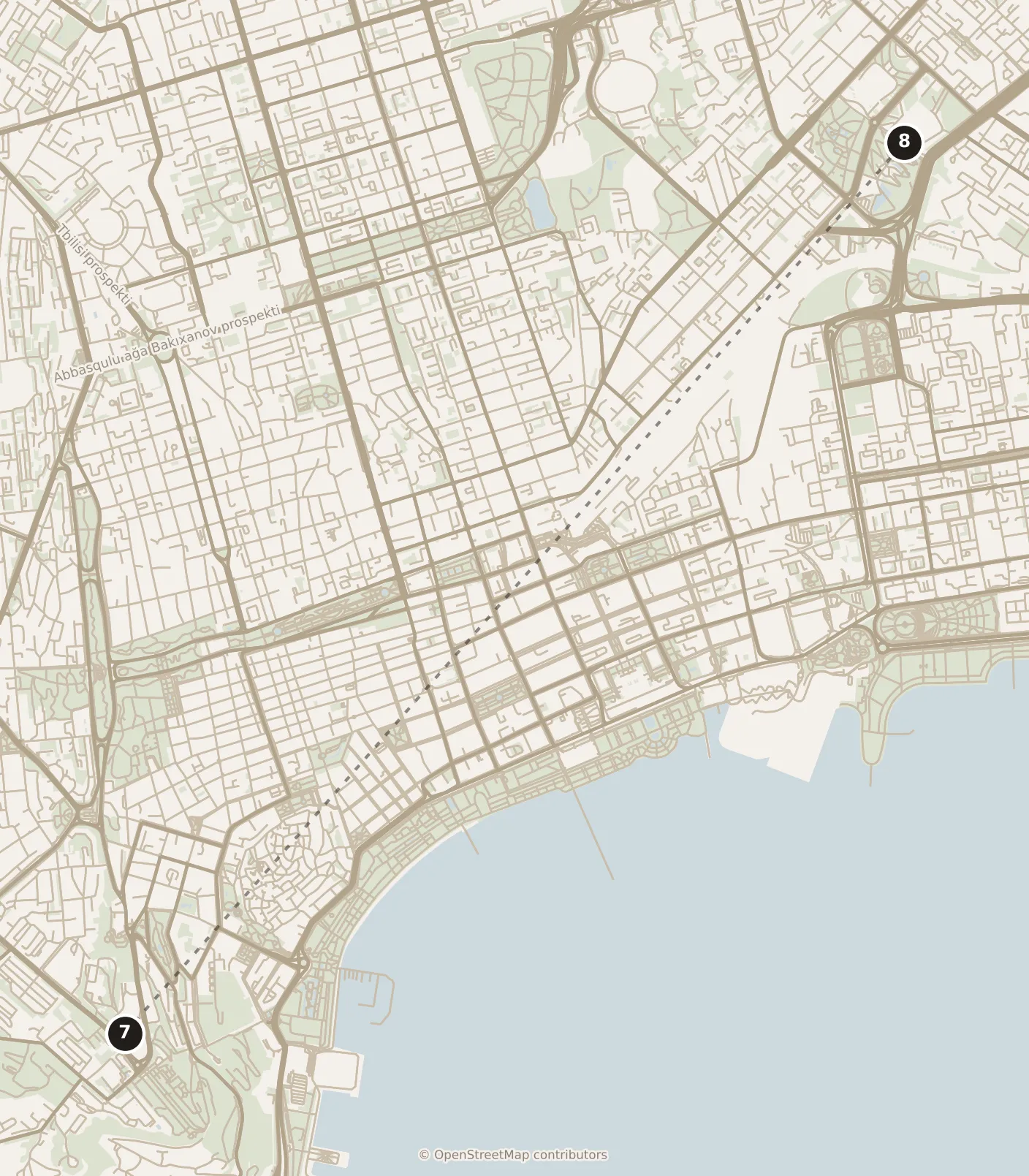
The leg out of the center: from stop 7 by taxi, not on foot.
- Afternoon
- 8Heydar Aliyev Centre
- Evening
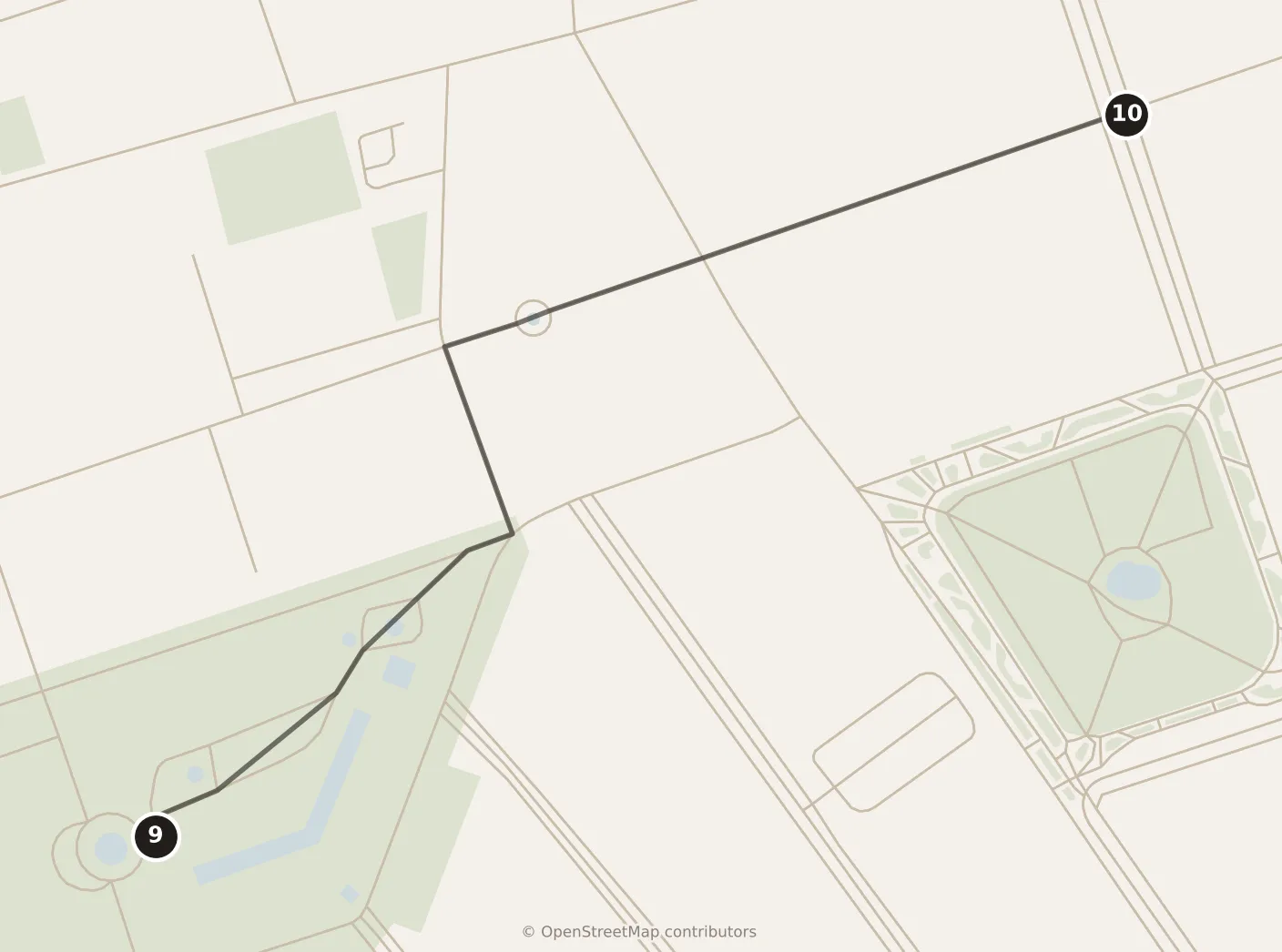
- 9Fountains Square
- 10Nizami Street
Today leaves the flat center for the hillside above it, where the city’s newest landmarks stand, then comes back down for the evening. It’s the one day that needs a couple of taxi rides rather than a single walkable loop, because the newer parts of Baku were built at a scale and a distance the Old City never had to plan around.
Morning
The morning’s destination is Highland Park, the terraced hilltop that gives the best single view over the Old City, the bay and the boulevard below it. A funicular climbs there from the boulevard when it is running — it has had spells out of service, so treat the stepped path up, about fifteen minutes at a fair pace, as the dependable plan and the ride as the shortcut. If you do ride, buy a BakıKart first: the same rechargeable card covers the funicular, the metro and the city buses, and it’s simpler to have one loaded than to work out a fare in line.
At the top, Martyrs’ Lane runs along the ridge: a long row of graves and an eternal flame, a memorial to Azerbaijanis killed in the conflicts of the last century, with the same panorama running its length. It’s a quiet, contemplative place rather than one built for photographs, and it’s treated that way by the Bakuvians who walk it.
From the park, it’s a short walk further along the ridge to where the Flame Towers stand: three glass-clad skyscrapers, unmistakable from almost anywhere in the city, shaped — deliberately — like flames. They’re best appreciated from a distance rather than up close, so the walk here is really about the changing angle on them as you approach, not about going inside.
Afternoon
From the Flame Towers, take a taxi across to the Heydar Aliyev Centre, the white, wave-shaped cultural building designed by Zaha Hadid that has become almost as recognisable a symbol of the city as the towers themselves. Ride-hailing apps work well here — Bolt is the one most visitors end up using — and it’s the easiest way to cover a distance across roads with no real sidewalk built for walking it. There’s no straight line anywhere in the building; even the plaza it sits on curves up into the walls without a visible seam. Give the exhibitions inside an hour if you want to see them, or take half that just for the building and its grounds, which is really what most people come for. It keeps a daily closing time like any museum, so it’s worth checking before you go and putting it earlier in the afternoon rather than at the end of it.
Evening
Take a taxi back down into the center, to Fountains Square, the pedestrianized square that is the closest thing Baku has to a living room: benches, working fountains, and the cafés around its edges filling up as the evening goes on. From there, Nizami Street runs off it as the main pedestrian shopping street, lined with grand stone facades from Baku’s oil-boom years at the turn of the twentieth century. This is where to end the day — no single sight left to see, just the street itself, busy and unhurried at once.
With a third day

Give the third day to Gobustan, on the coast a way south of the city — this is the one day of the three that genuinely leaves Baku. It’s roughly an hour’s drive from the center, and the reserve sits well away from any station — the practical ways out are a taxi hired for the round trip, a ride-hailing car with the return arranged before you set out, or an organized tour — so with the journey there and back this is naturally a longer outing than the two days before it, not a quick half-day add-on.
The reserve holds thousands of carvings cut into the rock over tens of thousands of years: hunting scenes, boats, dancing figures, made by hands long before the city on the coast existed in any form. A small site museum near the entrance sets out what’s known about them before you walk out among the rocks themselves, which is the better order to do it in — the carvings are easy to miss on a first pass if you don’t already know roughly what you’re looking for.
Local tip. The rock art is the reason to come; the mud volcanoes nearby are the reason to stay the extra hour. If the day is tight, see the carvings properly and treat the volcanoes as a bonus rather than the other way round — a rushed pass through the reserve loses far more than a skipped volcano field does.
Close by, the wider area is also known for its mud volcanoes: low, cool mounds that bubble and occasionally spit, entirely unlike the fire of a real volcano, and one of the odder landscapes within reach of the city. Arranging a car or a driver a day or two ahead is worth doing, rather than trying to find one on the day itself, especially in the warmer months.
Coming back into the city in the afternoon, there’s nothing else this day needs to hold: the rest of the afternoon and evening are free for whatever the first two days left out, or simply for slowing down before you leave.
Practicalities
Arrange transport to Gobustan a day or two ahead if you’re traveling in the busier months — a taxi or driver booked in advance is simpler than finding one at the reserve gate. Everything on days one and two is either free, walk-up, or bought on the spot.
If your Old City day would fall on the Palace of the Shirvanshahs’ weekly closure, swap the order and do the hillside day first. Check which day the Palace is closed before you fix your dates, since it isn’t worth guessing at — the Maiden Tower, the mosque and the lanes around them don’t share the same closure, so the Old City still holds a full morning on its own if the Palace is shut.
Getting between the stops on day two needs a taxi or a ride-hailing app for the two longer hops — Flame Towers to the Heydar Aliyev Centre, and back down to Fountains Square — since neither is a walk anyone should attempt on the roads between them. Day one and the Old City lanes are entirely on foot.


