Baku in a day: the old city, the boulevard and the Flame Towers by night

Last updated 15 August 2026
Overview
One day in Baku is not a poor trade, because the city’s most striking parts sit close together on the same low stretch of shore. The old walled town and the seafront are a few minutes apart on foot, and above both of them, on the ridge behind the boulevard, three glass towers stand and wait for dark. If there is a shape to this day, it is that: walk the old town in the morning, walk the water in the afternoon, and give the last hour to the hill above the city, for the one thing here that only happens after dark.
What a single day costs you is depth rather than range. You can stand in front of the old town’s two headline buildings, walk the length of the boulevard, and still be on the hill before dark — but you will not have time to go inside everything the old town holds, and you should not try. The Flame Towers are why the evening exists, and they are not much to look at by daylight, so the day is built backwards from when the light goes: the sun sets here from a little after five in December to around a quarter past eight at the end of June, so wherever your visit falls, count back from that.
This also suits someone here for only part of a day — off a flight, a stopover between connections, or a day in port — because everything below sits inside one compact stretch of the city and none of it needs more than a taxi or the metro to reach.
Highland Park — not on the walking map.
- Evening
- Highland Park — in the prose, not on the map
The day

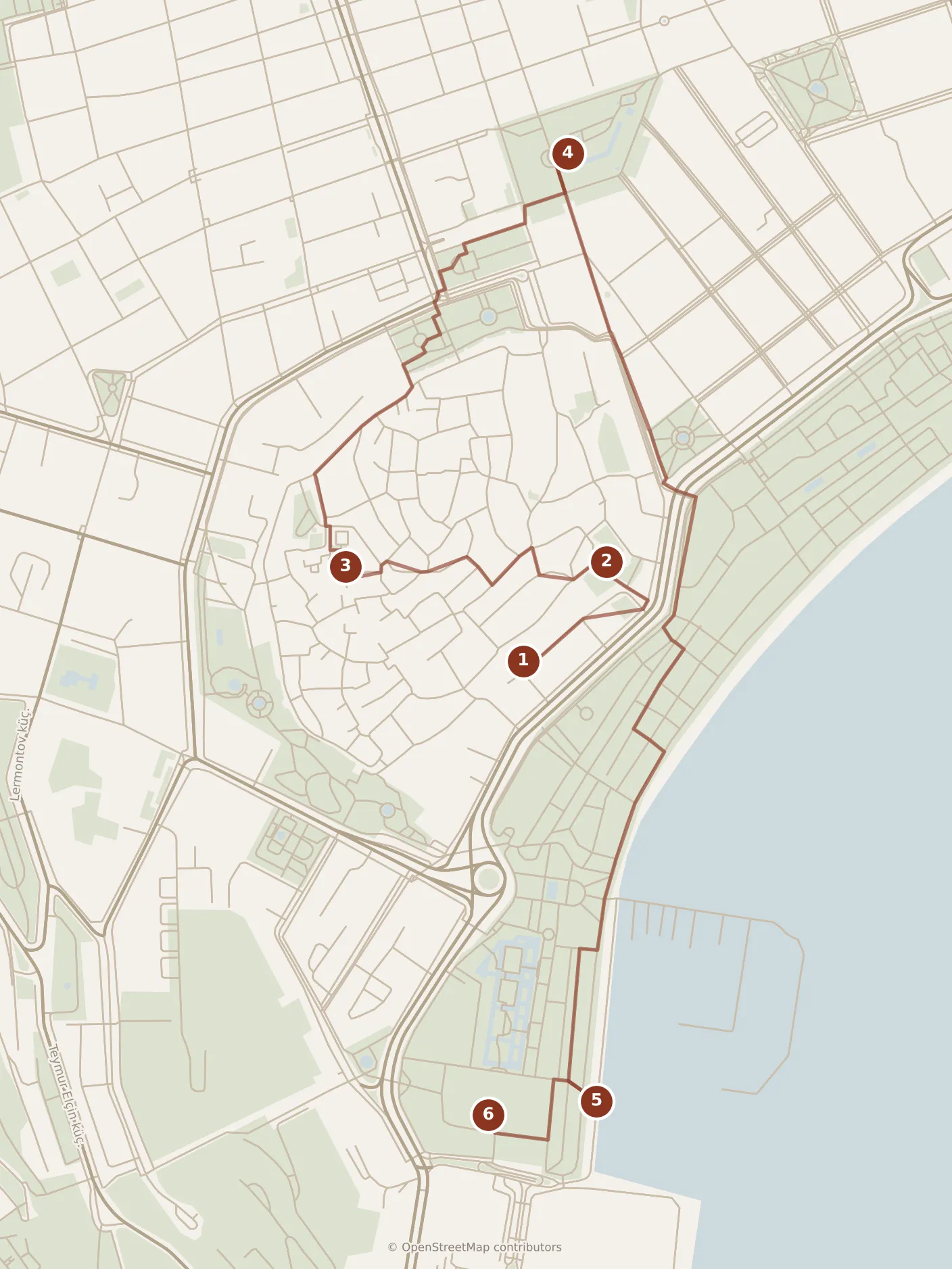
- Morning and afternoon
- 1Icherisheher
- 2Maiden Tower
- 3Shirvanshahs' Palace
- 4Fountains Square
- 5Baku Boulevard
- 6Carpet Museum
Morning
However you get into the center, Icherisheher, the walled old city, is the natural first stop: it is small enough that entering from any side still puts you within a few minutes’ walk of the tower, and it is where the old town’s UNESCO listing actually sits — the walls, the tower and the palace are all inside it, together. The streets within are narrow, stone-paved and genuinely mediaeval in their layout, which is the reason to walk them slowly rather than to try to name every building along them.
A short walk in, unmistakable, is Maiden Tower: a round stone tower eight stories high, older than anything conclusively dated around it, and still argued over — nobody agrees what it was originally built to do. Climb it. The stair inside is a tight single-file spiral, and it is worth the forty-five minutes it takes at an unhurried pace, mostly for the platform at the top, which is the one point in the old city with a clear view over its own roofs to the sea beyond the walls.
From the tower, a few minutes’ walk brings you to Shirvanshahs’ Palace, the walled compound built for the dynasty that ruled here into the sixteenth century: a run of courtyards, a small mosque, and the shah’s own mausoleum, stepped down the hillside in the order they were added rather than to any single plan. Give it an hour. It rewards reading what you are looking at rather than photographing it and moving on, and it is the quieter of the old city’s two paid stops.
Local tip. The tower and the palace are the two paid stops in the old city, and both cost roughly the same hour of your morning. If you can only manage one, the palace holds the fuller story of the place; the tower holds the better view of it. Choose the one you are less likely to see the equivalent of elsewhere.
Afternoon
Leave the old city and Fountains Square is just outside the walls: a pedestrianized knot of cafés and passing crowds, and the natural place to sit down for lunch. It is worth doing properly — the temptation on a single day is to buy something to carry and keep walking, and here that trades a real rest for very little.
From Fountains Square, the water is a walk of about ten minutes, and it changes the day considerably: the old city is stone and shade, and Baku Boulevard is glare and open sky, a long promenade the whole length of the shore that people walk for its own sake rather than to get anywhere in particular. Follow it until the view opens properly onto the Caspian Sea, and beyond the ordinary walk, the destination inside it is the Carpet Museum: a building shaped, deliberately, like a carpet rolled up on its side, holding a run of Azerbaijan’s regional carpet traditions rather than a single showcase. Give it forty-five minutes if you are keeping the day tight; it is the stop to cut first if you are not.
From the museum, a funicular is meant to make the climb to the ridge above the boulevard without the stairs. It has had spells out of service over the years, so treat the walk up — about fifteen minutes at a fair pace, on stepped paths — as the plan, and the funicular as the shortcut if it happens to be running that day.
Evening
At the top is Highland Park, a long terrace above the city that exists for one view: the old city and the boulevard below, the Caspian beyond them, and, close enough now to make out the individual panels, the Flame Towers on the next rise of the hill.
This is the stop the day is built around, and it is worth being precise about why. By daylight the towers are three glass high-rises, faintly flame-shaped if you already know to look for it. After dark, screens running the height of each one carry a program of color and movement, and that is the thing worth standing here for, not the daytime shape. Work backwards from the sunset band given above: the old city, lunch, the boulevard and the museum together come to a little under four hours of standing-in-place time before you reach this terrace, so on a December visit that means starting the old city by early afternoon at the latest, and on a June one it leaves a whole free morning before you need to move at all. That sum counts only the time inside the stops — not the climb — or the funicular’s line, if it is running and you take it — which is the one part of this day genuinely capable of running long if you arrive with everyone else right at dusk, so build slack in for that rather than for anything else.
Stay until the towers are properly lit — the display runs on into the evening rather than for one timed slot — and then walk back down — or ride the funicular if it is running and the line makes it the better choice, and pick up a taxi from the boulevard for wherever you are headed next. There is no need to retrace the old city on foot to find one.
Practicalities
Nothing on this route has to be booked ahead. The tower, the palace and the museum are all walk-up tickets, bought at the door.
Both the tower and the palace are the kind of state museum that tends to close one day a week in this part of the world, and I would rather send you to check than guess which: look it up the day before you go, and if it falls on yours, the old city’s streets and Fountains Square still make a full morning on their own, with the tower or the palace moved to the top of a next visit rather than lost from this one.
Move between the stops on foot for the old city and the walk down to the water. The metro’s Icherisheher station sits right at the old city’s edge if you would rather start or finish underground, and the metro and the funicular both run on the same card, BakıKart, sold and topped up at any station.
If you are carrying a bag with nowhere booked to put it down, know before you commit to the tower that its stair is tight, single file, and a bad place to be holding a case — that is the one stop to skip if you are between connections rather than staying somewhere. Everything else on the route is manageable with luggage, if slower.
Short on time, cut the Carpet Museum first: its shape is most of the point, and that reads well enough from outside. Caught by rain, skip the climb to Highland Park altogether rather than go up for a view the weather will erase — the towers are visible, just less dramatically, from street level on the boulevard once they are lit, and the hour you save is better spent back inside the palace, which rain does nothing to.


