Augsburg in two or three days: the merchant city, the water city

Last updated 15 October 2026
Overview
Augsburg is half an hour from Munich on a frequent train, and that proximity has decided how the city is visited: as an afternoon. Two days is not a generous allowance here. It is the minimum at which the place stops being a stop on the way to somewhere else.
What a short visit sees is the merchant city — the wide street, the bronze fountains, the palace fronts — and it deserves the attention, because for roughly a century this was one of the richest towns in Europe and it built accordingly. What a short visit misses is the second city underneath it, which is made of water. Three canals still run in open channels through the old craftsmen’s quarter, fed off the Lech and dropped through the town on a gradient that turned mills, forges and, later, looms. That system is why a town this far from a coast or a capital could be rich at all, and it is what carries the city’s UNESCO listing.
So the two days below split on that seam rather than by neighborhood. Day one is the money: the Renaissance center, walked top to bottom in one line. Day two is the water, and what the money did with it: the churches at the north end, the walled almshouse the richest man in Europe built for the poor, and the canal lanes down to the waterworks. A third day follows the water out of town to the weir that feeds the whole system — and, beside it, to the strangest thing on the World Heritage list.
One thing to know before you plan the first morning. The tower beside the town hall is closed for restoration. The Perlachturm has been shut since 2017 with its onion dome lifted off in 2025 and reopening currently planned for 2027; the town hall itself, and with it the gilded Goldener Saal that is the single most photographed interior in the city, reopened on 28 September 2026 after two years of works. Check the tower before you go rather than after. Day one below is written so that it works either way, which is the honest way to write it while the scaffolding is up.
Days one and two are walked. Nothing on either is more than half an hour on foot from the Rathausplatz, and most of it is within ten minutes.
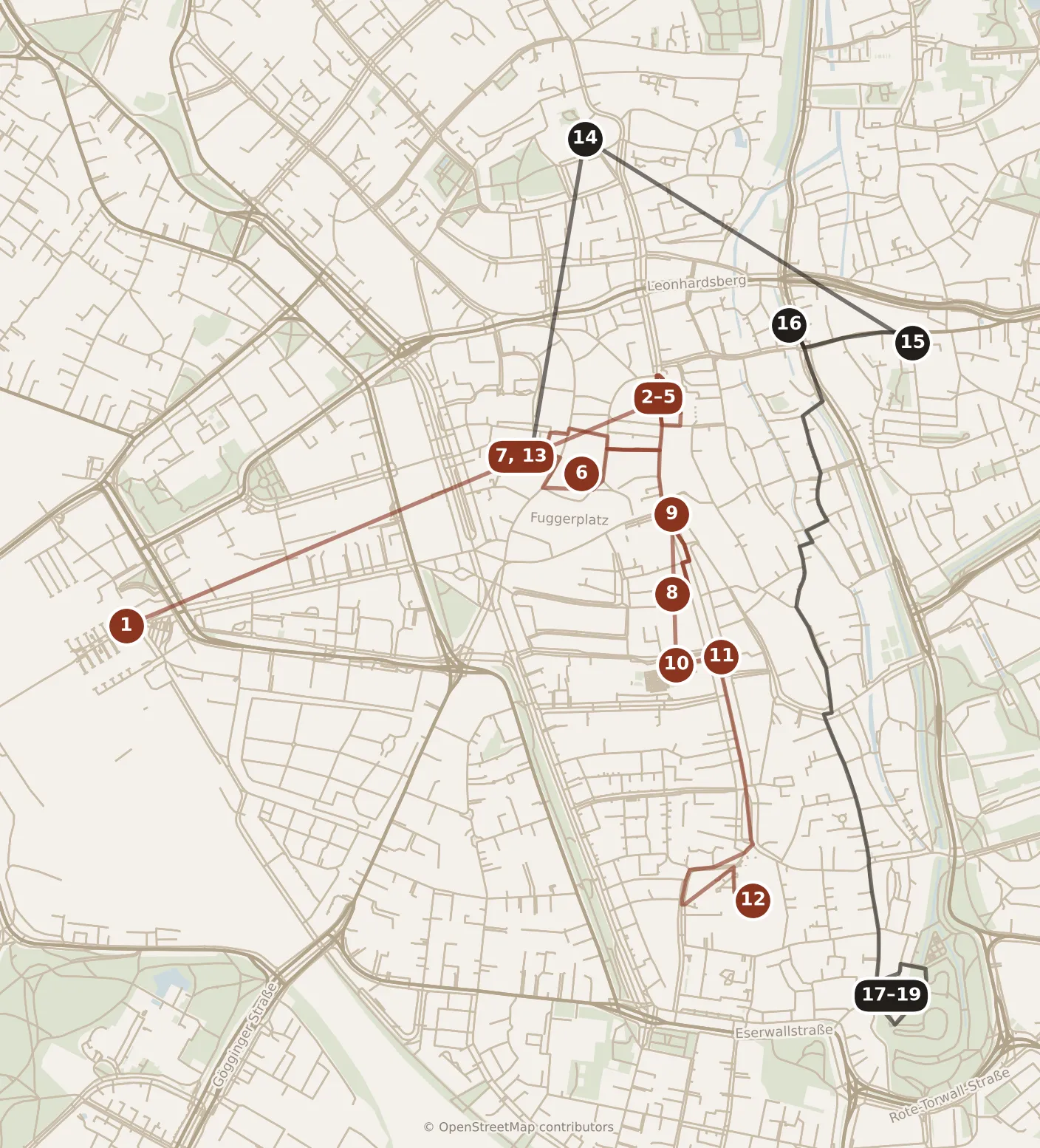
- Day one
- 1Augsburg Hauptbahnhof
- 2Rathausplatz
- 3Rathaus
- 4Perlachturm
- 5Augustusbrunnen
- 6Maximilianmuseum
- 7Stadtmarkt
- 8Fuggerhäuser
- 9Merkurbrunnen
- 10Schaezlerpalais
- 11Herkulesbrunnen
- 12St. Ulrich und Afra
- Day two
- 13St. Anna
- 14Augsburger Dom
- 15Fuggerei
- 16Lechviertel
- 17Rotes Tor
- 18Wasserwerk am Roten Tor
- 19Augsburger Puppenkiste
Day one

Morning
Walk in from the station. It is about fifteen minutes east to the Rathausplatz on the flat, the old town sits on a low rise you barely notice climbing, and arriving on foot is the only way to feel that the center is small — which is the fact the whole trip rests on.
The square is dominated by the Rathaus, and it is the reason Augsburg matters to architectural history: Elias Holl built it between 1615 and 1620, with the interiors finished by 1624, and nothing on that scale or of that confidence had been built in Germany before. The Goldener Saal upstairs was destroyed by bombing in 1944 and took until 1996 to put back. It reopened with the building in September 2026: give it half an hour and see it first.
Beside it the Perlachturm stands in scaffolding, so treat the tower as furniture rather than a viewpoint. The square itself is the better subject anyway. The Augustusbrunnen in the middle of it is the oldest of the city’s three bronze fountains, put up in 1594 for the sixteen-hundredth anniversary of a Roman foundation the city has never once stopped mentioning.
Two minutes west, the Maximilianmuseum occupies a merchant’s house and holds the original bronzes from all three fountains, brought indoors and replaced outside by copies. Out in the street the figures are four meters up and several hundred meters apart; here you stand at their eye level, and the afternoon’s walk becomes legible. If you would rather be outdoors after the hall, skip it and take the extra hour on the street. Nothing later depends on having gone in.
Lunch before you start south: the Stadtmarkt is four minutes west of the square, a covered market of stalls and counters where the city actually eats at midday, and it is the cheapest good meal on this itinerary.
Afternoon
Now walk south down Maximilianstraße, which is less a street than a demonstration. It is wide enough to be uncomfortable, lined with palazzo-scaled houses, and it was laid out to be looked down.
The first of them is the Fuggerhäuser, and it is where the two halves of this trip turn out to be the same story. Jakob Fugger built it from 1512 as a town house and warehouse, and in October 1518 the papal legate Cajetan was lodged in it and Martin Luther was brought here, three times over three days, to be talked out of his position. He was not talked out of it. The building is offices and shops now and there is little to go into; stand in front of it and know what happened inside, which is the whole of the visit.
Two of the three fountains stand further down. The Merkurbrunnen comes first, Mercury caught mid-stride, then the Herkulesbrunnen with Hercules bringing a club down on the Hydra. Both are by Adriaen de Vries and both are copies out here — if you went in this morning, these are the two you met at eye level, and that is the point of having gone.
Halfway along, the Schaezlerpalais interrupts the merchant houses with a rococo banqueting hall: mirrors, white and gold, a painted ceiling of clouds, built by a banker in the 1760s when the money was two centuries past its peak and the display had not stopped. The state gallery behind it holds German painting from the fifteenth century on. An hour if you are enjoying it, twenty minutes if you are not; the hall is the thing and it is the first room.
At the bottom of the street stand the two churches of St Ulrich und Afra, one Catholic and monumental, one Protestant and plain, close enough to touch. That is not an accident of planning. The smaller building was the abbey’s preaching hall and was handed to the Protestant congregation in 1526; the two have stood side by side ever since, and after the settlement of 1555 the pairing became the thing the city says about itself. Ten minutes inside each is enough. The point is the adjacency, not the interiors.
Evening
Walk back up the street as the light goes — twenty minutes unhurried, and the fountains are lit from below, which is the one hour of the day when the copies out in the street beat the originals indoors.
Then get off it. Maximilianstraße is broad and trafficked and empties once the shops shut, and the mistake a first evening makes is staying on it because it looks like the main event. The eating is a street back on either side, and the two sides are close enough that you can walk one and then the other before deciding.
Order the Zwetschgendatschi if it is late summer. The plum tart is not unique to Augsburg — you will meet it across the region — but the city has claimed it hard enough to have earned the nickname Datschiburg for the trouble, it is sold by the slice rather than made an occasion of, and the season is short enough that the question answers itself for most of the year.
Day two

Morning
Begin at St. Anna, five minutes west of the Rathausplatz down a lane that gives no warning of what is inside. Luther stayed here in 1518, as a guest of the Carmelites, on the nights between his hearings up the road — the church keeps a small museum about it on the upper floor, the Lutherstiege. And it holds the Fugger Chapel, which the family built for themselves between 1509 and 1512 and which is usually called the first Renaissance building in Germany. A working parish church with a burial chapel of that ambition inside it is a strange object, and twenty minutes is enough to feel it.
Then north, eight minutes, to the Augsburger Dom. It is a long building of many centuries, Romanesque at the core and Gothic at the east end, and it holds one thing worth the walk on its own: five figures of prophets — Jonah, Daniel, Hosea, David and Moses — in painted glass, set in the clerestory of the south side of the nave. They are the oldest surviving figurative stained glass anywhere, though how old is genuinely argued over: some date them to the 1060s, others to the early twelfth century. Four are close to original and the Moses was remade around 1550, which is worth knowing before you try to spot the join. Stand under the south clerestory and look up before you read anything else in the building, because once you start on the rest you will not come back to them.
Afternoon
Leave the cathedral going east, and let the ground do the explaining: within a few minutes you drop off the rise the old town sits on, and the streets change — plainer, narrower, and with water running beside the sidewalk.
First, north-east of that drop, the Fuggerei. It stands in the Jakobervorstadt rather than in the canal quarter proper, which matters only because you should not go looking for it among the channels: it is its own walled place with its own gates. Jakob Fugger, who financed emperors and was probably the richest man in Europe, founded it in 1521 as housing for Augsburg citizens who had fallen into poverty through no fault of their own. It has been lived in continuously for five centuries, and the rent is still what he set — 0.88 euro a year, plus three prayers a day for the founder’s family, written into the tenancy.
Local tip. The ticket admits you to the whole walled quarter rather than to a building, so spend it on the lanes rather than on the line for the show apartment. The flat takes ten minutes and shows you furniture; the lanes are the thing you came for, and they are still somebody’s front garden.
Then south into the Lechviertel proper and follow the water down. The quarter is named for the three canals that run through it in parallel — Vorderer, Mittlerer and Hinterer Lech, each with a lane of the same name beside it — and walking any of them southward for twenty-five minutes brings you to the Rotes Tor, the old south gate.
Behind it stands the Wasserwerk am Roten Tor: the waterworks that lifted drinking water into the town from the fifteenth century to the nineteenth, and the centrepiece of the water-management system inscribed by UNESCO in 2019. Two things to know. It is not one monument but an ensemble of towers, channels and pumps, and it reads as an engineering argument rather than a sight — this town was rich because it solved water first. And the towers are shown by guided tour only, on set times, so it is one of the two things on these two days you cannot simply walk into.
Evening
Stay down here rather than climbing back to the boulevard. The canal lanes hold a good share of the small places to eat, and the water is the loudest thing in the quarter after dark — which is not to say the streets off Maximilianstraße are dead, only that these are quieter and better to walk.
One specific thing sits where the afternoon ended. The Augsburger Puppenkiste is in the old hospital building beside the Rotes Tor, a hundred meters from the waterworks, and it is not the children’s diversion the description suggests: it is a marionette theater that became a national institution through decades of television, and adults go without apology. Performances are in German and most of the repertoire is fairy tale, so whether it is for you depends entirely on that — but it is of this city and nowhere else, and its tickets are sold in advance through its own box office. Decide before you travel rather than on the night.
If it is not for you, walk the canals twice instead. The channels are lit, and the second pass is when you start noticing which buildings turn to face the water and which have their backs to it — which tells you which trade was on which lane.
With a third day

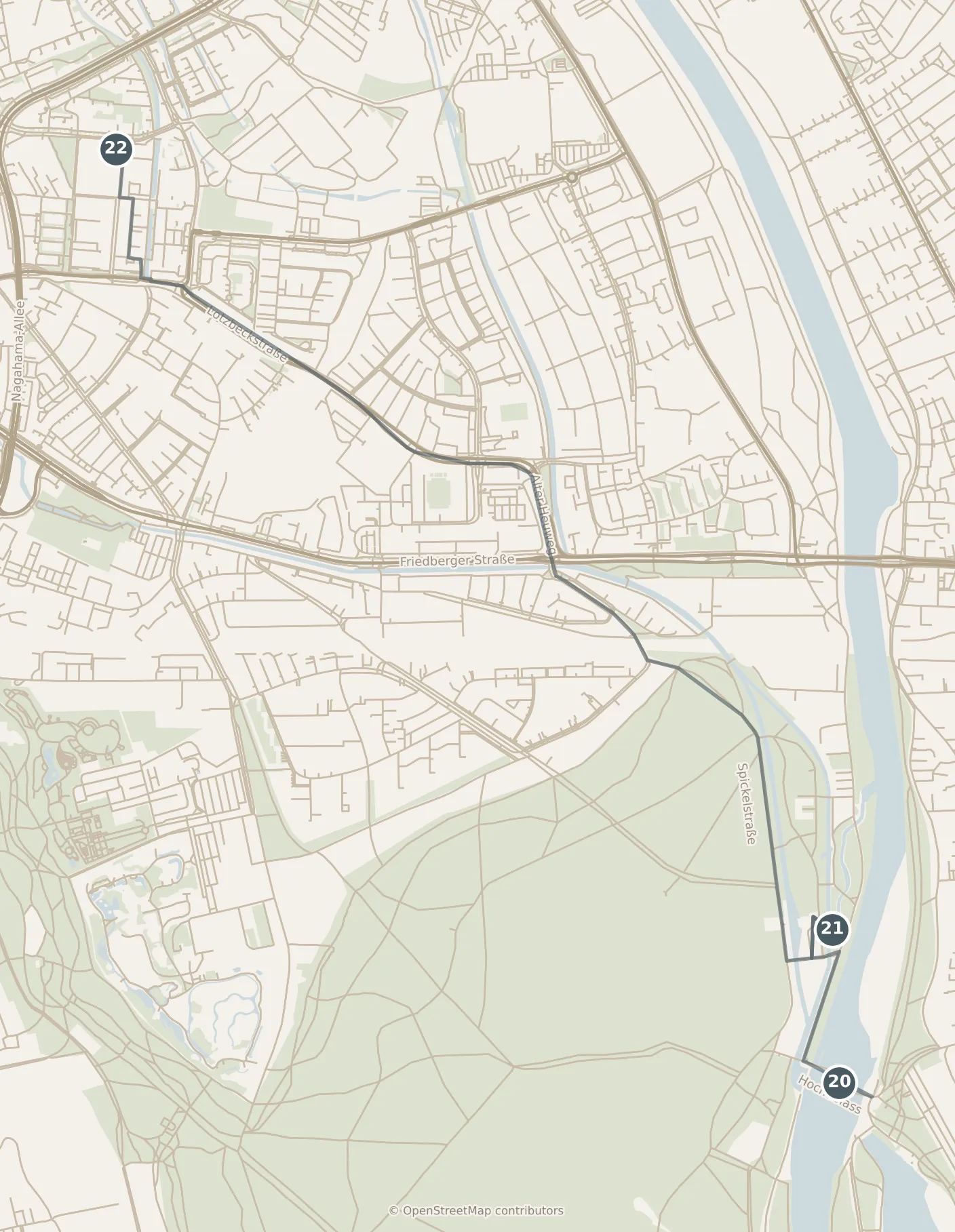
- With a third day
- 20Hochablass
- 21Eiskanal
- 22Textil- und Industriemuseum
A third day is not more of the same, and that is the argument for it. Days one and two show you what Augsburg’s money built; the third shows you the machine that made the money possible.
Go upstream to the Hochablass, the weir on the Lech four kilometers east of the center. This is the head of the whole system — the point where the river is divided and the canals you walked yesterday are sent into the town — and standing on it makes the previous day retrospectively legible. It is a tram ride east and a short walk, or an hour on foot along the river, which in decent weather is the better version. The riverbank here is where the city comes out in summer; the water at a working weir is fast and cold and not a place to get into casually, whatever you see other people doing.
A few hundred meters downstream is the oddest thing on the World Heritage list: the Eiskanal, the first artificial whitewater course ever built, cut for the 1972 Olympic canoe slalom and still in use. It is on the list for a serious reason — it is the modern end of eight hundred years of the same argument about what to do with a fast river — and you can walk the bank of it for nothing whenever there is no event on.
Then walk back downstream, about twenty minutes, to the Textil- und Industriemuseum, in the old Augsburger Kammgarnspinnerei — a worsted mill, not a cotton one, which matters because the fiber is what the city’s industry actually turned on. This is the modern half of the same story: the canals that drove medieval forges drove nineteenth-century looms, Augsburg became one of Europe’s largest textile centers, and then in the late twentieth century it stopped. The museum runs the surviving machines, which is the difference between a museum about industry and a museum of it. Two hours is not too long.
If machines are not what you came for, there are two honest alternatives. Stay in the city and spend the day slowly — the market in the morning, the canal lanes you rushed on day two, the stretch of water south of the Rotes Tor that most visitors never reach. Or leave it: Ulm is under an hour by train and has the tallest church tower in the world, and Munich is half an hour. Both beat stretching two good days into three thin ones.
Practicalities
Mondays. Three things on this route close: the Schaezlerpalais with its state gallery, the Maximilianmuseum, and the textile museum on the third day. That removes most of day one’s indoor time and all of the third day’s, so if one of your days falls on a Monday, make it day two — churches, streets, the Fuggerei and the canals, which survives it intact.
Sundays cost you the other half of the same problem. The Stadtmarkt is shut and so are the shops, which takes the market lunch out of day one and quietens the streets the first evening sends you to. The churches, by contrast, are at their most alive. It is a day to swap rather than to fight — but it wants the same slot the Monday rule above has already claimed, and on a Sunday–Monday visit there is no order that serves both. Give the Monday day two, because it shuts buildings outright where a Sunday only quietens them, and take the Sunday’s loss on day one: the market lunch goes, and the first evening’s streets are thinner than they should be.
8 August is the Hohe Friedensfest, a public holiday that exists in this city and nowhere else, and it closes things as a Sunday would. Worth checking against your dates precisely because no calendar outside Augsburg will warn you.
What needs arranging. The waterworks at the Rotes Tor is by guided tour on set times, and the Puppenkiste sells its tickets in advance — those two are the only things on the three days that a walk-up may not get you. The Fuggerei charges admission for the quarter and its gates close in the evening, a curfew kept since the sixteenth century, so it is a daytime stop and will not move to the end of an afternoon that has run long. Everything else here is walk-up, weather permitting.
Distances. Day one is about four kilometers of walking spread over a day, counting the walk in from the station and the length of Maximilianstraße twice; day two is much the same, and its longest single stretch is the twenty-five minutes down the canals from the Fuggerei to the Rotes Tor. Only the third day needs a tram, and only for the weir — the textile museum is a twenty-minute walk back from it and about the same from the center.


