One day in Augsburg: the oldest glass, the Fuggerei and the canal quarter

Last updated 15 October 2026
Overview
Augsburg is half an hour from Munich on a frequent train, and that has decided how it gets visited: as an afternoon, on the way to something else. One day is more than most people give it, and one day is genuinely enough — not as a consolation, but because the old town is small. Everything after the walk in from the station sits inside an oval about a kilometer and a half top to bottom, and every step of the day is walked. There is nothing to buy to get around.
What a day here buys you is a loop rather than a list, and the loop is the argument. The route goes out from the Hauptbahnhof along the top of the old town, drops east off the low rise the center stands on into the quarter where the water runs in open channels, follows those channels south to the old gate, and comes back up the merchant street to the square it started from. The only stretch it repeats is the walk to and from the station, and the return leg through the town is the sightseeing rather than the price of it.
What it costs you is the interiors. Augsburg has two serious collections beside a famous gilded hall, and on one day the hall earns its half hour while the collections are the first thing to give up: an hour indoors here is the hour that would have bought you the canal lanes, and the canal lanes are what this city has that the others on the same railway line do not.
One closure shapes the first hour, and it is worth knowing before you plan around a photograph. The town hall reopened on 28 September 2026 after two years of restoration, and with it the Goldener Saal, the gilded room that is the most photographed interior in the city. The Perlachturm beside it has been closed since 2017, when its staircase was condemned, with the full restoration begun in 2025 and completion announced for 2027 — its onion dome was lifted off in July 2025 and set down on the square below, where it has been standing at ground level during the works. Check the tower rather than assume, and read the morning below as written either way: it works with the tower shut, and if it has reopened you have gained something rather than lost the plan.
One stop on this day depends on the light, and it is not an evening one. The five prophet windows in the cathedral are painted glass with the sky behind them, and in the last thin hour of a December afternoon they are dark shapes. The sun sets here from about twenty past four in the middle of December to about twenty past nine at midsummer, so take your own month’s hour and work back: the cathedral sits about an hour into the route as written, and it wants a couple of hours of daylight still in the day when you reach it. From April to September that constrains nothing at all. In December an arrival much after one o’clock will not get the glass in the light, and the fix is to walk straight through to the cathedral and pick the square up on the way back down to lunch, which puts the windows half an hour earlier in the day. Be clear about what that buys, because it is not the loop: the day below runs five and a half hours, so a one o’clock start finishes two hours after a December sunset, and what the dark takes is the canal lanes — the best of the day, and the one stretch no reordering rescues. Only an arrival by about midday holds those in the light. After that the honest choice is the water in the dark, and the thing to give up is the two churches at the bottom of the merchant street: they are the stop with the least to lose and the first thing the dark takes.
December has a second thing in it that the light does not explain. From the Monday before the first Sunday of Advent to 24 December the Rathausplatz is the Christkindlesmarkt, on that square since 1963, so the square the day opens on is a market floor with stalls across it and the Augustusbrunnen standing inside it under its winter cladding. That is a reason to give the first stop longer than the half hour below, not a reason to skip it.
The stops below come to about three and a half hours spent inside things and a little under two hours on your feet between them: call it five and a half hours from the station and back to it. That number is standing still and walking, and nothing else. It does not include the Schaezlerpalais, the one interior this route deliberately walks past — go in and add an hour to everything above — and it does not include a slow lunch, which in this particular city is a reasonable way to lose another half hour.
Finally, the bag, because this is a format read mostly by people between trains. Augsburg Hauptbahnhof has luggage lockers — DB lists them among the station’s own facilities, which is where to check rather than trusting this line, since the station has been a building site since 2025 and stays one for years, and DB’s page does not say which part of the station they are in. The day starts and ends there, so in the ordinary case it is the easy one: leave the case, walk the loop, come back for it. Do take the trouble. The Fuggerei is somebody’s home and its lanes are cobbled and narrow, and the twenty-five minutes down the canals afterwards is the longest stretch of the day with nowhere to put anything down.
If the lockers are out and you are carrying everything, do not walk the loop as written — walk the short version, which is a real day and not a gesture. The first half is unchanged: station, Rathausplatz, cathedral, lunch at the market, the Fuggerei, so the oldest glass and the almshouse are both kept — the almshouse with the case in hand, which is the half of the warning above that no version of this day can answer, and the reason to exhaust the lockers first. Its lanes are cobbled and narrow and people live along them: go slowly, and keep to one side. Then, instead of turning south into the canal lanes, go back west to the top of Maximilianstraße and walk down it — the Merkurbrunnen, the Fuggerhäuser, the Schaezlerpalais and the Herkulesbrunnen stand on it in that order going south — as far as the two churches at the bottom, and west to the station from there, a little longer than the walk you came in on. That keeps every stop below but three: the canal lanes, the Rotes Tor and the waterworks behind it. It is shorter than the loop by the twenty-five minutes down the canals and the twenty spent at the gate and the towers, and that is the best of the day given up — the honest price of the case, and not a reason to skip the city.
The day

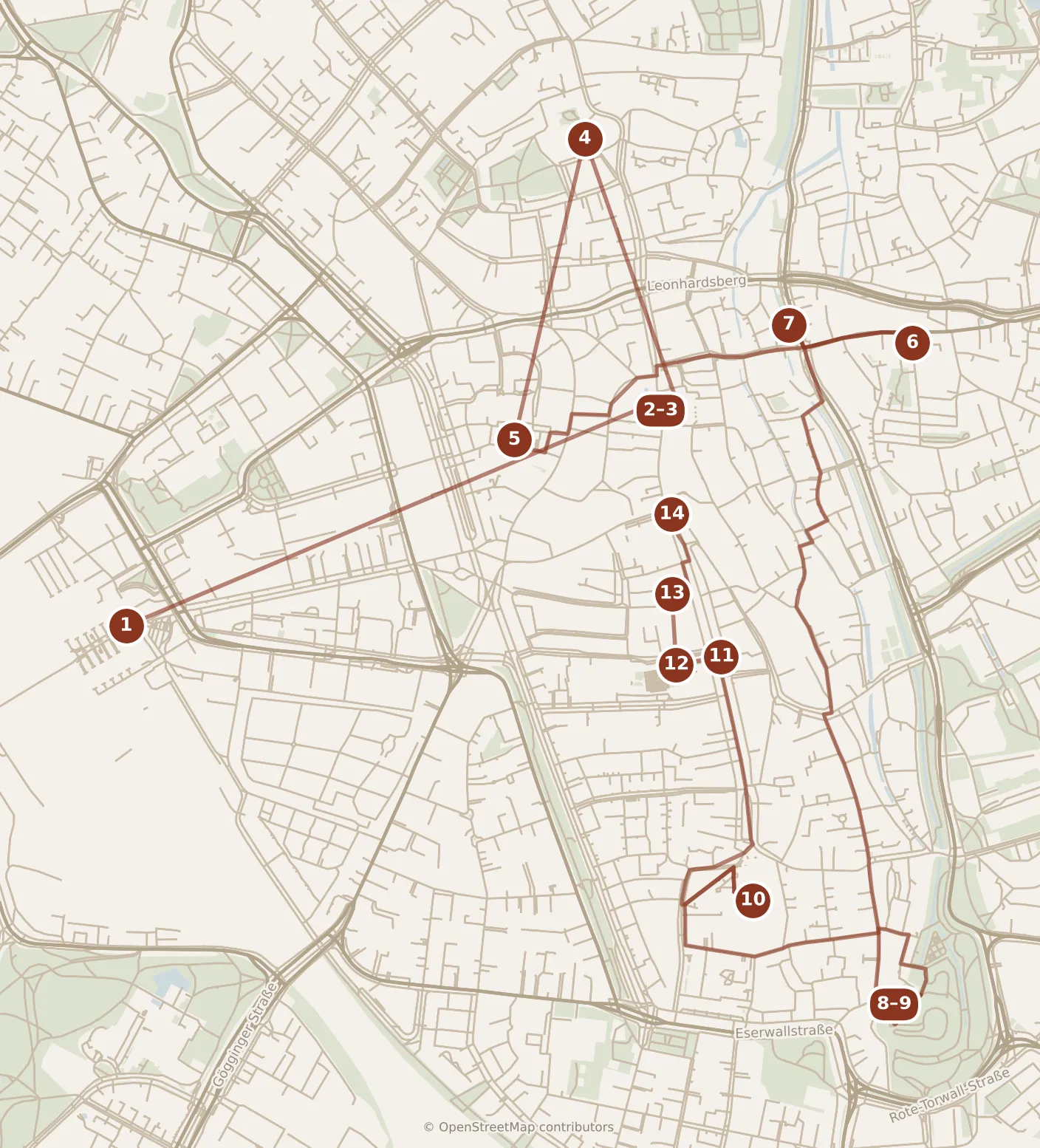
- The day
- 1Augsburg Hauptbahnhof
- 2Rathausplatz
- 3Rathaus
- 4Augsburger Dom
- 5Stadtmarkt
- 6Fuggerei
- 7Lechviertel
- 8Rotes Tor
- 9Wasserwerk am Roten Tor
- 10St. Ulrich und Afra
- 11Herkulesbrunnen
- 12Schaezlerpalais
- 13Fuggerhäuser
- 14Merkurbrunnen
Morning
Walk in from the Hauptbahnhof. It is just under twenty minutes east on the flat to the Rathausplatz, the old town climbs a rise so gentle you will not notice it, and arriving on foot is the only way to register how small the center is — which is the fact the whole day rests on.
The square is dominated by the Rathaus, and it is the reason Augsburg matters to architectural history. Elias Holl built it between 1615 and 1620, with the interiors finished by 1624, and nothing of that scale or that confidence had been put up in Germany before. The Goldener Saal upstairs reopened with the building in September 2026: give it half an hour and see it before anything else.
Beside it the Perlachturm stands in scaffolding. Treat the tower as furniture rather than a viewpoint — but look for its dome, which since 2025 has been sitting on the square at ground level, and which is a rare chance to stand beside a thing that normally lives on top of a tower. In the middle of the square is the Augustusbrunnen, the oldest of the city’s three bronze fountains, put up in 1594 to honor Augustus as the city’s founder — a Roman foundation the city has never once stopped mentioning. In winter it stands under wooden cladding, put on to keep the weather off it. Half an hour covers the square, the entrance hall and the fountain, and more than that in the Advent weeks when the market is on it.
Then nine minutes north to the Augsburger Dom. It is a long building of many centuries, Romanesque at the core and Gothic at the east end, and it holds one thing worth the walk on its own: five figures of prophets — Jonah, Daniel, Hosea, David and Moses — in painted glass, set in the clerestory windows high above the nave arcade on the south side. They are the oldest large-scale figurative stained glass surviving anywhere, and how old is genuinely argued: the proposals have run from the early eleventh century to the middle of the twelfth, the specialist literature now leans to the middle of the twelfth, and the tourist office still prints 1065. You find them by looking up rather than by walking anywhere, and they are smaller, darker and cruder than the glass around them, which is how you know you have the right row. Four are close to original and the Moses was remade around 1550. Give the cathedral half an hour and spend ten minutes of it on that one row of windows, because once you start on the rest of the building you will not come back to them.
Lunch is ten minutes back south-west, at the Stadtmarkt: two roofed halls with fixed open stalls east of them and the farmers’ market west, where the city actually eats at midday. The city’s own dish is the Zwetschgendatschi, the plum sheet cake sold by the slice in late summer, which Augsburg has claimed hard enough to have earned the nickname Datschiburg for its trouble; Kässpätzle, if a counter has it, is the Swabian regional plate rather than the city’s own. Three quarters of an hour, sitting down.
Afternoon
Thirteen minutes east of the market is the Fuggerei, and it is the one stop on this day you pay for. Jakob Fugger, who financed emperors and was probably the richest man in Europe, founded it in 1521 as housing for Augsburg citizens who had fallen into poverty through no fault of their own. It has been lived in continuously for five centuries and the rent is still the one he set: 0.88 euro a year, plus three prayers a day for the founder’s family, written into the tenancy. It stands in the Jakobervorstadt, behind its own walls and its own gates, and none of the three Lech canals runs past it — those are in the Lechviertel, south-west of it — so do not go looking for it on the water lanes.
Give it an hour, and spend the hour on the lanes — but know what that costs, because the ticket also admits you to four small museums inside the walls (history and living, the residents, daily life, and the wartime bunker) and to a furnished historic dwelling, and an hour on the lanes writes all of it off. Take one of them only if you are giving the Fuggerei more than the hour above. It is also the one door on this route that shuts while the streets do not: in 2026 the gates closed at eight in the evening from April to September and at six from October to March, which is what fixes the Fuggerei to the first half of the afternoon rather than the end of one. The Fuggerei’s own visitor page is where those hours are published, so read them there, build the afternoon forward from lunch, and if the hour has moved, build it forward from the new one. Nothing needs booking — the adult ticket was under ten euros in 2026, bought at the gate rather than online.
Now south into the Lechviertel, which is the half of Augsburg the day trips miss. The old craftsmen’s quarter is named for the three canals that run through it in parallel — Vorderer, Mittlerer and Hinterer Lech, each with a lane of the same name beside it — cut off the river and dropped through the town on a gradient that turned mills, forges and later looms. Follow any of them southward. Brecht was born on this stretch, at Auf dem Rain 7, with the Hinterer Lech running past the front of the house and the Mittlerer Lech behind it; it is a city museum now, and you walk by it whether or not you go in. The straight-line walk to the old south gate is about twenty minutes and the water does not go in straight lines, so reckon on twenty-five; it is the longest single stretch of the day and the most pleasant, and the thing to watch as you go is which buildings turn to face the channel and which have their backs to it, because that tells you which trade was on which lane.
The lanes end at the Rotes Tor, the old south gate, and immediately behind it is the Wasserwerk am Roten Tor: three water towers and two well-masters’ houses that lifted drinking water into the town from 1416 until 1879, and the oldest surviving waterworks in Germany. This is the centrepiece of the water management system inscribed by UNESCO in 2019, and the argument it makes is engineering rather than beauty — the canals supplied the power, the towers supplied the pressure, and the city separated drinking water from working water as early as 1545, which is why a town this far from a coast or a capital could be rich at all. The towers themselves are not walk-in and you should not build a day around them. The Brunnenmeisterhof courtyard is free to walk into while the museum in it is open, and either way twenty minutes outside among the towers, the gate and the channels carries the whole point.
From the gate it is a few minutes north-west to St. Ulrich und Afra, where two churches stand close enough to touch, one Catholic and monumental, one Protestant and plain. That is not an accident of planning: the smaller building was the abbey’s preaching hall and was given to the Protestant congregation in 1526, and after the religious settlement of 1555 the pairing became the thing this city says about itself. Ten minutes inside each is plenty. The adjacency is the point, not the interiors.
Evening
From the churches, walk north up Maximilianstraße, which is less a street than a demonstration: wide to the point of discomfort, lined with palazzo-scaled houses, and laid out to be looked down. It is about twenty minutes to the top with the stops below, and it is the return leg, so nothing on it is out of your way.
The Herkulesbrunnen comes first, Hercules bringing a club down on the Hydra, and the Schaezlerpalais stands beside it, interrupting the merchant houses with a rococo banqueting hall of mirrors, white and gold and a painted ceiling of clouds, built by a banker in the 1760s when the money was two centuries past its peak and the display had not stopped.
Local tip. You have one spare hour on this route and two places to put it: inside the Schaezlerpalais, or on the canal lanes at half the pace. On a single day, take the water. The hall is a very good rococo room and you have seen the like of it elsewhere; three open canals running down the middle of a German city is the thing this place has and the others on the line do not.
Two minutes further up are the Fuggerhäuser, and this is where the two halves of the day turn out to be one story. Jakob Fugger built the complex from 1512 as a town house and a warehouse, and in October 1518 the papal legate Cajetan was lodged in it and Luther was brought here three times over three days to be talked out of his position. He was not talked out of it. The upper floors hold offices and shops, but two of the three inner courtyards are open to visitors — the Damenhof, arcaded on Tuscan columns with painted arches and reckoned one of the finest courtyards in Germany, and the Serenadenhof. Go into the Damenhof, and know that the man who paid for the almshouse you walked through after lunch also paid for this, and that the Reformation was argued about behind that wall.
Last on the street, another two minutes north, is the Merkurbrunnen, Mercury caught mid-stride — by Adriaen de Vries, like the Hercules below it, and like the Hercules a copy, the originals of all three fountains having been taken indoors long ago.
Then get off the street. Maximilianstraße is broad, and the mistake a single evening makes is staying on it because it looks like the main event. The eating is a street back on either side, and the two sides are close enough that you can walk one and then the other before choosing. In winter you will not see the fountains at all: all three are boxed in wooden cladding against the weather, so the Hercules and the Mercury you walk past are hoardings rather than bronze. That gives the spare hour above a third possible home — the restored originals of all three fountains are indoors in the Maximilianmuseum. In summer they run and are there at any hour of the day or night, so take the street in daylight and give the spare hour back to the canals.
From the top of the street the Hauptbahnhof is just under twenty minutes west on foot, the same walk you came in on, with the lockers at the end of it. Allow the twenty minutes and not fifteen: it is the one stretch of this day with a deadline attached to it.
Practicalities
Nothing on this route needs booking, and one thing on it cannot be booked. The Fuggerei is walk-up and is the only ticket the day contains. The water towers behind the Rotes Tor are the exception in the other direction — they are shown by arrangement through the city’s tourist office rather than on a published schedule, so a single day is the wrong trip to spend chasing them. The courtyard and the outside are free and are what this itinerary sends you for.
The weekly closing day. The Schaezlerpalais is the only stop on the route that shuts one day a week, and the city’s own museums site is what publishes which day, so check it there if you intend to go inside. The same site carries the Maximilianmuseum and the Brecht house, which this day offers as somewhere to put the spare hour rather than as stops — if the hour is going to one of those, check that one on the same page rather than only this. If it falls on your day you lose nothing the route depends on: everything else on this loop is a street, a square, a church, a market or a walled quarter, and the day was written to walk past the palace rather than into it.
Sundays cost you the lunch. German shop hours close the Stadtmarkt on a Sunday and thin it out on a Saturday afternoon, which takes the market stop out of the morning. The canal lanes are the replacement — there is more eating down there than the quiet suggests — so on a Sunday go from the cathedral straight to the Fuggerei and eat afterwards, by the water. That order also puts the walled quarter well inside its gates’ hours instead of pushing at them. On a Sunday the churches are in use rather than empty, which is a different visit and can mean waiting for a service to end. Service times are not published anywhere a visitor will find them — the diocese pages that should carry them are dead — so the tourist office is the place to ask.
8 August is the one date to check against your own. The Hohe Friedensfest is a public holiday that exists in this city and nowhere else, and it shuts the shops and the market as a Sunday would. No calendar outside Augsburg will warn you, which is the only reason it is worth repeating here.
Distances. The loop comes to a little under eight kilometers of walking, none of it steep, in a center where nothing is more than twenty-odd minutes from the Rathausplatz. Four legs carry most of it: the two walks between the Hauptbahnhof and the square, just under twenty minutes each; the twenty-five minutes down the canals from the Fuggerei to the Rotes Tor; and the twenty minutes back up Maximilianstraße at the end, which is the only one of the four that is itself the sightseeing. Everything else is under a quarter of an hour. If what you want is the arrival, the trains and the transport pass rather than this route, that is the city guide’s ground and it covers it properly.


.jpg)
