Antwerp in two or three days: the cathedral, the museums of the Zuid, and the walk under the river

Last updated 15 August 2026
Overview
What a second day in Antwerp buys you is the indoors. A single day here is a walk — the cathedral, the squares, the water — and it is a good one, but it goes past every door it has time only to name. Two days is that walk plus the collections the walk was built to serve: a fashion museum on the street that gave the city its modern reputation, in the south four centuries of the painting this port paid for, and a printing house that has been in the same rooms since the sixteenth century with the presses still standing in them. That printing house is closed for renovation until 5 December 2026, and until that date day two is a two-collection day rather than a three: the morning goes to the Mayer van den Bergh collection, which is itself out of its building and being shown ten minutes east of the cathedral, the afternoon goes to the painting in the south, and the fashion museum comes out to make the hours work. The days below take one district each. Day one is the medieval core; day two runs south from behind the cathedral into Het Zuid and comes back to the river at the end of it.
Neither day needs a vehicle. After the walk in from the station, day one stays inside a kilometer of the cathedral, and day two’s longest single stretch is the twenty-five minutes back north in the evening. This is a flat, paved city and the trams are for the day your legs have finished, not for following this.
Two hours decide the shape, and only two. Day one is counted forward from the cathedral’s door. In 2026 it took visitors from ten in the morning, stopped admitting them in the middle of the afternoon on a Saturday, and did not open to them at all until after lunch on a Sunday; the cathedral publishes its own hours and that is where a change appears before it appears anywhere else. Read them against your date and count the morning forward from whatever you find — if the hour has moved, the shape has not. The second hour is not an hour but the light, and it belongs to the end of day two. The city stands on the east bank and can only be seen whole from the west one, and it is lit from behind you in the afternoon and against you in the morning, which is why the crossing under the river comes last rather than first. Sunset here runs from about half past four in the middle of December to a little after ten at the end of June — five and a half hours of spread, wider than anything else you will plan around — so take your own month’s hour and count back from it.
Day two’s clock depends on which building the morning gets. Until 5 December 2026 the day runs from the Maagdenhuis door to the mouth of the tunnel in about five and three quarters, lunch included, and that reaches the far bank with light still on the city even in the last week of December. With the printing house open it is about seven and a half hours from its door instead, and in the darkest weeks that will not close from a ten o’clock start — the fix is written into the day below: drop the fashion museum and its twenty minutes of street, take the Royal Museum in two hours rather than two and a half, and you are back to five and three quarters. Either figure is the time spent inside things and walking between them and it is nothing else: it has no coffee in it, no ticket desk, and no allowance for the fact that people who mean to give the Royal Museum of Fine Arts two hours routinely give it three.
What is worth settling before you travel is the timed slots, and until 5 December 2026 there are two of them rather than one. The Royal Museum of Fine Arts admits by timed slot — online, or at the ticket machine when you arrive; on a weekend the next free one can be hours off, so book the day before, and an adult ticket was in the twenty-euro range in 2026. The other is day two’s substitute morning: the Mayer van den Bergh collection is being shown as a ticketed exhibition sold online for a fixed time block, with no machine at the door to fall back on, so it is booked before you travel in the same sitting as the afternoon. From 5 December the morning is the printing house again and the Royal Museum is the only slot on the trip. Everything else you buy where you stand. How the trams and the premetro are paid for belongs to the city guide rather than to this route, but the word you would have to type is De Lijn — it runs them, the app of that name sells a one-way ticket or a day pass on a phone, and the reusable card the machines and shops load is a MOBIB. On these two days you are unlikely to need any of it before the third.
If day one is also your arrival day, think about the bag first. Day one begins inside Antwerpen-Centraal and never comes back to it, so book your train there — the airport one and a long-distance one alike — rather than to the city’s other station, because the walk in along the Meir that opens the day starts nowhere else. The day then walks steadily away from the station and finishes on the docks, thirty-five minutes back on foot. The lockers are inside the station, which is built on four levels; find them on the way in rather than at the end of a day that does not return there. The third day is the one that ends at Antwerpen-Centraal, which makes it the right last day for anyone with an evening train.
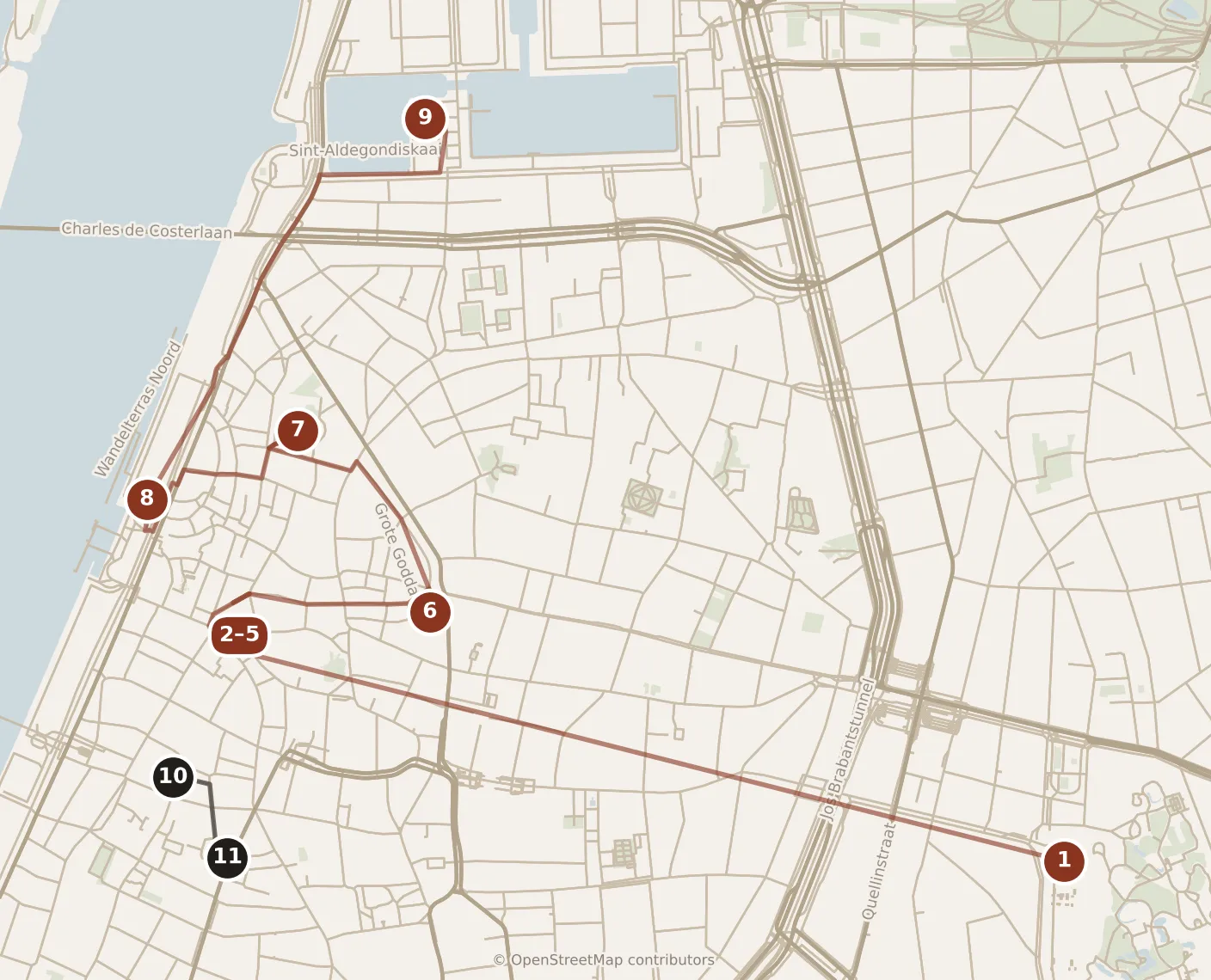
- Day one
- 1Antwerpen-Centraal
- 2Onze-Lieve-Vrouwekathedraal
- 3Handschoenmarkt
- 4Vlaeykensgang
- 5Grote Markt
- 6Carolus Borromeuskerk
- 7Sint-Pauluskerk
- 8Het Steen
- 9Museum aan de Stroom
- Day two
- 10Museum Plantin-Moretus
- 11MoMu
Day one

Today is one slow arc through the oldest square kilometer of the city: west from the station to the cathedral, north through the guild squares into the churches, out to the water, and then a last stretch up the quay to the docks. Nothing is retraced.
From the cathedral door the day below comes to about six hours, lunch included — the stops and the walks between them come to a little under five, and the sitting-down hour in the lanes behind the Grote Markt is the rest of it. So a ten o’clock start finishes on the roof in the late afternoon in any month of the year. That six hours counts what you do, the hour at the table and the walking between it all. It does not count the ticket desk at the cathedral, which in summer is the one line on this route, and it has no café in it.
Morning
Begin inside Antwerpen-Centraal — you are standing in it anyway — and then leave by the front and head west along De Keyserlei and the Meir. Half an hour of shopping street, and the dullest half hour of the two days, but it puts you at the top of the old town on your feet, and a tram would save you almost nothing on a straight line this short.
The Onze-Lieve-Vrouwekathedraal is what the morning is arranged around, and with two days you can give it an hour and a half instead of the hour a single day allows. From outside, look at the west front before you go in: only one of the two towers was ever completed, at a hundred and twenty-three meters, and the stub beside it has been waiting since the sixteenth century — the asymmetry is permanent, not scaffolding. Inside is the largest Gothic church in the country, and four altarpieces by Rubens hang in it. Two of them, The Raising of the Cross and The Descent from the Cross, are the reason anybody comes. Here is what the extra day is for: walk the aisles first and the paintings second, and then go back to the two triptychs once you have seen what they were hung among. On a single day you look at them and leave.
Come out on the north side into Handschoenmarkt, the small wedge of a square pressed against the tower where gloves were once sold. Five minutes. The wedge is wide enough to take in the spire without standing directly beneath it, which most of the lanes around the church are not.
A minute on, off Oude Koornmarkt, an arch you would walk past leads into the Vlaeykensgang — a lane of 1591 built as housing for the poorest people in one of the richest cities in Europe, and now eleven small brick houses around a set of courtyards. Since about 2020 the exit onto Hoogstraat has been shut, so you go in and come out the same way, which is part of why it stays quiet. The rest of the reason is that these are front doors rather than exhibits: go in quietly, read whatever the arch asks of you, and do not treat the courtyards as a set. Ten minutes.
A minute further north the lanes open onto the Grote Markt. Read it as a competition: each of the guild houses on the north and west sides is a narrow front trying to out-gable its neighbors, and the long horizontal palace across from them is the city hall, finished in 1565 to a design by Cornelis Floris de Vriendt, wrecked in the Spanish Fury of 1576 and put back within three years. The fountain in the middle is Jef Lambeaux’s, from 1887, and the young man on it is throwing a severed hand. Twenty minutes.
Lunch is in the lanes immediately behind the square, sitting down. Give it to stoverij — beef braised for hours in dark beer, with frieten — because the afternoon is two church interiors and you will not want it afterwards.
Afternoon
Seven minutes east, Hendrik Conscienceplein is a traffic-free cobbled rectangle with the Carolus Borromeuskerk closing one end. The facade is the reason to come: a tall screen of carved stone built up in tiers, more like the front of a palace than of a church, and the tower behind it is worth as long as the front. The interior was rebuilt after a fire in 1718 that destroyed thirty-nine ceiling paintings Rubens had made for it, which is a useful thing to know while you are looking at the ceiling that replaced them. Half an hour.
Eight minutes north-west, Sint-Pauluskerk is Brabantine Gothic with a Baroque tower on it, gutted by fire in 1968 and largely rebuilt, and it holds three more Rubens and a run of confessionals carved with figures at life size. But the thing that earns the walk is outdoors, in the walled yard beside it: a Calvary built up between 1697 and 1747 out of sixty-three life-sized statues, angels, saints, rocks and a tomb, arranged in the open air. Half an hour, and half of that in the yard. This church keeps a narrower window than anything else on day one — afternoons, and for much of the year weekends only — so it is the single stop here to check against your date. If it is closed nothing breaks; you reach the quay earlier with more evening in hand.
Local tip. If the afternoon runs short, drop the Carolus Borromeuskerk and keep Sint-Pauluskerk. They stand eight minutes apart and they are Baroque interiors of much the same generation, so you are not losing a category — and only one of the two has sixty-three statues standing in a yard beside it.
Six minutes west, past the end of the lanes, the quay opens out and Het Steen is on it: a squat stone gatehouse of the early thirteenth century, all that is left of a castle the nineteenth century demolished around it. What you want here is the outside and the water. Twenty-five minutes on Steenplein, which is the first point in two days at which the Scheldt explains the city — it is very wide, it is tidal, and there is no bridge anywhere in sight, which is a fact day two makes use of.
Evening
Seventeen minutes north along the water, on the old inner harbor in Het Eilandje, stands the Museum aan de Stroom: a stack of red sandstone boxes, each rotated against the one below so that the glass in the gaps winds up the outside. The escalators that climb it are free, they are a separate proposition from the ticketed floors, they run later than those do, and the roof at sixty meters hands you the old town, the docks and the river going north all at once. Three quarters of an hour, most of it at the top.
This is the one stop on day one that does not mind the dark. In December you will get here after the light has gone and see the port lit instead, which is a different picture rather than a poorer one — and that is precisely why day one is counted forward from a door and day two backwards from the sky.
Dinner is either five minutes away among the converted warehouses on the dock, which is the modern half of the city, or eighteen minutes back down into the lanes of the core. If you are walking to Antwerpen-Centraal afterwards, allow thirty-five minutes south-east across the top of the old town; there is also a tram from the Eilandje into the center — 7 at the time of writing, and lines here are renumbered often enough that the direction is the durable half of that sentence — which will take you as far as Meirbrug, still ten minutes short of the station.
Day two

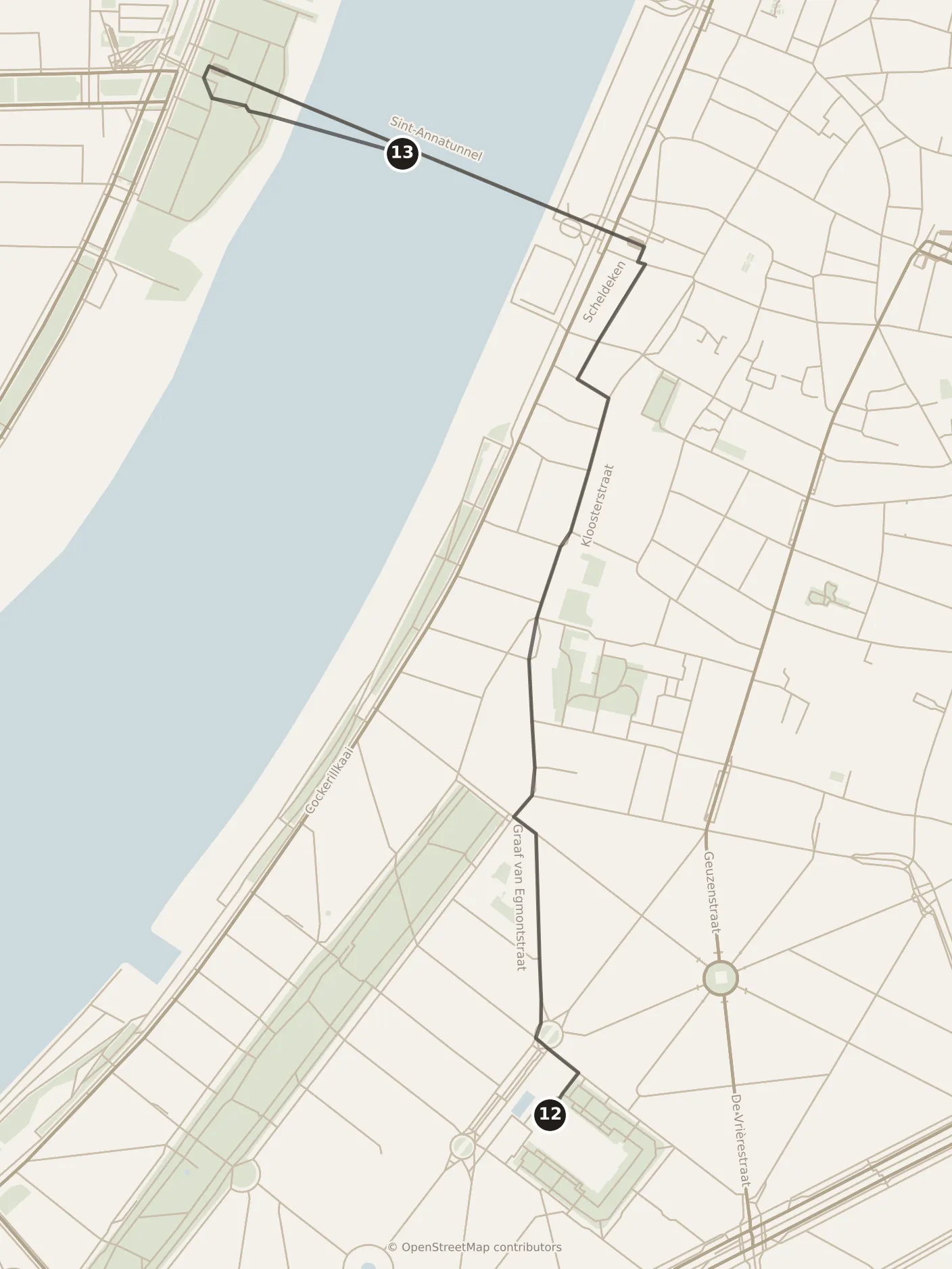
- Afternoon and evening
- 12KMSKA
- 13Sint-Annatunnel
The museum day, and it runs in a line south out of the old town into Het Zuid — through the fashion streets once the printing house reopens, and straight down from the collection east of the cathedral until then — and then back north to the river for the last of the light. This is the day the second night in Antwerp exists for.
Morning
The Museum Plantin-Moretus, which this morning is normally built on, closed on 3 August 2026 for renovation and reopens on 5 December 2026. Until that date the morning goes to the Museum Mayer van den Bergh’s collection — and not to the museum, because that door is shut too. The house on Lange Gasthuisstraat, east of the cathedral, is under a renovation of its own running to 2030, and the paintings have moved a short way up the same street into the Maagdenhuis, where about ninety of them are hung as an exhibition called Beloved, announced to run until September 2028. Pieter Bruegel the Elder’s Dulle Griet is in it, and that justifies a morning by itself. Give it an hour and a half.
Two things follow from its being an exhibition rather than a museum, and both cost you the morning if you ignore them. The ticket is sold online for a fixed time block and there is no machine at the door, so this is a booking to make before you travel and to place at the start of your morning — the second booking on the trip, alongside the afternoon in the south. And an exhibition has an end date and a borrowed address, either of which can move before the printing house reopens: read the museum’s own page against your own dates for where the collection is being shown and how the slot is sold, and take what it says over this paragraph. What will not have moved is the shape of the morning — an hour and a half with the collection, wherever it is standing, and the Monday rhythm described below until it says otherwise.
Square it with the picture, too. The walking map above carries day two’s morning at the end of day one’s, and it shows that morning in the order it will have after 5 December — the printing house, then the fashion street — so its numbered index and its maps-app links go to those two doors. Until the reopening, follow this paragraph rather than the map for the morning. Day one is unaffected, and so are day two’s afternoon and evening.
From the Maagdenhuis the walk south to the afternoon is the same twenty minutes as from the fashion museum, so nothing else in the day moves; what you lose is the fashion museum, which sits on the other side of the morning from it, and the day comes in an hour and three quarters shorter than the one counted from the printing house.
From 5 December the morning is the printing house again, and it is what day two runs in this order for. Start on Vrijdagmarkt, at the house and workshop of Christophe Plantin and his son-in-law Jan Moretus, who printed for half of Europe from these rooms. It is a UNESCO World Heritage site and there is nothing else like it: the presses stand where they were worked, two of them among the oldest anywhere in the world, and the library, the type foundry and the family’s own painted rooms are laid out as a house that happened to contain a factory. Two hours. If you slow down for one thing, make it the type — the punches and matrices in those cases are the physical originals of letters still being set today. A reopening date is a plan until the day it happens, so read the museum’s own page against your date before you build a morning on it.
Three minutes south, MoMu holds the corner of Nationalestraat in the middle of the fashion quarter. It runs on temporary exhibitions beside a rotating presentation drawn from its own collection, so the program rather than a fixed hang decides whether the hour is well spent — and that is a genuine risk, not a formality. It publishes what is on at any date on its own site, which is worth a minute before you give it an hour. What does not change is the street, and the reason a fashion museum stands on it: the designers who came out of the city’s fashion academy at the start of the 1980s, the Antwerp Six, and four decades of shops that followed them. An hour inside, twenty minutes walking the grid around it.
Lunch here rather than back on the squares — this is a district that feeds the people who work in it, and it is a better hour for the same money. That is the reopened branch. Until 5 December the fashion quarter is not on your line at all, and the lunch hour goes into the streets between Lange Gasthuisstraat and the top of Het Zuid, on the way down to the afternoon — the same kind of hour for the same reason, in the district you are actually crossing.
Afternoon
Twenty minutes south on foot, the Royal Museum of Fine Arts — KMSKA on every sign in the city — reopened in 2022 after eleven years closed. It is really two museums sharing a shell: the original top-lit nineteenth-century halls holding the historic collection, and a white sequence of new rooms cut into the courtyards above them for the modern one. What you came for is the historic side, and inside it the early Flemish panels and the room of Rubens, which is where his work lives outside the churches you spent yesterday in. Give it two and a half hours.
If you are flagging, cut the modern half rather than a wing of the historic one. It is very good and it is a different temperament entirely, and the reliable way to leave a museum resenting it is to attempt both in one afternoon.
Local tip. On a full day two — printing house, MoMu, Royal Museum — the one to drop is MoMu, and the reason is structural rather than snobbish: it is the only one whose program changes, so it is the only one you can skip without knowing what you skipped. Losing it and its twenty minutes of street takes an hour and twenty off the day and moves the river crossing that much earlier — which in winter is the difference between seeing the city front and seeing its outline.
Evening
Twenty-five minutes north on foot, along the streets a block back from the water, brings you to Sint-Jansvliet and the entrance to the Sint-Annatunnel. It was opened in 1933, it is a little over half a kilometer long, it sits some thirty meters beneath the river, and much of its original fitting is still in place, the wooden escalators included — those are taken out of service for maintenance from time to time and the elevators stand in for them. There is nothing to pay. Treat it as a road rather than as a monument: this is how people on the far bank cycle to work, so keep to one side, expect a bell behind you, and stand out of the middle if you want to look at the wood.
Come up on Linkeroever and the city front is across a very wide river with the afternoon sun behind you and on it — but do not expect it at the mouth of the tunnel. Walk out to the bank and give yourself a few minutes to find the angle that takes in the whole front rather than a slice of it. This is the moment day two is arranged around, so work backwards from it: the crossing, that walking and the standing about want an hour, everything above them comes to about five and three quarters until the printing house reopens and seven and a half after it, and the Overview gives you the sunset band to subtract from. Walk back through the tunnel rather than waiting on a boat. Dinner afterwards is in Sint-Andries or in the lanes behind the Grote Markt, seven minutes east of where you surface.
With a third day

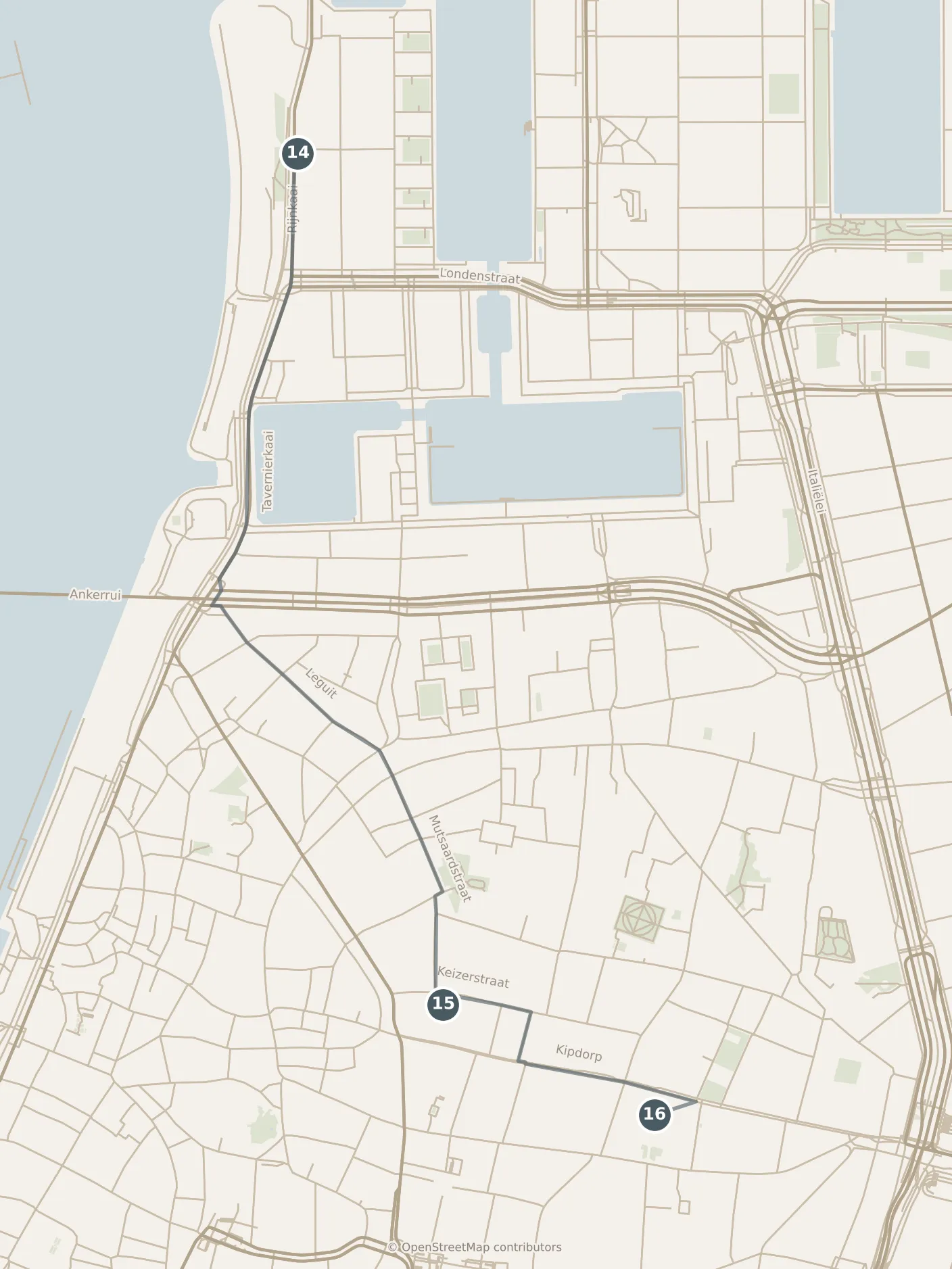
- With a third day
- 14Red Star Line Museum
- 15Snijders&Rockoxhuis
- 16Sint-Jacobskerk
A third day is appended, not inserted, and nothing above it moves. Days one and two are the city the money built; the third is where the money came from and where it ended up. It runs west to east across the top of the map — the docks first, then the eastern edge of the old town — and it finishes at Antwerpen-Centraal, which makes it the correct last day for anyone with a train.
From the Red Star Line door to the station the day below comes to about seven and a quarter hours, lunch included — taken between the docks and the old town rather than at either end of the walk. Take only the port floors of the Museum aan de Stroom and it is six and a quarter; skip that building altogether and it is five and a quarter. Count it back from your train rather than forward from breakfast, and drop from the middle.
Start on the docks at the Red Star Line Museum, in the sheds where the shipping line inspected, questioned and washed the emigrants it was carrying to New York before it would let them board. Something close to two million people left through this company in the half-century up to 1935, and the museum is built out of their paperwork, their luggage and the medical examination they had to pass. An hour and a half, and it is not a cheerful ninety minutes.
Nine minutes south is the Museum aan de Stroom again — this time the floors underneath the roof you stood on, which are a separate ticket from the escalators and hold the city’s own history of port, trade and river. Two hours to do it properly, an hour if you take only the port floors, and skipping it altogether is a defensible choice: you have already had the best thing the building does, and it is free.
Sixteen minutes south-east, back into the old town, the Snijders&Rockoxhuis is two adjoining houses — one belonging to Nicolaas Rockox, mayor of Antwerp and Rubens’s patron, the other to the painter Frans Snijders. It is hung as a house rather than as a gallery, with Rubens, Anthony van Dyck and Snijders on the walls of ordinary rooms, and after two days of churches and a very large museum it is the right scale to end on. An hour and a quarter.
Seven minutes east, Sint-Jacobskerk is where Rubens is buried, in the family chapel behind the high altar, which he had furnished himself and hung with one of his own paintings. That is the last of him and it is the right last of him. Half an hour. It keeps shorter and more seasonal hours than the cathedral does, so it is the stop on this day to check before setting out; if it is shut, the half hour goes to the streets below instead.
The last sixteen minutes east bring you to Antwerpen-Centraal, and the diamond quarter is on the station’s own doorstep — Hoveniersstraat, Pelikaanstraat and the blocks around them, along and behind the tracks, where a large share of the world’s rough stones still changes hands across a few plain streets of security doors. Whether it falls on your line to the station or costs you a few minutes round the side of it, take the few minutes. It is also the daily life of a Hasidic Jewish community that has been settled here for well over a century, and two things follow that a visitor cannot guess. The quarter keeps Shabbat: from Friday afternoon to Saturday night, and on Jewish holidays, the trade is closed and these are simply residential streets — walk through them by all means, but not as sightseeing. And do not photograph people here. Neither is a matter of manners in the abstract; the way you find out is by being stopped.
Finish inside Antwerpen-Centraal, which on day one you walked out of without looking up. The ceremonial hall of 1905 sits under its dome at the top of the building, and the later levels were tunneled in underneath it, so depending on which one your train uses you may arrive a floor or two below the part worth seeing: if in doubt, go up. Fifteen minutes, in a building you were going to be standing in regardless.
Practicalities
Bookings made before you travel: two until 5 December 2026, one after it. The Royal Museum of Fine Arts admits by timed slot, and although the machine in its entrance will give you one on the spot, the door is not a dependable substitute for the website at a weekend. Book the day before at the latest and take an early-afternoon slot, which is the shape day two is written to. The second is day two’s morning while the printing house is shut: the Mayer van den Bergh collection is being shown as an exhibition that sells a fixed time block online and nothing at the door, so it is not one you can turn up for — book it for the start of the morning, in the same sitting as the afternoon. From 5 December the morning is the printing house again and is bought on arrival like the rest. The cathedral, the two churches, the printing house once it reopens, the fashion museum, the docks museums and the house museums are all bought where you stand.
Monday is what decides whether the order above survives, and the split here is unusually clean. The city’s own museums take Monday off as a group — the printing house when it reopens, the fashion museum, the emigration museum, the Rockox houses and the Museum aan de Stroom, and that last one takes its free rooftop escalators down with it. The group breaks its own rule twice a year and in your favor: it opens on Easter Monday and on Pentecost Monday, two of the Mondays a visitor is likeliest to be traveling on. What it shuts for instead are fixed dates whatever the weekday — the first of January, the first of May, the first of November and the twenty-fifth of December, with a house here or there keeping one fewer or one more of its own. That is a rule rather than a list of dates that rot, and it is the same sentence every year. The Royal Museum of Fine Arts is outside all of it: in 2026 it opened every day of the year except the twenty-fifth of December and the first of January, closing early on the twenty-fourth and the thirty-first, which is the only reason a Monday here is workable at all. So if one of your days falls on a Monday, run day one’s core that morning — the cathedral, the squares, the alley and the quay do not close, and neither does the tunnel — then give the afternoon to the Royal Museum in the south and the last of the light to the crossing. What you give up is the rooftop, which moves to whichever day is not a Monday, and day two’s morning museum, which moves with it — those two are what the other day is built around. Check the two your own days rest on rather than trusting the group: a museum that changes its rest day does it quietly.
Sint-Pauluskerk on day one and Sint-Jacobskerk on the third day both keep narrow seasonal hours, and both publish them themselves. They are the two stops where turning up hopefully is a real gamble, and neither carries a day: day one absorbs the loss into a longer evening on the quay, and the third day absorbs it into the diamond streets. All four churches on these days are working parishes before they are anything else, and a service can close the nave inside the published hours — the cathedral, which day one is counted forward from, is the likeliest place for that to happen. The answer is to wait at the back until it ends or to come back later, and not to walk the aisles with a camera up.
The calendar that governs Antwerp is not a week. Two things take the squares over and neither sits on a date you can memorize. From the end of November into the first days of January, Winter in Antwerpen fills the Grote Markt and Groenplaats with a market and a rink: day one still works, but those two squares are a market rather than a square, and the twenty minutes on the Grote Markt becomes either an hour or not worth having. The footprint is set edition by edition and the city publishes the plan: read it against day one rather than assuming those two squares are the only ones taken, since Handschoenmarkt and the quay are close enough to be inside it in some years. And the Sinksenfoor, the city’s fair, is pegged to Pentecost, which moves with Easter — so it lands anywhere between the middle of May and the middle of June depending on the year. Its ground is away from both of these days; what does reach them is the Monday itself, which is one of the two the city’s museums stay open on, as above. The city publishes its own events calendar. Look your dates up on it rather than reasoning from a season, because the answer here is neither a weekday nor the same two weeks twice.
On distances: days one and two are walked end to end, and the two long stretches are the half hour out along the Meir at the start of day one and the twenty-five minutes north from the museum quarter at the end of day two. Neither has a shortcut worth a fare. The third day has the one real gap in it, between the docks and the old town, and sixteen minutes on foot is the honest answer there as well — but if your legs have finished by then, the tram from the Eilandje into the center — see day one’s evening — covers most of it.


.jpg)


.jpg)