Antwerp in one day: the cathedral's Rubens, the tunnel under the Scheldt, and the roof over the port

Last updated 4 August 2026
Overview
A single day in Antwerp is unusually well behaved. Almost everything worth the walk sits along a line about three kilometers long that bends once — west from the station to the Scheldt, then north along the water — and the route below is that line walked end to end, without doubling back along it until the walk to your train. Eight and a half kilometers in all, flat the whole way: this is a city built on a river plain and there is not a hill in the day.
What one day normally costs you is the museums, and here that bill is smaller than usual, because the two you would most regret are not on offer anyway. The house Rubens built for himself on the Wapper has been under a transformation since 2016, with the artist’s residence itself closed and 2030 named as the earliest it comes back; the Plantin-Moretus, the printing works that is a UNESCO World Heritage site, shut for renovation work on 3 August 2026 with 4 December given as the return. Check what has reopened before you plan around either — and then plan so that the answer does not matter, which is what this day does. The paintings you came for are in a church, and the church opens on all but one day of the year, announced exceptions apart.
That church is also the one hour this day genuinely rests on. In 2026 the cathedral admitted no visitors before ten in the morning, shut again at three on a Saturday, and did not open at all until one o’clock on a Sunday — the cathedral publishes its hours on its own site, which is where a change appears first. Build the morning back from whichever of those you are traveling on, and if the hours have moved, build it back from the new ones — what does not move is the shape. On a weekday the cathedral is the first thing you do. On a Saturday it is the only urgent thing. On a Sunday it is an afternoon appointment, and the river half of this day goes first — but leave Sint-Pauluskerk where it is, because it opens in the afternoon too, and a Sunday that moves it forward as well arrives at a locked door.
The stop whose value moves with the light is the last one: the roof of the Museum aan de Stroom, out on the old docks, sixty meters up, free, and open long after the collections beneath it have closed. From the cathedral door to that roof, the route below comes to about five hours. The complication is that the sun here is not consistent about anything — it sets from about twenty-five to five in the middle of December to a few minutes past ten at the end of June, a swing of five and a half hours, which is a larger variable than anything else on this page. So the backwards count closes only in the dark half of the year, and even there it is generous rather than tight: in the middle of December, five hours back from the light going puts you at the cathedral late in the morning, an hour and a half after its door opens. Between May and July the count does not close at all — you reach the roof in the late afternoon with hours of daylight still to spend, and the answer then is not to walk more slowly. Spend it on a museum, and put the museum before the roof rather than after it, because the surplus is daylight and the museums are shut through most of it. The Red Star Line Museum is a few minutes north of the roof, in the sheds where emigrants bound for New York were inspected before they boarded, and it closes in the late afternoon and all day Monday, so it goes into the afternoon ahead of the roof or not at all. The Royal Museum of Fine Arts, far south in Het Zuid, is not an insertion at all: it sells timed slots that have to be booked before you travel, online rather than at the door, and it too shuts well before the light does — so it is a decision taken before you leave, or it is not taken. The roof is what you climb last either way, and it costs nothing twice.
Five hours counts the walking and the time you spend inside things, and nothing else: there is no café stop built into it, so one comes out of the margin. It does not count the museum floors under that roof, which are a separate ticket and about two hours. The river crossing is inside it, and it is the part of the day people most often overrun, because the view back across the water is the reason they cross in the first place.
This is a day for empty hands. The tunnel goes thirty-one meters down and comes back up the same way, and the museum at the end is a climb; neither is impossible with a case and both are worse with one. If you are between trains, deal with the bag at Antwerpen-Centraal before you start walking, because this route does not pass the station again until the very end — and the end is thirty-five minutes south-east of the last stop, which is the longest single stretch on the itinerary and the one to put in the plan rather than discover.
The day

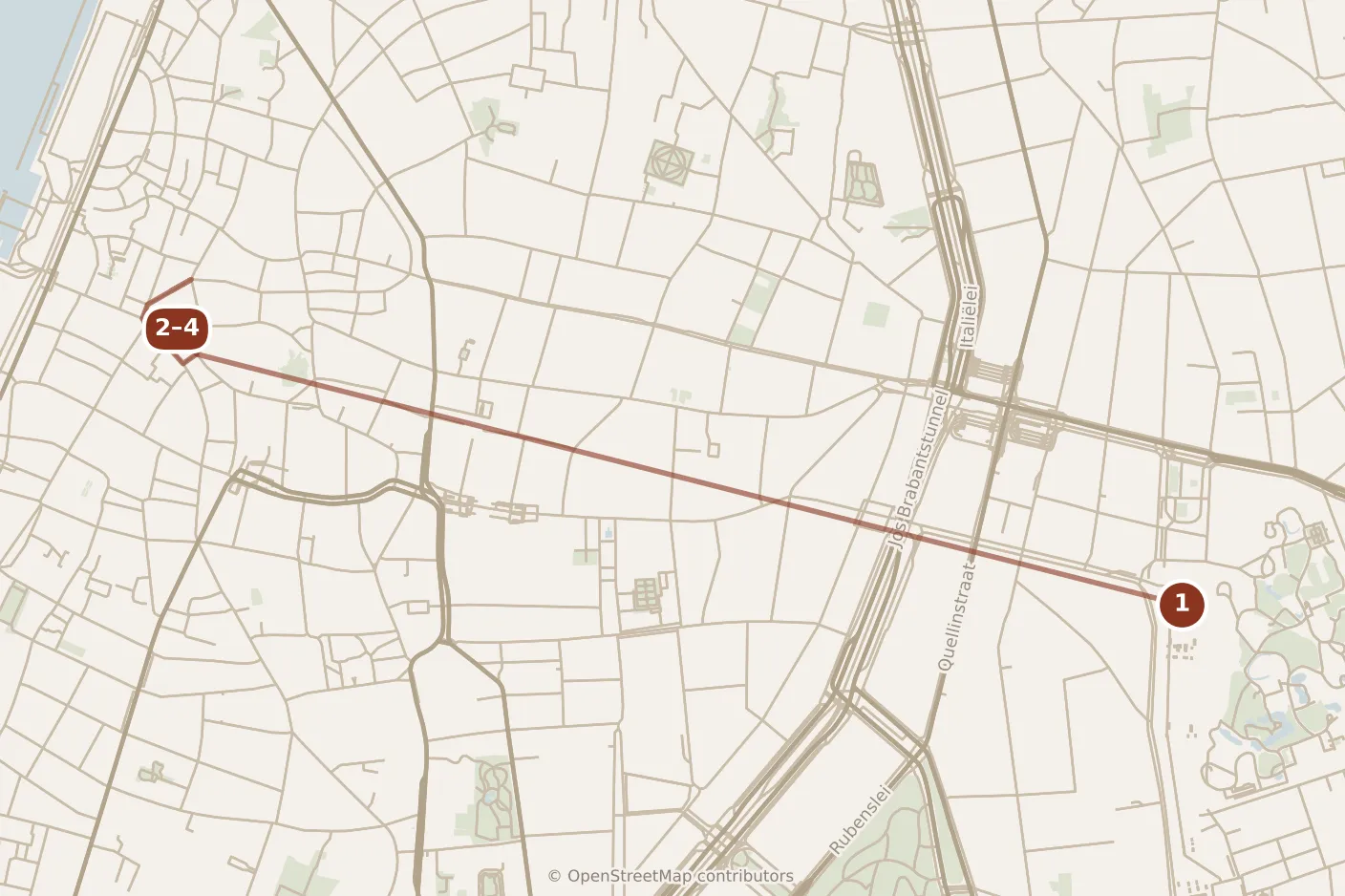
- Morning
- 1Antwerpen-Centraal
- 2Onze-Lieve-Vrouwekathedraal
- 3Vlaeykensgang
- 4Grote Markt
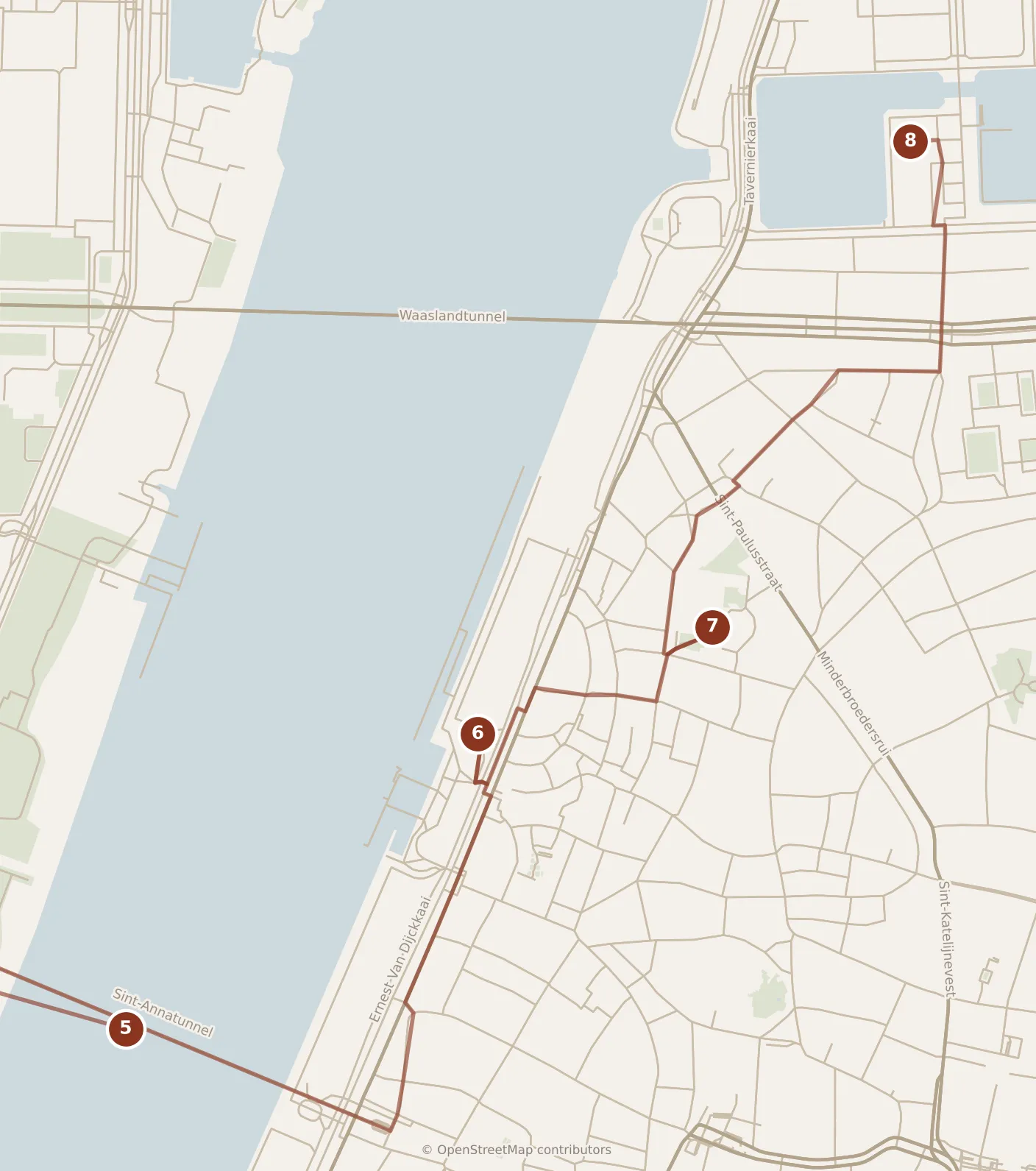
- Afternoon and evening
- 5Sint-Annatunnel
- 6Het Steen
- 7Sint-Pauluskerk
- 8Museum aan de Stroom
Morning
Start inside Antwerpen-Centraal, and give it fifteen minutes before you walk out. The stone building is Louis Delacenserie’s, finished in 1905, and the dome over the old waiting hall is why the city calls it the railway cathedral; behind it stands an iron and glass train shed 185 meters long, engineered by Van Bogaert. Since the line was driven under the city the platforms sit on four levels across fourteen tracks, which matters for a practical reason: the ceremonial half of this station is upstairs, and the train you arrive on may well put you down two floors below it. Walk up before you walk out.
Then straight west, out of the front and along De Keyserlei and the Meir — half an hour of pedestrian shopping street, with a run of old mansions above the shopfronts that almost nobody looks up at. The house Rubens built for himself stands a minute off it on your left; as above, the residence is closed and this day does not lean on it. Keep going.
The cathedral is what the morning is arranged around. Work started in 1352 and stopped, more or less, in 1521. One tower was finished — 123 meters, the tallest church tower in the Benelux — and the other reached the third string course, stalled after the fire of 1533 and was never taken further, which is why the west front is lopsided from every angle and always will be. Inside is the largest Gothic church in Belgium: 118 meters long, seven aisles wide, 125 pillars. Four Rubens altarpieces hang in it — The Raising of the Cross and The Descent from the Cross, the two great triptychs, with The Resurrection of Christ and the Assumption of the Virgin Mary besides. Give it an hour. If you have half of that, the two triptychs are what you came for, they are the largest things on the walls and you will not have to hunt for them, and the rest of a seven-aisled church can be walked in ten minutes.
Two minutes away, at Oude Koornmarkt 16, a low arch opens off the street into the Vlaeykensgang: a lane laid out in 1591 with eleven brick and sandstone back-houses along it, built for the poorest people in one of the richest cities in Europe. The shoemakers who lived here in the sixteenth and seventeenth centuries earned extra by ringing the cathedral’s alarm bells. Ten minutes. Its far end on Hoogstraat was closed by a new owner around 2020, so it is a dead end rather than a through route — which is why it is calmer than the streets it opens off — and you go in and come back out the way you went.
A minute north, the lanes open into the Grote Markt. Guild houses with stepped gables and gilded figures on three sides; the city hall of 1561 to 1565 by Cornelis Floris de Vriendt, Italian in a way nothing else on the square is, burnt to a shell in the Spanish Fury of 1576 and restored three years later. In the middle, Jef Lambeaux’s bronze of 1887 shows a young man in the act of throwing a severed hand into the river, which is the legend the city is named for; Antwerpse handjes, sold all over the center, are cookies of the same hand, and they travel well. Twenty minutes here, and then lunch.
Lunch goes in the lanes behind the square, because that is where the route is by lunchtime, and it should be sitting down. Stoverij — beef stewed slowly in dark beer, with frieten — is the plate to order here, and buying something to carry so you can keep walking is the wrong economy on the one day you have.
Afternoon
Just over ten minutes south-west of the square is Sint-Jansvliet and the mouth of the Sint-Annatunnel. It opened in 1933, runs 572 meters under the Scheldt at thirty-one and a half meters down, and a great deal of the original fitting-out survives, the wooden escalators included — they close for maintenance from time to time, most recently for eight weeks in early 2025, and the elevators run instead. It is free, and it is a street rather than an attraction — people cycle through it to work. Walk it, come up on the left bank, and turn round. The reason to cross is the view back: the whole city front seen from the far side of a wide river, and the one classic Antwerp view that costs nothing. Allow forty-five minutes for the round trip and expect to give more of it to standing on the far bank than to the tunnel.
Back through, then ten minutes north along the quay to Het Steen, which is the oldest building in the city: a gatehouse of 1200 to 1225 belonging to a castle that was demolished in the nineteenth century, a prison from 1303 to 1827, an archaeology museum from 1890, and a maritime museum until its collection moved up the river to the docks. It reopened in October 2021 as a visitor center with a modern concrete stair grafted onto its flank. On a single day the outside is the part worth having: twenty minutes with the river, which is the first time all day you see how wide it is.
Six minutes north-east, Sint-Pauluskerk is the afternoon’s one real interior, and the one stop on this route with a narrow window — it opens for the afternoon only, and for a good part of the year only on weekends. Check that single thing before you fix the order; the route as written puts you there in the middle of the afternoon, and if it is shut nothing breaks, you simply reach the docks earlier with more of the day in hand. It is a Brabantine Gothic church begun in the sixteenth century and dedicated in 1571, with a Baroque tower, and it burned in April 1968 — roof, vaults and the top of the tower — so a good deal of what you see is rebuilding rather than survival. Three more Rubens hang inside. Beside it, in an enclosed yard, stands a Calvary of sixty-three life-sized figures put up between 1697 and 1747: rocks, angels, saints and a tomb, assembled outdoors like a stage set, and unlike anything else in the city. Twenty-five minutes, and give the yard a decent share of them.
Evening
Twelve minutes north and you are at the Museum aan de Stroom, on the old inner harbor in Het Eilandje. It opened in 2011: ten stories of Indian red sandstone stacked like crates, each one turned a quarter on the one below, so that the curved glass in the gaps spirals up the outside of the building. That spiral is the point of coming. The escalator route through nine floors to the roof is free and needs no ticket, and each turn of it frames a different quarter of the flat land around — the old town, the cranes, the river bending away north. The roof at sixty meters has all of it at once, and it is where you finally see how much larger the port is than the city that owns it. Give it forty-five minutes and give most of them to the top.
Local tip. The way up is free and the museum floors are not, and the two keep different hours: the escalators to the roof stay open long after the collections have closed. So arriving here with the day gone is not a wasted walk. You have missed the ticket, which this route was giving up anyway, and not the view, which is the part you came for.
Then the last decision is where to eat and how much walking you will do afterwards. The docks around the museum have the converted warehouses and the waterfront places, five minutes from where you are standing; the better eating is eighteen minutes back down into the lanes behind the Grote Markt, and from there Antwerpen-Centraal is another thirty minutes east on foot. From the museum itself the station is thirty-five minutes south-east, across the top of the old town. Tram 7 has its terminus at the museum door and runs as far as Meirbrug, about ten minutes’ walk short of Antwerpen-Centraal; but the walk is a plain end to the day, and it takes the same thirty-five minutes whatever a schedule is doing.
Practicalities
Nothing on this route has to be booked before you travel; the one thing this page names that does, the Royal Museum of Fine Arts, is not on it. What the route requires is a cathedral ticket, bought at the door, and an adult was in the ten-to-fifteen-euro range in 2026 — the single unavoidable cost of the day, since the tunnel, the alley, the square, the quay and the roof are all free and Sint-Pauluskerk is a few euro more. Everything else you might need — how the trams and the premetro are paid for, getting in from the airport — belongs to the city guide rather than to this route, because it is true of Antwerp whatever you do here.
Two closures are worth checking against your date, because between them they decide the shape. The Museum aan de Stroom shuts on Mondays as a rule, and that closure takes the free roof with it, so a Monday costs this itinerary its ending: the substitute is the quay by Het Steen, which faces west over the river, needs nobody to open it, and gives you the same sunset from sixty meters lower — the quays are being rebuilt in stages until about 2030, so check that stretch is not fenced, and the same view west is there from the Sint-Jansvliet end and, through the tunnel, from the left bank. Sint-Pauluskerk is the other, with the narrow afternoon window described above. Check those two and you have checked everything on this route that can shut for the day. The cathedral is a third check and a different kind: it opens every day of the year except the first of January, bar a handful of announced exceptions, which is unusual and part of why this route is built on it — but its hours move with the day of the week, and that is what decides whether the church comes first, comes early, or comes after lunch, so check your date against the same page.
The roof is open air and sixty meters up beside a working port, so the wind there is a different proposition from the wind in the lanes; take a layer you would not have thought the month required.
If you are between trains, the shape of the bag is the shape of the day. The route starts at Antwerpen-Centraal and comes nowhere near it again until the end, and the end is at the far side of the old town — those thirty-five minutes back are the longest single stretch of the eight and a half kilometers, so treat them as part of the itinerary rather than as the bit after it. The tunnel is the one stop that punishes a case outright, thirty-one meters down and thirty-one back up. If you cannot put the bag down, the day to walk is the shorter one, and it is a real day rather than a consolation: fifteen minutes for the dome, half an hour west along the Meir, an hour in the cathedral, ten in the Vlaeykensgang, twenty on the Grote Markt, lunch in the lanes behind it, three quarters of an hour for the tunnel and the far bank, twenty at Het Steen, and thirty-five back east to your train. About five hours, in that order, with the cathedral, the alley, the square and the river all in it. What it gives up is the docks and the roof, which is the far end of the day and the part you cannot get back if the train is early. What it keeps is the tunnel, and that is deliberate rather than an oversight: it is the day’s hardest stop with a case, and it is also the only way to the view back across the river. If the stairs decide against it, cut it — the day loses three quarters of an hour and keeps the water from the quay at Het Steen. And if you can leave it: the station runs on four levels, and where the lockers sit on them is not a thing to discover with a train to catch, so look for them before you count the fifteen minutes the dome deserves.


_Antwerpen-Centraal_railway_station_main_hall_ceiling.jpg)
