Amsterdam in two or three days: the canal ring, a whole day on Museumplein, and the old east

Last updated 14 August 2026
Overview
Amsterdam is small enough to cross in a day, and a day here is a line: station, old center, canal ring, one museum, dinner. What a day cannot buy is the second museum. The Rijksmuseum and the Van Gogh Museum stand seven minutes apart on the same square, both are large, and taking them in one afternoon is how people go home having seen neither properly. So two days here is not one day stretched. It is the city cut into halves that barely touch: the ring and the Jordaan on the first day, and the whole of Museumplein on the second, given a day of its own rather than the tail of one.
The two halves are independent, and which comes first is yours to decide — what is not yours is the weekday, and the last section sets out the three rules that fix it. Day one is built around the one thing you did not choose, the timed slot printed on your Anne Frank House ticket; everything else on it keeps ordinary hours, with one exception the morning is arranged around: the inside of the Westerkerk is a weekday visit. Day two is built around the Rijksmuseum, which opened at nine and shut at five in 2026, every day of the year including public holidays. That closing hour is why day two starts in the morning rather than after lunch, and if the hour has moved by the time you read this the method has not: fix the museum’s last hour first, and lay the rest of the day back from it.
Three tickets, across the two days, all timed and all bought before you leave home: the Anne Frank House, the Rijksmuseum and the Van Gogh Museum. Together they came to something in the sixty-to-seventy-euro range for one adult in 2026. If you are taking the third day there is a fourth, the Jewish Cultural Quarter combination ticket, in the twenty-five-to-thirty-five-euro range for one adult in 2026, and it is worth buying before you travel rather than at the desk. Nothing else on either day is bought in advance — the only other thing worth reserving is a table, and day one says which one and why. And nothing inside a day is ridden — every leg between two stops is walked, and only five of them are longer than a quarter of an hour, two of those five being the Vondelpark itself rather than a transfer to it. Transport is needed at the edges of the days and nowhere in the middle of them.
Only one stop on the two days wants daylight, and it is the Vondelpark at the end of day two. So here is the band it needs: the sun goes down over Amsterdam at just before half past four in the second week of December and just after ten at night in the third week of June, a swing of nearly six hours across the year. Take your own month’s hour out of that, and note that the market where day two begins is about seven and three-quarter hours below the park gate. In June that means you could start at half past two and still walk the park in the light. In December it means you would have to have started before a quarter to nine, which is before the market opens and before the museum does — so in the dark months the park cannot end this day at all, and day two’s evening says what to do instead. Day one has no hinge in the sky whatever; its fixed point is the slot, and the whole morning is counted backwards from it.
Those counts model the hours you spend inside the places and on the sidewalk between them, and the largest thing they leave out is at Museumplein, where both museums put the ticket check, the security line and the coat check below ground before you reach a painting: that is a quarter of an hour twice over on a busy day, not once.
The one thing this route needs that the city guide has not already given you a name for is the fare system, and the name is OVpay — you tap a contactless bank card or a phone on the pink-and-blue readers, and you tap out again when you get off, on trams and buses as well as on the metro, or you are charged as though you never left. The old plastic OV-chipkaart still works and is being retired. Everything else about fares, caps and passes is the parent guide’s, and this route needs half a dozen short journeys across three days and nothing more.
Finally, the bag, which matters here exactly twice, because unlike a day-tripper you have a room to put it in. It matters on the arrival morning, and it matters absolutely: the Anne Frank House admits nothing larger than a sheet of A4 — a free cloakroom will take a coat and a small bag, a case it will not — and the slot is timed and not transferable, so a case at that door costs you the visit outright and the ticket does not save you. If you land before you can check in, the lockers at Amsterdam Centraal are signposted as bagagekluizen and they are outside the concourse rather than on it, so allow a few minutes to find them rather than expecting to walk straight there. And it matters again on the last afternoon, and the same lockers are the answer then: every one of the three days ends within about a quarter of an hour of Amsterdam Centraal by tram, so the case goes in on the way out and comes back out on the way to the train.
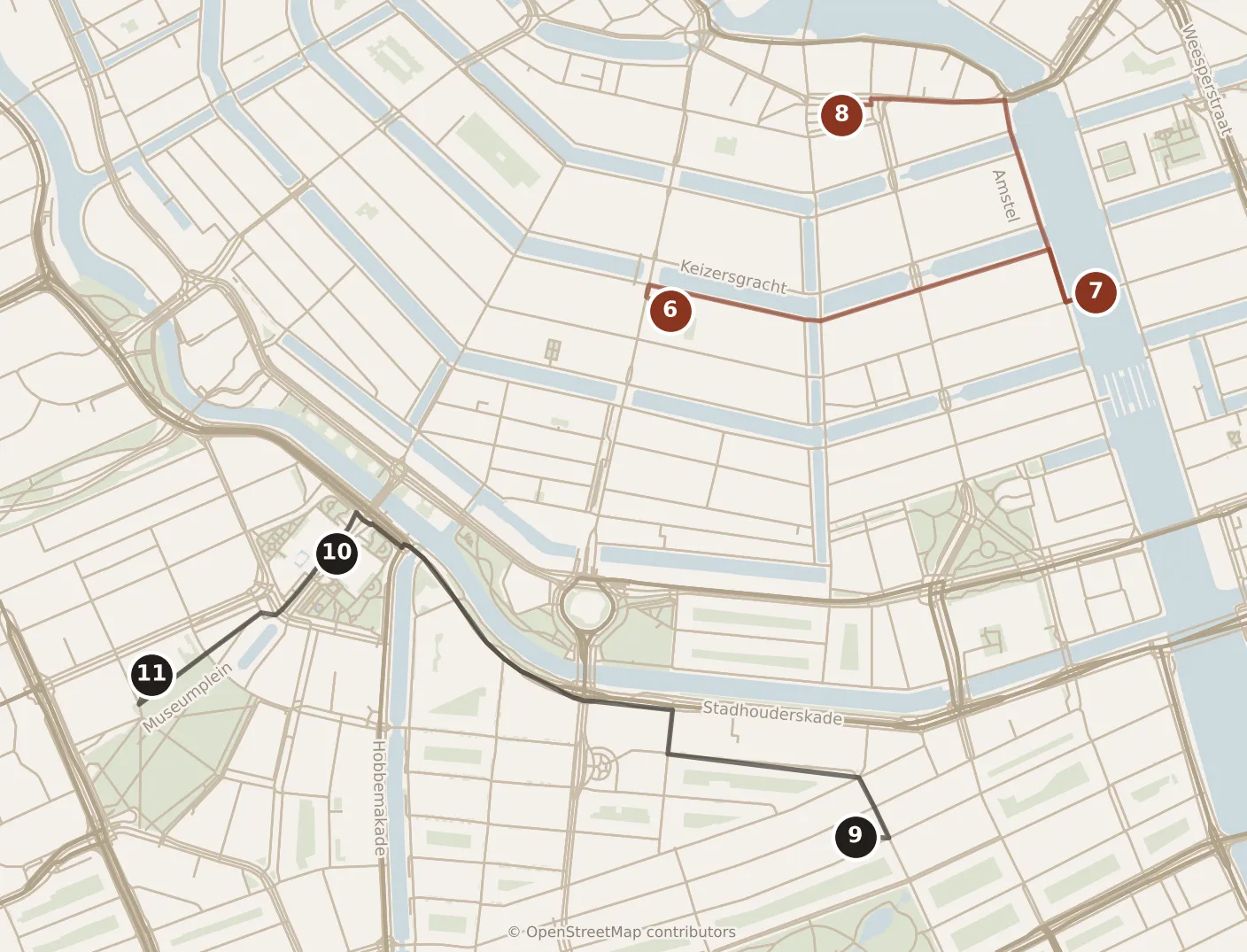
- Day one
- 6Museum Van Loon
- 7Magere Brug
- 8Rembrandtplein
- Day two
- 9Albert Cuyp Market
- 10Rijksmuseum
- 11Van Gogh Museum
Day one

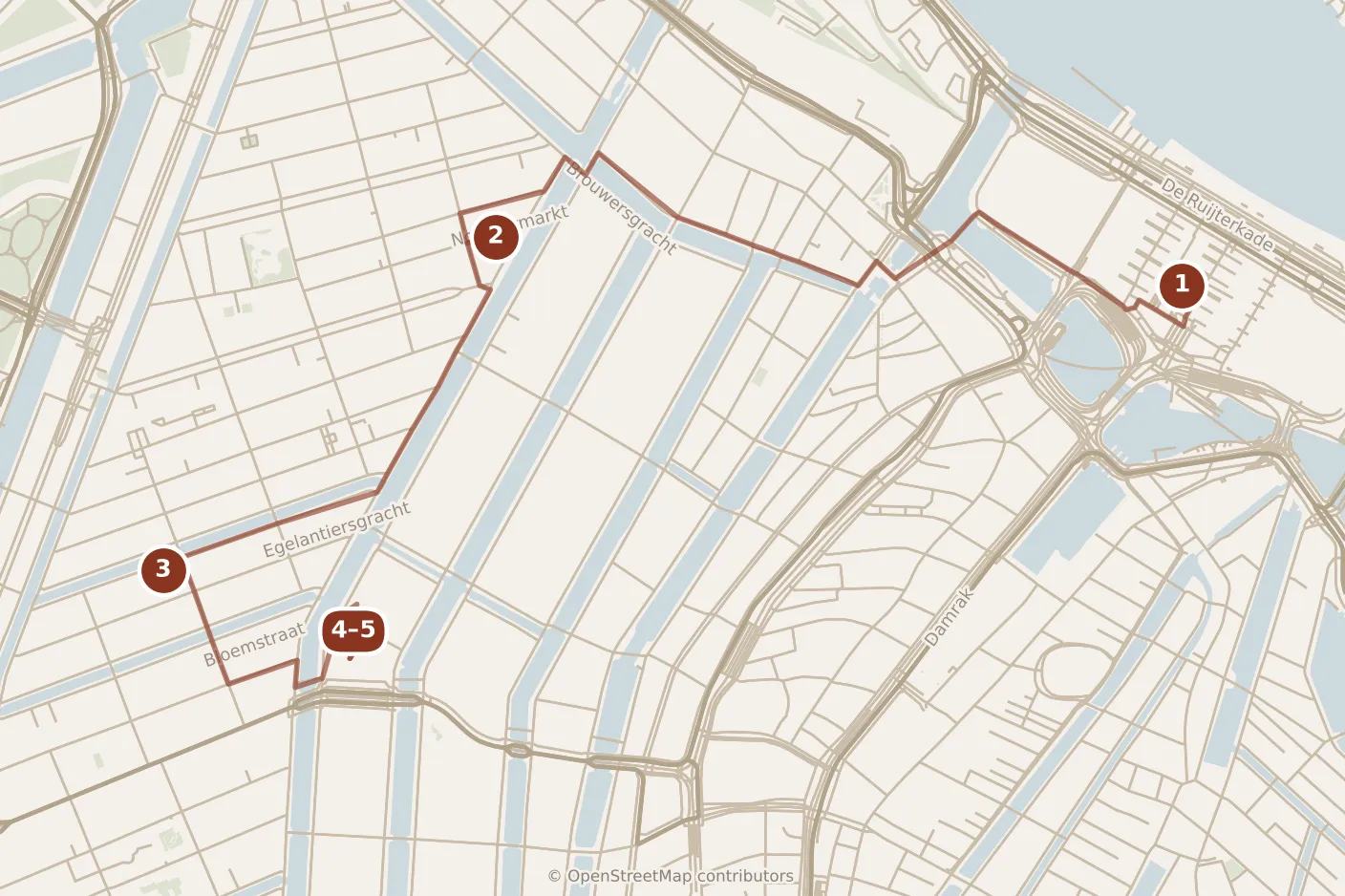
- Morning
- 1Amsterdam Centraal
- 2Noordermarkt
- 3Sint Andrieshofje
- 4Westerkerk
- 5Anne Frank House
Today is the ring and the Jordaan, and it runs in one direction only: out of the station, west into the small streets, then south down the canals until the water turns into the Amstel. You cross the Prinsengracht once and never go back over it.
Morning
First the leg nobody describes. From Schiphol Airport station, under the terminal, NS trains run direct to Amsterdam Centraal about eight times an hour and take a quarter of an hour or so; you do not need to know which one, because they all end up there. Out of the front of the station, turn right along the water and keep west: it is a little under twenty minutes on foot to the Noordermarkt, and it is the only part of today that is not worth slowing down for. If you are already sleeping in the city, ignore the station and join the day at the market.
Start at Amsterdam Centraal at about a quarter to eleven for a half-past-twelve slot, and adjust from there — everything between the station door and the Anne Frank House below comes to about an hour and three-quarters, walking included. That is the whole arithmetic of this morning.
The Noordermarkt is a triangle of cobbles with a church standing in the middle of it. The church is the Noorderkerk, built from 1620 to a Greek-cross plan by Hendrick de Keyser, and it is worth knowing what it is for: de Keyser was building the Westerkerk on the canal at exactly the same time, one church for the merchants who had just paid for the new ring and one for the workers crammed into the Jordaan behind it, and you will stand under the second of them in an hour. The square itself keeps market hours rather than city hours. A flea and antiques market runs on Monday mornings and an organic farmers’ market on Saturdays; on the other five days it is a handsome empty triangle with cafés round the edge, which is a perfectly good half-hour and a different one. Give it thirty minutes either way.
Twelve minutes south through the Jordaan — the shortest possible version is not the point, the lanes are — brings you to the Egelantiersgracht and the Sint Andrieshofje. A hofje is an almshouse courtyard, founded by somebody rich for somebody poor, and this one was begun in 1614 and finished three years later, which makes it one of the oldest of them. The way in is a plain door on the canal and a tiled corridor behind it, and what opens at the end is a garden with small houses round it and no noise at all. Read the last sentence as an instruction: people live here now, the gate is open on their sufferance, and the conduct is voices down, no photographs into windows, and nobody sits on the grass. A quarter of an hour, quietly, and out the way you came.
Five minutes further and you are at the Westerkerk, de Keyser’s other church, finished in 1631. The inside is free, takes twenty minutes and is open on weekdays only — in 2026 it admitted visitors from Monday to Friday between eleven in the morning and three in the afternoon, and that opening hour is what this morning is arranged around and the reason the market and the courtyard come first. The Westertoren above it is eighty-seven meters and used to be climbed on a guided tour of six at a time; it cannot be climbed now, because the church’s own site says the restoration work rules the tower out for years yet. That is the page to read before you build a morning around a view, rather than the ticket sites that are still selling one. On the little square at the foot of the tower, three flat triangles of pink granite set into the sidewalk and the canal edge are the Homomonument, designed by Karin Daan and unveiled in 1987 — the first monument of its kind anywhere, and easy to walk over without noticing.
Local tip. The church interior is the one thing this morning can lose without hurting. It keeps four hours a day and only on weekdays, while your Anne Frank slot does not move at all — so if the two will not meet, drop the church and keep the slot. Twenty free minutes against the fixed point of the day is not a close call.
A minute from the tower is the Anne Frank House, and it is next door to the church for a reason this morning makes literal: the clock she wrote about hearing was the one you have just been standing under. What you walk through is two buildings — a canal-front business making pectin under the name Opekta, and the achterhuis, the back house behind it, reached through the bookcase. Eight people lived in those rooms from July 1942 until August 1944. The detail that changes the visit is that Anne knew she was writing a book: in March 1944 the exiled minister Gerrit Bolkestein broadcast an appeal for Dutch people to keep diaries of the occupation, and she began rewriting hers from the beginning for publication afterwards. The manuscripts are in the last rooms, and Otto Frank’s decision to leave the annexe unfurnished means everything else you see is bare boards and steep stairs. An hour and a quarter, and it is a one-way route you cannot double back along.
If the slot you were given is before about noon, run the morning backwards rather than compressing it: walk from Amsterdam Centraal straight to the house, twenty-five minutes south-west, do the house, then go ten minutes north-east to the Noordermarkt and pick the morning up from there — market, courtyard, church, in that order, reaching the Westerkerk in the early afternoon, comfortably inside its hours rather than at the edge of its opening, and well before it shuts at three. Nothing is lost and nothing is added; the afternoon below then starts from the church instead of the house, which is the same walk, one minute shorter.
Afternoon
Lunch goes in the Jordaan, a few streets back the way you came. A herring stall, if you pass one, is ten minutes standing up; the reason to sit down for forty-five instead is that this afternoon is three hours on your feet with one chair in it, and bitterballen with something cold is a better use of a table than a sandwich is.
Then the long walk, and it is the best half-hour of the day rather than a transfer. Go south on the Prinsengracht, cross east at the first bridge you like, and take the Keizersgracht instead: it is the middle of the three great canals, and the houses are the same as the ones on either side of it. Under half an hour end to end. Two minutes off it, where the Herengracht bends between the Leidsestraat and the Vijzelstraat, is the Gouden Bocht, the one stretch where the city sold double-width plots in the 1660s: the fronts are twice as broad as everything else you have passed all day, which is what makes everything else legible.
The walk ends at Museum Van Loon, at Keizersgracht 672. The house went up in 1672 to a design by Adriaen Dortsman, one of an identical pair, and its first tenant was Ferdinand Bol, who had been Rembrandt’s pupil; the Van Loon family bought it in 1884 and it is still theirs. You have walked past three hundred of these fronts today and this is the one you go inside, and what makes it worth the ticket is that the whole plot survives: the house, then the seventeenth-century garden behind it, then the coach house closing the garden off, with the family’s own carriages still in it. Go down to the kitchens as well as up to the rooms. An hour and a quarter, and it opens seven days a week, Mondays included, which is what makes the Monday day one below work.
Thirteen minutes east, where the canals run out, the Amstel opens up and the Magere Brug crosses it: a white-painted wooden bascule bridge whose two leaves lift on counterweights, put up in 1934 to replace an 1871 wooden bridge that had replaced the 1691 original, and worked by hand until 1994. Fifteen minutes. The bridge still opens for boats and the whole apparatus goes up when it does, but there is no schedule to stand and wait for, so treat a lift as luck rather than as the reason to be there. It is lit after dark, and since it is nine minutes from where you will be eating, coming back to it after dinner costs almost nothing.
Evening
Nine minutes north-west is Rembrandtplein, and the honest description is that the square itself is the loud one — neon, chains, stag parties, a fairground quality that gets stronger as the night goes on. It was the butter market before it was Rembrandt’s square, and the statue in the middle is where the name came from. Come for the streets off it rather than for the square: the Utrechtsestraat runs south from the corner and is a proper eating and shopping street on a human scale, and it is where dinner goes. This is the evening for a rijsttafel if you are having one — the Indonesian rice table is the city’s great sit-down meal, it is priced per head, it takes two hours, and it is booked rather than walked into — book it when you book the museums, not on the day you want it. If you would rather eat in half the time, the same street will do that too.
Tram 14 passes the square and runs back through Dam to Amsterdam Centraal, so whatever end of town you are sleeping in, this evening does not need a taxi.
Day two

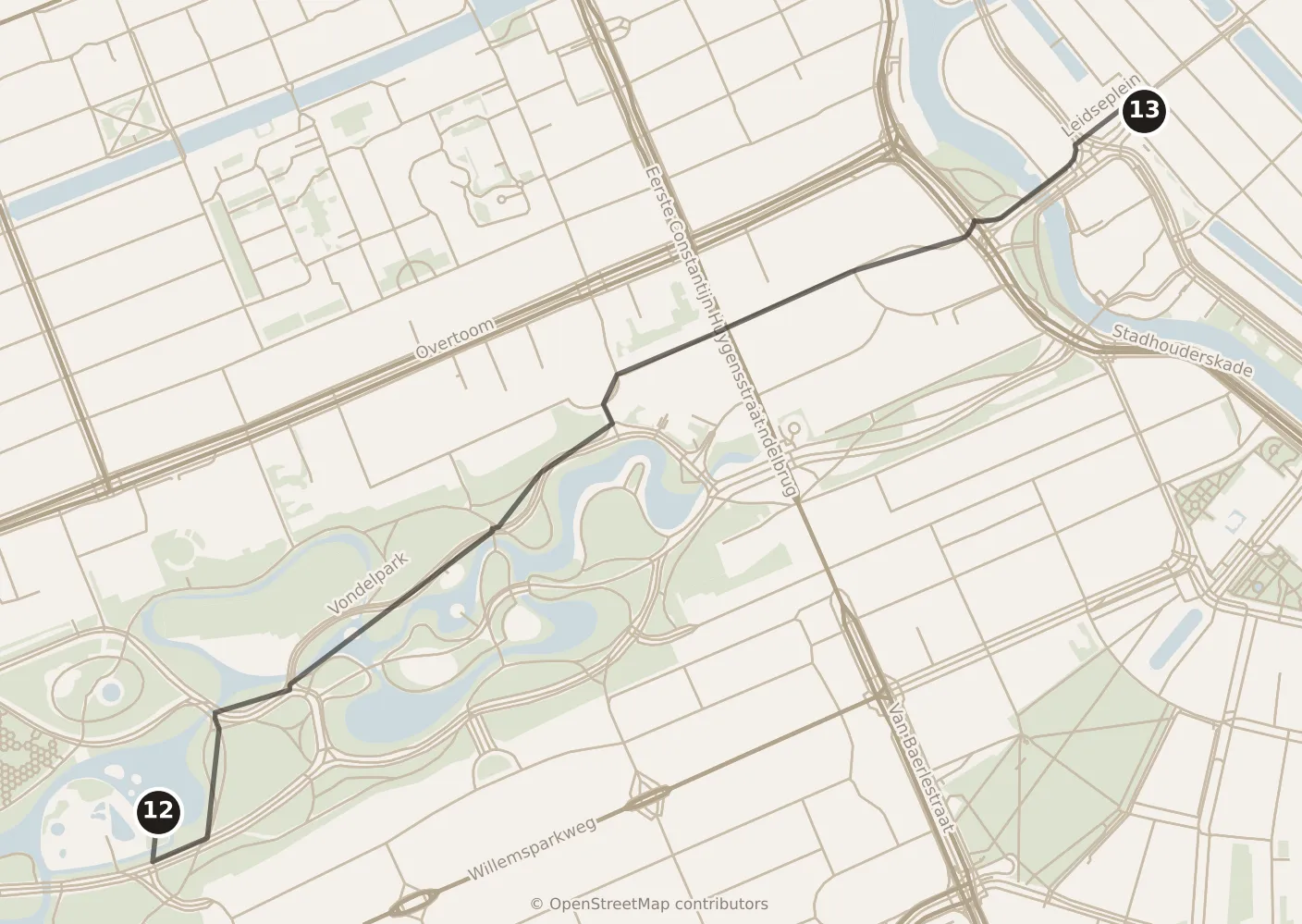
- Evening
- 12Vondelpark
- 13Leidseplein
Today is a market and two museums inside a square kilometer, and the reason it exists is that Museumplein does not fit into anybody’s spare afternoon. Everything today is south of the ring. Nothing on it is ridden, and the longest walk in it is the one out of the park at the end.
Morning
Get to De Pijp first: the metro 52 station is called De Pijp and stands at the corner of the Ferdinand Bolstraat, three stops south of Amsterdam Centraal, and the Albert Cuypstraat is the next street along. Start at half past nine.
The Albert Cuyp Market is a kilometer of stalls down the middle of an ordinary residential street, it runs Monday to Saturday and was opening at half past nine in 2026, which is where this day starts, and the point of coming now rather than later is that this is the closest these two days come to standing among people doing their shopping rather than among people doing what you are doing. Cheese, fish, fabric, flowers and bulbs, and a stall pressing stroopwafels to order, which are a different food from the packaged ones and worth the wait in line. Give it an hour. Do not eat a full breakfast here; the morning ahead is three hours standing up.
Eighteen minutes west and slightly north brings you to the Rijksmuseum, and the whole argument for a second day cashes out in the next three hours. Buy the slot for eleven, which is about ten minutes after the walk delivers you, and spend those ten minutes in line for the door rather than in the shop. The Gallery of Honour and the room at the end of it are what everybody comes for and you should walk them first while your feet are new: the militia portrait at the end, The Night Watch, is a daylight scene wearing a night-time name, because the varnish darkened and the title stuck. But three hours means the rest is not a rumor. Petronella Oortman’s dolls’ house is a two-and-a-half-meter cabinet furnished to scale with real silver, real porcelain and real miniature paintings, and it cost her about what a real canal house cost — the same fronts the other day walks past, shrunk and furnished right down to the porcelain. The Asian Pavilion is a separate building inside the building, quiet in a way the rest is not, with two enormous Japanese temple guardians at the door. There are ship models, cases of Delftware, and a gallery from which you look down into the Cuypers Library, a nineteenth-century reading room under a skylight that is still a working library and not an exhibit.
What to skip is the twentieth-century floor and the special exhibition, in that order. Three hours is generous for the Gallery of Honour, the dolls’ house, the Asian Pavilion and the library, and thin for the whole building; trying to walk all of it is how a good morning turns into a corridor.
Afternoon
Eat before you cross the square, and give it three-quarters of an hour, because there is nothing between the two museums but grass and there is nothing inside the second one you will want to interrupt. The streets off the square have the ordinary cafés; the museum restaurants are the fallback.
Seven minutes across the grass is the Van Gogh Museum, and it is not a gallery with some Van Goghs in it. It is the family collection — about two hundred paintings, five hundred drawings and more than seven hundred letters, kept together by Theo’s widow and then by his son, and hung in the order the work was made. That order is the reason to give it two hours rather than ninety minutes: you walk from the brown, thick, deliberately ugly Dutch years into the two French ones where everything turns, and the change happens in front of you across four rooms. The Potato Eaters, Sunflowers, The Bedroom and Almond Blossom are all here. Read at least one letter case properly; he explains himself better than any label does.
The building is two buildings and it shows: Gerrit Rietveld’s block of 1973, plain and top-lit, and Kisho Kurokawa’s elliptical wing of 1999 sunk beside it, which is where the temporary exhibitions go. Those are the thing to skip if the day has run long. The Stedelijk Museum stands on the same square and is a serious modern collection; it is not a third museum for this afternoon, and pretending otherwise is the mistake this whole itinerary exists to avoid.
Local tip. Book the Van Gogh slot for the middle of the afternoon rather than for “sometime”. The Rijksmuseum is the one that overruns — it is four times the size and you will not notice the hour going — and the Van Gogh is the one that will not let you in late. Give the overrun somewhere to go.
Evening
Twenty minutes west of the museum door is the middle of the Vondelpark, and this is the stop the Overview’s count is for. Forty-seven hectares laid out by Jan David Zocher in 1865 in the English manner — winding water, uneven ground, long sightlines that keep turning out to be staged — and named after Joost van den Vondel, the seventeenth-century playwright. It is not a sight and there is nothing in it to see; it is where the city goes after work, and after seven hours of standing in front of things that is the correct next thing. In summer the open-air theater puts on free performances. Give it a quarter of an hour of sitting on top of the walking.
Then out at the eastern end and on to Leidseplein, about twenty-five minutes from the middle of the park. The square is the other loud one, and the same rule applies as at Rembrandtplein on the canal day: the square is chains and lines, and one street back in any direction is where you eat. Tram 2 runs from here through Dam to Amsterdam Centraal in about a quarter of an hour, which is also the answer on a departure day — if day two is your last, this evening ends fifteen minutes from the trains rather than three kilometers from them.
In the dark months, move the park rather than losing it. From November to February the count above does not close, so take the park between the two museums instead: come out of the Rijksmuseum, eat, then walk twenty-six minutes west into the park, a quarter of an hour there, and twenty minutes back east to the Van Gogh Museum. It costs about forty minutes more walking than the direct seven-minute hop and it puts the park in the early afternoon in daylight, and it works because the Van Gogh Museum shut an hour later than the Rijksmuseum every day in 2026 — that hour is what pays for the detour. The evening then ends at Museumplein rather than at Leidseplein, and tram 2 calls at both.
With a third day

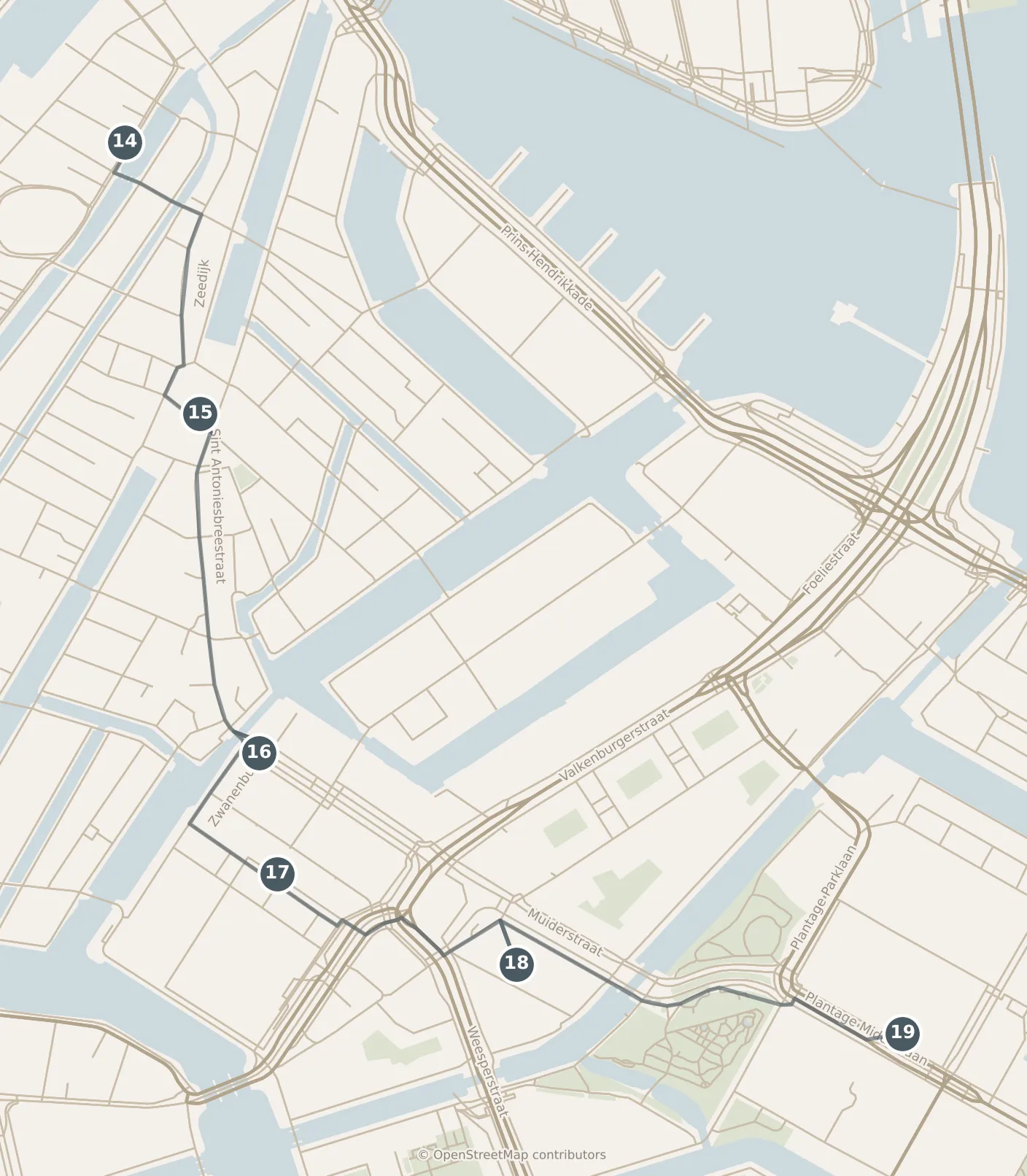
- With a third day
- 14Our Lord in the Attic
- 15Nieuwmarkt
- 16Rembrandt House Museum
- 17Waterlooplein
- 18Portuguese Synagogue
- 19National Holocaust Museum
A third day does not add another museum to Museumplein. It adds the other half of the city’s history, which is east of everything you have walked so far: the oldest streets, the guild city that was here before the ring was dug, and the quarter where about a tenth of this city lived until it was deported. It is a day of about six and three-quarter hours from the first door to the last, walking included, and its museums shut at five, so a ten o’clock start is not a preference but the margin.
Put it first, not last. Days one and two keep their contents and their internal order either way, and nothing in them moves; what changes is that the Anne Frank House then comes after the Jewish quarter rather than before it, which is the order that makes the smaller of the two mean more. It also changes which day carries your arrival: this one starts under ten minutes from Amsterdam Centraal, so it absorbs a morning train better than day one does, and day one simply begins at the Noordermarkt instead of at the station. The bag rule moves with it — the first stop below is four floors of seventeenth-century staircase and the third is another, and neither is a place to be holding a case.
Start at Our Lord in the Attic, on the Oudezijds Voorburgwal, a canal house of 1630 whose top three floors were turned into a Catholic church between 1661 and 1663: galleries above, an organ, and seating for something like a hundred and fifty. After the Reformation the city forbade Catholic worship and then declined to enforce the ban, so long as nothing was visible from the street — this is what a religion looks like when it is tolerated rather than allowed. The route down through the house is a working canal house of the period as well, kitchen to attic, and it is the best hour in this article for understanding how these buildings were lived in. It opens at ten and takes an hour. One thing to know standing there: the surrounding lanes are the red-light quarter, the windows are workplaces, and photographing the people in them is not tolerated and is enforced.
Six minutes south-east is the Nieuwmarkt and the Waag standing alone in the middle of it — a turreted brick gatehouse of 1488 that was the Sint Antoniespoort in the city wall until 1617, after which the wall came down, the city grew past it and the building became the weigh house and the guildhall. The surgeons’ guild had the top floor as its Theatrum Anatomicum, dissecting executed criminals in winter, and it commissioned the Anatomy Lesson of Nicolaes Tulp from a twenty-six-year-old Rembrandt for their room there. Twenty minutes outside, reading the guild arms on the towers.
Seven minutes south is where he then lived. The Rembrandt House Museum on the Jodenbreestraat is the house he bought at the top of his career and lost to bankruptcy seventeen years later, and it is a reconstruction rather than a survival — but it is reconstructed from the inventory the bankruptcy produced, which lists every object in every room, so it is a more literal document than most surviving interiors are. The big studio with the north light is the room to stand in, and there are etching demonstrations through the day on the press. An hour and a quarter.
Three minutes on, Waterlooplein is the flea market, Monday to Saturday, three hundred stalls of junk and army surplus and better things than either. Lunch is here, at a stall or in the streets behind it, and an hour covers both.
Five minutes east is the Portuguese Synagogue — the Esnoga, as the sign and the city say — opened in 1675 by Sephardic families who had left Portugal and Spain, and still a working synagogue, which is why it closes on Saturdays and Jewish holidays and why it is on this day rather than day one. It has never been wired: no electric light, no heating, a great brick box lit by high windows by day and by a thousand candles in brass chandeliers when it is not. In winter it is genuinely cold and you keep your coat on. Forty-five minutes.
One date breaks this day and it is not the Saturday everyone expects. In the winter half of the year the synagogue closed in the early afternoon on Fridays, ahead of the Sabbath, and the route above reaches it at about two. So on a winter Friday, take it before lunch: go from the Waag straight down to Waterlooplein and on to the synagogue, leave the Rembrandt House Museum out, and eat on Waterlooplein afterwards at about half past twelve. That is the day’s named cut being spent early rather than an improvisation, and the afternoon below is unchanged.
Eight minutes further out along the Plantage Middenlaan is the National Holocaust Museum, opened in March 2024 in the former Hervormde Kweekschool, a teacher-training college. Of the roughly 140,000 Jews in the Netherlands in 1940, about 102,000 were murdered, the highest proportion in western Europe, and this is the first museum to tell that whole story rather than one story inside it. A wall of the successive laws — what Jews might no longer own, teach, ride, marry — does more than any object in the building. Across the road is the Hollandsche Schouwburg, a theater requisitioned as the assembly point for deportation; the crèche next door to the college took the children, and the two of them backed onto the same garden, which is how at least six hundred children were carried out in laundry baskets and rucksacks by Walter Süskind, Johan van Hulst and the crèche staff. The museum wants an hour and a half; the theater across the road is a bare memorial and takes twenty minutes, and it is free to everyone, ticket or no ticket.
One ticket covers the synagogue, the Holocaust museum, the theater and the Jewish Museum beside the synagogue, it was in the twenty-five-to-thirty-five-euro range in 2026, and it stays valid for a week. On that ticket the Holocaust museum takes you without a time slot, which a single admission to it does not — so the combination is the simpler thing to hold as well as the cheaper, and buying it before you travel rather than at the desk saves the surcharge the desk adds.
Local tip. The one ticket buys four places and this day uses three of them. The fourth, the Jewish Museum, is inside a set of former synagogues two minutes from the Portuguese one and needs an hour you do not have today — so take it as a separate visit on another morning rather than squeezing it in, and let the week’s validity do the work.
Dinner goes back towards the Nieuwmarkt, just under twenty minutes north-west, which is a better evening than the Plantage and puts you where the trams are. Tram 14 runs the length of the Plantage Middenlaan and on through Waterlooplein and Dam to Amsterdam Centraal if the legs have finished first.
Practicalities
Four things are booked before you travel, and one of them decides everything. Anne Frank House tickets are sold on the museum’s own website and nowhere else, there is nothing on sale at the door, and in 2026 they were released in weekly batches — every Tuesday morning the slots for a visit six weeks later went up, and they went. Put that in a diary six weeks and a day ahead of your trip rather than treating it as an errand for the week before, and if the release moment has moved, find out when your own date opens and be at the screen. The Rijksmuseum and the Van Gogh Museum are both timed online slots and much easier, though the Van Gogh sells out weeks ahead between spring and autumn. The fourth is the Jewish Cultural Quarter combination ticket, and only if you are taking the third day. Everything else on these days is free, sold at the door, or a street.
The weekday rules, which matter more here than the order of the days. Three of them, and they do not conflict unless you have a Sunday.
- Day one wants a weekday and is best on a Monday. The inside of the Westerkerk is a Monday-to- Friday visit, so a Sunday costs you the church; the Monday flea market and the Saturday farmers’ market are the two days the Noordermarkt is a market rather than a square, and Monday is the only date in the week that gets you both that market and the church.
- Day two cannot be a Sunday, because the Albert Cuyp Market is shut on Sundays and it is the hour the day opens with.
- The third day cannot be a Saturday, because the Portuguese Synagogue closes for Shabbat, and in winter it wants any day but a Friday as well, for the reason and with the workaround set out in that section. It loses the Waterlooplein flea market on a Sunday. The quarter’s museums also shut on the Jewish high holidays, which fall on different dates each year and are worth one look at a calendar if you are here in September or October.
With three days every arrival works, and the arrangement follows from the rules rather than from a start day: put the Monday on day one wherever it falls, keep Sunday off day two, keep Saturday off the east day, and any leftover date will take any of the three. A Monday arrival is the best of them: the Monday takes day one, the Tuesday and the Wednesday divide the other two however you like, and every market on the route is open on the day you reach it — the Noordermarkt flea market, the Albert Cuyp Market and the Waterlooplein flea market, with the church as well. A Saturday and a Sunday arrival get the church and the first two of those markets, the Monday still landing on day one, but both of them put a Sunday on the east day, which costs the Waterlooplein flea market the bullet above names: the square and the lunch stay, the three hundred stalls do not. A Friday arrival is the one where the advice above to put the east day first has to give way: Friday on day one, Saturday on day two, Sunday on the east day is the only arrangement that satisfies all three rules, and it costs two things rather than none — the Waterlooplein stalls again, and the Noordermarkt, which on a Friday is the handsome empty triangle rather than a market. An arrival with no Monday and no Sunday in it loses only that triangle.
With two days, one arrival costs something and it is worth knowing which. Arriving on a Saturday, take day two first so the market runs, and day one on the Sunday without the inside of the Westerkerk. Arriving on a Sunday, do the reverse: day two on the Sunday minus its market hour, which is the hour this article tells you to cut anyway, and day one on the Monday with both the flea market and the church. The trap is the Saturday arrival taken in the printed order, which puts day two on the Sunday and silently deletes the hour it opens with.
If you are short, here is what goes, and it goes on the day that gains the minutes. On day one, cut the Magere Brug: going straight from Museum Van Loon to Rembrandtplein is eight minutes instead of thirty-seven, and the bridge is the only thing today that a photograph genuinely does convey. On day two, cut the market, not the park — it is the one hour on the day with no ticket against it, and giving that hour to the Rijksmuseum is the best use of an hour on this whole itinerary. On the third day, cut the Rembrandt House Museum: it is a reconstruction, and day two gives you an entire morning of the actual paintings. What should not go, on any of the days, is the half-hour of canal between the Anne Frank House and Museum Van Loon; it is the only stretch in the article that is the city itself rather than a thing inside it.
Getting between the stops. Everything within a day is on foot, and the five legs longer than a quarter of an hour are named where they fall. The rides are all at the edges: NS from Schiphol Airport into Amsterdam Centraal, metro 52 to De Pijp to start day two, and a tram home at the end of each evening. Half a dozen short journeys over three days, and every one of them a tap on and a tap off.
Leaving. None of the three days strands you. Tram 14 runs from Rembrandtplein and from the Plantage Middenlaan through Dam to Amsterdam Centraal, and tram 2 does the same from Leidseplein; each is about a quarter of an hour. On foot it is nearer half an hour from Rembrandtplein and from the Plantage and the better part of forty minutes from Leidseplein, which is the one evening not to be sentimental about if a train is waiting. And one thing the city guide makes general that this route makes constant: you will be crossing cycle lanes at every corner of every one of these days, and the lane between the sidewalk and the road is where the thing that hits you will come from.


