Amsterdam in one day: the old center, the canal ring on foot, and one museum

Last updated 4 August 2026
Overview
Amsterdam is small, flat and built in rings, and the useful consequence for one day is that this whole route is a single line drawn south-west across it. It begins at Centraal Station, ends about three kilometers away in De Pijp, and doubles back only once, for the eleven minutes north to the Westerkerk and the Anne Frank House. Almost every leg is under a quarter of an hour on foot. Two are not, and both are deliberate: the thirty-five minutes down the Prinsengracht in the early afternoon, which is not a transfer between two stops but the best half-hour of the day, and the twenty minutes east into De Pijp at the end, which is the walk to dinner.
What a single day costs you here is one of the two great museums on Museumplein. You get one of them, not both, and pretending otherwise is how people end up doing neither properly. Take the Rijksmuseum: it is about the place you are standing in — the ships, the maps, the silver, the faces of the people who paid for the canals you walk along that morning — while the Van Gogh Museum is a fine museum about a man who did most of his painting in France. If you have seen the Rijksmuseum before, or the person you are with wants the sunflowers, swap them; but choose before you set out, not on the square with your feet already hurting.
That choice is also what fixes the shape of the day, because the Rijksmuseum shut at five in 2026, and it did so every day of the year, public holidays included. Everything above it is built backwards from that. The morning below, station door to museum door and lunch included, comes to about five hours: start at nine and you arrive with the better part of three hours in hand, which is what the route through it needs. Start at eleven and you have one, and the honest answer then is to give up the Anne Frank House rather than the museum. If that closing hour has moved by the time you read this, the method has not — fix the museum’s last hour first, and lay the morning back from it.
Nothing here is timed to the light, and it is better to say so than to invent a deadline: the museum does not care what the sky is doing, and the canals are lit after dark. What the light decides is only how much of the walking you do in it, and that changes completely with the season — the sun goes down over Amsterdam at about half past four in the second week of December and not until just after ten at night around midsummer, a swing of five and a half hours between the two ends of the year. Take your own month’s hour and count back the five hours above. In June the answer is a start time in the late afternoon, which is the arithmetic telling you the light constrains nothing at all; in December it is late morning, and since this day begins at nine you have margin anyway. What the count really says in the dark months is that the last stretch, museum to dinner, happens after dark — and that costs nothing, because it is twenty minutes on a lit street towards a table. What would cost something is inverting the day to put the museum first, which spends the only daylight you have indoors and walks the canal ring in the dark.
The five hours model the time you spend inside the places and on the sidewalk between them, and they model nothing else. In particular they do not cover what happens between the museum door and the first painting: the Rijksmuseum is entered downwards, into an atrium under the building with the ticket desks, the security check and the cloakroom in it, and you climb back up into the galleries from there. In the middle of the afternoon that is not five minutes.
Finally, the bag, because the reader of a one-day itinerary is carrying one, and on this route that is not a question of comfort. The Anne Frank House admits nothing larger than a sheet of A4, and its own practical information tells you to leave a backpack or a case at your hotel or at Centraal before you come. The slot is timed and not transferable, so a bag at that door costs you the visit outright — the ticket is not what gets you in. Two further stops below are merely awkward with one: the Begijnhof is a residential courtyard that asks for quiet, and the Rijksmuseum will make you check it anyway.
So the bag goes into a locker at Amsterdam Centraal before the day starts, and you walk this route with empty hands. The lockers are outside the main concourse and the station operator publishes nothing that says exactly where, so follow the station’s own signage for luggage lockers and allow a few minutes to find them rather than expecting to walk straight to them. The route ends three kilometers from that locker, which sounds like the mistake this format is prone to and is not one: the De Pijp metro station is a few minutes from where the day finishes, and metro 52 runs from it to Centraal Station in three stops. The alternative is about forty minutes on foot, so do not plan on walking back.
If the bag cannot be left at all — the lockers full, a case too big for them — the day still works, but it works without the house, and it is worth knowing what that day is before you are standing in the station deciding. The line is identical: Centraal, the Oude Kerk, Dam Square and the palace, the Begijnhof, lunch and the Nine Streets, the Westerkerk, then the Prinsengracht south to the Rijksmuseum and east into De Pijp for dinner. The hour and a quarter the Anne Frank House would have taken goes to the museum instead, which you reach that much earlier and can take at walking pace rather than against its closing.
The day

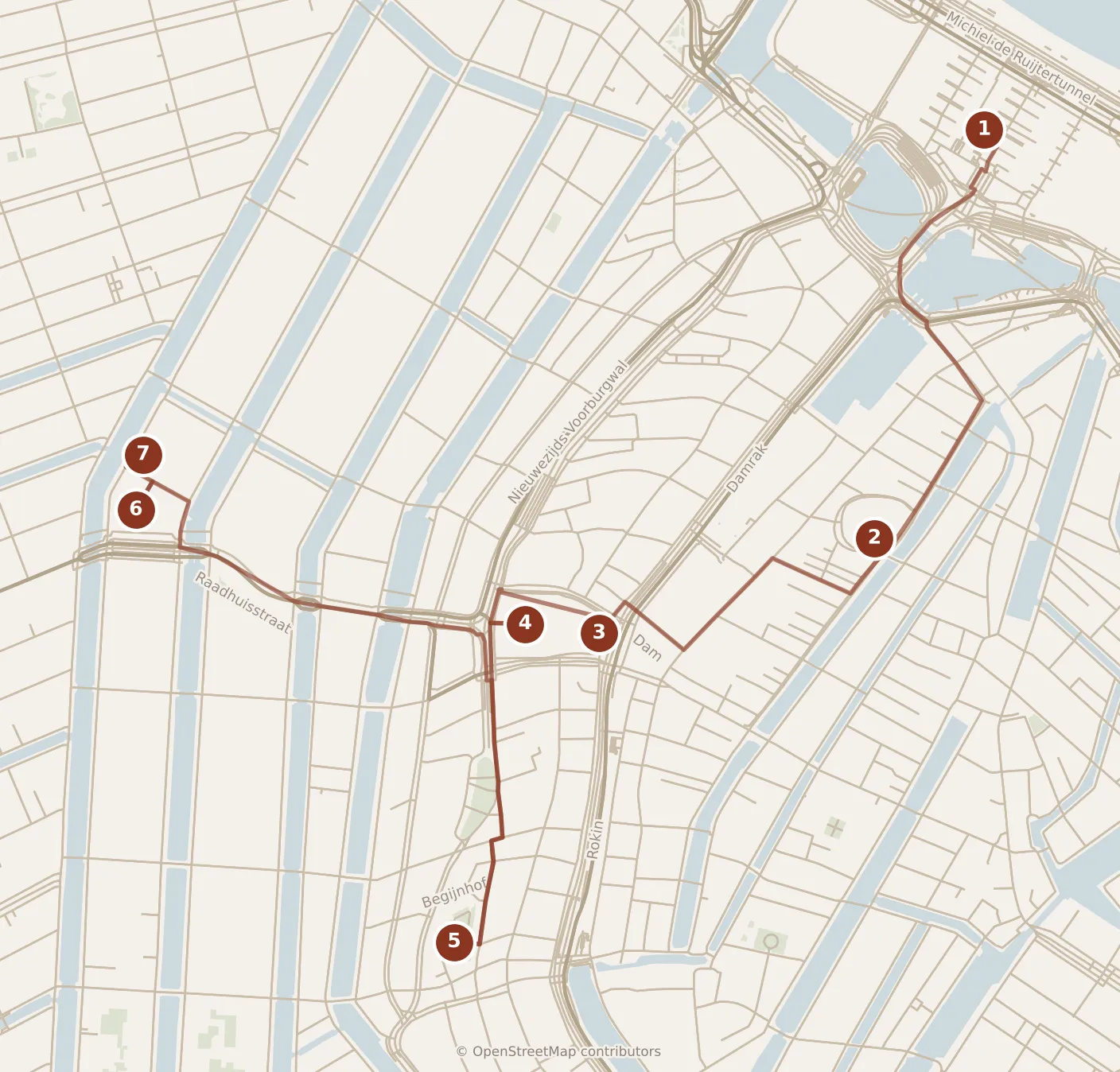
- Morning
- 1Amsterdam Centraal
- 2Oude Kerk
- 3Dam Square
- 4Royal Palace of Amsterdam
- 5Begijnhof
- The Nine Streets — in the prose, not on the map
- 6Westerkerk
- 7Anne Frank House
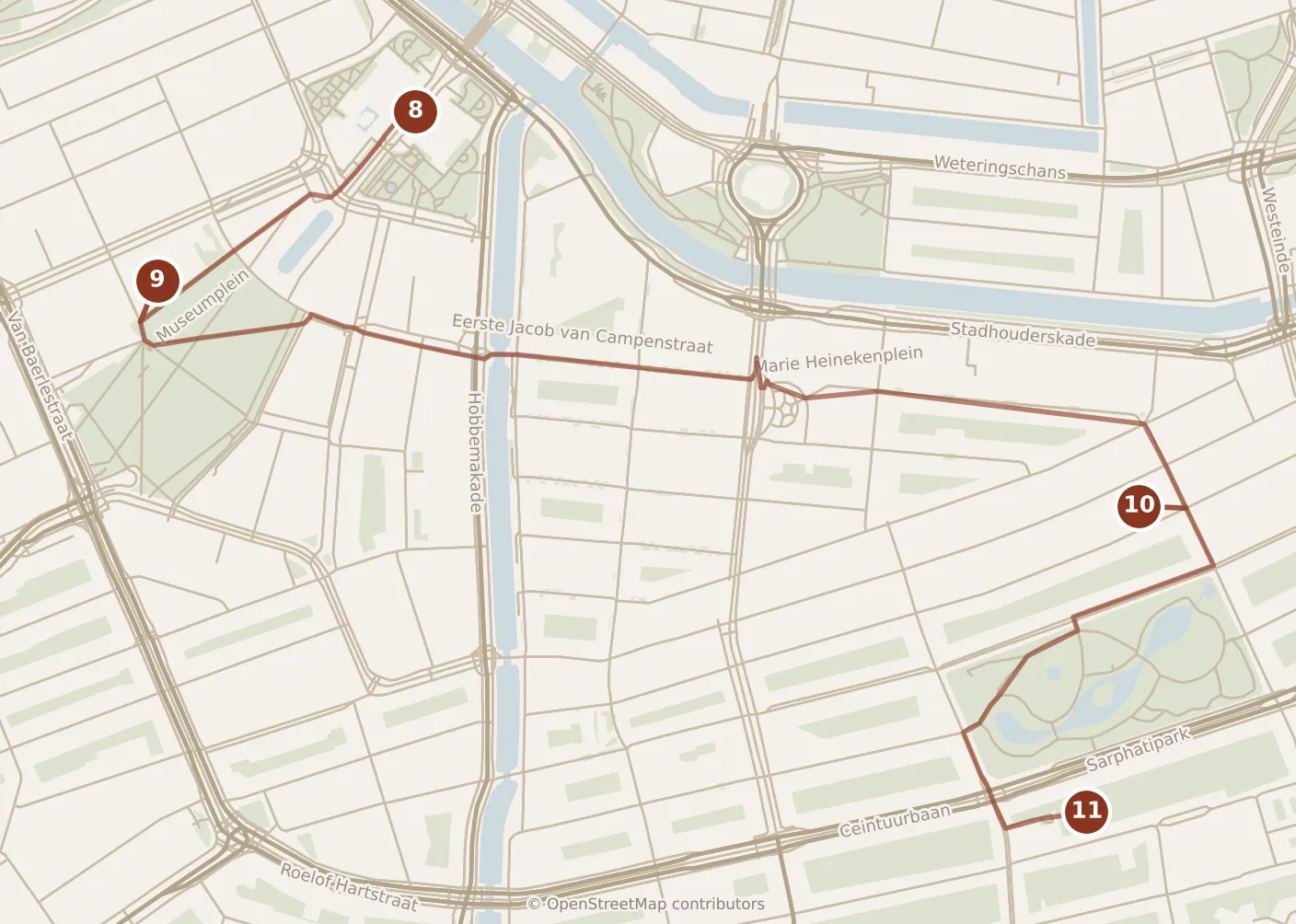
- Afternoon and evening
- 8Rijksmuseum
- 9Van Gogh Museum
- 10Albert Cuyp Market
- 11De Pijp
Morning
Start at Amsterdam Centraal at nine, bag stowed. Look back at it once from the far side of the water in front of it, because the two ends of this day are by the same hand: Pierre Cuypers finished the station in 1889, in red brick with towers and gables, four years after he had finished the Rijksmuseum. You begin and end inside one man’s handwriting.
Then walk south into the old town. Ten minutes in, on a small square of its own, is the Oude Kerk: the oldest building in the city, begun as a parish church in the thirteenth century, and now standing in the middle of the red-light quarter that grew up around it. That collision is the whole reason to come — a medieval church ringed by neon and window frames, the two of them entirely used to each other. The floor inside is laid with something like two and a half thousand gravestones, and Rembrandt’s first wife Saskia is under one of them; he is buried at the other end of this morning, in the Westerkerk. The interior is now programmed as a contemporary art space with a ticket and museum hours of its own, and it opens later than this day starts, so the route goes past the door rather than through it. Give the outside a quarter of an hour and read the building against its street.
Seven minutes west is Dam Square, which is the city’s front room and usually a mess of crowds, pigeons and a fairground ride. You are not here for the square. You are here for the Royal Palace of Amsterdam on it — built between 1648 and 1665, not as a palace at all but as the town hall of a republic that had just won a war and was as rich as anywhere in Europe. It stands on 13,659 wooden piles driven into the bog, and its own century called it the eighth wonder of the world without irony. It stopped being a town hall in 1808, when Louis Bonaparte moved in and turned it into a palace, and the monarch still uses it for state occasions, which is precisely why its interior closes at short notice and why this day does not build on it. Twenty minutes outside, reading it as what it is: a merchant city’s council chamber, wearing a crown it never asked for.
Nine minutes south, the noise stops. The Begijnhof is a medieval courtyard of houses around a lawn, built for a lay sisterhood — women who took no vows and kept their own property — and the way in for visitors is the gate in the Begijnensteeg, a low door off the Spui that most people walk straight past. There is a gate hour, and it is the one thing this morning cannot bring forward: in 2026 the courtyard opened at ten, and the route above reaches it at about a minute past, so the twenty minutes at the palace are not padding and starting earlier buys you nothing but a shut gate. It closed to visitors on one day of the year, 27 April. The hours are published on the Begijnhof’s own site, which is the only place worth reading them.
Two churches stand on the same courtyard, and the pair of them is the story: the old chapel was taken from the Beguines in 1578, when the city changed religion, and stood shut and empty for some thirty years before it was handed to the English-speaking Presbyterians who have it still; the Catholics answered in 1671 by knocking two houses together opposite and building a clandestine church there, in plain sight of the one they had lost. At number 34 is a house with a wooden front of about 1528, long reckoned the oldest in the country until an older one turned up in the Warmoesstraat in 2012. People live here. Twenty-five minutes, quietly.
Seven minutes west, across the Singel and the Herengracht, are the Nine Streets: nine short cross-streets stitching the three main canals together, each one a single block of small shops and kitchens at the foot of gabled houses. This is where lunch goes, and it should be sitting down — bitterballen and a beer in a brown café is the correct version, and it takes forty-five minutes rather than the ten you would spend eating something out of a paper bag while walking, which is the wrong economy in a city this walkable. Give the streets themselves twenty-five minutes on top of that; they are the best browsing on this route and the only shopping on it.
Eleven minutes north up the Keizersgracht and the Prinsengracht stands the Westerkerk, built between 1620 and 1631 to Hendrick de Keyser’s design. The Westertoren is eighty-seven meters and the tallest church tower in the city, and the thing on top of it is a copy of the Imperial Crown of Austria, which Maximilian granted the city the right to wear. Rembrandt was buried here in 1669 in a rented grave; the grave is long gone and there is a memorial and no stone, which tells you more about how he died than any biography. Inside is a whitewashed Protestant preaching hall with almost nothing in it — that emptiness is the point, but it is not a long visit. Ten minutes, mostly spent looking up — on a weekday. In 2026 the church was open to visitors Monday to Friday and not before eleven in the morning, and closed to them on weekends and on a short list of feast days. This route reaches the door at about noon, so a weekday clears that opening with room to spare; a Saturday or a Sunday does not, and nor does the early-slot variant at the end of this article. On those days the stop is the tower and the outside, and the morning loses ten minutes and nothing else. The church publishes its visiting days on its own site: read them there rather than trusting the paragraph in front of you.
And one minute from the tower is the Anne Frank House, which is why the Westerkerk comes immediately before it and not on some other part of the route: the clock Anne Frank wrote about hearing from the back annexe is the one you have just been standing under. Eight people hid in the rooms behind that canal-side business from July 1942 until they were found in August 1944; she died at Bergen-Belsen in Germany in the last months of the war. The museum is the building itself, and Otto Frank asked that the rooms be left unfurnished, so what you walk through is empty and steep and much smaller than the story is. It is a one-way route and you cannot go back. Give it an hour and a quarter, and know that you either hold a timed ticket or you do not get in — there is no door to wait in line at. The last section of this article is about buying one, and it wants reading six weeks before you travel rather than the night before you walk.
Afternoon
From the Anne Frank House the route turns south down the Prinsengracht and stays on it for most of the thirty-five minutes it takes to reach the Rijksmuseum. Do not shortcut this. The Prinsengracht is the outermost of the three great canals, and half an hour of it does something no photograph of it does: the houseboats, the bridges, the bicycles chained four deep to the railings, the front rooms uncurtained at eye level from the sidewalk. This is the stretch that turns a list of sights into a day in Amsterdam, and if the legs are the problem, the thing to cut is a stop, not this walk.
Then the Rijksmuseum, which needs the better part of three hours and rewards being taken narrowly. The Gallery of Honour runs the length of the building’s main floor and ends in the room with the Night Watch, and that gallery and the rooms opening off it are what you came for. The painting is 363 by 437 centimeters and it is not the size Rembrandt made it: in 1715 it was moved into the town hall — the building you stood in front of this morning — and trimmed on all four sides to fit between two columns, losing two figures, an arch and a balustrade that have never been found. It has been under a conservation program carried out in public, in the room, since 2019, with glass and scaffolding coming and going around it; whatever state that is in on your day, the painting stays on the wall throughout, which is exactly why the work is done there. Note the building too — this is the Cuypers you were looking at five hours ago at the station, in the same brick — and the cycle passage running straight through the middle of it: the argument over whether that tunnel should stay open to bicycles held the whole renovation up for years, and the cyclists won, which is the most Amsterdam sentence in this article.
Local tip. Do the Gallery of Honour and its side rooms first and completely, then treat whatever is left as a bonus. The way to lose an afternoon here is to start at the bottom of the building and work upwards, and arrive at the Night Watch with forty minutes and no legs.
Five minutes across the grass of Museumplein is the Van Gogh Museum, and this is where the choice made at the top of this article cashes out. If you took the Rijksmuseum, you now have an hour here at best and that is not enough for it — walk past, and put it at the top of the list for the next visit. If you swapped them, you have been here all afternoon instead and you will come out into the same square at the same time; the day below is unchanged.
Evening
Twenty minutes east of Museumplein, over the water and into a dense nineteenth-century grid, is De Pijp, and this is where the day stops being a route and becomes an evening. The spine of it is the Albert Cuyp Market, a street market a kilometer long, and you should know before you get there that you are arriving after it: this is the one stop on the route that keeps market hours rather than city hours, it does not run every day of the week, and it packs up in the late afternoon. So what you walk into is the quarter rather than the market — shutters down, the street being swept, and every kitchen either side of it opening for the night.
That is the right trade, because the eating is why this is the last stop. De Pijp is where much of the city actually eats: cheaper than the ring, denser than the museum quarter, and with a long-established immigrant food scene. A rijsttafel — the spread of many small Indonesian dishes eaten together — is the sit-down meal to have here, and after eight and a half hours on your feet a meal that arrives twenty plates at a time and lasts two hours is not an indulgence, it is the correct end to the day. Book it, though. The rice table is ordered and priced per head — one long-established Indonesian house in the city charged 42.50 euro a person in 2026 — and the places that do it properly take reservations through their own sites and by telephone. A two-hour table at the end of a Saturday is not something to walk in and hope for.
Then the station, and this is the one ride the whole route uses. The De Pijp metro station is a few minutes’ walk along the market street; metro 52 runs from there to Centraal Station in three stops, calling at Vijzelgracht and Rokin on the way. It is a matter of minutes, against about forty minutes on foot, and it puts you back in the station where the bag is. If your train is a tight one, allow for the fact that the lockers are outside the concourse and signposted rather than obvious: give yourself a quarter of an hour at that end rather than five minutes.
Practicalities
Two things on this day must be bought before you travel, and one of them is the reason people arrive in Amsterdam and do not see the thing they came for. Anne Frank House tickets are sold online only, on the museum’s own website — there is nothing on sale at the door — and in 2026 they were released in weekly batches: every Tuesday at ten in the morning, local time, the tickets for a visit six weeks later went on sale, and they went. So the booking is not something to do the week before; it is a diary entry six weeks and a day ahead of your trip. If that release moment has moved by the time you read this, the method has not: find out when the tickets for your own date go on sale, and be at the screen when they do. An adult ticket was in the fifteen-to-twenty-euro range in 2026. The Rijksmuseum is the other, and it is far easier — a timed online slot, generally available much closer in, in the twenty-to-twenty-five-euro range for an adult in 2026. The Van Gogh Museum, if you swap it in, is also a timed online ticket and also worth booking ahead. Everything else on this route is free or is a street, with one exception that is booked rather than bought: the rice table at the end of the day, which is priced per head and wants a table reserved ahead.
Nothing else here needs a transport ticket except the single metro ride at the end, from De Pijp to Centraal Station. If you have not read the city guide, that is where the fare system is explained; for this route you need one journey’s worth of it and nothing more. The whole of the rest of the day is on foot, which is roughly eight kilometers in total — flat, paved, and mostly split into legs of a quarter of an hour, but eight kilometers nonetheless. The other thing the city guide covers that this route makes urgent rather than theoretical: you will be crossing cycle lanes constantly, most of them between the sidewalk and the road, and the traffic that will hit you is not the traffic you are looking for.
Weekday closures are kind to this itinerary where it matters most, and it is worth knowing why. The Rijksmuseum, the Van Gogh Museum and the Anne Frank House were all open every day of the week in 2026, so the museum half of this day survives a Monday, which is not true of a great many European cities and is the single most common way a one-day plan breaks. Two things do not survive every day. The inside of the Westerkerk is a weekday visit only, so a weekend leaves you the tower and the outside and costs the morning ten minutes, as the morning above says. And the market at the end: it was shut on Sundays and public holidays in 2026. That costs this route very little, because it packs up in the late afternoon and you are arriving after its hours in any case — the reason to end in De Pijp is the eating, and that is there every night. But if the market itself is why you would go, it is the one stop here worth checking the day for before you fix the plan, and the way to buy it is to leave the museum half an hour early rather than to reorder anything.
The Anne Frank slot you are given is the one part of this day you did not choose, and it decides where the day starts. The route above assumes something around the middle of the day, which is where the walk naturally arrives. An early slot means going straight there from the station — twenty-five minutes on foot — and then picking the old center up afterwards, walking twelve minutes back east to Dam Square, on to the Begijnhof, and rejoining this route at the Nine Streets before turning south; the geography still works, and what it costs is that one back-leg, the inside of the Westerkerk, which that version reaches before it opens to visitors, and the Oude Kerk — seven minutes east of Dam Square and back again, if you want it at all. A late slot is easiest of all, since the house stays open into the evening, but it moves dinner into the canal ring and ends your day a little over twenty minutes’ walk from Centraal Station instead of three metro stops, which is not worse — only different, and worth knowing before the bag is in a locker across town.


