York in two to three days: the walls, the Minster and the medieval streets

Last updated 18 October 2026
Overview
York is a two-day city that rewards a third. Almost everything worth your time sits inside a ring of medieval wall you can cross on foot in twenty minutes, so the problem is never distance — it is that the center is so dense with old things that a reader with no plan ends up seeing the Shambles four times and the Minster in a hurry. The two days below split the walled city in half: day one is the north, the walls and the cathedral; day two is the south, the medieval streets and the castle. A third day crosses the river to the railway museum and walks the half of the wall the first two days leave out.
Nothing here needs a car, a bus or a taxi. The station is just outside the walls, on the west bank of the Ouse, and every stop below is a walk from it.
One thing shapes the days before you read them: the walls are open only in daylight and close at dusk, and the sun sets here from about a quarter to four in mid-December to about twenty to ten at the end of June. In summer that changes nothing. In winter it decides that the walls are a morning thing, which is why they open day one rather than close it.
The other is Sunday. The Minster is a working cathedral and gives Sunday mornings to worship rather than to sightseers, so if day one would fall on a Sunday, swap the two days: day two’s streets, hall and castle do not care what day it is.
You need nothing to follow this route but your feet. The one ticket worth buying ahead is the timed slot at the Jorvik Viking Centre on day two; everything else is bought on the day, and the parent guide covers getting here and getting around.
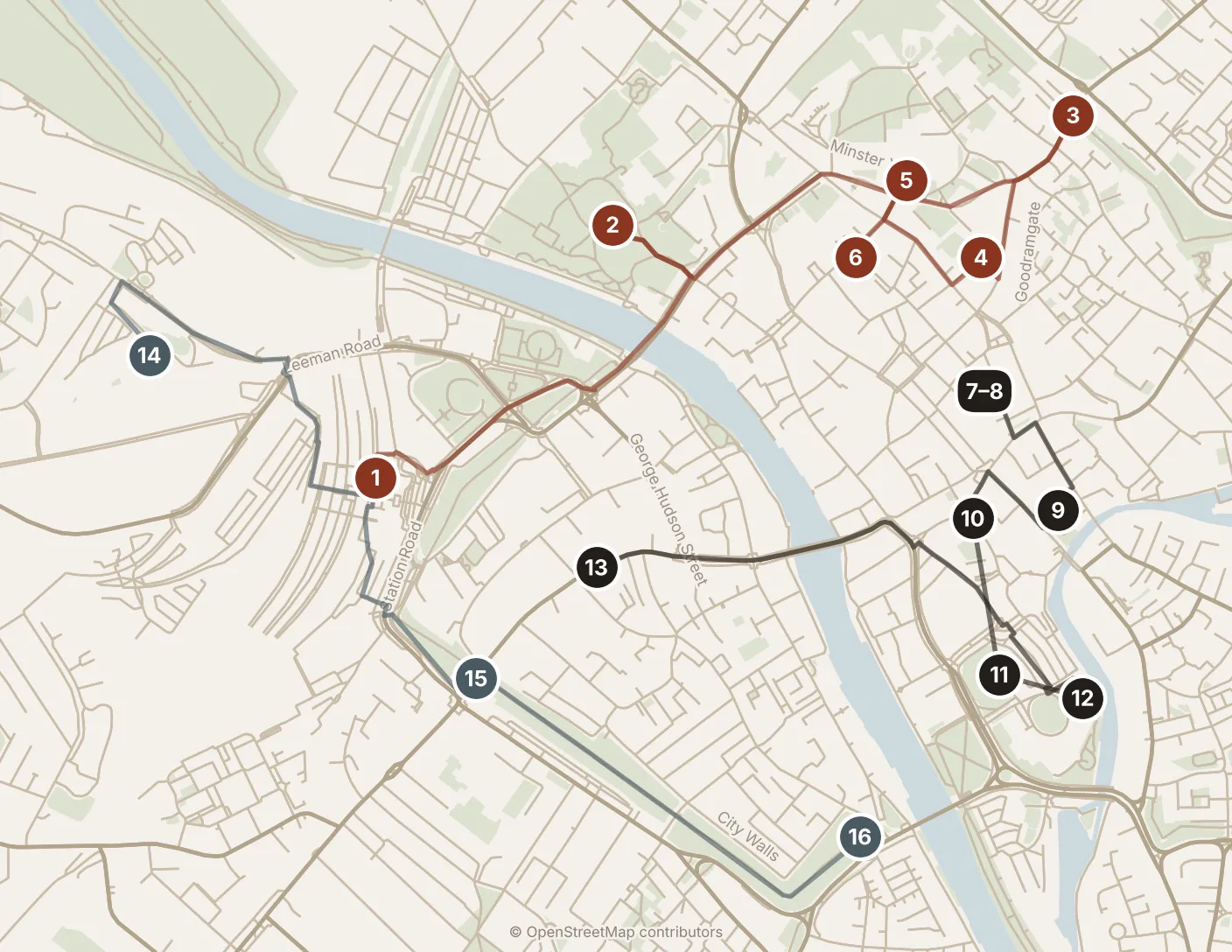
- Day one
- 1York railway station
- 2Museum Gardens
- Bootham Bar — in the prose, not on the map
- 3Monk Bar
- 4Holy Trinity Goodramgate
- 5York Minster
- 6Stonegate
- Day two
- 7The Shambles
- 8Shambles Market
- 9Merchant Adventurers' Hall
- 10Jorvik Viking Centre
- 11Clifford's Tower
- 12York Castle Museum
- 13Micklegate
- With a third day
- 14National Railway Museum
- 15Micklegate Bar
- 16Baile Hill
Day one

Today is the northern half of the walled city: the river, the best stretch of the walls, and the cathedral that every one of those views is pointed at.
Morning
Arrive at York railway station and walk out of the front, turning left. It is about ten minutes on foot over Lendal Bridge to Museum Gardens, the first stop, and the bridge gives you the river and your first sight of the walls running down to meet it. If you have arrived with a bag and cannot yet check in, drop it where you are sleeping before you go further: the walls climb by narrow, steep stone steps and the Minster tower is a spiral staircase, and those are the two stops on this day you cannot do holding one.
Museum Gardens are the botanical gardens laid out around the ruins of St Mary’s Abbey, once one of the richest Benedictine houses in the north of England, now a row of tall Gothic arches standing in the grass. The Yorkshire Museum sits in the same gardens; leave it for another trip. Give the ruins half an hour and walk out by the gate nearest the Minster, five minutes to Bootham Bar.
Bootham Bar is the gateway on the site of the Roman fort’s own gate, and the steps beside it take you up onto the walls. Walk them east to Monk Bar: a little under a kilometer of wall, and the stretch that circles the Minster’s north side, with the cathedral rising over the gardens and rooftops below you the whole way. Give it forty-five minutes and stop as often as you like; the wall is narrow, the parapet is low on the inner side, and there is no hurry. Come down at Monk Bar, the tallest of the gates.
Local tip. If the morning is short, do the wall and skip the abbey ruins, not the other way round: the ruins are an easy detour on another day, and in winter the walls lock in the middle of the afternoon.
Afternoon
From Monk Bar, walk back down Goodramgate for two minutes to Holy Trinity Goodramgate, a small medieval church set back behind a gate off the street. Inside are old wooden box pews, the only original ones left in York, uneven floors and medieval glass, largely spared by the Victorian restorers. It is a quarter of an hour, and it is the right size of building to see before the one you are about to see.
York Minster is three minutes on. It is one of the largest Gothic cathedrals in northern Europe, and it takes the rest of the afternoon. Give it two hours at the least. The thing not to miss is the Great East Window, finished by the glazier John Thornton in the early fifteenth century and the largest expanse of medieval stained glass in Britain; stand well back down the choir to see it whole, then go close for the panels. Then the Chapter House, an octagon with no central column holding up its vault, and the carved heads around the seats. The Undercroft, beneath the floor, shows the foundations of the Roman fort and of the Norman cathedral the present one was built over; give it half an hour if you like your history in layers, and skip it if your legs are telling you about the walls.
The central tower is a separate climb of 275 steps, on its own ticket for a set time, with limited places that can be gone by the afternoon, so buy it early in the day; trips are cancelled in bad weather. It is the highest view in the city, and with an hour spare it is worth it.
Evening
The Minster sings evensong on most days, free to attend; the cathedral publishes the time, and it is the way to hear the building used for what it was built for. Afterward walk down Petergate and into Stonegate, five minutes, a street of timber-framed and Georgian fronts that was the Roman road into the fortress. It is where the evening is, and there is no reason to go further.
Day two

Today is the southern half of the walled city, and it hinges on one street that is a street only before the crowds arrive.
Morning
The Shambles is the stop that does not wait. It is the old butchers’ street, generally taken to be the one whose stalls are recorded in the Domesday Book, its timber-framed houses leaning so far over the lane that the upper floors almost touch; some shop fronts still have the wide sills where meat was laid out. By mid-morning it is packed, and walking it then is shuffling. So count backwards: the street wants the first hour of the shopping day, before the coaches, and the morning below comes to about three and a half hours before lunch. Be in the Shambles at around nine and it is still a street. From Stonegate it is five minutes.
Behind it, Shambles Market is the open-air market of stalls in the square alongside; walk through, twenty minutes at most, for food and local produce.
Then the Merchant Adventurers’ Hall, five minutes south-east, off Fossgate. It is a guildhall built in the 1350s for the city’s merchants and still owned by their company: a great timber-framed hall, an undercroft below it that was once a hospital, and a chapel. Give it three-quarters of an hour.
The Jorvik Viking Centre is three minutes away on Coppergate, built on the site where archaeologists dug up a tenth-century Viking street between 1976 and 1981. You ride slowly through a reconstruction of that street, with its houses, workshops and smells, and then walk through the finds. Give it an hour. This is the one ticket on the route to buy ahead: entry is by timed slot, booked with Jorvik directly, and a walk-up visitor takes the next free slot. Book the slot for late morning so the Shambles comes first.
Lunch is on the streets around Coppergate. If it is a Sunday, this is the day for a roast with Yorkshire pudding; on any day, look in the bakeries for parkin, the dark Yorkshire ginger cake of oats and treacle.
Afternoon
Clifford’s Tower is four minutes south of Coppergate, the stone keep of York Castle, on top of the tall grassed mound the Normans raised. It is a place with a terrible history: in 1190 the city’s Jewish community took refuge in the wooden tower that stood here, and died in it. The site is run by English Heritage, which sells its tickets at the site and online; in 2022 a roof deck was built on top of the walls, and the view from it over the rooftops to the Minster is the counterpart to the one from the walls yesterday. Give it forty-five minutes, steps included.
York Castle Museum stands across the grass, in the buildings of the old prison. Its reason to exist is Kirkgate, a full-size reconstructed Victorian street of shop fronts you walk down, and the old cells behind it. Give it an hour and a half; if the day is short, Kirkgate alone is the half to keep.
Evening
Cross the Ouse by Ouse Bridge, about ten minutes from the castle, and walk up Micklegate, the long, sloping street of Georgian houses on the west bank. It is lined with pubs and bars, busiest and loudest on weekend nights, and it is the closest of the center’s evening streets to the station.
With a third day

Give the third day to the other side of the river: the railway museum in the morning and the southern half of the walls after it, so that your last stretch is the walk back toward the station.
The National Railway Museum is behind the station on Leeman Road, about ten minutes on foot from the station’s front, and it is free. It is the largest railway museum in Britain. In the Great Hall, around the turntable, stand the locomotives; Mallard, which in 1938 set the speed record for steam that still stands, is the one most people come for, and locomotives here do travel, so check it is home if it is the reason you are going. There is also a Japanese Shinkansen bullet train, the only one outside Japan, and in Station Hall the royal carriages. Give it two hours, and skip the smaller galleries unless the subject is yours.
Walk back past the station and south along the walls, which run beside it, to Micklegate Bar, about ten minutes. This was the gate through which kings entered the city from the south, and where traitors’ heads were once displayed on the gate. Climb up and follow the walls south and east for about ten minutes on foot to Baile Hill, the mound of a second Norman castle, where the wall comes down to the river at Skeldergate Bridge. From there Clifford’s Tower is across the water, and the circle with day two is closed.
That leaves the afternoon. If you came for the walls, the stretch on the far side of the Foss runs to Walmgate Bar, the only gate in the city that keeps its barbican, the walled outwork in front of it; it is the quietest part of the circuit and the part to walk if you have walked the rest. The station is a few minutes on foot from Micklegate Bar if you have a train to catch.
Practicalities
Book one thing before you arrive: the Jorvik slot, a few days ahead in summer and school holidays. Everything else on the three days is bought on the day (the Minster tower early, since its places are limited), and the National Railway Museum is free.
Two things decide the order. The walls are open only in daylight and close at dusk, and they shut altogether in icy weather; in winter keep them in the morning, as written. The Minster gives Sunday mornings to worship: if day one would be a Sunday, swap it with day two. The two days trade places freely otherwise, and the third day can go before either.
If you are short of time, the stop to drop first is York Castle Museum, then the Undercroft beneath the Minster. The Shambles, the walls and the Minster are the three that make this city; keep those.
Everything is on foot. The longest single walk is the fifteen minutes or so from the station to the Minster; the walls themselves are a walk, but steep and narrow at the steps, and wet stone is slippery.


