Malé in a day: the market, the mosques, and a swim to close it

Last updated 18 August 2026
Overview
Malé is the whole day in miniature: barely two kilometers from the harbor on its north side to the reclaimed beach on its east, and nothing on this route needs more than a short walk to reach. It is also one of the most densely built capitals anywhere — low blocks and narrow streets with almost no open ground left over — so what fills a day here is not distance but density: a market, two mosques, a park, a museum and a square, all inside a walk you could do twice without tiring.
Most visitors reach the city itself from Velana International Airport, across the water on Hulhulé. A public ferry crosses directly to a terminal on Malé’s north side — a short crossing, then a few minutes on foot to where this route begins. A taxi over the Sinamalé Bridge is the alternative, and in practice it is not always the quicker one, since the bridge carries the same traffic the ferry avoids.
The day ends at the water for the swim and the light going down. The city sits only a few degrees north of the equator, so the sunset barely moves through the year — always within about twenty minutes of six in the evening, whatever the month. Work backwards from that and the rest of the day has room to breathe.
Artificial Beach — not on the walking map.
- Evening
- Artificial Beach — in the prose, not on the map
The day

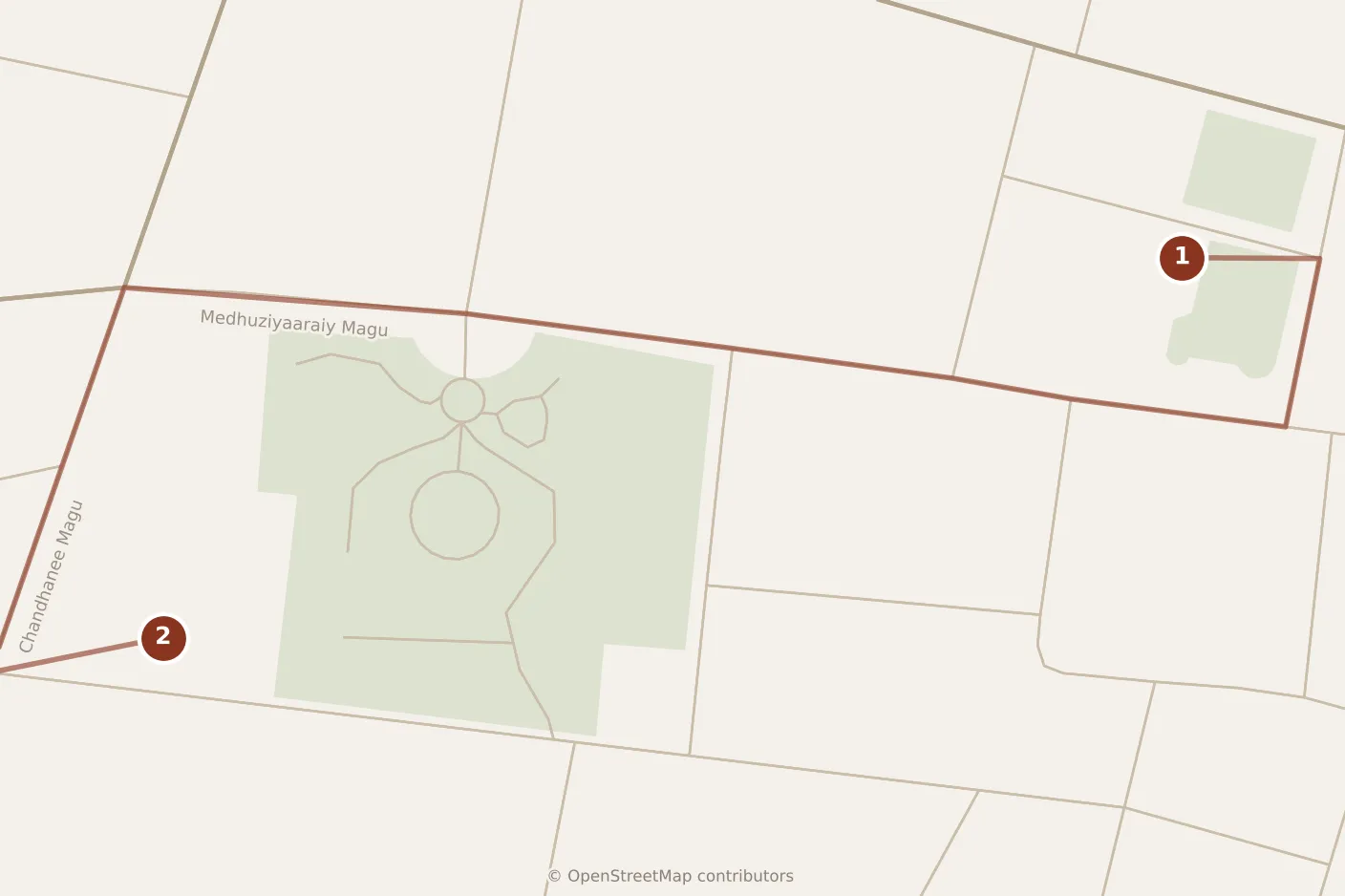
- Morning and afternoon
- Fish Market — in the prose, not on the map
- Local Market — in the prose, not on the map
- 1Hukuru Miskiy
- Grand Friday Mosque — in the prose, not on the map
- Sultan Park — in the prose, not on the map
- 2National Museum
- Republic Square — in the prose, not on the map
Morning
Begin at the Fish Market on the northern waterfront, where the boats that supplied it are usually still tied up alongside. It is a working market before it is a sight — reef fish and tuna laid out on the tiled floor, men shouting prices — and ten minutes is enough unless you want to watch longer. The Local Market next door is the gentler half: fruit, vegetables and small stalls of handicrafts, and a good place to pick up something for later in the day.
Have breakfast here rather than after: a plate of mas huni — shredded tuna, grated coconut and chili, eaten with flatbread — is a market-hour dish, and a teashop near the two markets is the easiest place to find it. Give it twenty minutes; it is eaten fast by design.
From the markets it is a short walk south into the older streets to Hukuru Miskiy — known in English as the old Friday mosque — a single-story building of coral stone carved in relief, standing since the seventeenth century and one of the oldest structures left in the city. Whether the interior is open to a non-Muslim visitor on the day you go is not something to assume either way; ask at the gate rather than guessing. The carving on the outside walls and the old graveyard beside it, its headstones cut with the same fine relief, are there to see regardless. Cover shoulders and knees before you reach it, and this is not the moment for a visit during prayers — time it around them rather than through them.
Local tip. The carved coral-stone walls and the old graveyard beside Hukuru Miskiy are there to see whatever the day’s access rules turn out to be; the interior is the part that depends on timing and the gatekeeper’s yes. If you only have a few minutes, the outside is the sure thing.
Continue a few minutes further to the Grand Friday Mosque, the gold-domed building at the center of the Islamic Centre and the largest mosque in the country. It receives visitors outside prayer times, modestly dressed, and the scale of the single hall inside is the reason to go in rather than only look at the dome from the street.
Afternoon
Sultan Park is a few minutes on from the mosque — the surviving garden of the old royal palace, before the monarchy ended in 1968, and now the closest thing the old town has to green space. Fifteen minutes covers it comfortably; it’s a rest more than a sight.
The National Museum sits inside the same grounds, three floors covering the sultanate up to the modern republic. It’s honest about its own gaps: a room of pre-Islamic stone carvings, Buddhist and Hindu, was smashed by a mob during the unrest of February 2012, and what survived is shown broken rather than replaced. Give the museum forty minutes to an hour depending on how much of that history interests you. It closes on Fridays and Saturdays — the Maldivian weekend — and entry is about ten US dollars, paid by card rather than cash; if your day falls on the weekend, the park on its own is still worth the stop.
Lunch belongs in this stretch of the day, and garudhiya is the dish for it: a clear, peppery fish broth eaten with rice, chili and lime on the side, sold at simple sit-down places rather than the market stalls of the morning. Give it the best part of an hour; it’s a meal to sit through, not carry.
From the park it’s a short walk back towards the water to Republic Square, the open plaza where the flag stands and the city holds its ceremonies. There’s little to do here beyond stand in it, which is the point: after the enclosed streets of the old town it’s the one place in Malé with any real distance in it. From the square the waterfront promenade runs along the harbor, and it’s worth ten minutes just to walk it and watch the boats working the anchorage — the same working harbor the day started at, seen from further along it.
Evening
From the waterfront it’s a walk of a little under twenty minutes east across the island to the Artificial Beach — a reclaimed strip of sand and a breakwater, the livelier of the capital’s two man-made beaches (Rasfannu, on the west side, is its quieter twin) and the one this day ends nearest to. It fills in the late afternoon with locals rather than tourists: families, teenagers, a football or two on the sand.
This is the swim, if you want one, and the hour the day has been built towards — though not the sunset itself: this is the island’s eastern shore, so the sun goes down behind the city and the sky over the water reddens rather than performs. What you get instead is the capital coming out once the heat breaks, which is the better show. Aim to be in place with the best part of an hour of light still in hand — near the equator that number barely changes whichever month you’re reading this in. If you’re carrying a bag and want to swim, there’s nothing here to leave it at: either take turns with someone, or treat the beach as a place to sit and watch rather than swim, since nobody is minding it for you.
Evening food here means hedhikaa — the small fried and steamed snacks sold from carts and stalls along the beach road, the local equivalent of street food eaten standing up — and they’re the right way to close the day: something to eat on the sand or the sea wall while the light goes.
If you have a flight to catch afterwards, give yourself the best part of an hour to get back across the water and through the airport gate — the crossing itself is short, but it is also the one leg of the day you cannot control the timing of.
Practicalities
Nothing on this route needs booking in advance; it’s a market, two mosques, a park, a museum and a beach, all walked to rather than waited in line for.
Friday is the exception to build around. The city genuinely pauses through Friday morning — shops shutter, the markets thin, and this is not the day to start the route as written. If your one day in Malé falls on a Friday, save the market and mosque circuit for the afternoon and open with Sultan Park instead — remembering that the museum inside it keeps the Friday–Saturday weekend, so on those days the park is a rest, not a visit; everything else here still works, just in a different order.
There is nowhere on this route to buy alcohol, and nowhere in the inhabited part of the city that sells it — that’s true everywhere here, not a gap in this particular walk, and it’s worth knowing before you go looking.
The National Museum is the one stop with an opening pattern worth checking rather than assuming: confirm its closing day before you fix the order of the afternoon, and if it falls on yours, Sultan Park’s grounds still justify the detour on their own.
Distances throughout are short enough that nothing above needs a bus or a boat: the longest single stretch on this route is the walk east to the Artificial Beach in the evening, at under twenty minutes, and everything before it sits within about ten minutes of the last thing.


