La Maddalena in Two or Three Days: Town, Archipelago and Caprera

Last updated 18 August 2026
Overview
La Maddalena is not one place but a scatter of granite islands in the Strait of Bonifacio, close enough to Corsica that on a clear day it is the coastline you can see, not just a name on a map. You reach it by sea: a ferry crosses from Palau, on the Sardinian mainland, in fifteen to twenty minutes and runs often through the day. That crossing is the real start of the trip, and it is worth building the first morning around whichever sailing you catch rather than a fixed hour of your own.
Two days is the honest minimum and covers two different things well: a day on foot in the town and along its nearest beach, and a full day out among the archipelago’s islands by boat, which is the reason most people come. A third day leaves La Maddalena itself and crosses the causeway to Caprera, the next island over, for the house where Giuseppe Garibaldi lived out his last years and the pine woods and coves around it.
The one thing that can reorder this trip is the sea, not the calendar. The boat day depends on calm water in the strait, which can turn windy with little notice, so if your stay gives you any choice of dates, keep the archipelago day loose and take it on the best forecast rather than fixing it in advance — the town day and Caprera are both fine in a stiffer breeze.
Cala Gavetta, Santa Maria Maddalena — not on the walking map.
- Day one · Morning
- 1Cala Gavetta
- Santa Maria Maddalena — in the prose, not on the map
Punta Tegge — not on the walking map; you get there by bus.
- Day one · Afternoon
- Punta Tegge — in the prose, not on the map
Cala Corsara — not on the walking map.
- Day two · Morning
- Cala Corsara — in the prose, not on the map
Compendio Garibaldino, Cala Coticcio — not on the walking map.
- With a third day
- 4Compendio Garibaldino
- Cala Coticcio — in the prose, not on the map
Day one

Everything today is on La Maddalena itself, on foot, and it is built to let you arrive, get your bearings, and be in the water by the afternoon.
Morning
From the ferry, walk into Cala Gavetta, the old harbor at the edge of the town center: a curve of moored fishing boats and yachts with the lanes of the old town rising directly behind it. This is the address to fix in your head for the rest of the stay — most of what matters in the town is within a few minutes of it.
Climb into the lanes behind the harbor to the parish church, dedicated to Santa Maria Maddalena, the town’s own patron and the source of its name. It is a plain building from the outside and worth going in for one specific reason: silver given to it by Nelson, whose fleet was based in this archipelago for two years at the start of the nineteenth century while it watched the French coast. It is a genuinely odd thing to find in a small Sardinian parish church, and it is why the church is worth ten minutes rather than a glance from the square. As with most Italian churches, expect it to close over the middle of the day; if you arrive then, the lanes around it are worth the wait.
Afternoon
Go out to Punta Tegge, the closest beach to town and the right choice for a first swim: pale sand with a shallow, sandy bottom and calm water, framed by granite slabs, with none of the boat traffic of the islands you will see tomorrow. Give it the rest of the afternoon — there is a snack bar and restrooms behind the sand, so this is one of the few stops on the island you can reach empty-handed, though shade is still yours to bring. Stay for the sun going down: this is the island’s west-facing corner and the best sunset it has. How you get there decides whether you can stay for it: the town buses run roughly hourly in season but the last one back is around 19:30, well before a July or August sunset, so take a rented bike or scooter (both are common here and the roads are easy) if you mean to see the light go. The bus is fine if you are coming back before dinner.
Evening
Back into town for the evening — however you came out — and let the harbor do the work: Cala Gavetta and the lanes around it fill up as the light goes, and this is where to eat. Fregola con arselle, a Sardinian pasta the size of couscous cooked with small clams, is the reliable order and the right weight after a day in the sun. Zuppa gallurese — bread and cheese baked in broth until it holds together like a savory bread pudding — is the festive dish this part of Sardinia is known for, and worth asking for by name; a proper one is baked for the day rather than kept on standby, so treat finding it as luck, not default.
Day two

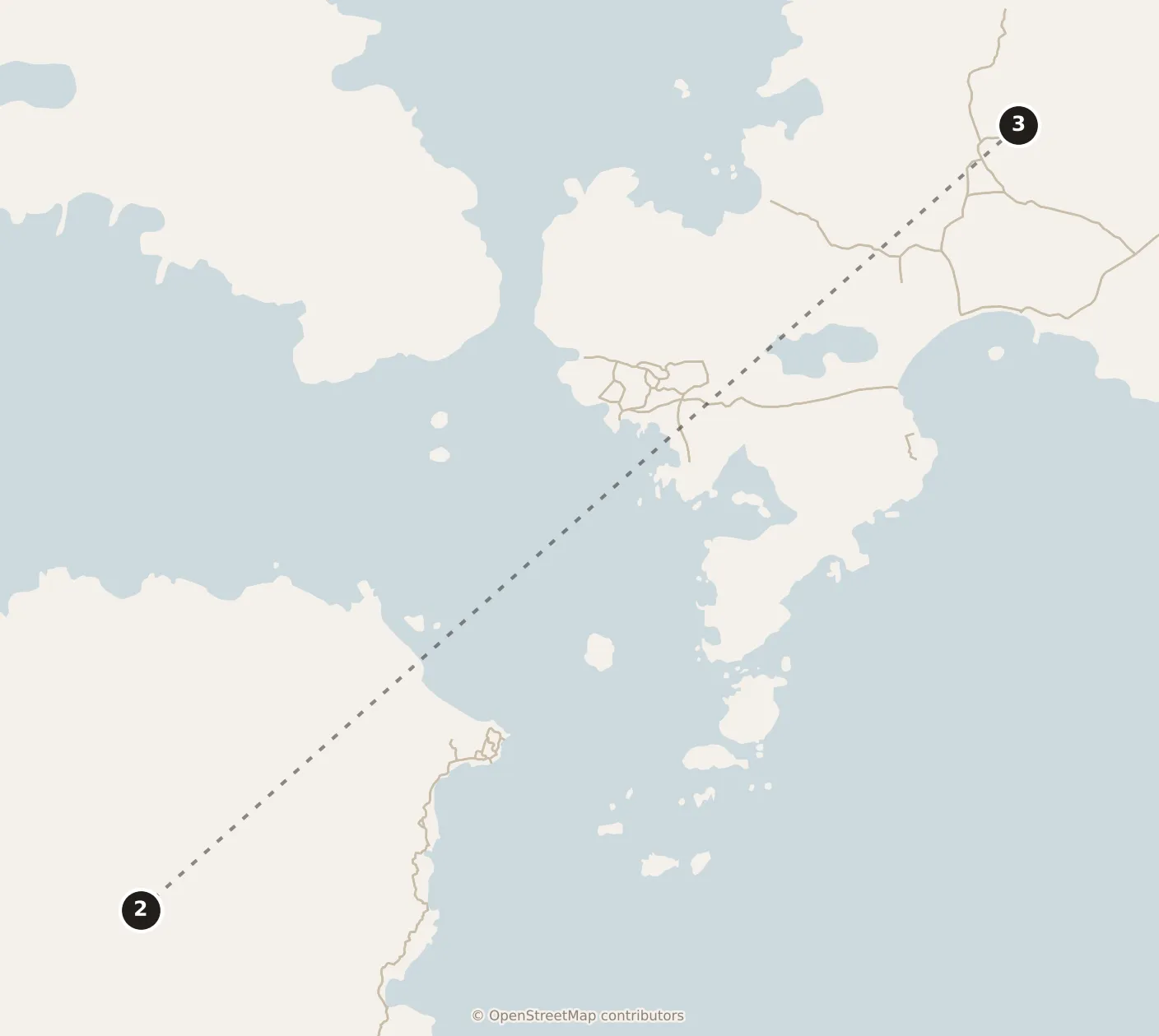
- Afternoon
- 2Budelli
- 3Santa Maria
This is a boat day, start to finish, and the town is not part of it: a full-day excursion out of Cala Gavetta circling three of the archipelago’s islands, back by evening. In peak season these trips fill up, so book a place a day or two ahead rather than turning up at the harbor hoping for a spare seat — a shared full day on a proper boat runs roughly fifty to seventy euro a head depending on the season, and it is usually the most expensive single thing on this trip.
Morning
The boat’s first stop is usually Cala Corsara, on Spargi: a bay closed in by pale granite boulders worn into rounded shapes by the wind, with water shallow enough near the rocks to see the sand underneath it clearly. This is the cove to actually get in the water at length — give it the best part of the morning, since what follows is more about looking than swimming.
Afternoon
Next comes Budelli, and the one thing to know about it before you get there: the boat will bring you close along its shore to see Spiaggia Rosa, the beach whose sand is genuinely pink, colored by the crushed remains of a tiny reddish marine organism ground into the shell sand — and on this trip you will see it only from the water. Landing on it has been forbidden for decades, to stop exactly the kind of foot traffic that was wearing the color away, and no boat will put you ashore there whatever it is offering; the only way onto the island is the park’s own guided walk, booked separately and not part of any excursion. It is still worth the detour: even from the distance the park makes boats keep — a few hundred meters, with the waters off the beach closed to swimming as well — the color is real, and the honesty of not being allowed onto it is part of what makes the sight land.
The day usually closes with Santa Maria, the smallest and calmest of the three: a strip of island with shallow turquoise water on its sheltered side, good for a last swim before the crossing back. There is little shade here either, so treat it as a swim stop rather than somewhere to linger without water.
Evening
The boat returns to Cala Gavetta as the light softens, and after a day entirely on the water, the harbor in the evening is worth sitting still in rather than walking further. If you skipped it the night before, this is the evening for fregola con arselle, with the day’s swimming behind you.
With a third day

Give the third day to Caprera, the island next door, reached over a causeway rather than by boat — a short bus or taxi ride from town, or a fairly flat cycle if you would rather do it under your own power. This is where Giuseppe Garibaldi settled after a life spent making and unmaking countries, and where he is buried.
The Compendio Garibaldino is the house he lived in, kept largely as it was, with the working rooms of a man who farmed the land around it as much as he did anything else. It closes on Mondays, and its hours are seasonal — check them before you set out; if your third day lands on a Monday, swap it with the boat day (Practicalities says how), or settle for the pine woods and coves around it, which still make a full morning on their own. A modest entry ticket is required for the house itself; the grounds around it are not gated in the same way. Give the house itself about an hour, more if the life it tells is one you already know something about.
Beyond it, Caprera is largely pine forest threaded with paths down to a string of small coves, quieter and less visited than anything on yesterday’s boat because nothing here has a jetty to land at. Cala Coticcio, tucked in on the island’s far side, is the best known of them and the one reason people come this far in — but in the summer season access to it is limited to guided, reservation-only visits, brought in specifically to stop the cove being worn down by its own popularity. Treat it as something to arrange from La Maddalena in advance rather than a stop you can simply walk up to; if you cannot get a place, the closer coves nearer the house are a genuinely fair substitute for the same afternoon, without the booking.
Practicalities
Book two things ahead if you can: the archipelago boat excursion on day two, which fills in season, and Cala Coticcio’s guided access on day three, which in season is capped by design. Outside July and August the excursion boat can usually be booked the evening before; in high summer give it a day or two’s lead. The Palau ferry itself is turn-up-and-go for a foot passenger all year — only a car space needs booking in summer.
The Compendio Garibaldino closes on Mondays — if your third day would land on it, swap in the archipelago day instead and keep Caprera for whichever day the house is open.
Movement is simple and never crosses back on itself: day one is on foot in town plus a short ride out and back to the beach — by bus, or by bike or scooter if you are staying for the sunset, since the last bus back goes before it — day two is entirely by boat, and day three is a single causeway crossing by bus, taxi or bike, with the rest of it walked. Nothing on this trip needs a car.


.JPG)
.JPG)
